

A Tongue Image Dataset with Pathological Annotations for AI-assisted Diagnosis in Traditional Chinese Medicine



Article Information
Abstract
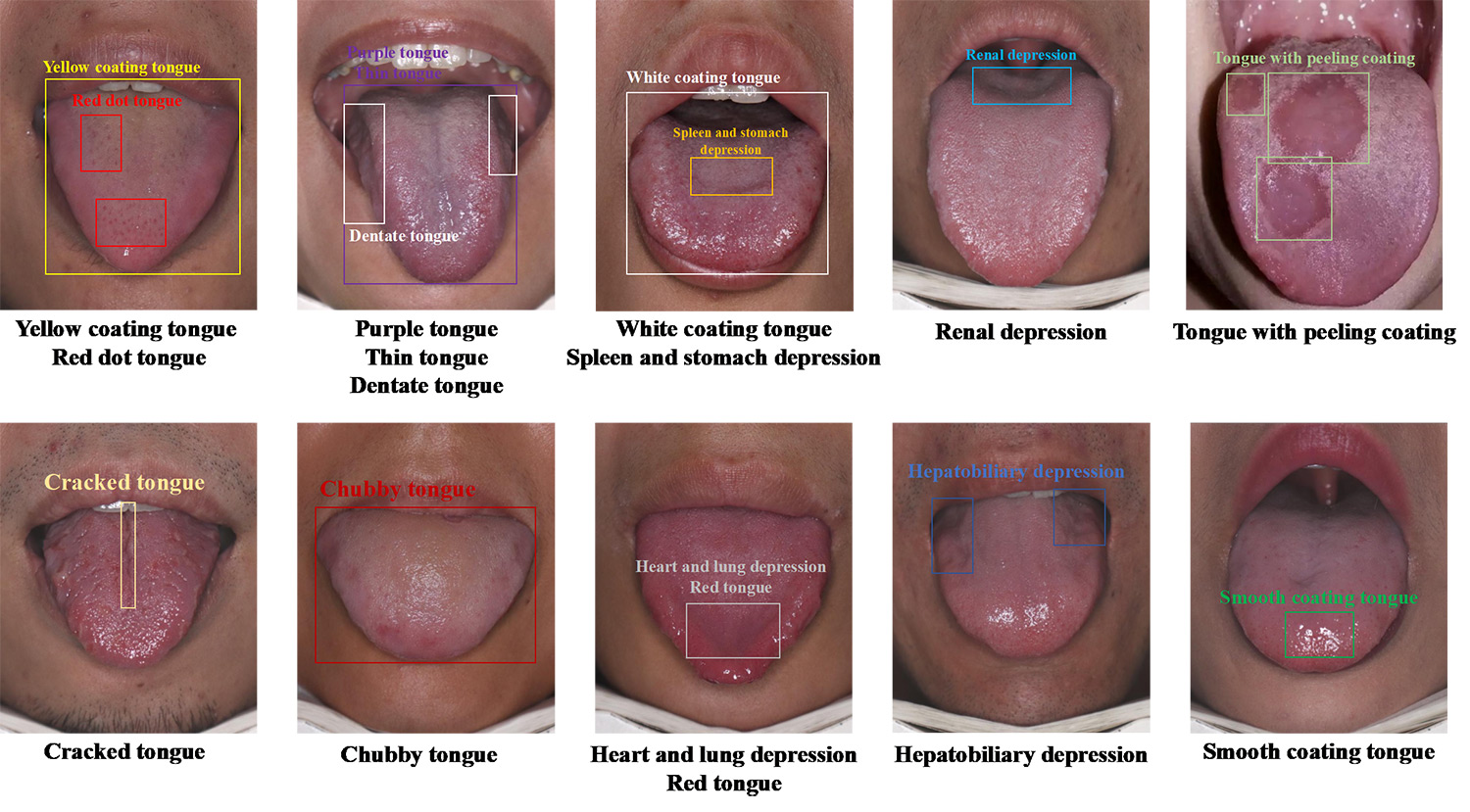
Tongue diagnosis is a core component of Traditional Chinese Medicine (TCM) with important clinical application value, yet its standardization is severely hampered by the subjectivity of manual interpretation and the lack of unified imaging acquisition protocols. Worse still, the scarcity of large-scale annotated datasets has become a key bottleneck restricting the development of artificial intelligence (AI)-assisted TCM tongue diagnosis technology. To address these critical issues, this study constructs a high-quality standardized dataset dedicated to AI-driven TCM tongue diagnosis research. The dataset contains 6,719 high-resolution tongue images collected under strictly standardized conditions, and all images are annotated with 20 pathological symptom categories in line with TCM theoretical systems. Each image is attached with an average of 2.54 clinical labels, all of which have been double-verified and confirmed by licensed TCM practitioners to ensure clinical authenticity and annotation accuracy. In order to facilitate academic research and industrial applications, we have used three mainstream annotation formats (COCO, TXT, XML) to annotate the data, making the dataset compatible and universal. To verify the practical value and effectiveness of the dataset for AI model training, we conducted a comprehensive benchmark test on it using twelve classic deep learning detection models, including multiple variants of YOLOv5/v7/v8 as well as SSD and MobileNetV2. The experimental results fully demonstrate that the dataset can effectively support the training and performance evaluation of AI models for tongue diagnosis. As a high-quality public data resource, this dataset lays a solid and critical foundation for developing reliable computational analysis tools in the field of TCM, alleviating the long-term data shortage problem that hinders the digital development of TCM tongue diagnosis, and promoting the deep integration of AI technology with TCM research and clinical practice through standardized and high-quality diagnostic image data.
Graphical Abstract
Keywords
Data Availability Statement
Funding
Conflicts of Interest
AI Use Statement
Ethical Approval and Consent to Participate
References
- Wang, W. Y., Zhou, H., Wang, Y. F., Sang, B. S., & Liu, L. (2021). Current policies and measures on the development of traditional Chinese medicine in China. Pharmacological research, 163, 105187.
[CrossRef] [Google Scholar] - Kim, M., Cobbin, D., & Zaslawski, C. (2008). Traditional Chinese medicine tongue inspection: an examination of the inter-and intrapractitioner reliability for specific tongue characteristics. The Journal of Alternative and Complementary Medicine: Paradigm, Practice, and Policy Advancing Integrative Health, 14(5), 527-536.
[CrossRef] [Google Scholar] - Bruno, A., Capasso, P., Cattaneo, G., Petrillo, U. F., & Improta, R. (2023). A novel image dataset for source camera identification and image based recognition systems. Multimedia Tools and Applications, 82(8), 11221-11237.
[CrossRef] [Google Scholar] - Wang, Z., Lu, B., Long, Y., Zhong, F., Cheung, T. H., Dou, Q., & Liu, Y. (2022, September). Autolaparo: A new dataset of integrated multi-tasks for image-guided surgical automation in laparoscopic hysterectomy. In International Conference on Medical Image Computing and Computer-Assisted Intervention (pp. 486-496). Cham: Springer Nature Switzerland.
[CrossRef] [Google Scholar] - Lv, X., Zhang, S., Liu, Q., Xie, H., Zhong, B., & Zhou, H. (2022). BacklitNet: A dataset and network for backlit image enhancement. Computer Vision and Image Understanding, 218, 103403.
[CrossRef] [Google Scholar] - Luo, X., Liao, W., Xiao, J., Chen, J., Song, T., Zhang, X., ... & Zhang, S. (2022). WORD: A large scale dataset, benchmark and clinical applicable study for abdominal organ segmentation from CT image. Medical Image Analysis, 82, 102642.
[CrossRef] [Google Scholar] - Kalervo, A., Ylioinas, J., Häikiö, M., Karhu, A., & Kannala, J. (2019, May). Cubicasa5k: A dataset and an improved multi-task model for floorplan image analysis. In Scandinavian Conference on Image Analysis (pp. 28-40). Cham: Springer International Publishing.
[CrossRef] [Google Scholar] - Lin, Z., Lin, J., Zhu, L., Fu, H., Qin, J., & Wang, L. (2022, September). A new dataset and a baseline model for breast lesion detection in ultrasound videos. In International Conference on Medical Image Computing and Computer-Assisted Intervention (pp. 614-623). Cham: Springer Nature Switzerland.
[CrossRef] [Google Scholar] - Gupta, A., Gehlot, S., Goswami, S., Motwani, S., Gupta, R., Faura, Á. G., ... & Ye, J. (2023). Segpc-2021: A challenge & dataset on segmentation of multiple myeloma plasma cells from microscopic images. Medical Image Analysis, 83, 102677.
[CrossRef] [Google Scholar] - ScienceDB. (2013). Tongue Image Dataset [Data set]. Retrieved from https://www.scidb.cn/en/detail?dataSetId=8417299de5ef4f3db5ec62e01a969d54
[Google Scholar] - BioHit. (n.d.). TongeImageDataset [Source code]. GitHub. Retrieved from https://github.com/BioHit/TongeImageDataset
[Google Scholar] - Chang, W. H., Chen, C. C., Wu, H. K., Hsu, P. C., Lo, L. C., Chu, H. T., & Chang, H. H. (2024). Tongue feature dataset construction and real-time detection. PLoS ONE, 19(3), e0296070.
[CrossRef] [Google Scholar] - Fu, J., & Yang, M. (2019). Yellow Emperor's Classic of Medicine, The-Essential Questions: Translation Of Huangdi Neijing Suwen. World Scientific.
[Google Scholar] - Maciocia, G. (1987). Tongue Diagnosis in Chinese Medicine. Eastland Press.
[Google Scholar] - Jin, X., Gao, L., Tong, A., Chen, Z., Kong, J., Sun, N., ... & Su, T. (2025). TCM-Tongue: A Standardized Tongue Image Dataset with Pathological Annotations for AI-Assisted TCM Diagnosis. arXiv preprint arXiv:2507.18288.
[Google Scholar] - Casas, E., Ramos, L., Bendek, E., & Rivas-Echeverría, F. (2023). Assessing the Effectiveness of YOLO Architectures for Smoke and Wildfire Detection. IEEE Access, 11, 96554–96583.
[CrossRef] [Google Scholar] - Su, K., Cao, L., Zhao, B., Li, N., Wu, D., & Han, X. (2024). N-IoU: better IoU-based bounding box regression loss for object detection. Neural Computing and Applications, 36(6), 3049-3063.
[CrossRef] [Google Scholar] - Jiang, T., Li, C., Yang, M., & Wang, Z. (2022). An improved YOLOv5s algorithm for object detection with an attention mechanism. Electronics, 11(16), 2494.
[CrossRef] [Google Scholar] - Feng, J., Yu, C., Shi, X., Zheng, Z., Yang, L., & Hu, Y. (2023). Research on winter jujube object detection based on optimized Yolov5s. Agronomy, 13(3), 810.
[CrossRef] [Google Scholar] - Tsai, F. T., Nguyen, V. T., Duong, T. P., Phan, Q. H., & Lien, C. H. (2023). Tomato fruit detection using modified yolov5m model with convolutional neural networks. Plants, 12(17), 3067.
[CrossRef] [Google Scholar] - Liu, H. W., Zheng, Y. L., Zhong, C. J., Liao, K. Y., Sun, B. Y., Zhao, H. X., ... & Xie, B. (2024). Defect detection of printed matter based on improved YOLOv5l. Laser & Optoelectronics Progress, 61(10), 1012002.
[Google Scholar] - Wang, S., Yao, L., Xu, L., Hu, D., Zhou, J., & Chen, Y. (2024). An improved YOLOv7-Tiny method for the segmentation of images of vegetable fields. Agriculture, 14(6), 856.
[CrossRef] [Google Scholar] - Yu, M., & Jia, Y. (2023, October). Improved YOLOv7 Small Object Detection Algorithm for Seaside Aerial Images. In International Symposium on Artificial Intelligence and Robotics (pp. 483-491). Singapore: Springer Nature Singapore.
[CrossRef] [Google Scholar] - Ge, Z., Zhang, Y., Jiang, Y., Ge, H., Wu, X., Jia, Z., ... & Jia, K. (2024). Lightweight YOLOv7 algorithm for multi-object recognition on contrabands in terahertz images. Applied Sciences, 14(4), 1398.
[CrossRef] [Google Scholar] - Zhu, D., Huang, Z., Yung, K., & Ip, A. W. (2024). Drug recognition detection based on deep learning and improved YOLOv8. Journal of Organizational and End User Computing (JOEUC), 36(1), 1-21.
[CrossRef] [Google Scholar] - Huang, Y., Jiang, X., Zhou, C., Zhuo, X., Xiong, J., & Zhang, M. (2025). Study on mango ripeness detection on production line based on improved YOLOv8s. Journal of Food Measurement and Characterization, 19(1), 768-780.
[CrossRef] [Google Scholar] - Wang, Z., Yuan, G., Zhou, H., Ma, Y., & Ma, Y. (2023). Foreign-object detection in high-voltage transmission line based on improved YOLOv8m. Applied Sciences, 13(23), 12775.
[CrossRef] [Google Scholar] - Alaqeb, A. M. A., Rashid, M. M., Zaki, H. F. M., & Embong, A. H. (2024, August). An estimation algorithm for improved maritime obstacle detection. In 2024 9th International Conference on Mechatronics Engineering (ICOM) (pp. 459-465). IEEE.
[CrossRef] [Google Scholar] - He, L. H., Zhou, Y. Z., Liu, L., Cao, W., & Ma, J. H. (2025). Research on object detection and recognition in remote sensing images based on YOLOv11. Scientific Reports, 15(1), 14032.
[CrossRef] [Google Scholar] - Ge, T., Ning, B., & Xie, Y. (2025). YOLO-AFR: an improved YOLOv12-based model for accurate and real-time dangerous driving behavior detection. Applied Sciences, 15(11), 6090.
[CrossRef] [Google Scholar] - Chen, Z., Wu, K., Li, Y., Wang, M., & Li, W. (2019). SSD-MSN: An Improved Multi-Scale Object Detection Network Based on SSD. IEEE Access, 7, 80622–80632.
[CrossRef] [Google Scholar] - Jiang, Y., Peng, T., & Tan, N. (2019). Cp-ssd: Context information scene perception object detection based on ssd. Applied Sciences, 9(14), 2785.
[CrossRef] [Google Scholar] - Gulzar, Y. (2023). Fruit image classification model based on MobileNetV2 with deep transfer learning technique. Sustainability, 15(3), 1906.
[CrossRef] [Google Scholar] - Redmon, J., Divvala, S., Girshick, R., & Farhadi, A. (2016). You only look once: Unified, real-time object detection. In Proceedings of the IEEE conference on computer vision and pattern recognition (pp. 779-788).
[CrossRef] [Google Scholar] - Liu, W., Anguelov, D., Erhan, D., Szegedy, C., Reed, S., Fu, C. Y., & Berg, A. C. (2016, September). Ssd: Single shot multibox detector. In European conference on computer vision (pp. 21-37). Cham: Springer International Publishing.
[CrossRef] [Google Scholar] - Ren, S., He, K., Girshick, R., & Sun, J. (2016). Faster R-CNN: Towards real-time object detection with region proposal networks. IEEE transactions on pattern analysis and machine intelligence, 39(6), 1137-1149.
[CrossRef] [Google Scholar] - He, K., Gkioxari, G., Dollar, P., & Girshick, R. (2017, October). Mask R-CNN. In 2017 IEEE International Conference on Computer Vision (ICCV) (pp. 2980-2988). IEEE Computer Society.
[CrossRef] [Google Scholar]
Cite This Article
TY  - JOUR
AU  - Gao, Longfei
AU  - Jin, Xuebo
PY  - 2026
DA  - 2026/03/10
TI  - A Tongue Image Dataset with Pathological Annotations for AI-assisted Diagnosis in Traditional Chinese Medicine
JO  - Biomedical Informatics and Smart Healthcare
T2  - Biomedical Informatics and Smart Healthcare
JF  - Biomedical Informatics and Smart Healthcare
VL  - 2
IS  - 1
SP  - 5
EP  - 19
DO  - 10.62762/BISH.2026.303296
UR  - https://www.icck.org/article/abs/BISH.2026.303296
KW  - tongue diagnosis
KW  - traditional Chinese medicine
KW  - medical image dataset
KW  - deep learning
KW  - object detection
AB  - Tongue diagnosis is a core component of Traditional Chinese Medicine (TCM) with important clinical application value, yet its standardization is severely hampered by the subjectivity of manual interpretation and the lack of unified imaging acquisition protocols. Worse still, the scarcity of large-scale annotated datasets has become a key bottleneck restricting the development of artificial intelligence (AI)-assisted TCM tongue diagnosis technology. To address these critical issues, this study constructs a high-quality standardized dataset dedicated to AI-driven TCM tongue diagnosis research. The dataset contains 6,719 high-resolution tongue images collected under strictly standardized conditions, and all images are annotated with 20 pathological symptom categories in line with TCM theoretical systems. Each image is attached with an average of 2.54 clinical labels, all of which have been double-verified and confirmed by licensed TCM practitioners to ensure clinical authenticity and annotation accuracy. In order to facilitate academic research and industrial applications, we have used three mainstream annotation formats (COCO, TXT, XML) to annotate the data, making the dataset compatible and universal. To verify the practical value and effectiveness of the dataset for AI model training, we conducted a comprehensive benchmark test on it using twelve classic deep learning detection models, including multiple variants of YOLOv5/v7/v8 as well as SSD and MobileNetV2. The experimental results fully demonstrate that the dataset can effectively support the training and performance evaluation of AI models for tongue diagnosis. As a high-quality public data resource, this dataset lays a solid and critical foundation for developing reliable computational analysis tools in the field of TCM, alleviating the long-term data shortage problem that hinders the digital development of TCM tongue diagnosis, and promoting the deep integration of AI technology with TCM research and clinical practice through standardized and high-quality diagnostic image data.
SN  - 3068-5524
PB  - Institute of Central Computation and Knowledge
LA  - English
ER  -
@article{Gao2026A,
  author = {Longfei Gao and Xuebo Jin},
  title = {A Tongue Image Dataset with Pathological Annotations for AI-assisted Diagnosis in Traditional Chinese Medicine},
  journal = {Biomedical Informatics and Smart Healthcare},
  year = {2026},
  volume = {2},
  number = {1},
  pages = {5-19},
  doi = {10.62762/BISH.2026.303296},
  url = {https://www.icck.org/article/abs/BISH.2026.303296},
  abstract = {Tongue diagnosis is a core component of Traditional Chinese Medicine (TCM) with important clinical application value, yet its standardization is severely hampered by the subjectivity of manual interpretation and the lack of unified imaging acquisition protocols. Worse still, the scarcity of large-scale annotated datasets has become a key bottleneck restricting the development of artificial intelligence (AI)-assisted TCM tongue diagnosis technology. To address these critical issues, this study constructs a high-quality standardized dataset dedicated to AI-driven TCM tongue diagnosis research. The dataset contains 6,719 high-resolution tongue images collected under strictly standardized conditions, and all images are annotated with 20 pathological symptom categories in line with TCM theoretical systems. Each image is attached with an average of 2.54 clinical labels, all of which have been double-verified and confirmed by licensed TCM practitioners to ensure clinical authenticity and annotation accuracy. In order to facilitate academic research and industrial applications, we have used three mainstream annotation formats (COCO, TXT, XML) to annotate the data, making the dataset compatible and universal. To verify the practical value and effectiveness of the dataset for AI model training, we conducted a comprehensive benchmark test on it using twelve classic deep learning detection models, including multiple variants of YOLOv5/v7/v8 as well as SSD and MobileNetV2. The experimental results fully demonstrate that the dataset can effectively support the training and performance evaluation of AI models for tongue diagnosis. As a high-quality public data resource, this dataset lays a solid and critical foundation for developing reliable computational analysis tools in the field of TCM, alleviating the long-term data shortage problem that hinders the digital development of TCM tongue diagnosis, and promoting the deep integration of AI technology with TCM research and clinical practice through standardized and high-quality diagnostic image data.},
  keywords = {tongue diagnosis, traditional Chinese medicine, medical image dataset, deep learning, object detection},
  issn = {3068-5524},
  publisher = {Institute of Central Computation and Knowledge}
}
Article Metrics
Publisher's Note
ICCK stays neutral with regard to jurisdictional claims in published maps and institutional affiliations.
Rights and Permissions
 Copyright © 2026 by the Author(s). Published by Institute of Central Computation and Knowledge. This article is an open access article distributed under the terms and conditions of the Creative Commons Attribution (CC BY) license (https://creativecommons.org/licenses/by/4.0/), which permits use, sharing, adaptation, distribution and reproduction in any medium or format, as long as you give appropriate credit to the original author(s) and the source, provide a link to the Creative Commons licence, and indicate if changes were made.


Portico
