A Track Splitting Determination Method for Elliptical Extended Targets Based on Spatio Temporal Similarity
Research Article  ·  Published: 25 June 2025
Issue cover
Chinese Journal of Information Fusion
Volume 2, Issue 2, 2025: 171-181
Research Article Open Access

A Track Splitting Determination Method for Elliptical Extended Targets Based on Spatio Temporal Similarity

1 School of Automation, Southeast University, Nanjing 210096, China
2 Key Laboratory of Measurement and Control of Complex Systems of Engineering, Nanjing 210096, China
3 School of Automation, Nanjing University of Science and Technology, Nanjing 210094, China
* Corresponding Author: Chaoqun Yang, [email protected]
Volume 2, Issue 2
You have full access to this open access article · CC BY 4.0 License

Article Information

Abstract

Extended target tracking in occlusion scenarios often suffers from split errors due to sensor limitations and complex target interactions, leading to degraded tracking performance for autonomous vehicles and surveillance systems. To address this issue, in this paper, we propose a Gaussian Wasserstein distance-enhanced spatio-temporal similarity method for split error correction. We first analyze the spatio-temporal characteristics of split extended targets and model their geometric uncertainties via elliptical Gaussian distributions. Then, we integrate the Gaussian Wasserstein distance into the clue-aware trajectory similarity calculation framework to simultaneously capture positional and shape discrepancies, and designs an adaptive validation gate mechanism to dynamically adjust the threshold for track splitting, enabling accurate determination and fusion of split targets. Finally, simulation experiments are conducted to demonstrate the effectiveness of the proposed method.

Graphical Abstract

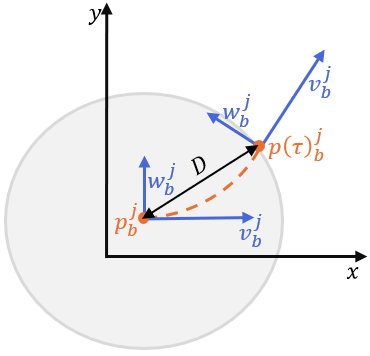
A Track Splitting Determination Method for Elliptical Extended Targets Based on Spatio Temporal Similarity

Keywords

extended target tracking target splitting gaussian wasserstein distance spatiotemporal trajectories error correction

Data Availability Statement

Data will be made available on request.

Funding

This work was supported in part by the Jiangsu Province Natural Science Foundation of China under Grant BK20230827; in part by the National Natural Science Foundation of China under Grant 62303109; in part by the Zhishan Young Scholar Research Fund of Southeast University under Grant 2242024RCB0011; in part by the Southeast University Start-up Research Fund under Grant RF1028623002.

Conflicts of Interest

The authors declare no conflicts of interest.

Ethical Approval and Consent to Participate

Not applicable.

References

  1. Ersü, C., Petlenkov, E., & Janson, K. (2024). A Systematic Review of Cutting-Edge Radar Technologies: Applications for Unmanned Ground Vehicles (UGVs). Sensors, 24(23), 7807.
    [CrossRef] [Google Scholar]
  2. Wang, W., Xu, Y., Zhang, K., Sun, Y., & Li, P. (2025). A GGIW PMBM Smoother for Multiple Extended Object Tracking. Electronics Letters, 61(1), 1-5.
    [CrossRef] [Google Scholar]
  3. Yang, C., Cao, X., & Shi, Z. (2023). Road-map aided Gaussian mixture labeled multi-Bernoulli filter for ground multi-target tracking. IEEE Transactions on Vehicular Technology, 72(6), 7137-7147.
    [CrossRef] [Google Scholar]
  4. Granstrom, K., Lundquist, C., & Orguner, O. (2012). Extended target tracking using a Gaussian-mixture PHD filter. IEEE Transactions on Aerospace and Electronic Systems, 48(4), 3268-3286.
    [CrossRef] [Google Scholar]
  5. Granstrom, K., & Orguner, U. (2012). A PHD filter for tracking multiple extended targets using random matrices. IEEE Transactions on Signal Processing, 60(11), 5657-5671.
    [CrossRef] [Google Scholar]
  6. Habtemariam, B., Tharmarasa, R., Thayaparan, T., Mallick, M., & Kirubarajan, T. (2013). A multiple-detection joint probabilistic data association filter. IEEE Journal of Selected Topics in Signal Processing, 7(3), 461-471.
    [CrossRef] [Google Scholar]
  7. Zhang, G., Lian, F., & Han, C. (2014). CBMeMBer filters for nonstandard targets, I: extended targets. In 17th International Conference on Information Fusion (pp. 1-6).
    [Google Scholar]
  8. Beard, M., Reuter, S., Granström, K., Vo, B. T., Vo, B. N., & Scheel, A. (2015). Multiple extended target tracking with labeled random finite sets. IEEE Transactions on Signal Processing, 64(7), 1638-1653.
    [CrossRef] [Google Scholar]
  9. Granström, K., Fatemi, M., & Svensson, L. (2016). Gamma Gaussian inverse-Wishart Poisson multi-Bernoulli filter for extended target tracking. In 19th International Conference on Information Fusion (pp. 893-900).
    [Google Scholar]
  10. Xu, M., Yang, C., Cao, X., Yang, S., Cao, X., & Shi, Z. (2024). Irregular extended target tracking with unknown measurement noise covariance. Signal Processing, 225, 109600.
    [CrossRef] [Google Scholar]
  11. Wang, G., Wang, Y., Gu, R., Hu, W., & Hwang, J. N. (2022). Split and connect: A universal tracklet booster for multi-object tracking. IEEE Transactions on Multimedia, 25, 1256-1268.
    [CrossRef] [Google Scholar]
  12. Asad, M., Khan, S., Mehmood, Z., Shi, Y., Memon, S. A., & Khan, U. (2020). A split target detection and tracking algorithm for ballistic missile tracking during the re-entry phase. Defence Technology, 16(6), 1142-1150.
    [CrossRef] [Google Scholar]
  13. Jin, J., Ma, M., & Liu, C. (2021, December). Group Targets Splitting Algorithm for Ballistic Missile Penetration Applications. In 2021 CIE International Conference on Radar (Radar) (pp. 843-847). IEEE.
    [CrossRef] [Google Scholar]
  14. Dong, L., Zhang, Y., Zhao, L., Zheng, T., Wang, W., Li, J., ... & Yao, D. (2022). DRT: A new toolbox for the Standard EEG Data Structure in large-scale EEG applications. SoftwareX, 17, 100933.
    [CrossRef] [Google Scholar]
  15. Yang, C., Liang, X., Shi, Z., Zhang, H., & Cao, X. (2025). Augmented LRFS-based filter: Holistic tracking of group objects. Signal Processing, 226, 1-10.
    [CrossRef] [Google Scholar]
  16. Granström, K., Natale, A., Braca, P., Ludeno, G., & Serafino, F. (2015). Gamma Gaussian inverse Wishart probability hypothesis density for extended target tracking using X-band marine radar data. IEEE Transactions on Geoscience and Remote Sensing, 53(12), 6617-6631.
    [CrossRef] [Google Scholar]
  17. Yang, S., Baum, M., & Granström, K. (2016). Metrics for performance evaluation of elliptic extended object tracking methods. In IEEE International Conference on Multisensor Fusion and Integration for Intelligent Systems (pp. 523-528).
    [CrossRef] [Google Scholar]
  18. Loraamm, R., Downs, J., Anderson, J., & Lamb, D. S. (2020). PySTPrism: Tools for voxel-based space–time prisms. SoftwareX, 12, 1-5.
    [CrossRef] [Google Scholar]
  19. Zheng, Y. (2015). Trajectory data mining: an overview. ACM Transactions on Intelligent Systems and Technology, 6(3), 1-41.
    [CrossRef] [Google Scholar]
  20. Sun, L., & Zhou, W. (2017). A multi-source trajectory correlation algorithm based on spatial-temporal similarity. In 20th International Conference on Information Fusion (pp. 1-7).
    [CrossRef] [Google Scholar]
  21. Thormann, K., & Baum, M. (2019). Optimal fusion of elliptic extended target estimates based on the Wasserstein distance. In 22th International Conference on Information Fusion (pp. 1-6).
    [CrossRef] [Google Scholar]
  22. Schuhmacher, D. , Vo, B. T. , & Vo, B. N.(2008). A consistent metric for performance evaluation of multi-object filters.IEEE Transactions on Signal Processing, 56(8), 3447-3457.
    [CrossRef] [Google Scholar]
  23. Rahmathullah, A. S. , García-Fernández, Ángel F, & Svensson, L.(2016). Generalized optimal sub-pattern assignment metric. In 20th International Conference on Information Fusion (pp. 1-8).
    [CrossRef] [Google Scholar]

Cited By (1)

  1. Jiashi Shen, Mengdie Xu, Chaoqun Yang. Measurement-Driven Dynamic Basis Point-Adjusted Gaussian Process Algorithm for Extended Target Tracking. Journal of Shanghai Jiaotong University (Science), 2026 .
    [CrossRef]
* Citation data provided by Crossref Cited-by.

Cite This Article

APA Style
Shen, J., Yang, C., He, L., & Cao, X. (2025). A Track Splitting Determination Method for Elliptical Extended Targets Based on Spatio Temporal Similarity. Chinese Journal of Information Fusion, 2(2), 171–181. https://doi.org/10.62762/CJIF.2025.519610
Export Citation
RIS Format
Compatible with EndNote, Zotero, Mendeley, and other reference managers
TY  - JOUR
AU  - Shen, Jiashi
AU  - Yang, Chaoqun
AU  - He, Lidong
AU  - Cao, Xianghui
PY  - 2025
DA  - 2025/06/25
TI  - A Track Splitting Determination Method for Elliptical Extended Targets Based on Spatio Temporal Similarity
JO  - Chinese Journal of Information Fusion
T2  - Chinese Journal of Information Fusion
JF  - Chinese Journal of Information Fusion
VL  - 2
IS  - 2
SP  - 171
EP  - 181
DO  - 10.62762/CJIF.2025.519610
UR  - https://www.icck.org/article/abs/CJIF.2025.519610
KW  - extended target tracking
KW  - target splitting
KW  - gaussian wasserstein distance
KW  - spatiotemporal trajectories
KW  - error correction
AB  - Extended target tracking in occlusion scenarios often suffers from split errors due to sensor limitations and complex target interactions, leading to degraded tracking performance for autonomous vehicles and surveillance systems. To address this issue, in this paper, we propose a Gaussian Wasserstein distance-enhanced spatio-temporal similarity method for split error correction. We first analyze the spatio-temporal characteristics of split extended targets and model their geometric uncertainties via elliptical Gaussian distributions. Then, we integrate the Gaussian Wasserstein distance into the clue-aware trajectory similarity calculation framework to simultaneously capture positional and shape discrepancies, and designs an adaptive validation gate mechanism to dynamically adjust the threshold for track splitting, enabling accurate determination and fusion of split targets. Finally, simulation experiments are conducted to demonstrate the effectiveness of the proposed method.
SN  - 2998-3371
PB  - Institute of Central Computation and Knowledge
LA  - English
ER  - 
BibTeX Format
Compatible with LaTeX, BibTeX, and other reference managers
@article{Shen2025A,
  author = {Jiashi Shen and Chaoqun Yang and Lidong He and Xianghui Cao},
  title = {A Track Splitting Determination Method for Elliptical Extended Targets Based on Spatio Temporal Similarity},
  journal = {Chinese Journal of Information Fusion},
  year = {2025},
  volume = {2},
  number = {2},
  pages = {171-181},
  doi = {10.62762/CJIF.2025.519610},
  url = {https://www.icck.org/article/abs/CJIF.2025.519610},
  abstract = {Extended target tracking in occlusion scenarios often suffers from split errors due to sensor limitations and complex target interactions, leading to degraded tracking performance for autonomous vehicles and surveillance systems. To address this issue, in this paper, we propose a Gaussian Wasserstein distance-enhanced spatio-temporal similarity method for split error correction. We first analyze the spatio-temporal characteristics of split extended targets and model their geometric uncertainties via elliptical Gaussian distributions. Then, we integrate the Gaussian Wasserstein distance into the clue-aware trajectory similarity calculation framework to simultaneously capture positional and shape discrepancies, and designs an adaptive validation gate mechanism to dynamically adjust the threshold for track splitting, enabling accurate determination and fusion of split targets. Finally, simulation experiments are conducted to demonstrate the effectiveness of the proposed method.},
  keywords = {extended target tracking, target splitting, gaussian wasserstein distance, spatiotemporal trajectories, error correction},
  issn = {2998-3371},
  publisher = {Institute of Central Computation and Knowledge}
}

Article Metrics

Citations
Views
3129
PDF Downloads
566

Publisher's Note

ICCK stays neutral with regard to jurisdictional claims in published maps and institutional affiliations.

Rights and Permissions

CC BY Copyright © 2025 by the Author(s). Published by Institute of Central Computation and Knowledge. This article is an open access article distributed under the terms and conditions of the Creative Commons Attribution (CC BY) license (https://creativecommons.org/licenses/by/4.0/), which permits use, sharing, adaptation, distribution and reproduction in any medium or format, as long as you give appropriate credit to the original author(s) and the source, provide a link to the Creative Commons licence, and indicate if changes were made.
Chinese Journal of Information Fusion
ISSN: 2998-3371 (Online) | ISSN: 2998-3363 (Print)
Portico
Preserved at
Portico