A Novel Electromagnetic Spectrum Prediction Model Based upon Multi-Dimensional Feature Fusion
Research Article  ·  Published: 20 November 2025
Issue cover
Chinese Journal of Information Fusion
Volume 3, Issue 1, 2026: 1-16
Research Article Open Access

A Novel Electromagnetic Spectrum Prediction Model Based upon Multi-Dimensional Feature Fusion

1 College of Information and Communication Engineering, Harbin Engineering University, Harbin 150000, China
2 School of Engineering and Mathematic Sciences, La Trobe University, Melbourne VIC 3086, Australia
3 Department of Informatics and Telecommunications, National and Kapodistrian University of Athens, Athens 15784, Greece
4 School of Communications and Information Engineering, Nanjing University of Posts and Telecommunications, Nanjing 210003, China
* Corresponding Authors: Guan Gui, [email protected]; Yun Lin, [email protected]
Volume 3, Issue 1
You have full access to this open access article · CC BY 4.0 License

Article Information

Abstract

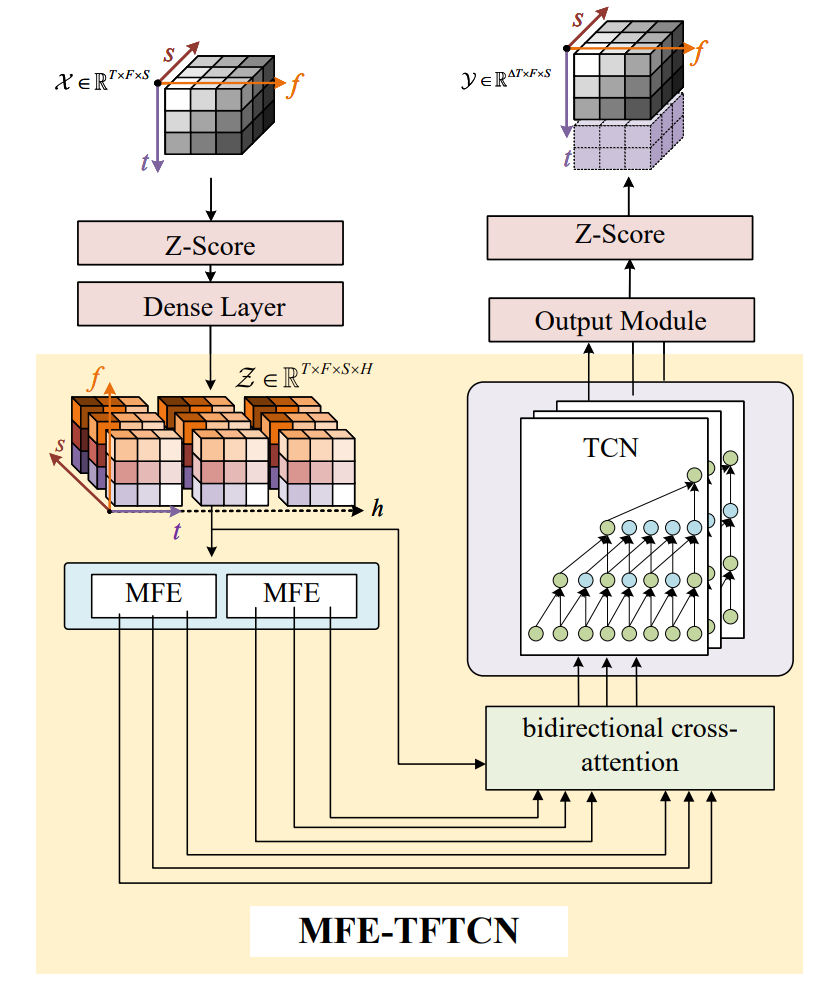
In the era of increasingly scarce spectrum resources, electromagnetic spectrum (EMS) prediction has emerged as a critical means for enhancing spectrum utilization efficiency. However, most of the existing EMS methods primarily exploit low-dimensional features such as temporal, frequency, or spatial characteristics in an individual fashion, which limits their ability to fully capture the inherent complexity of spectrum dynamics. To improve the performance, this paper proposes a novel EMS prediction model, which involving three operations, namely multi-dimensional decoupling, feature fusion and temporal prediction. Firstly, for multi-dimensional decoupling operation, we propose a Multi-dimensional Feature Extraction (MFE) module, which characterizes the complex temporal-frequency-spatial variations of EMS data by leveraging both single-dimensional features and cross-dimension dependencies (i.e., temporal-frequency, temporal-spatial, and frequency-spatial relationships). By explicitly modeling these correlations, the MFE module enhances the prediction performance of the proposed model. Secondly, to reduce redundancy between these decoupled multi-path features, we introduce a Tensor-Feature-Fused (TF) module. Through a bidirectional cross-attention mechanism, the proposed TF module enables symmetric information exchange between multi-path features and the original spectrum data, by selectively integrating both inter-path features and intra-feature information. Finally, by employing a Temporal Convolutional Network (TCN), the data obtained by the TF module are processed to capture multi-scale dependencies so that the accuracy of spectrum prediction is enhanced. The performance of the proposed model, termed as MFE-TFTCN, has been extensively evaluated by means of computer simulations. Various experimental results obtained through the use of a publicly European multi-location dataset have demonstrated that, compared to state-of-the-art EMS prediction methods, the proposed model achieves superior prediction performance by effectively capturing temporal-frequency-spatial interdependencies.

Graphical Abstract

A Novel Electromagnetic Spectrum Prediction Model Based upon Multi-Dimensional Feature Fusion

Keywords

electromagnetic spectrum prediction multi-dimensional decoupling bidirectional cross-attention mechanism temporal convolutional network

Data Availability Statement

Data will be made available on request.

Funding

This work was supported by the National Natural Science Foundation of China under Grant 62201172.

Conflicts of Interest

The authors declare no conflicts of interest.

Ethical Approval and Consent to Participate

Not applicable.

References

  1. Wang, C. X., Di Renzo, M., Stanczak, S., Wang, S., & Larsson, E. G. (2020). Artificial intelligence enabled wireless networking for 5G and beyond: Recent advances and future challenges. IEEE Wireless Communications, 27(1), 16-23.
    [CrossRef] [Google Scholar]
  2. Zhou, Z., Lyu, G., Huang, Y., Wang, Z., Jia, Z., & Yang, Z. (2024, August). Sdformer: transformer with spectral filter and dynamic attention for multivariate time series long-term forecasting. In Proceedings of the Thirty-Third International Joint Conference on Artificial Intelligence (IJCAI-24), Jeju, Republic of Korea (pp. 3-9).
    [Google Scholar]
  3. Li, T. B., Su, Y. T., Song, D., Li, W. H., Wei, Z. Q., & Liu, A. A. (2024). Multi-scale spatial-temporal transformer for meteorological variable forecasting. IEEE Transactions on Circuits and Systems for Video Technology.
    [CrossRef] [Google Scholar]
  4. Chen, X., Zhang, H., Zhang, S., Feng, J., Xia, H., Rao, P., & Ai, J. (2024). A space infrared dim target recognition algorithm based on improved DS theory and multi-dimensional feature decision level fusion ensemble classifier. Remote Sensing, 16(3), 510.
    [CrossRef] [Google Scholar]
  5. Ya, T. U., Yun, L. I. N., Haoran, Z. H. A., Yu, W. A. N. G., Guan, G. U. I., & Shiwen, M. A. O. (2022). Large-scale real-world radio signal recognition with deep learning. Chinese Journal of Aeronautics, 35(9), 35-48.
    [CrossRef] [Google Scholar]
  6. Ji, A., Li, D., Dai, Z., Cui, M., Yu, L., & Duan, Z. (2025). A hybrid graph memory network approach with multi-level feature representation for traffic flow forecast. Expert Systems with Applications, 130316.
    [CrossRef] [Google Scholar]
  7. Yazdanpanah, O., Chang, M., & Ali Bakhshi, E. (2025). Attention-based hybrid convolutional-long short-term memory network for bridge pier hysteresis and backbone curves prediction. Integrated Computer-Aided Engineering, 32(2), 176-195.
    [CrossRef] [Google Scholar]
  8. Yan, J., Peng, Y., Li, Q., Shao, H., Bin, G., Zheng, J., ... & Zhou, J. (2025). Riesz Time-frequency Spectrum Transform and Its Application in Rolling Bearing Fault Diagnosis. IEEE Sensors Journal.
    [CrossRef] [Google Scholar]
  9. Lin, Y., Tu, Y., & Dou, Z. (2020). An improved neural network pruning technology for automatic modulation classification in edge devices. IEEE Transactions on Vehicular Technology, 69(5), 5703-5706.
    [CrossRef] [Google Scholar]
  10. Lin, Y., Zhao, H., Ma, X., Tu, Y., & Wang, M. (2020). Adversarial attacks in modulation recognition with convolutional neural networks. IEEE Transactions on Reliability, 70(1), 389-401.
    [CrossRef] [Google Scholar]
  11. Cao, D., Zhao, J., Hu, W., Zhang, Y., Liao, Q., Chen, Z., & Blaabjerg, F. (2021). Robust deep Gaussian process-based probabilistic electrical load forecasting against anomalous events. IEEE Transactions on Industrial Informatics, 18(2), 1142-1153.
    [CrossRef] [Google Scholar]
  12. Rahim, V. A., & Prema, S. C. (2021, December). A combined spectrum prediction and sensing approach for cognitive radios. In 2021 IEEE 18th India Council International Conference (INDICON) (pp. 1-6). IEEE.
    [CrossRef] [Google Scholar]
  13. Radhakrishnan, N., Kandeepan, S., Yu, X., & Baldini, G. (2024, December). Multi step temporal spectrum occupancy prediction using deep learning. In 2024 17th International Conference on Signal Processing and Communication System (ICSPCS) (pp. 1-6). IEEE.
    [CrossRef] [Google Scholar]
  14. Brown, C., & Ghasemi, A. (2023). Evolution toward data-driven spectrum sharing: Opportunities and challenges. IEEE Access, 11, 99680-99692.
    [CrossRef] [Google Scholar]
  15. Gao, Y., Zhao, C., & Fu, N. (2021, September). Joint multi-channel multi-step spectrum prediction algorithm. In 2021 IEEE 94th Vehicular Technology Conference (VTC2021-Fall) (pp. 1-5). IEEE.
    [CrossRef] [Google Scholar]
  16. Ren, X., Mosavat-Jahromi, H., Cai, L., & Kidston, D. (2021). Spatio-temporal spectrum load prediction using convolutional neural network and ResNet. IEEE Transactions on Cognitive Communications and Networking, 8(2), 502-513.
    [CrossRef] [Google Scholar]
  17. Basak, S., Rajendran, S., Pollin, S., & Scheers, B. (2023). Spectrum prediction for protocol-aware RF jamming. IEEE Transactions on Cognitive Communications and Networking, 10(2), 363-373.
    [CrossRef] [Google Scholar]
  18. Li, S., Sun, Y., Han, Y., Zhang, Z., Yao, M., Chen, J., ... & Lin, Y. (2024). CL-MFGCN: Graph Structure Contrastive Learning and Multi-Scale Feature Fusion Graph Convolutional Network for Spectrum Prediction. IEEE Internet of Things Journal.
    [CrossRef] [Google Scholar]
  19. Naikwadi, M. H., & Patil, K. P. (2022). A multi-dimensional real world spectrum occupancy data measurement and analysis for spectrum inference in cognitive radio network. International Journal of Communication Networks and Information Security, 14(2), 244-260.
    [CrossRef] [Google Scholar]
  20. Han, Z., Zhao, J., Leung, H., Ma, K. F., & Wang, W. (2019). A review of deep learning models for time series prediction. IEEE Sensors Journal, 21(6), 7833-7848.
    [CrossRef] [Google Scholar]
  21. Zhang, H., Tian, Q., & Han, Y. (2022, September). Multi channel spectrum prediction algorithm based on GCN and LSTM. In 2022 IEEE 96th Vehicular Technology Conference (VTC2022-Fall) (pp. 1-5). IEEE.
    [CrossRef] [Google Scholar]
  22. Li, X., Liu, Z., Xu, Y., Wang, X., & Song, T. (2020, August). Recovering missing values from corrupted historical spectrum observations for dependable spectrum prediction. In 2020 IEEE/CIC International Conference on Communications in China (ICCC) (pp. 941-946). IEEE.
    [CrossRef] [Google Scholar]
  23. Deng, J., Deng, J., Yin, D., Jiang, R., & Song, X. (2023). Tts-norm: Forecasting tensor time series via multi-way normalization. ACM Transactions on Knowledge Discovery from Data, 18(1), 1-25.
    [CrossRef] [Google Scholar]
  24. Jebur, R. S., & Thaher, R. H. (2022, October). Multiple FBG wavelength peaks detection using Z-score algorithm. In 2022 International Symposium on Multidisciplinary Studies and Innovative Technologies (ISMSIT) (pp. 223-226). IEEE.
    [CrossRef] [Google Scholar]
  25. Tian, G., Zhang, C., Shi, Y., & Li, X. (2024). MultiWaveNet: A long time series forecasting framework based on multi-scale analysis and multi-channel feature fusion. Expert Systems with Applications, 251, 124088.
    [CrossRef] [Google Scholar]
  26. He, N., Fang, L., Li, S., Plaza, J., & Plaza, A. (2019). Skip-connected covariance network for remote sensing scene classification. IEEE transactions on neural networks and learning systems, 31(5), 1461-1474.
    [CrossRef] [Google Scholar]
  27. Rajendran, S., Calvo-Palomino, R., Fuchs, M., Van den Bergh, B., Cordobés, H., Giustiniano, D., ... & Lenders, V. (2017). Electrosense: Open and big spectrum data. IEEE Communications Magazine, 56(1), 210-217.
    [CrossRef] [Google Scholar]
  28. Yang, M., Yang, J., Xiao, Z., & Huang, M. (2021, January). A modular spectrum sensing node for Resources-Oriented Radio Monitoring. In 2021 International Conference on Computer Communication and Informatics (ICCCI) (pp. 1-8). IEEE.
    [CrossRef] [Google Scholar]
  29. Shi, Q., Yin, J., Cai, J., Cichocki, A., Yokota, T., Chen, L., ... & Zeng, J. (2020, April). Block Hankel tensor ARIMA for multiple short time series forecasting. In Proceedings of the AAAI Conference on Artificial Intelligence (Vol. 34, No. 04, pp. 5758-5766).
    [CrossRef] [Google Scholar]
  30. Li, X., Wang, X., Song, T., & Hu, J. (2021). Robust online prediction of spectrum map with incomplete and corrupted observations. IEEE Transactions on Mobile Computing, 21(12), 4583-4594.
    [CrossRef] [Google Scholar]
  31. Bohara, B., Fernandez, R. I., Gollapudi, V., & Li, X. (2022, November). Short-term aggregated residential load forecasting using BiLSTM and CNN-BiLSTM. In 2022 International Conference on Innovation and Intelligence for Informatics, Computing, and Technologies (3ICT) (pp. 37-43). IEEE.
    [CrossRef] [Google Scholar]
  32. Shi, X., Chen, Z., Wang, H., Yeung, D. Y., Wong, W. K., & Woo, W. C. (2015). Convolutional LSTM network: A machine learning approach for precipitation nowcasting. Advances in neural information processing systems, 28.
    [Google Scholar]
  33. Sen, R., Yu, H. F., & Dhillon, I. S. (2019). Think globally, act locally: A deep neural network approach to high-dimensional time series forecasting. Advances in neural information processing systems, 32.
    [Google Scholar]

Cited By (1)

  1. Limin Guo, Yuwu Wang, Xiaohai Zhou, Yue Wu, Guifu Yang. Infrared and Visible Ship Image Fusion Based on Adaptive Cross-Modal Feature Interaction and Multiscale Frequency-Domain Transformation. IEEE Transactions on Geoscience and Remote Sensing, 2026 , 64 .
    [CrossRef]
* Citation data provided by Crossref Cited-by.

Cite This Article

APA Style
Han, Y., Song, J., Wang, Z., Xiang, W., Mathiopoulos, P. T., Gui, G., & Lin, Y. (2025). A Novel Electromagnetic Spectrum Prediction Model Based upon Multi-Dimensional Feature Fusion. Chinese Journal of Information Fusion, 3(1), 1–16. https://doi.org/10.62762/CJIF.2025.747641
Export Citation
RIS Format
Compatible with EndNote, Zotero, Mendeley, and other reference managers
TY  - JOUR
AU  - Han, Yu
AU  - Song, Jiayi
AU  - Wang, Zhiqi
AU  - Xiang, Wei
AU  - Mathiopoulos, P. Takis
AU  - Gui, Guan
AU  - Lin, Yun
PY  - 2025
DA  - 2025/11/20
TI  - A Novel Electromagnetic Spectrum Prediction Model Based upon Multi-Dimensional Feature Fusion
JO  - Chinese Journal of Information Fusion
T2  - Chinese Journal of Information Fusion
JF  - Chinese Journal of Information Fusion
VL  - 3
IS  - 1
SP  - 1
EP  - 16
DO  - 10.62762/CJIF.2025.747641
UR  - https://www.icck.org/article/abs/CJIF.2025.747641
KW  - electromagnetic spectrum prediction
KW  - multi-dimensional decoupling
KW  - bidirectional cross-attention mechanism
KW  - temporal convolutional network
AB  - In the era of increasingly scarce spectrum resources, electromagnetic spectrum (EMS) prediction has emerged as a critical means for enhancing spectrum utilization efficiency. However, most of the existing EMS methods primarily exploit low-dimensional features such as temporal, frequency, or spatial characteristics in an individual fashion, which limits their ability to fully capture the inherent complexity of spectrum dynamics. To improve the performance, this paper proposes a novel EMS prediction model, which involving three operations, namely multi-dimensional decoupling, feature fusion and temporal prediction. Firstly, for multi-dimensional decoupling operation, we propose a Multi-dimensional Feature Extraction (MFE) module, which characterizes the complex temporal-frequency-spatial variations of EMS data by leveraging both single-dimensional features and cross-dimension dependencies (i.e., temporal-frequency, temporal-spatial, and frequency-spatial relationships). By explicitly modeling these correlations, the MFE module enhances the prediction performance of the proposed model. Secondly, to reduce redundancy between these decoupled multi-path features, we introduce a Tensor-Feature-Fused (TF) module. Through a bidirectional cross-attention mechanism, the proposed TF module enables symmetric information exchange between multi-path features and the original spectrum data, by selectively integrating both inter-path features and intra-feature information. Finally, by employing a Temporal Convolutional Network (TCN), the data obtained by the TF module are processed to capture multi-scale dependencies so that the accuracy of spectrum prediction is enhanced. The performance of the proposed model, termed as MFE-TFTCN, has been extensively evaluated by means of computer simulations. Various experimental results obtained through the use of a publicly European multi-location dataset have demonstrated that, compared to state-of-the-art EMS prediction methods, the proposed model achieves superior prediction performance by effectively capturing temporal-frequency-spatial interdependencies.
SN  - 2998-3371
PB  - Institute of Central Computation and Knowledge
LA  - English
ER  - 
BibTeX Format
Compatible with LaTeX, BibTeX, and other reference managers
@article{Han2025A,
  author = {Yu Han and Jiayi Song and Zhiqi Wang and Wei Xiang and P. Takis Mathiopoulos and Guan Gui and Yun Lin},
  title = {A Novel Electromagnetic Spectrum Prediction Model Based upon Multi-Dimensional Feature Fusion},
  journal = {Chinese Journal of Information Fusion},
  year = {2025},
  volume = {3},
  number = {1},
  pages = {1-16},
  doi = {10.62762/CJIF.2025.747641},
  url = {https://www.icck.org/article/abs/CJIF.2025.747641},
  abstract = {In the era of increasingly scarce spectrum resources, electromagnetic spectrum (EMS) prediction has emerged as a critical means for enhancing spectrum utilization efficiency. However, most of the existing EMS methods primarily exploit low-dimensional features such as temporal, frequency, or spatial characteristics in an individual fashion, which limits their ability to fully capture the inherent complexity of spectrum dynamics. To improve the performance, this paper proposes a novel EMS prediction model, which involving three operations, namely multi-dimensional decoupling, feature fusion and temporal prediction. Firstly, for multi-dimensional decoupling operation, we propose a Multi-dimensional Feature Extraction (MFE) module, which characterizes the complex temporal-frequency-spatial variations of EMS data by leveraging both single-dimensional features and cross-dimension dependencies (i.e., temporal-frequency, temporal-spatial, and frequency-spatial relationships). By explicitly modeling these correlations, the MFE module enhances the prediction performance of the proposed model. Secondly, to reduce redundancy between these decoupled multi-path features, we introduce a Tensor-Feature-Fused (TF) module. Through a bidirectional cross-attention mechanism, the proposed TF module enables symmetric information exchange between multi-path features and the original spectrum data, by selectively integrating both inter-path features and intra-feature information. Finally, by employing a Temporal Convolutional Network (TCN), the data obtained by the TF module are processed to capture multi-scale dependencies so that the accuracy of spectrum prediction is enhanced. The performance of the proposed model, termed as MFE-TFTCN, has been extensively evaluated by means of computer simulations. Various experimental results obtained through the use of a publicly European multi-location dataset have demonstrated that, compared to state-of-the-art EMS prediction methods, the proposed model achieves superior prediction performance by effectively capturing temporal-frequency-spatial interdependencies.},
  keywords = {electromagnetic spectrum prediction, multi-dimensional decoupling, bidirectional cross-attention mechanism, temporal convolutional network},
  issn = {2998-3371},
  publisher = {Institute of Central Computation and Knowledge}
}

Article Metrics

Citations
Views
2430
PDF Downloads
527

Publisher's Note

ICCK stays neutral with regard to jurisdictional claims in published maps and institutional affiliations.

Rights and Permissions

CC BY Copyright © 2025 by the Author(s). Published by Institute of Central Computation and Knowledge. This article is an open access article distributed under the terms and conditions of the Creative Commons Attribution (CC BY) license (https://creativecommons.org/licenses/by/4.0/), which permits use, sharing, adaptation, distribution and reproduction in any medium or format, as long as you give appropriate credit to the original author(s) and the source, provide a link to the Creative Commons licence, and indicate if changes were made.

Chinese Journal of Information Fusion
ISSN: 2998-3371 (Online) | ISSN: 2998-3363 (Print)
Portico
Preserved at
Portico