

Digital Intelligence in Agriculture
ISSN: 3069-3187 (Online)
Email: [email protected]



 Submit Manuscript
Edit a Special Issue
Submit Manuscript
Edit a Special Issue


TY  - JOUR
AU  - Cui, Yuxiu
AU  - Chang, Yueming
AU  - Hong, Ying
AU  - Yan, Yuling
PY  - 2025
DA  - 2025/12/08
TI  - Digital-Intelligence Assessment of Production–Living–Ecological Spaces for Agricultural Modernization: A Case Study of Ulanqab City
JO  - Digital Intelligence in Agriculture
T2  - Digital Intelligence in Agriculture
JF  - Digital Intelligence in Agriculture
VL  - 1
IS  - 2
SP  - 61
EP  - 78
DO  - 10.62762/DIA.2025.135622
UR  - https://www.icck.org/article/abs/DIA.2025.135622
KW  - production-living-ecological (PLE) spaces
KW  - digital intelligence
KW  - agricultural modernization
KW  - coupling coordination model
KW  - Ulanqab City
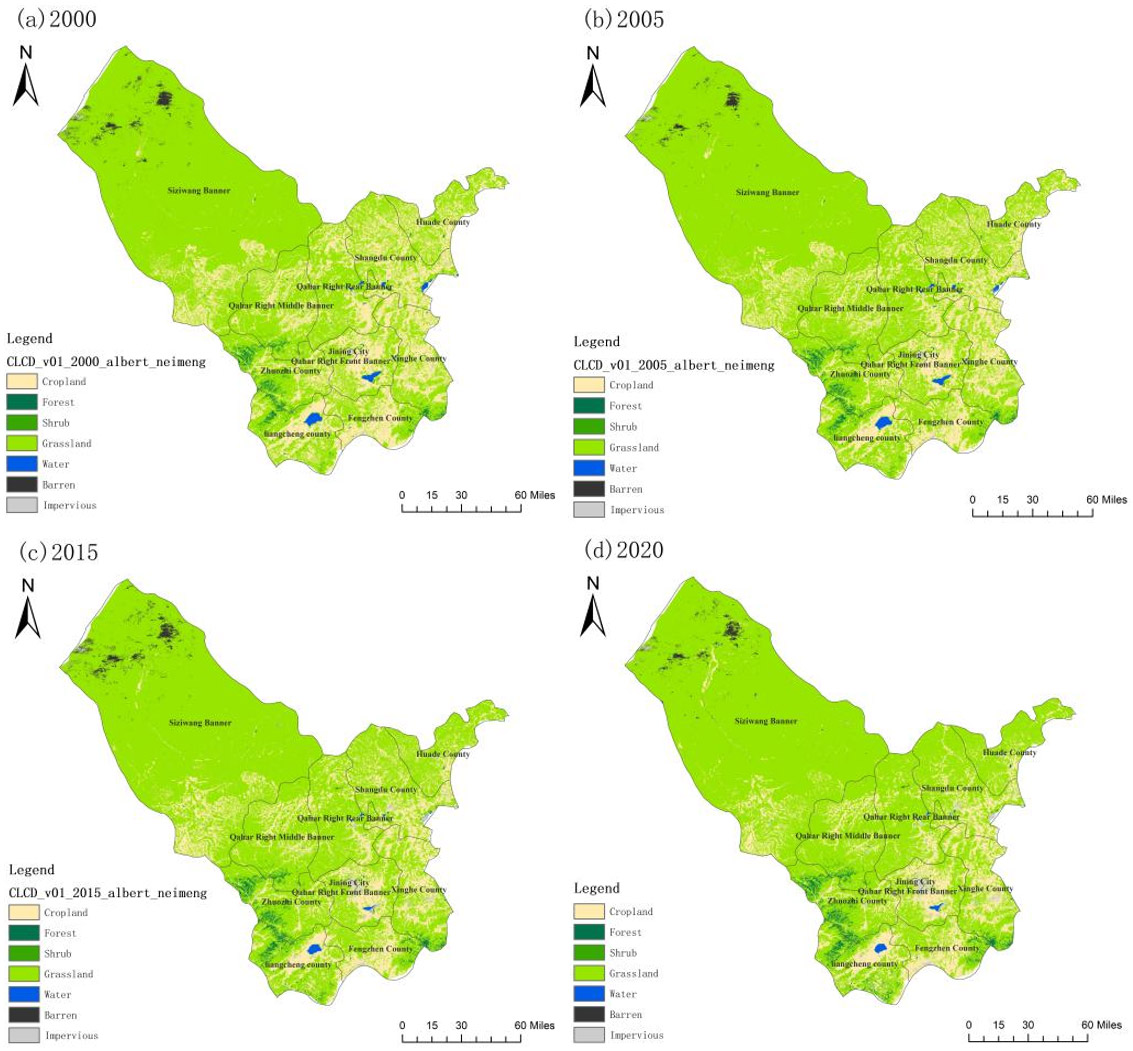
AB  - Against the backdrop of the synergistic advancement of rural revitalization and agricultural modernization, optimizing the Production-Living-Ecological (PLE) spatial pattern and introducing digital-intelligent technologies have become key pathways for enhancing sustainable rural development capabilities. This study takes Ulanqab City in Inner Mongolia, a typical agro-pastoral ecotone, as a case study. Based on multi-source remote sensing image data from 2000 to 2020, it comprehensively utilizes a coupling coordination model and spatial information technology to evaluate the evolution characteristics of its PLE spaces and the coordination mechanisms of agricultural functions, supplemented by NDVI and soil moisture data to link ecological and agricultural functions. The results indicate that the city's PLE spaces exhibit a pattern of "North-South differentiation, overall coordination," temporally evolving through three stages: "maladjustment-breaking-in-differentiation." The southern region promotes PLE synergy and urban-rural integration leveraging clean energy and smart logistics; the central region maintains functional balance through the Grain for Green program and characteristic eco-agriculture; the northern region is constrained by traditional animal husbandry and ecological degradation. Addressing regional disparities, differentiated pathways are proposed: developing "smart agriculture + digital supply chains" in the south, constructing an "ecological–intensive" intelligent animal husbandry model in the north, and establishing a remote sensing and Internet of Things (IoT) based value realization mechanism for eco-agriculture in the central region. Recommendations include enhancing agricultural digitalization levels and PLE functional coordination through spatial regulation, green technology empowerment, and ecological compensation policies, providing theoretical and data support for achieving sustainable agricultural development and modernized rural revitalization.
SN  - 3069-3187
PB  - Institute of Central Computation and Knowledge
LA  - English
ER  -
@article{Cui2025DigitalInt,
  author = {Yuxiu Cui and Yueming Chang and Ying Hong and Yuling Yan},
  title = {Digital-Intelligence Assessment of Production–Living–Ecological Spaces for Agricultural Modernization: A Case Study of Ulanqab City},
  journal = {Digital Intelligence in Agriculture},
  year = {2025},
  volume = {1},
  number = {2},
  pages = {61-78},
  doi = {10.62762/DIA.2025.135622},
  url = {https://www.icck.org/article/abs/DIA.2025.135622},
  abstract = {Against the backdrop of the synergistic advancement of rural revitalization and agricultural modernization, optimizing the Production-Living-Ecological (PLE) spatial pattern and introducing digital-intelligent technologies have become key pathways for enhancing sustainable rural development capabilities. This study takes Ulanqab City in Inner Mongolia, a typical agro-pastoral ecotone, as a case study. Based on multi-source remote sensing image data from 2000 to 2020, it comprehensively utilizes a coupling coordination model and spatial information technology to evaluate the evolution characteristics of its PLE spaces and the coordination mechanisms of agricultural functions, supplemented by NDVI and soil moisture data to link ecological and agricultural functions. The results indicate that the city's PLE spaces exhibit a pattern of "North-South differentiation, overall coordination," temporally evolving through three stages: "maladjustment-breaking-in-differentiation." The southern region promotes PLE synergy and urban-rural integration leveraging clean energy and smart logistics; the central region maintains functional balance through the Grain for Green program and characteristic eco-agriculture; the northern region is constrained by traditional animal husbandry and ecological degradation. Addressing regional disparities, differentiated pathways are proposed: developing "smart agriculture + digital supply chains" in the south, constructing an "ecological–intensive" intelligent animal husbandry model in the north, and establishing a remote sensing and Internet of Things (IoT) based value realization mechanism for eco-agriculture in the central region. Recommendations include enhancing agricultural digitalization levels and PLE functional coordination through spatial regulation, green technology empowerment, and ecological compensation policies, providing theoretical and data support for achieving sustainable agricultural development and modernized rural revitalization.},
  keywords = {production-living-ecological (PLE) spaces, digital intelligence, agricultural modernization, coupling coordination model, Ulanqab City},
  issn = {3069-3187},
  publisher = {Institute of Central Computation and Knowledge}
}
 Copyright © 2025 by the Author(s). Published by Institute of Central Computation and Knowledge. This article is an open access article distributed under the terms and conditions of the Creative Commons Attribution (CC BY) license (https://creativecommons.org/licenses/by/4.0/), which permits use, sharing, adaptation, distribution and reproduction in any medium or format, as long as you give appropriate credit to the original author(s) and the source, provide a link to the Creative Commons licence, and indicate if changes were made.

Portico
All published articles are preserved here permanently:
https://www.portico.org/publishers/icck/