


Comparative Study of Lightweight Deep Learning Models for Greenhouse Tomato Leaf Disease Classification Using the Public TLID Dataset




Article Information
Abstract
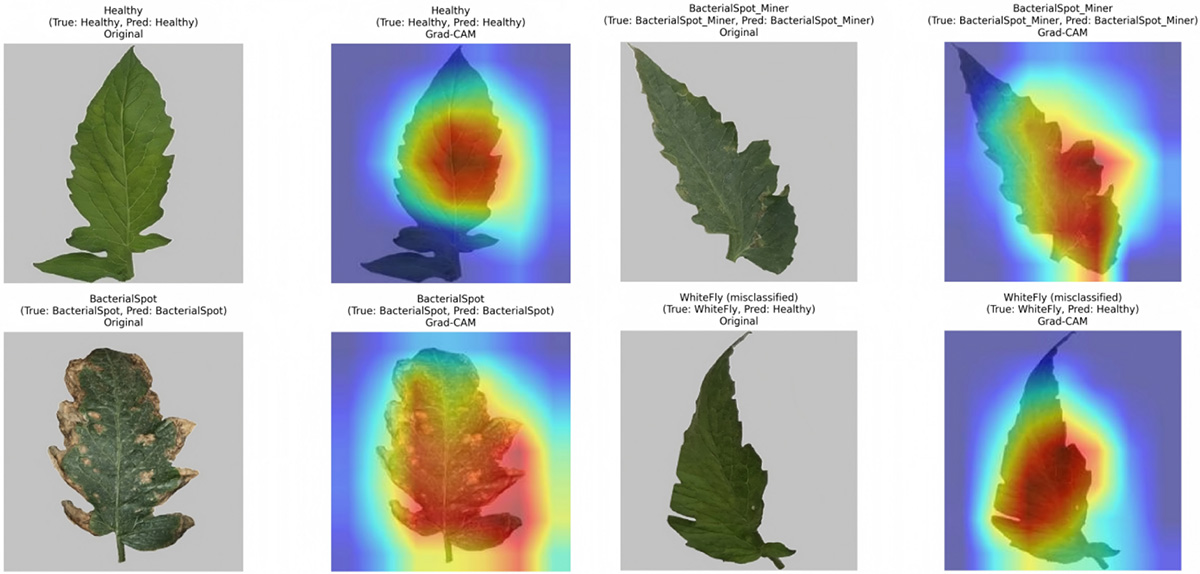
Accurate recognition of greenhouse tomato leaf diseases is crucial for crop monitoring, timely intervention, and yield protection. In greenhouse environments, disease symptoms are often affected by complex illumination, background clutter, overlapping leaves, mixed patterns, and subtle inter-class differences, making reliable image-based diagnosis challenging. To evaluate compact convolutional neural networks for this task, this study presents a controlled comparison of five CNN models—MobileNetV3-Large, ShuffleNetV2\_x1\_0, MobileNetV2, EfficientNet-B0, and ResNet18—using the public Tomato Leaf Image Dataset (TLID). A curated split of 15,254 images covering seven conditions was used, with 10,674 for training, 2,286 for validation, and 2,294 for testing. All models were trained from scratch under identical preprocessing, augmentation, optimization, and selection protocols. Performance was assessed using accuracy, macro-precision/recall/F1, class-wise metrics, confusion matrix, and Grad-CAM visualization. Results show ResNet18 achieved the best overall performance with 71.80% test accuracy and macro-F1 of 0.6726. Among lightweight models, EfficientNet-B0 delivered the strongest results, reaching 70.40% accuracy and macro-F1 of 0.6299, establishing it as the most competitive lightweight baseline. Class-wise analysis indicated Healthy was recognized most reliably, while WhiteFly remained the most challenging due to limited samples, subtle cues, and overlap with healthy leaves. Grad-CAM visualization confirmed the best model focused on symptom-relevant regions rather than background. Overall, findings provide a benchmark for TLID-based classification, identifying EfficientNet-B0 as the strongest lightweight baseline and ResNet18 as the top-performing reference model.
Graphical Abstract
Keywords
Data Availability Statement
Funding
Conflicts of Interest
AI Use Statement
Ethical Approval and Consent to Participate
References
- Mohanty, S. P., Hughes, D. P., & Salathe, M. (2016). Using deep learning for image-based plant disease detection. Frontiers in Plant Science, 7, 1419.
[CrossRef] [Google Scholar] - Hughes, D., & Salathé, M. (2015). An open access repository of images on plant health to enable the development of mobile disease diagnostics. arXiv preprint arXiv:1511.08060.
[Google Scholar] - Zimmermann, G. B., Pellenz, M. E., Costa, Y. M. G., & Britto Jr, A. S. (2025). Enhancing disease and pest detection in greenhouse tomato cultivation using advanced machine learning on new dataset of images. Journal of the Brazilian Computer Society, 31(1), 187-202.
[CrossRef] [Google Scholar] - Pellenz, M., Zimmermann, G. B., Britto Jr, A. S., & Costa, Y. M. G. (2025). Tomato Leaf Image Dataset (TLID/PTLID) [Dataset]. Mendeley Data, V2.
[CrossRef] [Google Scholar] - Brahimi, M., Boukhalfa, K., & Moussaoui, A. (2017). Deep learning for tomato diseases: Classification and symptoms visualization. Applied Artificial Intelligence, 31(4), 299-315.
[CrossRef] [Google Scholar] - Tan, L., Lu, J., & Jiang, H. (2021). Tomato leaf diseases classification based on leaf images: A comparison between classical machine learning and deep learning methods. AgriEngineering, 3(3), 542-558.
[CrossRef] [Google Scholar] - Zhang, Y., Wu, G., & Shen, J. (2026). Precise tea leaf disease detection using UAV low-altitude remote sensing and optimized YOLO11 model. PLoS One, 21(2), e0342545.
[CrossRef] [Google Scholar] - Sandler, M., Howard, A., Zhu, M., Zhmoginov, A., & Chen, L. C. (2018). MobileNetV2: Inverted residuals and linear bottlenecks. In Proceedings of the IEEE/CVF Conference on Computer Vision and Pattern Recognition (pp. 4510-4520).
[CrossRef] [Google Scholar] - Howard, A., Sandler, M., Chen, B., Wang, W., Chen, L. C., Tan, M., ... & Le, Q. (2019, October). Searching for MobileNetV3. In 2019 IEEE/CVF International Conference on Computer Vision (ICCV) (pp. 1314-1324). IEEE.
[CrossRef] [Google Scholar] - Ma, N., Zhang, X., Zheng, H. T., & Sun, J. (2018, September). ShuffleNet V2: Practical Guidelines for Efficient CNN Architecture Design. In European Conference on Computer Vision (pp. 122-138).
[CrossRef] [Google Scholar] - Tan, M., & Le, Q. (2019, May). Efficientnet: Rethinking model scaling for convolutional neural networks. In International conference on machine learning (pp. 6105-6114). PMLR.
[Google Scholar] - He, K., Zhang, X., Ren, S., & Sun, J. (2016, June). Deep Residual Learning for Image Recognition. In 2016 IEEE Conference on Computer Vision and Pattern Recognition (CVPR) (pp. 770-778). IEEE.
[CrossRef] [Google Scholar] - Selvaraju, R. R., Cogswell, M., Das, A., Vedantam, R., Parikh, D., & Batra, D. (2017). Grad-CAM: Visual explanations from deep networks via gradient-based localization. In Proceedings of the IEEE International Conference on Computer Vision (pp. 618-626).
[CrossRef] [Google Scholar] - Attallah, O. (2023). Tomato Leaf Disease Classification via Compact Convolutional Neural Networks with Transfer Learning and Feature Selection. Horticulturae, 9(2), 149.
[CrossRef] [Google Scholar] - Bhujel, A., Kim, N. E., Arulmozhi, E., Basak, J. K., & Kim, H. T. (2022). A lightweight attention-based convolutional neural networks for tomato leaf disease classification. Agriculture, 12(2), 228.
[CrossRef] [Google Scholar] - Chen, H., Wang, Y., Jiang, P., Zhang, R., & Peng, J. (2023). LBFNet: A Tomato Leaf Disease Identification Model Based on Three-Channel Attention Mechanism and Quantitative Pruning. Applied Sciences, 13(9), 5589.
[CrossRef] [Google Scholar] - Saeed, A., Abdel-Aziz, A. A., Mossad, A., Abdelhamid, M. A., Alkhaled, A. Y., & Mayhoub, M. (2023). Smart Detection of Tomato Leaf Diseases Using Transfer Learning-Based Convolutional Neural Networks. Agriculture, 13(1), 139.
[CrossRef] [Google Scholar]
Cite This Article
TY  - JOUR
AU  - Ni, Lihao
AU  - Ye, Fuyin
AU  - Cui, Xiaojun
AU  - Peng, Xiaoman
AU  - Song, Shaoshuai
AU  - Luo, Wei
PY  - 2026
DA  - 2026/03/21
TI  - Comparative Study of Lightweight Deep Learning Models for Greenhouse Tomato Leaf Disease Classification Using the Public TLID Dataset
JO  - Digital Intelligence in Agriculture
T2  - Digital Intelligence in Agriculture
JF  - Digital Intelligence in Agriculture
VL  - 2
IS  - 1
SP  - 45
EP  - 53
DO  - 10.62762/DIA.2026.103152
UR  - https://www.icck.org/article/abs/DIA.2026.103152
KW  - greenhouse tomato leaf disease classification
KW  - lightweight convolutional neural network
KW  - TLID
KW  - EfficientNet-B0
KW  - ResNet18
KW  - Grad-CAM
AB  - Accurate recognition of greenhouse tomato leaf diseases is crucial for crop monitoring, timely intervention, and yield protection. In greenhouse environments, disease symptoms are often affected by complex illumination, background clutter, overlapping leaves, mixed patterns, and subtle inter-class differences, making reliable image-based diagnosis challenging. To evaluate compact convolutional neural networks for this task, this study presents a controlled comparison of five CNN models—MobileNetV3-Large, ShuffleNetV2\_x1\_0, MobileNetV2, EfficientNet-B0, and ResNet18—using the public Tomato Leaf Image Dataset (TLID). A curated split of 15,254 images covering seven conditions was used, with 10,674 for training, 2,286 for validation, and 2,294 for testing. All models were trained from scratch under identical preprocessing, augmentation, optimization, and selection protocols. Performance was assessed using accuracy, macro-precision/recall/F1, class-wise metrics, confusion matrix, and Grad-CAM visualization. Results show ResNet18 achieved the best overall performance with 71.80% test accuracy and macro-F1 of 0.6726. Among lightweight models, EfficientNet-B0 delivered the strongest results, reaching 70.40% accuracy and macro-F1 of 0.6299, establishing it as the most competitive lightweight baseline. Class-wise analysis indicated Healthy was recognized most reliably, while WhiteFly remained the most challenging due to limited samples, subtle cues, and overlap with healthy leaves. Grad-CAM visualization confirmed the best model focused on symptom-relevant regions rather than background. Overall, findings provide a benchmark for TLID-based classification, identifying EfficientNet-B0 as the strongest lightweight baseline and ResNet18 as the top-performing reference model.
SN  - 3069-3187
PB  - Institute of Central Computation and Knowledge
LA  - English
ER  -
@article{Ni2026Comparativ,
  author = {Lihao Ni and Fuyin Ye and Xiaojun Cui and Xiaoman Peng and Shaoshuai Song and Wei Luo},
  title = {Comparative Study of Lightweight Deep Learning Models for Greenhouse Tomato Leaf Disease Classification Using the Public TLID Dataset},
  journal = {Digital Intelligence in Agriculture},
  year = {2026},
  volume = {2},
  number = {1},
  pages = {45-53},
  doi = {10.62762/DIA.2026.103152},
  url = {https://www.icck.org/article/abs/DIA.2026.103152},
  abstract = {Accurate recognition of greenhouse tomato leaf diseases is crucial for crop monitoring, timely intervention, and yield protection. In greenhouse environments, disease symptoms are often affected by complex illumination, background clutter, overlapping leaves, mixed patterns, and subtle inter-class differences, making reliable image-based diagnosis challenging. To evaluate compact convolutional neural networks for this task, this study presents a controlled comparison of five CNN models—MobileNetV3-Large, ShuffleNetV2\\_x1\\_0, MobileNetV2, EfficientNet-B0, and ResNet18—using the public Tomato Leaf Image Dataset (TLID). A curated split of 15,254 images covering seven conditions was used, with 10,674 for training, 2,286 for validation, and 2,294 for testing. All models were trained from scratch under identical preprocessing, augmentation, optimization, and selection protocols. Performance was assessed using accuracy, macro-precision/recall/F1, class-wise metrics, confusion matrix, and Grad-CAM visualization. Results show ResNet18 achieved the best overall performance with 71.80\% test accuracy and macro-F1 of 0.6726. Among lightweight models, EfficientNet-B0 delivered the strongest results, reaching 70.40\% accuracy and macro-F1 of 0.6299, establishing it as the most competitive lightweight baseline. Class-wise analysis indicated Healthy was recognized most reliably, while WhiteFly remained the most challenging due to limited samples, subtle cues, and overlap with healthy leaves. Grad-CAM visualization confirmed the best model focused on symptom-relevant regions rather than background. Overall, findings provide a benchmark for TLID-based classification, identifying EfficientNet-B0 as the strongest lightweight baseline and ResNet18 as the top-performing reference model.},
  keywords = {greenhouse tomato leaf disease classification, lightweight convolutional neural network, TLID, EfficientNet-B0, ResNet18, Grad-CAM},
  issn = {3069-3187},
  publisher = {Institute of Central Computation and Knowledge}
}
Article Metrics
Publisher's Note
ICCK stays neutral with regard to jurisdictional claims in published maps and institutional affiliations.
Rights and Permissions
 Copyright © 2026 by the Author(s). Published by Institute of Central Computation and Knowledge. This article is an open access article distributed under the terms and conditions of the Creative Commons Attribution (CC BY) license (https://creativecommons.org/licenses/by/4.0/), which permits use, sharing, adaptation, distribution and reproduction in any medium or format, as long as you give appropriate credit to the original author(s) and the source, provide a link to the Creative Commons licence, and indicate if changes were made.

