


Research on Innovative Applications of Generative Artificial Intelligence in Agricultural Informatization


Article Information
Abstract
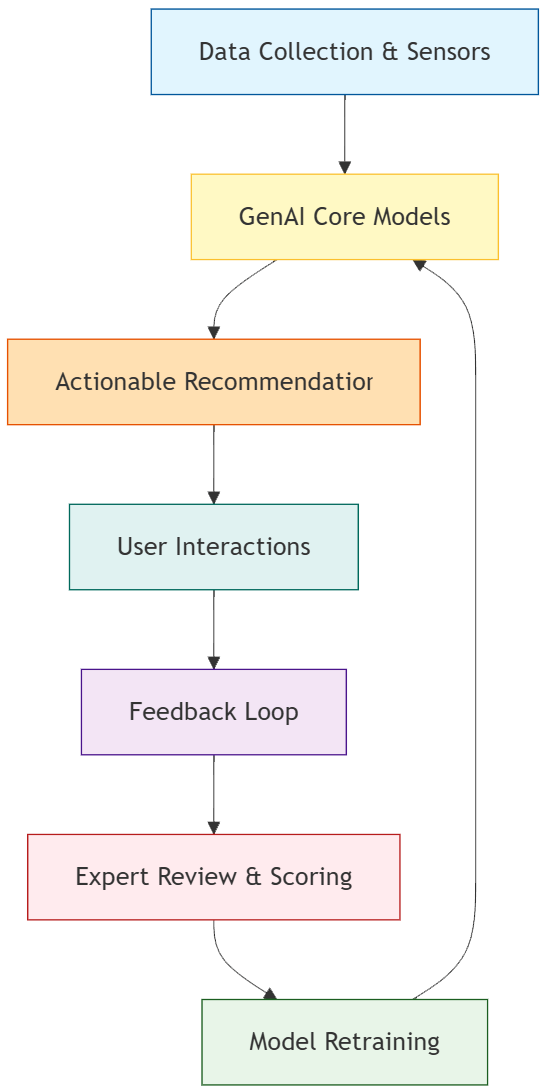
The integration of information technology into agriculture is fundamental to modern agricultural development. However, traditional agricultural information models, which rely on analytical AI for prediction and monitoring, face significant limitations in handling unstructured data, generating actionable knowledge, and supporting complex decision-making in dynamic farm environments. This study's core innovation lies in constructing a “Generative AI-Driven Agricultural Informatization Framework” (GAAIF), which quantifies the synergistic mechanisms between generative models and specific agricultural scenarios. By introducing a multi-modal data fusion engine and a task-specific fine-tuning protocol, a suite of generative AI tools, including a textile crop (cotton) pest advisory chatbot and a dynamic supply chain optimizer, was developed. Field tests and simulations in the Xinjiang cotton basin and Jiangxi sericulture regions showed that the integrated solution substantially improved pest management efficiency (decision time reduced by approximately 87%), reduced supply chain losses by 32.5%, and increased farmer advisory service satisfaction from 55% to 94% compared with traditional decision-support systems. This research provides a systematic technical paradigm and implementation strategy for the next generation of agricultural intelligence, with particular relevance to the textile raw material sector.
Graphical Abstract
Keywords
Data Availability Statement
Funding
Conflicts of Interest
AI Use Statement
Ethical Approval and Consent to Participate
References
- Wolfert, S., Ge, L., Verdouw, C., & Bogaardt, M. J. (2017). Big data in smart farming–a review. Agricultural systems, 153, 69-80.
[CrossRef] [Google Scholar] - Liakos, K. G., Busato, P., Moshou, D., Pearson, S., & Bochtis, D. (2018). Machine learning in agriculture: A review. Sensors, 18(8), 2674.
[CrossRef] [Google Scholar] - Kamir, E., Waldner, F., & Hochman, Z. (2020). Estimating wheat yields in Australia using climate records, satellite image time series and machine learning methods. ISPRS Journal of Photogrammetry and Remote Sensing, 160, 124-135.
[CrossRef] [Google Scholar] - Van Klompenburg, T., Kassahun, A., & Catal, C. (2020). Crop yield prediction using machine learning: A systematic literature review. Computers and electronics in agriculture, 177, 105709.
[CrossRef] [Google Scholar] - Espejo-Garcia, B., Mylonas, N., Athanasakos, L., Fountas, S., & Vasilakoglou, I. (2020). Towards weeds identification assistance through transfer learning. Computers and Electronics in Agriculture, 171, 105306.
[CrossRef] [Google Scholar] - Bommasani, R., Hudson, D. A., Adeli, E., Altman, R., Arora, S., von Arx, S., ... & Liang, P. (2021). On the opportunities and risks of foundation models. arXiv preprint arXiv:2108.07258.
[Google Scholar] - Duckett, T., Pearson, S., Blackmore, S., Grieve, B., Chen, W. H., Cielniak, G., ... & Yang, G. Z. (2018). Agricultural robotics: the future of robotic agriculture. arXiv preprint arXiv:1806.06762.
[Google Scholar] - Iaksch, J., Fernandes, E., & Borsato, M. (2021). Digitalization and big data in smart farming–a review. Journal of Management Analytics, 8(2), 333-349.
[CrossRef] [Google Scholar] - Niu, Y., Han, W., Zhang, H., Zhang, L., & Chen, H. (2021). Estimating fractional vegetation cover of maize under water stress from UAV multispectral imagery using machine learning algorithms. Computers and Electronics in Agriculture, 189, 106414.
[CrossRef] [Google Scholar] - Albahli, S. (2025). Agrifusionnet: A lightweight deep learning model for multisource plant disease diagnosis. Agriculture, 15(14), 1523.
[CrossRef] [Google Scholar] - Eldem, A., & Eldem, H. (2026). The development and evaluation of agricultural question-answering systems based on large language models. Scientific Reports, 16(1), 5357.
[CrossRef] [Google Scholar] - Zhai, Z., Martínez, J. F., Beltran, V., & Martínez, N. L. (2020). Decision support systems for agriculture 4.0: Survey and challenges. Computers and Electronics in Agriculture, 170, 105256.
[CrossRef] [Google Scholar] - Jiang, Y., Wang, R., Ding, R., Sun, Z., Jiang, Y., & Liu, W. (2025). Research review of agricultural machinery power chassis in hilly and mountainous areas. Agriculture, 15(11), 1158.
[CrossRef] [Google Scholar] - Kamilaris, A., & Prenafeta-Boldú, F. X. (2018). Deep learning in agriculture: A survey. Computers and Electronics in Agriculture, 147, 70-90.
[CrossRef] [Google Scholar] - Zhao, J., Fan, S., Zhang, B., Wang, A., Zhang, L., & Zhu, Q. (2025). Research status and development trends of deep reinforcement learning in the intelligent transformation of agricultural machinery. Agriculture, 15(11), 1223.
[CrossRef] [Google Scholar] - Wei, Y., Jiang, X., Liu, C., & Li, R. (2025). Research on Adaptive Improvement and Promotion Path of Intelligent Agricultural Machinery in Hilly and Mountainous Areas. Digital Intelligence in Agriculture, 1(2), 110-119.
[CrossRef] [Google Scholar] - Dharani, M. K., Thamilselvan, R., Natesan, P., Kalaivaani, P. C. D., & Santhoshkumar, S. (2021, February). Review on crop prediction using deep learning techniques. In Journal of physics: conference series (Vol. 1767, No. 1, p. 012026). IOP Publishing.
[CrossRef] [Google Scholar] - Goodfellow, I. J., Pouget-Abadie, J., Mirza, M., Xu, B., Warde-Farley, D., Ozair, S., ... & Bengio, Y. (2014). Generative adversarial nets. Advances in neural information processing systems, 27.
[Google Scholar] - Arsenovic, M., Karanovic, M., Sladojevic, S., Anderla, A., & Stefanovic, D. (2019). Solving current limitations of deep learning based approaches for plant disease detection. Symmetry, 11(7), 939.
[CrossRef] [Google Scholar] - Radford, A., Narasimhan, K., Salimans, T., & Sutskever, I. (2018). Improving language understanding by generative pre-training. OpenAI Technical Report. Retrieved from https://openai.com/research/language-unsupervised
[Google Scholar] - Brown, T., Mann, B., Ryder, N., Subbiah, M., Kaplan, J. D., Dhariwal, P., ... & Amodei, D. (2020). Language models are few-shot learners. Advances in neural information processing systems, 33, 1877-1901.
[Google Scholar] - Alayrac, J. B., Donahue, J., Luc, P., Miech, A., Barr, I., Hasson, Y., ... & Simonyan, K. (2022). Flamingo: a visual language model for few-shot learning. Advances in neural information processing systems, 35, 23716-23736.
[Google Scholar] - Zhou, Y., & Ryo, M. (2024, September). Agribench: A hierarchical agriculture benchmark for multimodal large language models. In European Conference on Computer Vision (pp. 207-223). Cham: Springer Nature Switzerland.
[CrossRef] [Google Scholar] - Touvron, H., Martin, L., Stone, K., Albert, P., Almahairi, A., Babaei, Y., ... & Scialom, T. (2023). Llama 2: Open foundation and fine-tuned chat models. arXiv preprint arXiv:2307.09288.
[Google Scholar] - Xu, W., Yang, W., Chen, P., Zhan, Y., Zhang, L., & Lan, Y. (2023). Cotton fiber quality estimation based on machine learning using time series UAV remote sensing data. Remote Sensing, 15(3), 586.
[CrossRef] [Google Scholar] - Reddy, C. H., Bhat, M. R., Kankanawadi, N., & Gowda, N. P. K. (2025). Artificial Intelligence in the New Era of Sericulture. Journal of Scientific Research and Reports, 31(8), 788-803.
[CrossRef] [Google Scholar] - Bwambale, E., Abagale, F. K., & Anornu, G. K. (2023). Data-driven model predictive control for precision irrigation management. Smart Agricultural Technology, 3, 100074.
[CrossRef] [Google Scholar] - Giri, C., Jain, S., Zeng, X., & Bruniaux, P. (2019). A detailed review of artificial intelligence applied in the fashion and apparel industry. IEEE Access, 7, 95376-95396.
[CrossRef] [Google Scholar] - Yin, S., Xi, Y., Zhang, X., Sun, C., & Mao, Q. (2025). Foundation models in agriculture: A comprehensive review. Agriculture, 15(8), 847.
[CrossRef] [Google Scholar] - Yadav, S., & Kaushik, A. (2023). Comparative study of pre-trained language models for text classification in smart agriculture domain. In Advances in Data-driven Computing and Intelligent Systems: Selected Papers from ADCIS 2022, Volume 2 (pp. 267-279). Singapore: Springer Nature Singapore.
[CrossRef] [Google Scholar] - Jones, J. W., Antle, J. M., Basso, B., Boote, K. J., Conant, R. T., Foster, I., ... & Wheeler, T. R. (2017). Toward a new generation of agricultural system data, models, and knowledge products: State of agricultural systems science. Agricultural systems, 155, 269-288.
[CrossRef] [Google Scholar] - Wei, J., Tay, Y., Bommasani, R., Raffel, C., Zoph, B., Borgeaud, S., ... & Fedus, W. (2022). Emergent abilities of large language models. arXiv preprint arXiv:2206.07682.
[Google Scholar] - Ji, Z., Lee, N., Frieske, R., Yu, T., Su, D., Xu, Y., ... & Fung, P. (2023). Survey of hallucination in natural language generation. ACM computing surveys, 55(12), 1-38.
[CrossRef] [Google Scholar] - Lewis, P., Perez, E., Piktus, A., Petroni, F., Karpukhin, V., Goyal, N., ... & Kiela, D. (2020). Retrieval-augmented generation for knowledge-intensive nlp tasks. Advances in neural information processing systems, 33, 9459-9474.
[Google Scholar] - Yang, Z., Song, Y., Ahmed, I., & Harris, I. (2026). Fine-Tuning vs. RAG for Multi-Hop Question Answering with Novel Knowledge. arXiv preprint arXiv:2601.07054.
[Google Scholar] - Grieves, M. (2014). Digital twin: manufacturing excellence through virtual factory replication. White paper, 1(2014), 1-7.
[Google Scholar] - Peladarinos, N., Piromalis, D., Cheimaras, V., Tserepas, E., Munteanu, R. A., & Papageorgas, P. (2023). Enhancing smart agriculture by implementing digital twins: A comprehensive review. Sensors, 23(16), 7128.
[CrossRef] [Google Scholar] - Manivasagam, V. S. (2025). From bytes to farm: Transferability of industrial digital twins in agricultural systems. Journal of Biosystems Engineering, 50(1), 130-144.
[CrossRef] [Google Scholar] - Tao, F., Qi, Q., Wang, L., & Nee, A. Y. C. (2019). Digital twins and cyber–physical systems toward smart manufacturing and industry 4.0: Correlation and comparison. Engineering, 5(4), 653-661.
[CrossRef] [Google Scholar] - Tzachor, A., Devare, M., King, B., Avin, S., & Ó hÉigeartaigh, S. (2022). Responsible artificial intelligence in agriculture requires systemic understanding of risks and externalities. Nature Machine Intelligence, 4(2), 104-109.
[CrossRef] [Google Scholar]
Cite This Article
TY  - JOUR
AU  - Wei, Yongqiang
AU  - Li, Yiyang
AU  - Xu, Zhaoxing
AU  - Wang, Bin
AU  - Zhang, Gesen
PY  - 2026
DA  - 2026/03/16
TI  - Research on Innovative Applications of Generative Artificial Intelligence in Agricultural Informatization
JO  - Digital Intelligence in Agriculture
T2  - Digital Intelligence in Agriculture
JF  - Digital Intelligence in Agriculture
VL  - 2
IS  - 1
SP  - 19
EP  - 31
DO  - 10.62762/DIA.2026.926094
UR  - https://www.icck.org/article/abs/DIA.2026.926094
KW  - generative artificial intelligence
KW  - agricultural information
KW  - smart agriculture
KW  - large language models
KW  - digital twin
KW  - textile crop agriculture
AB  - The integration of information technology into agriculture is fundamental to modern agricultural development. However, traditional agricultural information models, which rely on analytical AI for prediction and monitoring, face significant limitations in handling unstructured data, generating actionable knowledge, and supporting complex decision-making in dynamic farm environments. This study's core innovation lies in constructing a “Generative AI-Driven Agricultural Informatization Framework” (GAAIF), which quantifies the synergistic mechanisms between generative models and specific agricultural scenarios. By introducing a multi-modal data fusion engine and a task-specific fine-tuning protocol, a suite of generative AI tools, including a textile crop (cotton) pest advisory chatbot and a dynamic supply chain optimizer, was developed. Field tests and simulations in the Xinjiang cotton basin and Jiangxi sericulture regions showed that the integrated solution substantially improved pest management efficiency (decision time reduced by approximately 87%), reduced supply chain losses by 32.5%, and increased farmer advisory service satisfaction from 55% to 94% compared with traditional decision-support systems. This research provides a systematic technical paradigm and implementation strategy for the next generation of agricultural intelligence, with particular relevance to the textile raw material sector.
SN  - 3069-3187
PB  - Institute of Central Computation and Knowledge
LA  - English
ER  -
@article{Wei2026Research,
  author = {Yongqiang Wei and Yiyang Li and Zhaoxing Xu and Bin Wang and Gesen Zhang},
  title = {Research on Innovative Applications of Generative Artificial Intelligence in Agricultural Informatization},
  journal = {Digital Intelligence in Agriculture},
  year = {2026},
  volume = {2},
  number = {1},
  pages = {19-31},
  doi = {10.62762/DIA.2026.926094},
  url = {https://www.icck.org/article/abs/DIA.2026.926094},
  abstract = {The integration of information technology into agriculture is fundamental to modern agricultural development. However, traditional agricultural information models, which rely on analytical AI for prediction and monitoring, face significant limitations in handling unstructured data, generating actionable knowledge, and supporting complex decision-making in dynamic farm environments. This study's core innovation lies in constructing a “Generative AI-Driven Agricultural Informatization Framework” (GAAIF), which quantifies the synergistic mechanisms between generative models and specific agricultural scenarios. By introducing a multi-modal data fusion engine and a task-specific fine-tuning protocol, a suite of generative AI tools, including a textile crop (cotton) pest advisory chatbot and a dynamic supply chain optimizer, was developed. Field tests and simulations in the Xinjiang cotton basin and Jiangxi sericulture regions showed that the integrated solution substantially improved pest management efficiency (decision time reduced by approximately 87\%), reduced supply chain losses by 32.5\%, and increased farmer advisory service satisfaction from 55\% to 94\% compared with traditional decision-support systems. This research provides a systematic technical paradigm and implementation strategy for the next generation of agricultural intelligence, with particular relevance to the textile raw material sector.},
  keywords = {generative artificial intelligence, agricultural information, smart agriculture, large language models, digital twin, textile crop agriculture},
  issn = {3069-3187},
  publisher = {Institute of Central Computation and Knowledge}
}
Article Metrics
Publisher's Note
ICCK stays neutral with regard to jurisdictional claims in published maps and institutional affiliations.
Rights and Permissions
 Copyright © 2026 by the Author(s). Published by Institute of Central Computation and Knowledge. This article is an open access article distributed under the terms and conditions of the Creative Commons Attribution (CC BY) license (https://creativecommons.org/licenses/by/4.0/), which permits use, sharing, adaptation, distribution and reproduction in any medium or format, as long as you give appropriate credit to the original author(s) and the source, provide a link to the Creative Commons licence, and indicate if changes were made.

