-
CiteScore
-
Impact Factor
Volume 1, Issue 3, Frontiers in Educational Innovation and Research
Volume 1, Issue 3, 2025
Submit Manuscript Edit a Special Issue
Article QR Code
Article QR Code
Scan the QR code for reading
Popular articles
Frontiers in Educational Innovation and Research, Volume 1, Issue 3, 2025: 100-109

Open Access | Research Article | 29 December 2025
Reconstruction of Data Structures Course Teaching Model for Smart Agriculture Talent Cultivation: Integrated Practice of Value Shaping and Capability Development
1 School of Software, Jiangxi Agricultural University, Nanchang 330045, China
* Corresponding Author: Wenlong Yi, [email protected]
Received: 24 October 2025, Accepted: 02 November 2025, Published: 29 December 2025  
Abstract
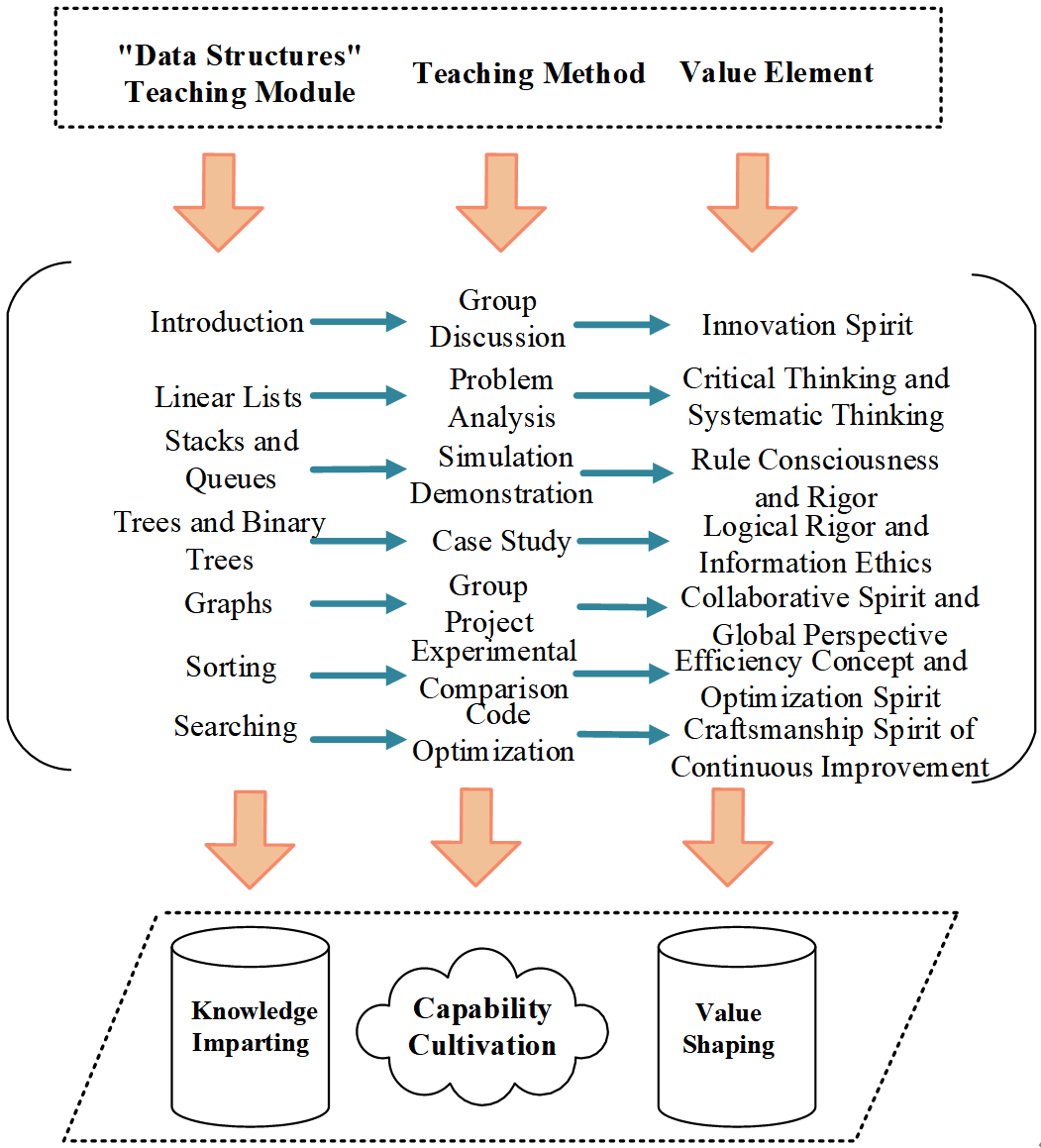
In response to the current imbalance phenomenon of "emphasizing skills while neglecting values" in programming practice teaching oriented toward smart agriculture, this study employs the Data Structures course as a vehicle. It applies Checkland's Soft Systems Methodology (SSM) to construct a three-dimensional integrated teaching objective system of "knowledge transfer–capability cultivation–value shaping." Through systematic reconstruction of seven teaching modules centered on linear lists, trees, graphs, sorting, and searching, the teaching objectives are transformed from mere knowledge acquisition to an organic integration of knowledge, capability, and value objectives. In the value dimension, the teaching scheme emphasizes integrating core value elements oriented toward smart agriculture, including systematic engineering decision-making, data security and privacy protection, resource conservation and efficiency optimization, and rigorous professional ethics and compliance spirit. Statistical analysis of controlled experiments conducted over two rounds with 350 students demonstrates that the experimental group achieved improved average scores (p < 0.05) with more concentrated grade distribution and notably reduced standard deviation. This study provides an operational reform pathway for the deep integration of professional and value education in smart agriculture-related courses.

Graphical Abstract
Reconstruction of Data Structures Course Teaching Model for Smart Agriculture Talent Cultivation: Integrated Practice of Value Shaping and Capability Development

Keywords
smart agriculture
soft systems methodology
three-dimensional teaching objectives
value-integrated teaching

Data Availability Statement
Data will be made available on request.

Funding
This work was supported by the Key Project of Jiangxi Provincial Higher Education Teaching Reform Research under Grant JXJG-23-3-4.

Conflicts of Interest
The authors declare no conflicts of interest.

Ethical Approval and Consent to Participate
Not applicable.

References
  1. Yao, D., & Lin, J. (2025). Cognitive enhancement through competency-based programming education: a 12-year longitudinal study. Education and Information Technologies, 1-37.
    [CrossRef]   [Google Scholar]
  2. Kleine, M. S., Zacharias, K., & Ozkan, D. (2023). Contextualization in engineering education: A scoping literature review. Journal of Engineering Education, 113(4), 894–918.
    [CrossRef]   [Google Scholar]
  3. Li, M., & Liu, X. (2025). Enhancing humanities and social sciences curriculum in engineering institutions by using interdisciplinary approaches. Cogent Education, 12(1), 2433831.
    [CrossRef]   [Google Scholar]
  4. Rose, D. C., & Chilvers, J. (2018). Agriculture 4.0: Broadening responsible innovation in an era of smart farming. Frontiers in Sustainable Food Systems, 2, 387545.
    [CrossRef]   [Google Scholar]
  5. Klerkx, L., Jakku, E., & Labarthe, P. (2019). A review of social science on digital agriculture, smart farming and agriculture 4.0: New contributions and a future research agenda. NJAS-Wageningen journal of life sciences, 90, 100315.
    [CrossRef]   [Google Scholar]
  6. Ul Hassan, M., Murtaza, A., & Rashid, K. (2025). Redefining higher education institutions (HEIs) in the era of globalisation and global crises: A proposal for future sustainability. European Journal of Education, 60(1), e12822.
    [CrossRef]   [Google Scholar]
  7. Kerruish, E. (2023). Critical thinking in higher education: taking Stiegler’s counsel on the digital milieu. Pedagogy, Culture & Society, 33(1), 1–17.
    [CrossRef]   [Google Scholar]
  8. Yi, W., Huang, X., Kuzmin, S., Gerasimov, I., & Luo, Y. (2025). Seekg: Sentiment analysis for E-Learning evaluation incorporating knowledge graphs. Education and Information Technologies, 1-30.
    [CrossRef]   [Google Scholar]
  9. Le, N. D. (2025). ABET-Compliant Training Program Implementation Impact on Improvement of Training Quality. Journal of Technical Education and Training, 17(2), 197-212.
    [Google Scholar]
  10. Martin, D. A., Conlon, E., & Bowe, B. (2021). A multi-level review of engineering ethics education: Towards a socio-technical orientation of engineering education for ethics. Science and Engineering Ethics, 27(5), 60.
    [CrossRef]   [Google Scholar]
  11. Wolfert, S., Ge, L., Verdouw, C., & Bogaardt, M. J. (2017). Big data in smart farming–a review. Agricultural systems, 153, 69-80.
    [CrossRef]   [Google Scholar]
  12. Singun, A. J. (2025). Unveiling the barriers to digital transformation in higher education institutions: a systematic literature review. Discover Education, 4(1), 37.
    [CrossRef]   [Google Scholar]
  13. Gardelle, L. (2025). Sustainability in engineering education in Europe over the last 15 years: visions and tendencies among educators as revealed by a literature review. European Journal of Engineering Education, 1-28.
    [CrossRef]   [Google Scholar]
  14. Checkland, P. B. (1989). Soft systems methodology. Human systems management, 8(4), 273-289.
    [CrossRef]   [Google Scholar]
  15. Firmansyah, J., Ibrahim, I., & Saputra, H. (2024). Analyzing the Perceptions and Expectations of Students Towards Science Using Soft System Methodology. Jurnal Pendidikan Progresif, 14(1), 451–467.
    [CrossRef]   [Google Scholar]
  16. Liu, Y. (2022). Construction of talent training mechanism for innovation and entrepreneurship education in colleges and universities based on data fusion algorithm. Frontiers in Psychology, 13, 968023.
    [CrossRef]   [Google Scholar]
  17. Rivas, S. F., Saiz, C., & Ossa, C. (2022). Metacognitive strategies and development of critical thinking in higher education. Frontiers in psychology, 13, 913219.
    [CrossRef]   [Google Scholar]
  18. Liu, T., Chen, Z., Xu, M., Wang, Q., & Zheng, X. (2025, April). An Artificial Intelligence Approach to Data Manipulation for Agricultural Curriculum Optimization Based on Factors of Industry, Research and Education. In 2025 11th International Symposium on System Security, Safety, and Reliability (ISSSR) (pp. 459-466). IEEE.
    [CrossRef]   [Google Scholar]
  19. Marshall, R., Pardo, A., Smith, D., & Watson, T. (2022). Implementing next generation privacy and ethics research in education technology. British Journal of Educational Technology, 53(4), 737-755.
    [CrossRef]   [Google Scholar]
  20. Paul, P. K., Rajesh, R., & Aithal, P. S. (2024). Agricultural informatics: emphasising potentiality and proposed model on innovative and emerging Doctor of Education in Agricultural Informatics program for smart agricultural systems. International Journal of Enterprise Network Management, 15(4), 417-443.
    [CrossRef]   [Google Scholar]
  21. Tareq, Z. A., & Yusof, R. J. R. (2024). Modeling a problem-solving approach through computational thinking for teaching programming. IEEE Transactions on Education, 67(2), 282-291.
    [CrossRef]   [Google Scholar]
  22. Kamilaris, A., & Prenafeta-Boldú, F. X. (2018). A review of the use of convolutional neural networks in agriculture. The Journal of Agricultural Science, 156(3), 312-322.
    [CrossRef]   [Google Scholar]
  23. Malhotra, R., Massoudi, M., & Jindal, R. (2023). Shifting from traditional engineering education towards competency-based approach: The most recommended approach-review. Education and Information Technologies, 28(7), 9081–9111.
    [CrossRef]   [Google Scholar]
  24. Yao, D., Zhang, X., & Liu, Y. (2022). Teaching reform in C programming course from the perspective of sustainable development: Construction and 9-Year practice of “three Classrooms–four Integrations–five Combinations” teaching Model. Sustainability, 14(22), 15226.
    [CrossRef]   [Google Scholar]
  25. Markus, K. A., & Borsboom, D. (2024). Frontiers of test validity theory: Measurement, causation, and meaning. Routledge.
    [CrossRef]   [Google Scholar]

Cite This Article
APA Style
Yi, W., Chen, J., & Weng, L. (2025). Reconstruction of Data Structures Course Teaching Model for Smart Agriculture Talent Cultivation: Integrated Practice of Value Shaping and Capability Development. Frontiers in Educational Innovation and Research, 1(3), 100–109. https://doi.org/10.62762/FEIR.2025.323427
Export Citation
RIS Format
Compatible with EndNote, Zotero, Mendeley, and other reference managers
RIS format data for reference managers
TY  - JOUR
AU  - Yi, Wenlong
AU  - Chen, Jie
AU  - Weng, Liming
PY  - 2025
DA  - 2025/12/29
TI  - Reconstruction of Data Structures Course Teaching Model for Smart Agriculture Talent Cultivation: Integrated Practice of Value Shaping and Capability Development
JO  - Frontiers in Educational Innovation and Research
T2  - Frontiers in Educational Innovation and Research
JF  - Frontiers in Educational Innovation and Research
VL  - 1
IS  - 3
SP  - 100
EP  - 109
DO  - 10.62762/FEIR.2025.323427
UR  - https://www.icck.org/article/abs/FEIR.2025.323427
KW  - smart agriculture
KW  - soft systems methodology
KW  - three-dimensional teaching objectives
KW  - value-integrated teaching
AB  - In response to the current imbalance phenomenon of "emphasizing skills while neglecting values" in programming practice teaching oriented toward smart agriculture, this study employs the Data Structures course as a vehicle. It applies Checkland's Soft Systems Methodology (SSM) to construct a three-dimensional integrated teaching objective system of "knowledge transfer–capability cultivation–value shaping." Through systematic reconstruction of seven teaching modules centered on linear lists, trees, graphs, sorting, and searching, the teaching objectives are transformed from mere knowledge acquisition to an organic integration of knowledge, capability, and value objectives. In the value dimension, the teaching scheme emphasizes integrating core value elements oriented toward smart agriculture, including systematic engineering decision-making, data security and privacy protection, resource conservation and efficiency optimization, and rigorous professional ethics and compliance spirit. Statistical analysis of controlled experiments conducted over two rounds with 350 students demonstrates that the experimental group achieved improved average scores (p < 0.05) with more concentrated grade distribution and notably reduced standard deviation. This study provides an operational reform pathway for the deep integration of professional and value education in smart agriculture-related courses.
SN  - 3068-5664
PB  - Institute of Central Computation and Knowledge
LA  - English
ER  - 
BibTeX Format
Compatible with LaTeX, BibTeX, and other reference managers
BibTeX format data for LaTeX and reference managers
@article{Yi2025Reconstruc,
  author = {Wenlong Yi and Jie Chen and Liming Weng},
  title = {Reconstruction of Data Structures Course Teaching Model for Smart Agriculture Talent Cultivation: Integrated Practice of Value Shaping and Capability Development},
  journal = {Frontiers in Educational Innovation and Research},
  year = {2025},
  volume = {1},
  number = {3},
  pages = {100-109},
  doi = {10.62762/FEIR.2025.323427},
  url = {https://www.icck.org/article/abs/FEIR.2025.323427},
  abstract = {In response to the current imbalance phenomenon of "emphasizing skills while neglecting values" in programming practice teaching oriented toward smart agriculture, this study employs the Data Structures course as a vehicle. It applies Checkland's Soft Systems Methodology (SSM) to construct a three-dimensional integrated teaching objective system of "knowledge transfer–capability cultivation–value shaping." Through systematic reconstruction of seven teaching modules centered on linear lists, trees, graphs, sorting, and searching, the teaching objectives are transformed from mere knowledge acquisition to an organic integration of knowledge, capability, and value objectives. In the value dimension, the teaching scheme emphasizes integrating core value elements oriented toward smart agriculture, including systematic engineering decision-making, data security and privacy protection, resource conservation and efficiency optimization, and rigorous professional ethics and compliance spirit. Statistical analysis of controlled experiments conducted over two rounds with 350 students demonstrates that the experimental group achieved improved average scores (p < 0.05) with more concentrated grade distribution and notably reduced standard deviation. This study provides an operational reform pathway for the deep integration of professional and value education in smart agriculture-related courses.},
  keywords = {smart agriculture, soft systems methodology, three-dimensional teaching objectives, value-integrated teaching},
  issn = {3068-5664},
  publisher = {Institute of Central Computation and Knowledge}
}

Article Metrics
Citations:

Crossref

0

Scopus

0

Web of Science

0
Article Access Statistics:
Views: 13
PDF Downloads: 3

Publisher's Note
ICCK stays neutral with regard to jurisdictional claims in published maps and institutional affiliations.

Rights and Permissions
CC BY Copyright © 2025 by the Author(s). Published by Institute of Central Computation and Knowledge. This article is an open access article distributed under the terms and conditions of the Creative Commons Attribution (CC BY) license (https://creativecommons.org/licenses/by/4.0/), which permits use, sharing, adaptation, distribution and reproduction in any medium or format, as long as you give appropriate credit to the original author(s) and the source, provide a link to the Creative Commons licence, and indicate if changes were made.
Frontiers in Educational Innovation and Research

Frontiers in Educational Innovation and Research

ISSN: 3068-5664 (Online)

Email: [email protected]

Portico

Portico

All published articles are preserved here permanently:
https://www.portico.org/publishers/icck/