

MHD Hybrid Nanofluid Flow with Heat Radiation over a Stretching Surface: Numerical Approach



Article Information
Abstract
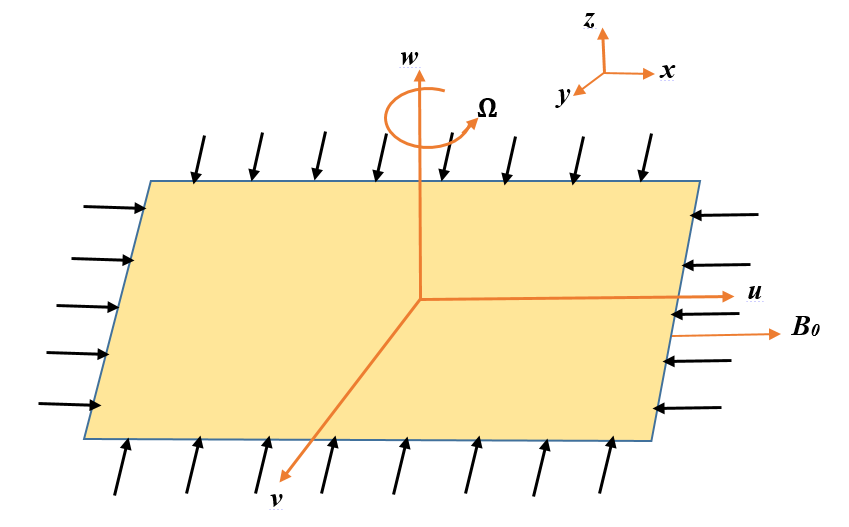
This study investigates the three-dimensional magnetohydrodynamic (MHD) radiative flow and heat transfer of a kerosene-based hybrid nanofluid containing Al$_2$O$_3$ and Cu nanoparticles over a stretching sheet. The governing partial differential equations (PDEs) are formulated and transformed into a coupled system of ordinary differential equations (ODEs) via suitable similarity transformations. The resulting nonlinear ODEs are solved using the Homotopy Analysis Method (HAM), with the effects of various physical parameters on velocity and temperature profiles illustrated through graphical and numerical results. Furthermore, the influences of key parameters—including skin friction coefficients, heat transfer characteristics, rotation parameter, Biot number, and magnetic field strength—on the flow and thermal behaviors are analyzed. The findings reveal that the rotation parameter, Biot number, and magnetic field strength significantly affect the velocity profiles and heat transfer performance of the hybrid nanofluid system.
Graphical Abstract
Keywords
Data Availability Statement
Funding
Conflicts of Interest
AI Use Statement
Ethical Approval and Consent to Participate
References
- Taylor, R., Coulombe, S., Otanicar, T., Phelan, P., Gunawan, A., Lv, W., ... & Tyagi, H. (2013). Small particles, big impacts: A review of the diverse applications of nanofluids. Journal of applied physics, 113(1), 011301.
[CrossRef] [Google Scholar] - Buongiorno, J. (2006). Convective Transport in Nanofluids. Journal of Heat Transfer, 128(3), 240-250.
[CrossRef] [Google Scholar] - Banisharif, A., Estellé, P., Rashidi, A., Van Vaerenbergh, S., & Aghajani, M. (2021). Heat transfer properties of metal, metal oxides, and carbon water-based nanofluids in the ethanol condensation process. Colloids and Surfaces A: Physicochemical and Engineering Aspects, 622, 126720.
[CrossRef] [Google Scholar] - Minkowycz, W. J., Sparrow, E., & Abraham, J. P. (Eds.). (2016). Nanoparticle heat transfer and fluid flow. CRC press.
[Google Scholar] - Das, S. K., Choi, S. U. S., Yu, W., & Pradeep, T. (2007). Nanofluids: Science and Technology. Wiley-Interscience.
[Google Scholar] - Kakaç, S., & Pramuanjaroenkij, A. (2009). Review of convective heat transfer enhancement with nanofluids. International journal of heat and mass transfer, 52(13-14), 3187-3196.
[CrossRef] [Google Scholar] - Witharana, S., Chen, H., & Ding, Y. (2011). Stability of nanofluids in quiescent and shear flow fields. Nanoscale Research Letters, 6(1), 231.
[CrossRef] [Google Scholar] - Chen, H., Witharana, S., Jin, Y., Kim, C., & Ding, Y. (2009). Predicting thermal conductivity of liquid suspensions of nanoparticles (nanofluids) based on rheology. Particuology, 7(2), 151-157.
[CrossRef] [Google Scholar] - Mahian, O., Kolsi, L., Amani, M., Estellé, P., Ahmadi, G., Kleinstreuer, C., ... & Pop, I. (2019). Recent advances in modeling and simulation of nanofluid flows-Part I: Fundamentals and theory. Physics reports, 790, 1-48.
[CrossRef] [Google Scholar] - Sreekumar, S., Shah, N., Mondol, J. D., Hewitt, N., & Chakrabarti, S. (2022). Numerical investigation and feasibility study on MXene/water nanofluid based photovoltaic/thermal system. Cleaner Energy Systems, 2, 100010.
[CrossRef] [Google Scholar] - Alizadeh, M. R., & Dehghan, A. A. (2014). Conjugate natural convection of nanofluids in an enclosure with a volumetric heat source. Arabian Journal for Science and Engineering, 39(2), 1195-1207.
[CrossRef] [Google Scholar] - Maiga, S. E. B., Palm, S. J., Nguyen, C. T., Roy, G., & Galanis, N. (2005). Heat transfer enhancement by using nanofluids in forced convection flows. International journal of heat and fluid flow, 26(4), 530-546.
[CrossRef] [Google Scholar] - Kuznetsov, A. V., & Nield, D. A. (2010). Natural convective boundary-layer flow of a nanofluid past a vertical plate. International Journal of Thermal Sciences, 49(2), 243-247.
[CrossRef] [Google Scholar] - Wasan, D. T., & Nikolov, A. D. (2003). Spreading of nanofluids on solids. Nature, 423(6936), 156-159.
[CrossRef] [Google Scholar] - Kuntoglu, M. (2022). State of the Art on Hybrid Nanofluids and Their Usage in Machining Processes. Nanomaterials in Manufacturing Processes, 1-30.
[Google Scholar] - Abbasi, S., Zebarjad, S. M., Baghban, S. H. N., Youssefi, A., & Ekrami-Kakhki, M. S. (2016). Experimental investigation of the rheological behavior and viscosity of decorated multi-walled carbon nanotubes with TiO2 nanoparticles/water nanofluids. Journal of Thermal Analysis and Calorimetry, 123(1), 81-89.
[CrossRef] [Google Scholar] - Barbés, B., Páramo, R., Blanco, E., & Casanova, C. (2014). Thermal conductivity and specific heat capacity measurements of CuO nanofluids. Journal of Thermal Analysis and Calorimetry, 115(2), 1883-1891.
[CrossRef] [Google Scholar] - Shamshirband, S., Malvandi, A., Karimipour, A., Goodarzi, M., Afrand, M., Petković, D., ... & Mahmoodian, N. (2015). Performance investigation of micro-and nano-sized particle erosion in a 90 elbow using an ANFIS model. Powder Technology, 284, 336-343.
[CrossRef] [Google Scholar] - Hemmat Esfe, M., Saedodin, S., Yan, W. M., Afrand, M., & Sina, N. (2016). Study on thermal conductivity of water-based nanofluids with hybrid suspensions of CNTs/Al2O3 nanoparticles. Journal of Thermal Analysis and Calorimetry, 124(1), 455-460.
[CrossRef] [Google Scholar] - Choi, S. U. (1995, November). Enhancing thermal conductivity of fluids with nanoparticles. In ASME international mechanical engineering congress and exposition (Vol. 17421, pp. 99-105). American Society of Mechanical Engineers.
[CrossRef] [Google Scholar] - Kang, H. U., Kim, S. H., & Oh, J. M. (2006). Estimation of thermal conductivity of nanofluid using experimental effective particle volume. Experimental Heat Transfer, 19(3), 181-191.
[CrossRef] [Google Scholar] - Lee, S., Eastman, J. A., Li, S. A., & Choi, S. S. (1999). Measuring thermal conductivity of fluids containing oxide nanoparticles. Journal of Heat Transfer, 121(2), 280-289.
[CrossRef] [Google Scholar] - Eastman, J. A., Choi, S. U. S., Li, S., Yu, W., & Thompson, L. J. (2001). Abnormally elevated effective heat conductivities of copper nanoparticle-containing ethylene glycol-based nanofluids. Applied Physics Letters, 78, 718-720.
[CrossRef] [Google Scholar] - Aybar, H. Ş., Sharifpur, M., Azizian, M. R., Mehrabi, M., & Meyer, J. P. (2015). A review of thermal conductivity models for nanofluids. Heat Transfer Engineering, 36(13), 1085-1110.
[CrossRef] [Google Scholar] - Ahmed, N., Khan, U., & Mohyud-Din, S. T. (2017). The impact of an effective Prandtl number model on the squeezed flow of $\gamma$Al2O3-H2O and $\gamma$Al2O3-C2H6O2 nanofluids was examined. Journal of Molecular Liquids, 238, 447-454.
[CrossRef] [Google Scholar] - Sun, B., Yang, D., Li, H., & Guo, Y. (2020). The impact of a continuous magnetic field on Fe3O4/water magnetic convective heat transfer nanofluid in circular, horizontal tubes. Applied Thermal Engineering, 171, 114920.
[CrossRef] [Google Scholar] - Kumar, P. M., & Kumar, C. A. (2020). Al2O3/water nanofluids are used in a numerical analysis of the heat transfer performance of an electronic chip's six circular channel heat sink. Materials Today: Proceedings, 21, 194-201.
[CrossRef] [Google Scholar] - Lahmar, S., Kezzar, M., Eid, M. R., & Sari, M. R. (2020). Heat transfer of squeezing unsteady nanofluid flow under the effects of an inclined magnetic field and variable thermal conductivity. Physica A: Statistical Mechanics and Its Applications, 540, 123138.
[CrossRef] [Google Scholar] - Sheikholeslami, M., & Rokni, H. B. (2018). Numerical simulation for impact of Coulomb force on nanofluid heat transfer in a porous enclosure in presence of thermal radiation. International Journal of Heat and Mass Transfer, 118, 823-831.
[CrossRef] [Google Scholar] - Gbadeyan, J. A., Titiloye, E. O., & Adeosun, A. T. (2020). Effect of changing thermal conductivity and viscosity on Casson nanofluid flow with convective heating and velocity slip. Heliyon, 6, e03076.
[CrossRef] [Google Scholar] - Fedele, L., Colla, L., & Bobbo, S. (2012). Viscosity and thermal conductivity measurements of water-based nanofluids containing titanium oxide nanoparticles. International journal of refrigeration, 35(5), 1359-1366.
[CrossRef] [Google Scholar] - Gulzar, O., Qayoum, A., & Gupta, R. (2019). Experimental study on stability and rheological behaviour of hybrid Al2O3-TiO2 Therminol-55 nanofluids for concentrating solar collectors. Powder Technology, 352, 436-444.
[CrossRef] [Google Scholar] - Sarkar, J., Ghosh, P., & Adil, A. (2015). A review on hybrid nanofluids: recent research, development and applications. Renewable and Sustainable Energy Reviews, 43, 164-177.
[CrossRef] [Google Scholar] - Yang, L., Ji, W., Mao, M., & Huang, J. N. (2020). Dynamic stability, sedimentation, and time-dependent heat transfer characteristics of TiO2 and CNT nanofluids. Journal of Thermal Analysis and Calorimetry, 141(3), 1183-1195.
[CrossRef] [Google Scholar] - Khashi'ie, N. S., Arifin, N. M., Nazar, R., Hafidzuddin, E. H., Wahi, N., & Pop, I. (2020). Magnetohydrodynamics (MHD) axisymmetric flow and heat transfer of a hybrid nanofluid past a radially permeable stretching/shrinking sheet with Joule heating. Chinese Journal of Physics, 64, 251-263.
[CrossRef] [Google Scholar] - Wole-Osho, I., Okonkwo, E. C., Kavaz, D., & Abbasoglu, S. (2020). An experimental investigation into the effect of particle mixture ratio on specific heat capacity and dynamic viscosity of Al2O3-ZnO hybrid nanofluids. Powder Technology, 363, 699-716.
[CrossRef] [Google Scholar] - Aly, E. H., & Pop, I. (2020). MHD flow and heat transfer near stagnation point over a stretching/shrinking surface with partial slip and viscous dissipation: hybrid nanofluid versus nanofluid. Powder Technology, 367, 192-205.
[CrossRef] [Google Scholar] - Aghahadi, M. H., Niknejadi, M., & Toghraie, D. (2019). An experimental study on the rheological behavior of hybrid Tungsten oxide (WO3)-MWCNTs/engine oil Newtonian nanofluids. Journal of Molecular Structure, 1197, 497-507.
[CrossRef] [Google Scholar] - Hayat, T., Aziz, A., Muhammad, T., & Alsaedi, A. (2018). Darcy-Forchheimer flow of nanofluid in a rotating frame. International Journal of Numerical Methods for Heat & Fluid Flow, 28(12), 2895-2915.
[CrossRef] [Google Scholar] - Huminic, G., & Huminic, A. (2020). Entropy formation of nanofluid and hybrid nanofluid flow in thermal systems: a review. Journal of Molecular Liquids, 302, 112533.
[CrossRef] [Google Scholar] - Huminic, G., & Huminic, A. (2018). Heat transfer capability of the hybrid nanofluids for heat transfer applications. Journal of Molecular Liquids, 272, 857-870.
[CrossRef] [Google Scholar] - Saba, F., Ahmed, N., Khan, U., & Mohyud-Din, S. T. (2019). A novel coupling of (CNT-Fe3O4/H2O) hybrid nanofluid for improvements in heat transfer for flow in an asymmetric channel with dilating/squeezing walls. International Journal of Heat and Mass Transfer, 136, 186-195.
[CrossRef] [Google Scholar] - de Oliveira, L. R., Ribeiro, S. R. F. L., Reis, M. H. M., Cardoso, V. L., & Bandarra Filho, E. P. (2019). Experimental study on the thermal conductivity and viscosity of ethylene glycol-based nanofluid containing diamond‑silver hybrid material. Diamond and Related Materials, 96, 216-230.
[CrossRef] [Google Scholar] - Iqbal, Z., Akbar, N. S., Azhar, E., & Maraj, E. N. (2018). Performance of hybrid nanofluid (Cu-CuO/water) on MHD rotating transport in oscillating vertical channel inspired by Hall current and thermal radiation. Alexandria engineering journal, 57(3), 1943-1954.
[CrossRef] [Google Scholar] - Rahimi-Gorji, M., Pourmehran, O., Hatami, M., & Ganji, D. D. (2015). Statistical optimization of microchannel heat sink (MCHS) geometry cooled by different nanofluids using RSM analysis. The European Physical Journal Plus, 130(2), 22.
[CrossRef] [Google Scholar] - Pourmehran, O., Rahimi-Gorji, M., Hatami, M., Sahebi, S. A. R., & Domairry, G. (2015). Numerical optimization of microchannel heat sink (MCHS) performance cooled by KKL based nanofluids in saturated porous medium. Journal of the Taiwan Institute of Chemical Engineers, 55, 49-68.
[CrossRef] [Google Scholar] - Gupta, M., Arora, N., Kumar, R., Kumar, S., & Dilbaghi, N. (2014). A comprehensive review of experimental investigations of forced convective heat transfer characteristics for various nanofluids. International journal of mechanical and materials engineering, 9(1), 11.
[CrossRef] [Google Scholar] - Safaei, M. R., Safdari Shadloo, M., Goodarzi, M. S., Hadjadj, A., Goshayeshi, H. R., Afrand, M., & Kazi, S. N. (2016). A survey on experimental and numerical studies of convection heat transfer of nanofluids inside closed conduits. Advances in Mechanical Engineering, 8(10), 1687814016673569.
[CrossRef] [Google Scholar] - Wu, J. M., & Zhao, J. (2013). A review of nanofluid heat transfer and critical heat flux enhancement—research gap to engineering application. Progress in Nuclear Energy, 66, 13-24.
[CrossRef] [Google Scholar] - Wong, K. V., & Castillo, M. J. (2010). Heat transfer mechanisms and clustering in nanofluids. Advances in Mechanical Engineering, 2, 795478.
[CrossRef] [Google Scholar] - Rudyak, V. Y., Minakov, A. V., & Krasnolutskii, S. L. (2016). Physics and mechanics of heat exchange processes in nanofluid flows. Physical mesomechanics, 19(3), 298-306.
[CrossRef] [Google Scholar] - Mohammed, H. A., Bhaskaran, G., Shuaib, N. H., & Saidur, R. (2011). Heat transfer and fluid flow characteristics in microchannels heat exchanger using nanofluids: a review. Renewable and Sustainable Energy Reviews, 15(3), 1502-1512.
[CrossRef] [Google Scholar] - Tabasum, R., Mehmood, R., & Pourmehran, O. (2018). Velocity slip in mixed convective oblique transport of titanium oxide/water (nano-polymer) with temperature-dependent viscosity. The European Physical Journal Plus, 133(9), 361.
[CrossRef] [Google Scholar] - Alfvén, H. (1942). Existence of Electromagnetic-Hydrodynamic Waves. Nature, 150(3805), 405-406.
[CrossRef] [Google Scholar] - Alfvén, H. (1943). On the Existence of Electromagnetic-Hydrodynamic Waves. Arkiv för matematik, astronomi och fysik, 29B(2), 1-7.
[Google Scholar] - Roberts, P. H., & King, E. M. (2013). On the genesis of the Earth's magnetism. Reports on Progress in Physics, 76(9), 096801.
[CrossRef] [Google Scholar] - Christensen, U. R. (2010). Dynamo scaling laws and applications to the planets. Space science reviews, 152(1), 565-590.
[CrossRef] [Google Scholar] - Glatzmaiers, G. A., & Roberts, P. H. (1995). A three-dimensional self-consistent computer simulation of a geomagnetic field reversal. Nature, 377(6546), 203-209.
[CrossRef] [Google Scholar] - Jones, C. A. (2011). Planetary magnetic fields and fluid dynamos. Annual Review of Fluid Mechanics, 43(1), 583-614.
[CrossRef] [Google Scholar] - Sheikholeslami, M., Ganji, D. D., Gorji-Bandpy, M., & Soleimani, S. (2014). Magnetic field effect on nanofluid flow and heat transfer using KKL model. Journal of the Taiwan Institute of Chemical Engineers, 45(3), 795-807.
[CrossRef] [Google Scholar] - Naramgari, S., & Sulochana, C. (2016). MHD flow over a permeable stretching/shrinking sheet of a nanofluid with suction/injection. Alexandria Engineering Journal, 55(2), 819-827.
[CrossRef] [Google Scholar] - Howell, J. R., Mengüç, M. P., Daun, K., & Siegel, R. (2020). Thermal radiation heat transfer. CRC press.
[Google Scholar] - Meseguer, J., Pérez-Grande, I., & Sanz-Andrés, A. (2012). Spacecraft thermal control. Elsevier.
[Google Scholar] - Planck, M. (1914). The Theory of Heat Radiation. P Blakiston's Son & Co.
[Google Scholar] - Huang, K. (2008). Statistical mechanics. John Wiley & Sons.
[Google Scholar] - Liao, S. J. (1992). The proposed homotopy analysis technique for the solution of nonlinear problems (Doctoral dissertation, Ph. D. Thesis, Shanghai Jiao Tong University).
[Google Scholar] - Liao, S. J. (1999). An explicit, totally analytic approximation of Blasius' viscous flow problems. International Journal of Non-Linear Mechanics, 34(4), 759-778.
[CrossRef] [Google Scholar] - Liao, S. (2003). Beyond perturbation: introduction to the homotopy analysis method. Chapman and Hall/CRC.
[Google Scholar]
Cite This Article
TY  - JOUR
AU  - Taj, Ahmad
AU  - Ibrahim, Tanzila
AU  - Murad, Aqsa
AU  - Ali, Ayesha
AU  - Islam, Saeed
PY  - 2026
DA  - 2026/03/19
TI  - MHD Hybrid Nanofluid Flow with Heat Radiation over a Stretching Surface: Numerical Approach
JO  - International Journal of Thermo-Fluid Systems and Sustainable Energy
T2  - International Journal of Thermo-Fluid Systems and Sustainable Energy
JF  - International Journal of Thermo-Fluid Systems and Sustainable Energy
VL  - 2
IS  - 1
SP  - 4
EP  - 17
DO  - 10.62762/IJTSSE.2025.263639
UR  - https://www.icck.org/article/abs/IJTSSE.2025.263639
KW  - hybrid nanofluid
KW  - magnetohydrodynamics (MHD)
KW  - heat radiation
KW  - stretching sheet
KW  - homotopy analysis method (HAM)
AB  - This study investigates the three-dimensional magnetohydrodynamic (MHD) radiative flow and heat transfer of a kerosene-based hybrid nanofluid containing Al$_2$O$_3$ and Cu nanoparticles over a stretching sheet. The governing partial differential equations (PDEs) are formulated and transformed into a coupled system of ordinary differential equations (ODEs) via suitable similarity transformations. The resulting nonlinear ODEs are solved using the Homotopy Analysis Method (HAM), with the effects of various physical parameters on velocity and temperature profiles illustrated through graphical and numerical results. Furthermore, the influences of key parameters—including skin friction coefficients, heat transfer characteristics, rotation parameter, Biot number, and magnetic field strength—on the flow and thermal behaviors are analyzed. The findings reveal that the rotation parameter, Biot number, and magnetic field strength significantly affect the velocity profiles and heat transfer performance of the hybrid nanofluid system.
SN  - 3069-1877
PB  - Institute of Central Computation and Knowledge
LA  - English
ER  -
@article{Taj2026MHD,
  author = {Ahmad Taj and Tanzila Ibrahim and Aqsa Murad and Ayesha Ali and Saeed Islam},
  title = {MHD Hybrid Nanofluid Flow with Heat Radiation over a Stretching Surface: Numerical Approach},
  journal = {International Journal of Thermo-Fluid Systems and Sustainable Energy},
  year = {2026},
  volume = {2},
  number = {1},
  pages = {4-17},
  doi = {10.62762/IJTSSE.2025.263639},
  url = {https://www.icck.org/article/abs/IJTSSE.2025.263639},
  abstract = {This study investigates the three-dimensional magnetohydrodynamic (MHD) radiative flow and heat transfer of a kerosene-based hybrid nanofluid containing Al\$\_2\$O\$\_3\$ and Cu nanoparticles over a stretching sheet. The governing partial differential equations (PDEs) are formulated and transformed into a coupled system of ordinary differential equations (ODEs) via suitable similarity transformations. The resulting nonlinear ODEs are solved using the Homotopy Analysis Method (HAM), with the effects of various physical parameters on velocity and temperature profiles illustrated through graphical and numerical results. Furthermore, the influences of key parameters—including skin friction coefficients, heat transfer characteristics, rotation parameter, Biot number, and magnetic field strength—on the flow and thermal behaviors are analyzed. The findings reveal that the rotation parameter, Biot number, and magnetic field strength significantly affect the velocity profiles and heat transfer performance of the hybrid nanofluid system.},
  keywords = {hybrid nanofluid, magnetohydrodynamics (MHD), heat radiation, stretching sheet, homotopy analysis method (HAM)},
  issn = {3069-1877},
  publisher = {Institute of Central Computation and Knowledge}
}
Article Metrics
Publisher's Note
ICCK stays neutral with regard to jurisdictional claims in published maps and institutional affiliations.
Rights and Permissions
 Copyright © 2026 by the Author(s). Published by Institute of Central Computation and Knowledge. This article is an open access article distributed under the terms and conditions of the Creative Commons Attribution (CC BY) license (https://creativecommons.org/licenses/by/4.0/), which permits use, sharing, adaptation, distribution and reproduction in any medium or format, as long as you give appropriate credit to the original author(s) and the source, provide a link to the Creative Commons licence, and indicate if changes were made.


Portico
