
Heat-Transfer Gain Versus Irreversibility Cost in a Radiative MHD Tri-Hybrid Nanofluid Thin Film: An Equal-Loading Second-Law Assessment



Article Information
Abstract
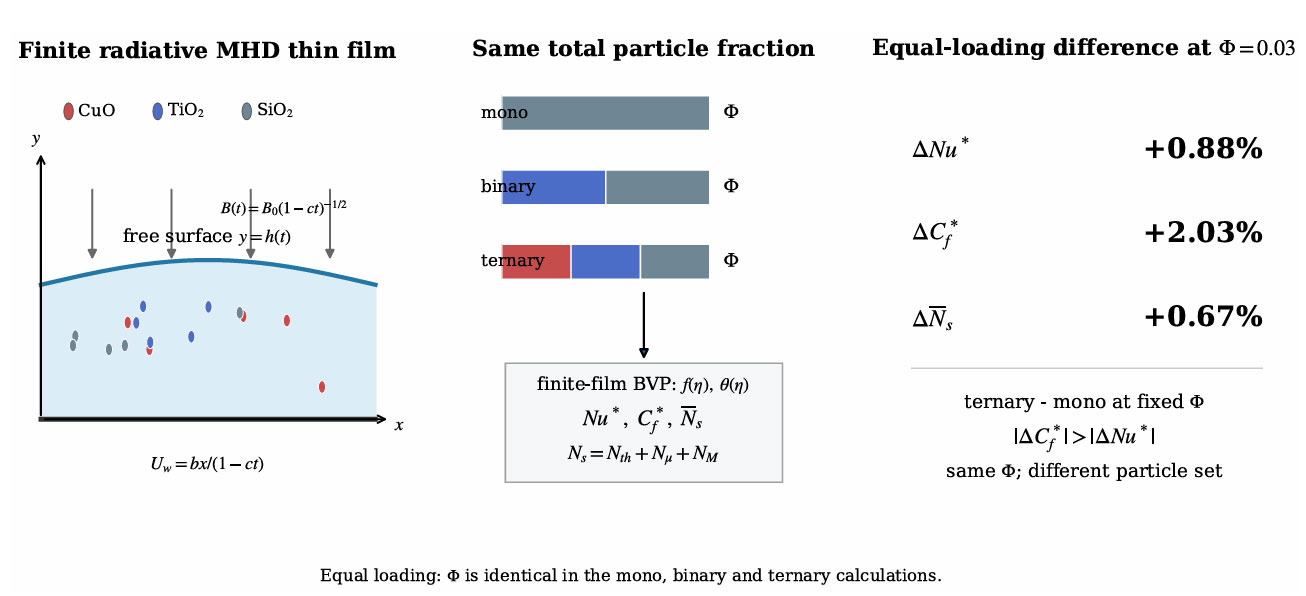
Comparisons among mono-, binary- and ternary nanofluids often change the particle set and the total solid loading at the same time, so the effect of composition cannot be told apart from that of concentration. We recalculate an unsteady radiative magnetohydrodynamic (MHD) CuO-TiO$_2$-SiO$_2$/blood thin film with the same total particle volume fraction in every suspension. The finite free surface is found by shooting with fourth-order Runge-Kutta integration and checked with an independent collocation code. At a total particle fraction of 3%, replacing SiO$_2$/blood by the ternary suspension raises the reduced wall heat-transfer rate by 0.881%, the wall-drag measure by 2.029% and the integrated entropy measure by 0.668%. The shooting benchmark agrees with the classical finite-film solution to within $9.55\times10^{-4}$%, and on the production grid ($N_c=48$) shooting and collocation differ by at most 0.0432% in the reported wall quantities at the reference state. The spread produced by alternative conductivity constructions is smaller than the heat-transfer increment. Magnetic forcing, film unsteadiness and radiation change the response far more than particle substitution does. Under equal loading, the ternary mixture therefore gives a small thermal gain at the price of a larger relative drag penalty.
Graphical Abstract
Keywords
Data Availability Statement
Funding
Conflicts of Interest
AI Use Statement
Ethical Approval and Consent to Participate
References
- Andersson, H. I., Aarseth, J. B., & Dandapat, B. S. (2000). Heat transfer in a liquid film on an unsteady stretching surface. International Journal of Heat and Mass Transfer, 43(1), 69-74.
[CrossRef] [Google Scholar] - Wang, C. (2006). Analytic solutions for a liquid film on an unsteady stretching surface. Heat and Mass Transfer, 42(8), 759-766.
[CrossRef] [Google Scholar] - Liu, I.-C., & Andersson, H. I. (2008). Heat transfer in a liquid film on an unsteady stretching sheet. International Journal of Thermal Sciences, 47(6), 766-772.
[CrossRef] [Google Scholar] - Abel, M. S., Mahesha, N., & Tawade, J. (2009). Heat transfer in a liquid film over an unsteady stretching surface with viscous dissipation in presence of external magnetic field. Applied Mathematical Modelling, 33(8), 3430-3441.
[CrossRef] [Google Scholar] - Noor, N. F. M., & Hashim, I. (2010). Thermocapillarity and magnetic field effects in a thin liquid film on an unsteady stretching surface. International Journal of Heat and Mass Transfer, 53(9-10), 2044-2051.
[CrossRef] [Google Scholar] - Liu, I. C., Wang, H. H., & Umavathi, J. C. (2013). Effect of viscous dissipation, internal heat source/sink, and thermal radiation on a hydromagnetic liquid film over an unsteady stretching sheet. Journal of Heat Transfer, 135(3), 031701.
[CrossRef] [Google Scholar] - Rabby, M. I. I., Uddin, M. W., Hassan, N. M. S., Al Nur, M., Uddin, R., Istiaque, S., & Abir, M. M. M. (2024). Recent progresses in tri-hybrid nanofluids: A comprehensive review on preparation, stability, thermo-hydraulic properties, and applications. Journal of Molecular Liquids, 408, 125257.
[CrossRef] [Google Scholar] - Mousavi, M., Pouranfard, A., & Darvishi, P. (2024). Experimental study and modeling of thermal and rheological characteristics of water-based CuO/CaCO3/SiO2 ternary hybrid nanofluid. Colloids and Surfaces A: Physicochemical and Engineering Aspects, 686, 133367.
[CrossRef] [Google Scholar] - Jan, A., Mushtaq, M., & Hussain, M. (2024). Heat transfer enhancement of forced convection magnetized cross model ternary hybrid nanofluid flow over a stretching cylinder: non-similar analysis. International Journal of Heat and Fluid Flow, 106, 109302.
[CrossRef] [Google Scholar] - Chandel, S., & Sharma, D. (2024). Ternary nanofluid dynamics in stagnated flow with exponential heat and inclined magnetic field: Applications in advanced cooling and aerospace system. International Journal of Heat and Fluid Flow, 109, 109508.
[CrossRef] [Google Scholar] - Rafique, K., Mahmood, Z., Khan, U., Muhammad, T., Mir, A., Aich, W., & Kolsi, L. (2024). Unsteady MHD flow analysis of hybrid nanofluid over a shrinking surface with porous media and heat generation: computational study on entropy generation and Bejan number. International Journal of Heat and Fluid Flow, 107, 109419.
[CrossRef] [Google Scholar] - Akbar, Y., Li, K., Iqbal, J., Yang, X., & Mao, X. (2026). Thermodynamic analysis of nanofluid with aggregated and non-aggregated nanoparticles. International Journal of Heat and Fluid Flow, 118, 110205.
[CrossRef] [Google Scholar] - Khanafer, K., & Vafai, K. (2011). A critical synthesis of thermophysical characteristics of nanofluids. International Journal of Heat and Mass Transfer, 54(19-20), 4410-4428.
[CrossRef] [Google Scholar] - Sahoo, R. R., & Kumar, V. (2020). Development of a new correlation to determine the viscosity of ternary hybrid nanofluid. International Communications in Heat and Mass Transfer, 111, 104451.
[CrossRef] [Google Scholar] - Ullah, A. Z., Guo, X., Gul, T., Ali, I., Saeed, A., & Galal, A. M. (2023). Thin film flow of the ternary hybrid nanofluid over a rotating disk under the influence of magnetic field due to nonlinear convection. Journal of Magnetism and Magnetic Materials, 573, 170673.
[CrossRef] [Google Scholar] - Sreelakshmi, K., Mary, G. L. R., Alqsair, U. F., Elsemary, I. M., Alsayegh, R., Khan, S. U., & Kolsi, L. (2024). Evaluation of heat transfer for unsteady thin film flow of mono and hybrid nanomaterials with five different shape features. Case Studies in Thermal Engineering, 62, 105168.
[CrossRef] [Google Scholar] - Kavitha, L., Rehman, K. U., Varma, S. V. K., Shatanawi, W., Kumar, G. V., & Asghar, Z. (2025). Parametric analysis for thermally magnetized hybrid ternary (TMHT) nanofluid flow on thin film with temperature stratification. International Journal of Thermofluids, 26, 101089.
[CrossRef] [Google Scholar] - Wang, J., Kumar, M. D., Mamatha, S. U., Jithendra, T., Kouki, M., & Shah, N. A. (2025). Deep learning-based Adam optimization for magnetohydrodynamics radiative thin film flow of ternary hybrid nanofluid with oscillatory boundary conditions. Chaos, Solitons & Fractals, 196, 116448.
[CrossRef] [Google Scholar] - Waheed, S. E. (2016). Flow and heat transfer in a Maxwell liquid film over an unsteady stretching sheet in a porous medium with radiation. SpringerPlus, 5(1), 1061.
[CrossRef] [Google Scholar] - Sohail, M., Waseem, F., Abodayeh, K., & Rafique, E. (2026). Analysis of entropy generation on Darcy-Forchheimer squeezed hybrid nanofluid flow between two parallel rotating disks by considering thermal radiation and viscous dissipation. Numerical Heat Transfer, Part B: Fundamentals, 87(1), 2391501.
[CrossRef] [Google Scholar] - Waseem, F., Sohail, M., Sarhan, N., Awwad, E. M., & Khan, M. J. (2024). Utilization of OHAM to investigate entropy generation with a temperature-dependent thermal conductivity model in hybrid nanofluid using the radiation phenomenon. Open Physics, 22(1), 20240059.
[CrossRef] [Google Scholar] - Waseem, F., Sohail, M., & Singh, A. (2024). Entropy analysis of three-dimensional stretched magnetized hybrid nanofluid with thermal radiation and heat generation. BioNanoScience, 14(2), 547-565.
[CrossRef] [Google Scholar] - Jazaa, Y., Rehman, S., & Albouchi, F. (2024). On the enhancement of heat transport and entropy generation of the thin film flow of partially ionized non-Newtonian hybrid nanofluid. Journal of the Taiwan Institute of Chemical Engineers, 157, 105412.
[CrossRef] [Google Scholar] - Sindhu, T., & Jagadeeshkumar, K. (2025). Entropy generation and regression analysis of unsteady Carreau ternary hybrid nanofluid flow with electromagnetic and thermal influences. Discover Nano, 20(1), 231.
[CrossRef] [Google Scholar] - Pavuldass, P., & Reddy, P. B. A. (2026). Entropy generation and response surface analysis of tri-hybrid casson nanofluid with nonlinear radiation over a rotating disk. Discover Nano, 21(1), 357.
[CrossRef] [Google Scholar] - Abdul Hakeem, A. K., Shafiq, A., Parimala, P. M., Ragupathi, P., Ganga, B., Sindhu, T. N., Iqbal, M. A., & Ali, S. (2026). Thermodynamic irreversibility in ternary hybrid nanofluid flow over a curved stretching sheet with thermal dissipation effects. Results in Engineering, 30, 110191.
[CrossRef] [Google Scholar] - Turkyilmazoglu, M. (2024). Two models on the unsteady heat and fluid flow induced by stretching or shrinking sheets and novel time-dependent solutions. ASME Journal of Heat and Mass Transfer, 146(10), 101802.
[CrossRef] [Google Scholar] - Naganthran, K., Hashim, I., Nazar, R., Jalaluddin, D. A., & Aruchunan, E. (2023). Thermocapillarity in Cross hybrid nanofilm flow past an unsteady stretching sheet. Coatings, 13(4), 702.
[CrossRef] [Google Scholar] - Wang, C. Y. (1990). Liquid film on an unsteady stretching surface. Quarterly of applied Mathematics, 48(4), 601-610.
[CrossRef] [Google Scholar] - Maatki, C., Khan, S. U., Selimefendigil, F., & Kolsi, L. (2025). Artificial neural network-guided heat transfer analysis for thin film flow of tri-hybrid nanofluid under realistic thermal constraints: Advanced energy applications. Case Studies in Thermal Engineering, 74, 106975.
[CrossRef] [Google Scholar] - Brinkman, H. C. (1952). The viscosity of concentrated suspensions and solutions. Journal of chemical physics, 20(4), 571-571.
[CrossRef] [Google Scholar] - Bruggeman, D. A. G. (1935). Berechnung verschiedener physikalischer Konstanten von heterogenen Substanzen. I. Dielektrizitätskonstanten und Leitfähigkeiten der Mischkörper aus isotropen Substanzen. Annalen der Physik, 416(7), 636-664.
[CrossRef] [Google Scholar]
[Google Scholar]
[Google Scholar]- Hussein, U. N., Khashi'ie, N. S., Arifin, N. M., & Pop, I. (2025). Heat transfer and flow dynamics of ternary hybrid nanofluid over a permeable disk under magnetic field and Joule heating effects. Frontiers in Heat and Mass Transfer, 23(2), 383-395.
[CrossRef] [Google Scholar]
Cite This Article
TY  - JOUR
AU  - Khan, Muhammad Riaz
AU  - Khan, Noor Aslam
PY  - 2026
DA  - 2026/11/28
TI  - Heat-Transfer Gain Versus Irreversibility Cost in a Radiative MHD Tri-Hybrid Nanofluid Thin Film: An Equal-Loading Second-Law Assessment
JO  - International Journal of Thermo-Fluid Systems and Sustainable Energy
T2  - International Journal of Thermo-Fluid Systems and Sustainable Energy
JF  - International Journal of Thermo-Fluid Systems and Sustainable Energy
VL  - 3
IS  - 1
SP  - 14
EP  - 30
DO  - 10.62762/IJTSSE.2026.306879
UR  - https://www.icck.org/article/abs/ijtsse.2026.306879
KW  - tri-hybrid nanofluid
KW  - thin-film flow
KW  - entropy generation
KW  - nonlinear thermal radiation
KW  - magnetohydrodynamics
KW  - equal solid loading
AB  - Comparisons among mono-, binary- and ternary nanofluids often change the particle set and the total solid loading at the same time, so the effect of composition cannot be told apart from that of concentration. We recalculate an unsteady radiative magnetohydrodynamic (MHD) CuO-TiO$_2$-SiO$_2$/blood thin film with the same total particle volume fraction in every suspension. The finite free surface is found by shooting with fourth-order Runge-Kutta integration and checked with an independent collocation code. At a total particle fraction of 3%, replacing SiO$_2$/blood by the ternary suspension raises the reduced wall heat-transfer rate by 0.881%, the wall-drag measure by 2.029% and the integrated entropy measure by 0.668%. The shooting benchmark agrees with the classical finite-film solution to within $9.55\times10^{-4}$%, and on the production grid ($N_c=48$) shooting and collocation differ by at most 0.0432% in the reported wall quantities at the reference state. The spread produced by alternative conductivity constructions is smaller than the heat-transfer increment. Magnetic forcing, film unsteadiness and radiation change the response far more than particle substitution does. Under equal loading, the ternary mixture therefore gives a small thermal gain at the price of a larger relative drag penalty.
SN  - 3069-1877
PB  - Institute of Central Computation and Knowledge
LA  - English
ER  -
@article{Khan2026HeatTransf,
  author = {Muhammad Riaz Khan and Noor Aslam Khan},
  title = {Heat-Transfer Gain Versus Irreversibility Cost in a Radiative MHD Tri-Hybrid Nanofluid Thin Film: An Equal-Loading Second-Law Assessment},
  journal = {International Journal of Thermo-Fluid Systems and Sustainable Energy},
  year = {2026},
  volume = {3},
  number = {1},
  pages = {14-30},
  doi = {10.62762/IJTSSE.2026.306879},
  url = {https://www.icck.org/article/abs/ijtsse.2026.306879},
  abstract = {Comparisons among mono-, binary- and ternary nanofluids often change the particle set and the total solid loading at the same time, so the effect of composition cannot be told apart from that of concentration. We recalculate an unsteady radiative magnetohydrodynamic (MHD) CuO-TiO\$\_2\$-SiO\$\_2\$/blood thin film with the same total particle volume fraction in every suspension. The finite free surface is found by shooting with fourth-order Runge-Kutta integration and checked with an independent collocation code. At a total particle fraction of 3\%, replacing SiO\$\_2\$/blood by the ternary suspension raises the reduced wall heat-transfer rate by 0.881\%, the wall-drag measure by 2.029\% and the integrated entropy measure by 0.668\%. The shooting benchmark agrees with the classical finite-film solution to within \$9.55\times10^{-4}\$\%, and on the production grid (\$N\_c=48\$) shooting and collocation differ by at most 0.0432\% in the reported wall quantities at the reference state. The spread produced by alternative conductivity constructions is smaller than the heat-transfer increment. Magnetic forcing, film unsteadiness and radiation change the response far more than particle substitution does. Under equal loading, the ternary mixture therefore gives a small thermal gain at the price of a larger relative drag penalty.},
  keywords = {tri-hybrid nanofluid, thin-film flow, entropy generation, nonlinear thermal radiation, magnetohydrodynamics, equal solid loading},
  issn = {3069-1877},
  publisher = {Institute of Central Computation and Knowledge}
}
Article Metrics
Publisher's Note
ICCK stays neutral with regard to jurisdictional claims in published maps and institutional affiliations.
Rights and Permissions
 Copyright © 2026 by the Author(s). Published by Institute of Central Computation and Knowledge. This article is an open access article distributed under the terms and conditions of the Creative Commons Attribution (CC BY) license (https://creativecommons.org/licenses/by/4.0/), which permits use, sharing, adaptation, distribution and reproduction in any medium or format, as long as you give appropriate credit to the original author(s) and the source, provide a link to the Creative Commons licence, and indicate if changes were made.


Portico
