Volume 1, Issue 1, Journal of Advanced Biomaterials
Volume 1, Issue 1, 2025
Submit Manuscript Edit a Special Issue
Article QR Code
Article QR Code
Scan the QR code for reading
Popular articles
Journal of Advanced Biomaterials, Volume 1, Issue 1, 2025: 10-25

Open Access | Research Article | 18 February 2026
Green Synthesis of TiO$_2$ Nanoparticles Using Azadirachta Indica with Multifunctional Bioactivity
1 Department of Physics, Abdul Wali Khan University Mardan, Khyber Pakhtunkhwa 23200, Pakistan
2 Department of Zoology, Abdul Wali Khan University Mardan, Khyber Pakhtunkhwa 23200, Pakistan
* Corresponding Author: Said Karim Shah, [email protected]
ARK: ark:/57805/jab.2025.294658
Received: 25 July 2025, Accepted: 13 November 2025, Published: 18 February 2026  
Abstract
In this study, titanium dioxide nanoparticles (TiO$_2$-NPs) were synthesized via a green, cost-effective method using Azadirachta indica leaf extract as a natural capping and reducing agent. Characterization techniques including UV-vis, FTIR, XRD, SEM, EDX, and PL spectroscopy confirmed successful synthesis. UV-vis and FTIR confirmed surface functionalization by organic residues, while XRD revealed a well-crystalline anatase phase with average crystallite sizes of 42.2--54 nm. SEM analysis showed predominantly spherical particles (70--90 nm), and EDX confirmed high purity with only Ti and oxygen present. PL spectra exhibited emission peaks at 420, 468, 493, and 539 nm. The green TiO$_2$-NPs demonstrated multifunctional biomedical activities. In vitro anti-inflammatory assays showed significant human red blood cell membrane stabilization, with maximum inhibition of 74.7% and 71.3% in heat-induced hemolysis tests. Compared to diclofenac sodium standard, TiO$_2$-NPs achieved 87.3% and 76.3% inhibition at high concentrations. Anti-diabetic assays revealed up to 71.4% inhibition of glucose uptake by yeast cells (vs. 86.6% for standard drugs), while glucose adsorption ranged from 0.45 to 7.3 mg/g. Antibacterial activity against Gram-positive (Staphylococcus aureus) and Gram-negative (Escherichia coli) strains showed inhibition zones of 22.2 mm and 21.2 mm, respectively, comparable to standard drugs (23.3 mm and 21.7 mm). These results highlight green TiO$_2$-NPs as promising candidates for biomedical applications.

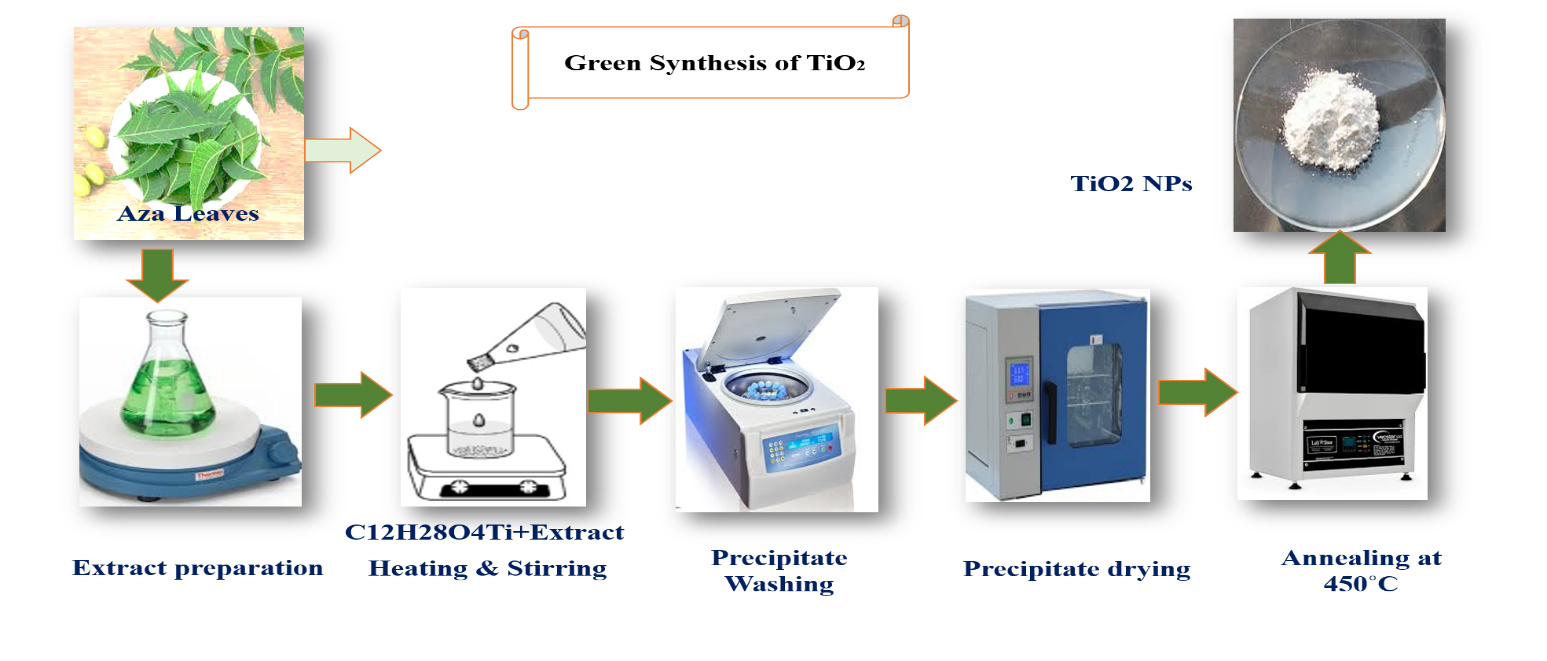
Graphical Abstract
Green Synthesis of TiO$_2$ Nanoparticles Using Azadirachta Indica with Multifunctional Bioactivity

Keywords
green TiO$_2$-NPs
azadirachta indica leaf extract
anti-inflammatory
anti-diabetic
anti-bacterial efficacy

Data Availability Statement
Data will be made available on request.

Funding
This work was supported by the Higher Education Department of Khyber Pakhtunkhwa under Project ID 3118, through Grant PMU/1-22/HEREF/2014-15/Vol-VIII/7294.

Conflicts of Interest
The authors declare no conflicts of interest.

AI Use Statement
During the preparation of this work, the author(s) used ChatGPT to assist with English language improvements. The author(s) reviewed and edited the content as necessary and take(s) full responsibility for the final version of the publication.

Ethical Approval and Consent to Participate
All procedures involving human participants were approved by the Institutional Ethical Review Committee of Abdul Wali Khan University, Mardan, Pakistan and conducted in accordance with institutional ethical and biosafety guidelines. Informed consent was obtained from a healthy adult blood donor prior to sample collection.

References
  1. Saritha, G. N. G., Anju, T., & Kumar, A. (2022). Nanotechnology-Big impact: How nanotechnology is changing the future of agriculture?. Journal of Agriculture and Food Research, 10, 100457.
    [CrossRef]   [Google Scholar]
  2. Kurul, F., Turkmen, H., Cetin, A. E., & Topkaya, S. N. (2025). Nanomedicine: How nanomaterials are transforming drug delivery, bio-imaging, and diagnosis. Next Nanotechnology, 7, 100129.
    [CrossRef]   [Google Scholar]
  3. Joseph, T. M., Kar Mahapatra, D., Esmaeili, A., Piszczyk, Ł., Hasanin, M. S., Kattali, M., ... & Thomas, S. (2023). Nanoparticles: taking a unique position in medicine. Nanomaterials, 13(3), 574.
    [CrossRef]   [Google Scholar]
  4. Sim, S., & Wong, N. K. (2021). Nanotechnology and its use in imaging and drug delivery. Biomedical reports, 14(5), 42.
    [CrossRef]   [Google Scholar]
  5. Altammar, K. A. (2023). A review on nanoparticles: characteristics, synthesis, applications, and challenges. Frontiers in Microbiology, 14, 1155622.
    [CrossRef]   [Google Scholar]
  6. Khan, I., Saeed, K., & Khan, I. (2019). Nanoparticles: Properties, applications and toxicities. Arabian journal of chemistry, 12(7), 908-931.
    [CrossRef]   [Google Scholar]
  7. Hasan, S. (2015). A review on nanoparticles: their synthesis and types. Res. J. Recent Sci, 2277, 2502.
    [Google Scholar]
  8. Ealia, S. A. M., & Saravanakumar, M. P. (2017, November). A review on the classification, characterisation, synthesis of nanoparticles and their application. In IOP conference series: materials science and engineering (Vol. 263, No. 3, p. 032019). IOP Publishing.
    [CrossRef]   [Google Scholar]
  9. Khan, Y., Sadia, H., Ali Shah, S. Z., Khan, M. N., Shah, A. A., Ullah, N., ... & Khan, M. I. (2022). Classification, synthetic, and characterization approaches to nanoparticles, and their applications in various fields of nanotechnology: A review. Catalysts, 12(11), 1386.
    [CrossRef]   [Google Scholar]
  10. Rahman, A., Rehman, G., Shah, N., Hamayun, M., Ali, S., Ali, A., ... & Alrefaei, A. F. (2023). Biosynthesis and characterization of silver nanoparticles using Tribulus terrestris seeds: Revealed promising antidiabetic potentials. Molecules, 28(10), 4203.
    [CrossRef]   [Google Scholar]
  11. Ahmad, I., Khan, M. N., Hayat, K., Ahmad, T., Shams, D. F., Khan, W., ... & Shah, S. K. (2024). Investigating the antibacterial and anti-inflammatory potential of polyol-synthesized silver nanoparticles. ACS omega, 9(11), 13208-13216.
    [CrossRef]   [Google Scholar]
  12. Ullah, A., Sadiq, A., Usman, M., Ahmad, I., Sher, A., Rehman, G., ... & Gunnella, R. (2025). Facile synthesis of zinc-based Prussian blue analogue (Zn-PBAs) for supercapacitor and biomedical applications. Sustainable Materials and Technologies, 44, e01357.
    [CrossRef]   [Google Scholar]
  13. Khan, S., Ullah, A., Ahmad, I., Sher, A., Rehman, G., Hayat, K., ... & Gunnella, R. (2025). Therapeutic potential of green-synthesized ZnO from Azadirachta indica: a study on anti-diabetic, anti-inflammatory, and anti-bacterial activities. Journal of Sol-Gel Science and Technology, 116(2), 1581-1596.
    [CrossRef]   [Google Scholar]
  14. Babaei, A., Mousavi, S. M., Ghasemi, M., Pirbonyeh, N., Soleimani, M., & Moattari, A. (2021). Gold nanoparticles show potential in vitro antiviral and anticancer activity. Life Sciences, 284, 119652.
    [CrossRef]   [Google Scholar]
  15. Zahoor, S., Sheraz, S., Shams, D. F., Rehman, G., Nayab, S., Shah, M. I. A., ... & Khan, W. (2023). Biosynthesis and Anti‐inflammatory Activity of Zinc Oxide Nanoparticles Using Leaf Extract of Senecio chrysanthemoides. BioMed research international, 2023(1), 3280708.
    [CrossRef]   [Google Scholar]
  16. Nikolopoulou, S. G., Boukos, N., Sakellis, E., & Efthimiadou, E. K. (2020). Synthesis of biocompatible silver nanoparticles by a modified polyol method for theranostic applications: Studies on red blood cells, internalization ability and antibacterial activity. Journal of Inorganic Biochemistry, 211, 111177.
    [CrossRef]   [Google Scholar]
  17. Zhao, Y., Li, C., Liu, X., Gu, F., Jiang, H., Shao, W., ... & He, Y. (2007). Synthesis and optical properties of TiO2 nanoparticles. Materials Letters, 61(1), 79-83.
    [CrossRef]   [Google Scholar]
  18. Pavithra, S., Bessy, T. C., Bindhu, M. R., Venkatesan, R., Parimaladevi, R., Alam, M. M., ... & Umadevi, M. (2023). Photocatalytic and photovoltaic applications of green synthesized titanium oxide (TiO2) nanoparticles by Calotropis gigantea extract. Journal of Alloys and Compounds, 960, 170638.
    [CrossRef]   [Google Scholar]
  19. Ismail, W., Ibrahim, G., Atta, H., Sun, B., El-Shaer, A., & Abdelfatah, M. (2024). Improvement physical and photoelectrochemical properties of TiO2 nanorods toward biosensor and optoelectronic applications. Ceramics International, 50(10), 17968-17976.
    [CrossRef]   [Google Scholar]
  20. Chun Chen, P., Chon Chen, C., & Hsun Chen, S. (2017). A review on production, characterization, and photocatalytic applications of TiO2 nanoparticles and nanotubes. Current Nanoscience, 13(4), 373-393.
    [CrossRef]   [Google Scholar]
  21. Diebold, U. (2003). Structure and properties of TiO$_2$ surfaces: a brief review. Applied Physics A, 76(5), 681-687.
    [CrossRef]   [Google Scholar]
  22. Jafari, S., Mahyad, B., Hashemzadeh, H., Janfaza, S., Gholikhani, T., & Tayebi, L. (2020). Biomedical applications of TiO$_2$ nanostructures; recent advances. International Journal of Nanomedicine, 15, 3447-3470.
    [CrossRef]   [Google Scholar]
  23. Akakuru, O. U., Iqbal, M. Z., Saeed, M., Liu, C., Paosen, S., & Jiang, X. (2020). TiO$_2$ nanoparticles: properties and applications. In TiO$_2$ Nanoparticles (pp. 1-66). Elsevier.
    [CrossRef]   [Google Scholar]
  24. Ziental, D., Czarczynska-Goslinska, B., Mlynarczyk, D. T., Glowacka-Sobotta, A., Stanisz, B., Goslinski, T., & Sobotta, L. (2020). Titanium dioxide nanoparticles: prospects and applications in medicine. Nanomaterials, 10(2), 387.
    [CrossRef]   [Google Scholar]
  25. Wu, A., & Ren, W. (2020). TiO$_2$ nanoparticles: applications in nanobiotechnology and nanomedicine. John Wiley & Sons.
    [Google Scholar]
  26. Gad, M. M., & Abualsaud, R. (2019). Behavior of PMMA denture base materials containing titanium dioxide nanoparticles. A literature review. International Journal of Biomaterials, 2019(1), 6190610.
    [CrossRef]   [Google Scholar]
  27. Çeşmeli, S., & Avci, C. B. (2019). Application of titanium dioxide (TiO$_2$) nanoparticles in cancer therapies. Journal of Drug Targeting, 27(7), 762-766.
    [CrossRef]   [Google Scholar]
  28. Samrot, A. V., Angalene, J. L. A., Roshini, S. M., Stefi, S. M., Preethi, R., & Raji, P. (2022). Nanoparticles, a double-edged sword with oxidant as well as antioxidant properties—a review. Oxygen, 2(4), 591-604.
    [CrossRef]   [Google Scholar]
  29. Buraso, W., Lachom, V., Siriya, P., & Laokul, P. (2018). Synthesis of TiO$_2$ nanoparticles via a simple precipitation method and photocatalytic performance. Materials Research Express, 5(11), 115003.
    [CrossRef]   [Google Scholar]
  30. Sadek, O., Touhtouh, S., Rkhis, M., Anoua, R., El Jouad, M., Belhora, F., & Hajjaji, A. (2022). Synthesis by sol-gel method and characterization of nano-TiO2 powders. Materials Today: Proceedings, 66, 456-458.
    [CrossRef]   [Google Scholar]
  31. Arthi, G., Kavitha, B., & Palanisamy, P. K. (2023). Solvothermal synthesis of 3D hierarchical rutile TiO$_2$ nanostructures for efficient dye-sensitized solar cells. Materials Letters, 337, 133961.
    [CrossRef]   [Google Scholar]
  32. Ansari, A., Siddiqui, V. U., Rehman, W. U., Akram, M. K., Siddiqi, W. A., Alosaimi, A. M., ... & Rafatullah, M. (2022). Green synthesis of TiO2 nanoparticles using Acorus calamus leaf extract and evaluating its photocatalytic and in vitro antimicrobial activity. Catalysts, 12(2), 181.
    [CrossRef]   [Google Scholar]
  33. Aravind, M., Amalanathan, M., & Mary, M. S. M. (2021). Synthesis of TiO2 nanoparticles by chemical and green synthesis methods and their multifaceted properties. SN Applied Sciences, 3(4), 409.
    [CrossRef]   [Google Scholar]
  34. Chouke, P. B., Potbhare, A. K., Bhusari, G. S., Mondal, A., Chaudhary, R. G., & Meshram, N. P. (2019). Green fabrication of zinc oxide nanospheres by Aspidopterys cordata for effective antioxidant and antibacterial activity. Advanced Materials Letters, 10(5), 355-360.
    [CrossRef]   [Google Scholar]
  35. Potbhare, A. K., Chaudhary, R. G., Chouke, P. B., Yerpude, S., Mondal, A., & Meshram, N. P. (2020). Rhizoctonia solani assisted biosynthesis of silver nanoparticles for antibacterial assay. Materials Today: Proceedings, 29, 939-945.
    [CrossRef]   [Google Scholar]
  36. Venkatappa, M. M., Dandin, C. J., Shivakumar, H. R., Thippeswamy, B., & Shivanna, S. (2023). Green synthesised TiO$_2$ nanoparticles-mediated Terenna asiatica: evaluation of their role in reducing oxidative stress, inflammation and human breast cancer proliferation. Molecules, 28(13), 5126.
    [CrossRef]   [Google Scholar]
  37. Peng, Y., Ao, M., Dong, B., Jiang, Y., Yu, L., Chen, Z., ... & Xu, R. (2021). Anti-inflammatory effects of curcumin in the inflammatory diseases: status, limitations and countermeasures. Drug Design, Development and Therapy, 15, 4503-4525.
    [CrossRef]   [Google Scholar]
  38. Abouzid, M. R., Ali, K., Elnahass, Y. H., & Senousy, M. M. (2022). An overview of diabetes mellitus in Egypt and the significance of integrating preventive cardiology in diabetes management. Cureus, 14(7), e27290.
    [CrossRef]   [Google Scholar]
  39. Jwad, S. M., & Al-Fatlawi, H. Y. (2022). Types of diabetes and their effect on the immune system. Journal of Advances in Pharmacy Practice, 4(1), 21-30.
    [Google Scholar]
  40. Abduh, N. A., Al-Senani, G. M., Al-Kadhi, N. S., Almaghrabi, O. A., Alshammari, N. K., & Abduh, M. S. (2025). Green synthesis of Zn-doped TiO$_2$ nanomaterials for photocatalytic degradation of crystal violet and methylene blue dyes under sunlight. Biomass Conversion and Biorefinery, 15(3), 4849-4865.
    [CrossRef]   [Google Scholar]
  41. Preuss, H. G. (1997). Effects of glucose/insulin perturbations on aging and chronic disorders of aging: the evidence. Journal of the American College of Nutrition, 16(5), 397-403.
    [CrossRef]   [Google Scholar]
  42. Yao, M., Li, Y., Wang, H., Shen, H., & Wang, Y. (2023). Projected burden of stroke in China through 2050. Chinese Medical Journal, 136(13), 1598-1605.
    [CrossRef]   [Google Scholar]
  43. Hashmat, I., Azad, H., & Ahmed, A. (2012). Neem (Azadirachta indica A. Juss)-A nature's drugstore: an overview. International Research Journal of Biological Sciences, 1(6), 76-79.
    [Google Scholar]
  44. Paul, R., Prasad, M., & Sah, N. K. (2011). Anticancer biology of Azadirachta indica L (neem): a mini review. Cancer Biology & Therapy, 12(6), 467-476.
    [CrossRef]   [Google Scholar]
  45. Shekhar, S., Sharma, S., Kumar, A., & Sharma, B. (2023). Green chemistry based benign approach for the synthesis of titanium oxide nanoparticles using extracts of Azadirachta indica. Cleaner Engineering and Technology, 13, 100607.
    [CrossRef]   [Google Scholar]
  46. Sun, Y., Wang, S., & Zheng, J. (2019). Biosynthesis of TiO$_2$ nanoparticles and their application for treatment of brain injury-An in-vitro toxicity study towards central nervous system. Journal of Photochemistry and Photobiology B: Biology, 194, 1-5.
    [CrossRef]   [Google Scholar]
  47. Maheshna, N., Kumar, R., Singh, S., & Sharma, A. (2022). Green synthesis of titanium dioxide nanoparticles and their multifaceted applications. International Journal of Health Sciences, 6(S2), 12515-12526.
    [CrossRef]   [Google Scholar]
  48. Tasisa, Y. E., Sarma, T. K., Krishnaraj, R., & Sarma, S. (2024). Band gap engineering of titanium dioxide (TiO2) nanoparticles prepared via green route and its visible light driven for environmental remediation. Results in Chemistry, 11, 101850.
    [CrossRef]   [Google Scholar]
  49. Ullah, A. M. A., Tamanna, A. N., Hossain, A., Akter, M., Kabir, M. F., Tareq, A. R. M., ... & Khan, M. N. I. (2019). In vitro cytotoxicity and antibiotic application of green route surface modified ferromagnetic TiO 2 nanoparticles. RSC advances, 9(23), 13254-13262.
    [CrossRef]   [Google Scholar]
  50. Subapriya, R., & Nagini, S. (2005). Medicinal properties of neem leaves: a review. Current Medicinal Chemistry-Anti-Cancer Agents, 5(2), 149-156.
    [CrossRef]   [Google Scholar]
  51. Zhu, X., Zhang, J., Chen, F., & Wang, L. (2021). Preparation and characterization of Cu-doped TiO$_2$ nanomaterials with anatase/rutile/brookite triphasic structure and their photocatalytic activity. Journal of Materials Science: Materials in Electronics, 32(17), 21511-21524.
    [CrossRef]   [Google Scholar]
  52. Ganapathy, K., Rastogi, V., Lora, C. P., Suriyaprakash, J., Alarfaj, A. A., Hirad, A. H., & Indumathi, T. (2024). Biogenic synthesis of dopamine/carboxymethyl cellulose/TiO2 nanoparticles using Psidium guajava leaf extract with enhanced antimicrobial and anticancer activities. Bioprocess and Biosystems Engineering, 47(1), 131-143.
    [CrossRef]   [Google Scholar]
  53. Karmakar, S., Kumar, S., Rana, L., & Sharma, R. (2017). Optical properties of TiO$_2$@C nanocomposites: synthesized by green synthesis technique. Materials Letters, 8(4), 449-457.
    [CrossRef]   [Google Scholar]
  54. Muthuvel, A., Said, N. M., Jothibas, M., Gurushankar, K., & Mohana, V. (2021). Microwave-assisted green synthesis of nanoscaled titanium oxide: photocatalyst, antibacterial and antioxidant properties. Journal of Materials Science: Materials in Electronics, 32(18), 23522-23539.
    [CrossRef]   [Google Scholar]
  55. Verma, V., Al-Dossari, M., Singh, J., & Chauhan, P. (2022). A Review on Green Synthesis of TiO$_2$ NPs: Photocatalysis and Antimicrobial Applications. Polymers, 14(7), 1444.
    [CrossRef]   [Google Scholar]
  56. Sellami, H., Khettaf, S., Boumaza, S., & Chaalal, O. (2025). Structural and optical characterization of TiO$_2$ nanoparticles synthesized using Globularia alypum leaf extract and the antibacterial properties. Discover Applied Sciences, 7(8), 834.
    [CrossRef]   [Google Scholar]
  57. Shakeel, N., Piwoński, I., Iqbal, P., & Kisielewska, A. (2025). Green Synthesis of Titanium Dioxide Nanoparticles: Physicochemical Characterization and Applications: A Review. International Journal of Molecular Sciences, 26(12), 5454.
    [CrossRef]   [Google Scholar]
  58. Bhatti, A., Sharma, R., Singh, P., & Kumar, V. (2025). Synergistic Effect of TiO$_2$-Nanoparticles and Plant Growth-Promoting Microorganisms on the Physiological Parameters and Antioxidant Responses of Capsicum annum Cultivars. Antioxidants, 14(1), 89.
    [CrossRef]   [Google Scholar]
  59. Al-darwesh, M. Y., Al-Kadhi, N. S., Al-Senani, G. M., & Abduh, N. A. (2025). Antimicrobial, anti-inflammatory, and anticancer potential of green synthesis TiO$_2$ nanoparticles using Sophora flavescens root extract. Chemical Papers, 79(2), 1207-1221.
    [CrossRef]   [Google Scholar]
  60. Li, D., Li, L., Guo, W., Chang, Z., & Lu, M. (2015). Synthesis and characterization of Mo–Sb–S tridoped TiO2 nanoparticles with enhanced visible light photocatalytic activity. Materials Science in Semiconductor Processing, 31, 530-535.
    [CrossRef]   [Google Scholar]
  61. Nga, N. T. A., & Alahmadi, T. A. (2024). Assessment of possible biomedical applications of green synthesized TiO2NPs-an in-vitro approach. Environmental Research, 248, 118278.
    [CrossRef]   [Google Scholar]
  62. Moaty, A. A. A., El-Kholie, E. A., & Adarous, R. A. (2022). The Anti-Diabetic Effect of Neem Leaves (Azadirachta indica,) in Alloxan-Induced Diabetic Rats. Journal of Home Economics, 32(2), 19-31.
    [Google Scholar]
  63. Tunkaew, K., Liewhiran, C., & Vaddhanaphuti, C. S. (2024). Functionalized metal oxide nanoparticles: A promising intervention against major health burden of diseases. Life Sciences, 358, 123154.
    [CrossRef]   [Google Scholar]
  64. Shehadeh, M. B., Suaifan, G. A., & Abu-Odeh, A. M. (2021). Plants secondary metabolites as blood glucose-lowering molecules. Molecules, 26(14), 4333.
    [CrossRef]   [Google Scholar]
  65. Allahverdiyev, A. M., Abamor, E. S., Bagirova, M., & Rafailovich, M. (2011). Antimicrobial effects of TiO$_2$ and Ag2O nanoparticles against drug-resistant bacteria and leishmania parasites. Future Microbiology, 6(8), 933-940.
    [CrossRef]   [Google Scholar]
  66. Khater, M. S., Osman, M. S., & Hassan, A. A. (2020). Study to elucidate effect of titanium dioxide nanoparticles on bacterial membrane potential and membrane permeability. Materials Research Express, 7(3), 035005.
    [CrossRef]   [Google Scholar]
  67. Pandya, P., & Ghosh, S. (2024). Biogenic TiO$_2$ Nanoparticles for Advanced Antimicrobial and Antiviral Applications. In V. Kokkarachedu & R. Sadiku (Eds.), Nanoparticles in Modern Antimicrobial and Antiviral Applications (pp. 151-174). Springer International Publishing.
    [CrossRef]   [Google Scholar]
  68. Anandgaonker, P., Kulkarni, G., Gaikwad, S., & Rajbhoj, A. (2019). Synthesis of TiO$_2$ nanoparticles by electrochemical method and their antibacterial application. Arabian Journal of Chemistry, 12(8), 1815-1822.
    [CrossRef]   [Google Scholar]
  69. Hussein, E. M., Desoky, W. M., Hanafy, M. F., & Guirguis, O. W. (2021). Effect of TiO2 nanoparticles on the structural configurations and thermal, mechanical, and optical properties of chitosan/TiO2 nanoparticle composites. Journal of Physics and Chemistry of Solids, 152, 109983.
    [CrossRef]   [Google Scholar]
  70. Albukhaty, S., Naderi-Manesh, H., & Tiraihi, T. (2022). Preparation and characterization of titanium dioxide nanoparticles and in vitro investigation of their cytotoxicity and antibacterial activity against Staphylococcus aureus and Escherichia coli. Animal Biotechnology, 33(5), 864-870.
    [CrossRef]   [Google Scholar]
  71. Thakur, B. K., Kumar, A., & Kumar, D. (2019). Green synthesis of titanium dioxide nanoparticles using Azadirachta indica leaf extract and evaluation of their antibacterial activity. South African Journal of Botany, 124, 223-227.
    [CrossRef]   [Google Scholar]
  72. Santhoshkumar, T., Rahuman, A. A., Jayaseelan, C., Rajakumar, G., Marimuthu, S., Kirthi, A. V., ... & Kim, S. K. (2014). Green synthesis of titanium dioxide nanoparticles using Psidium guajava extract and its antibacterial and antioxidant properties. Asian Pacific Journal of Tropical Medicine, 7(12), 968-976.
    [CrossRef]   [Google Scholar]
  73. Arora, B., Murar, M., & Dhumale, V. (2015). Antimicrobial potential of TiO$_2$ nanoparticles against MDR Pseudomonas aeruginosa. Journal of Experimental Nanoscience, 10(11), 819-827.
    [CrossRef]   [Google Scholar]

Cite This Article
APA Style
Mamoor, S., Ullah, A., Khan, S., Akber, W. A., Ali, S., Sher, A., Rehman, G., Hayat, K., & Shah, S. K. (2026). Green Synthesis of TiO2 Nanoparticles Using Azadirachta Indica with Multifunctional Bioactivity. Journal of Advanced Biomaterials, 1(1), 10–25. https://doi.org/10.62762/JAB.2025.294658
Export Citation
RIS Format
Compatible with EndNote, Zotero, Mendeley, and other reference managers
RIS format data for reference managers
TY  - JOUR
AU  - Mamoor, Sidra
AU  - Ullah, Atta
AU  - Khan, Sulaiman
AU  - Akber, Waleed Ahsan
AU  - Ali, Shakir
AU  - Sher, Adil
AU  - Rehman, Gauhar
AU  - Hayat, Khizar
AU  - Shah, Said Karim
PY  - 2026
DA  - 2026/02/18
TI  - Green Synthesis of TiO$_2$ Nanoparticles Using Azadirachta Indica with Multifunctional Bioactivity
JO  - Journal of Advanced Biomaterials
T2  - Journal of Advanced Biomaterials
JF  - Journal of Advanced Biomaterials
VL  - 1
IS  - 1
SP  - 10
EP  - 25
DO  - 10.62762/JAB.2025.294658
UR  - https://www.icck.org/article/abs/JAB.2025.294658
KW  - green TiO$_2$-NPs
KW  - azadirachta indica leaf extract
KW  - anti-inflammatory
KW  - anti-diabetic
KW  - anti-bacterial efficacy
AB  - In this study, titanium dioxide nanoparticles (TiO$_2$-NPs) were synthesized via a green, cost-effective method using Azadirachta indica leaf extract as a natural capping and reducing agent. Characterization techniques including UV-vis, FTIR, XRD, SEM, EDX, and PL spectroscopy confirmed successful synthesis. UV-vis and FTIR confirmed surface functionalization by organic residues, while XRD revealed a well-crystalline anatase phase with average crystallite sizes of 42.2--54 nm. SEM analysis showed predominantly spherical particles (70--90 nm), and EDX confirmed high purity with only Ti and oxygen present. PL spectra exhibited emission peaks at 420, 468, 493, and 539 nm. The green TiO$_2$-NPs demonstrated multifunctional biomedical activities. In vitro anti-inflammatory assays showed significant human red blood cell membrane stabilization, with maximum inhibition of 74.7% and 71.3% in heat-induced hemolysis tests. Compared to diclofenac sodium standard, TiO$_2$-NPs achieved 87.3% and 76.3% inhibition at high concentrations. Anti-diabetic assays revealed up to 71.4% inhibition of glucose uptake by yeast cells (vs. 86.6% for standard drugs), while glucose adsorption ranged from 0.45 to 7.3 mg/g. Antibacterial activity against Gram-positive (Staphylococcus aureus) and Gram-negative (Escherichia coli) strains showed inhibition zones of 22.2 mm and 21.2 mm, respectively, comparable to standard drugs (23.3 mm and 21.7 mm). These results highlight green TiO$_2$-NPs as promising candidates for biomedical applications.
SN  - pending
PB  - Institute of Central Computation and Knowledge
LA  - English
ER  - 
BibTeX Format
Compatible with LaTeX, BibTeX, and other reference managers
BibTeX format data for LaTeX and reference managers
@article{Mamoor2026Green,
  author = {Sidra Mamoor and Atta Ullah and Sulaiman Khan and Waleed Ahsan Akber and Shakir Ali and Adil Sher and Gauhar Rehman and Khizar Hayat and Said Karim Shah},
  title = {Green Synthesis of TiO\$\_2\$ Nanoparticles Using Azadirachta Indica with Multifunctional Bioactivity},
  journal = {Journal of Advanced Biomaterials},
  year = {2026},
  volume = {1},
  number = {1},
  pages = {10-25},
  doi = {10.62762/JAB.2025.294658},
  url = {https://www.icck.org/article/abs/JAB.2025.294658},
  abstract = {In this study, titanium dioxide nanoparticles (TiO\$\_2\$-NPs) were synthesized via a green, cost-effective method using Azadirachta indica leaf extract as a natural capping and reducing agent. Characterization techniques including UV-vis, FTIR, XRD, SEM, EDX, and PL spectroscopy confirmed successful synthesis. UV-vis and FTIR confirmed surface functionalization by organic residues, while XRD revealed a well-crystalline anatase phase with average crystallite sizes of 42.2--54 nm. SEM analysis showed predominantly spherical particles (70--90 nm), and EDX confirmed high purity with only Ti and oxygen present. PL spectra exhibited emission peaks at 420, 468, 493, and 539 nm. The green TiO\$\_2\$-NPs demonstrated multifunctional biomedical activities. In vitro anti-inflammatory assays showed significant human red blood cell membrane stabilization, with maximum inhibition of 74.7\% and 71.3\% in heat-induced hemolysis tests. Compared to diclofenac sodium standard, TiO\$\_2\$-NPs achieved 87.3\% and 76.3\% inhibition at high concentrations. Anti-diabetic assays revealed up to 71.4\% inhibition of glucose uptake by yeast cells (vs. 86.6\% for standard drugs), while glucose adsorption ranged from 0.45 to 7.3 mg/g. Antibacterial activity against Gram-positive (Staphylococcus aureus) and Gram-negative (Escherichia coli) strains showed inhibition zones of 22.2 mm and 21.2 mm, respectively, comparable to standard drugs (23.3 mm and 21.7 mm). These results highlight green TiO\$\_2\$-NPs as promising candidates for biomedical applications.},
  keywords = {green TiO\$\_2\$-NPs, azadirachta indica leaf extract, anti-inflammatory, anti-diabetic, anti-bacterial efficacy},
  issn = {pending},
  publisher = {Institute of Central Computation and Knowledge}
}

Article Metrics
Citations:

Crossref

0

Scopus

0

Web of Science

0
Article Access Statistics:
Views: 24
PDF Downloads: 8

Publisher's Note
ICCK stays neutral with regard to jurisdictional claims in published maps and institutional affiliations.

Rights and Permissions
CC BY Copyright © 2026 by the Author(s). Published by Institute of Central Computation and Knowledge. This article is an open access article distributed under the terms and conditions of the Creative Commons Attribution (CC BY) license (https://creativecommons.org/licenses/by/4.0/), which permits use, sharing, adaptation, distribution and reproduction in any medium or format, as long as you give appropriate credit to the original author(s) and the source, provide a link to the Creative Commons licence, and indicate if changes were made.
Journal of Advanced Biomaterials

Journal of Advanced Biomaterials

ISSN: pending (Online) | ISSN: pending (Print)

Email: [email protected]

Portico

Portico

All published articles are preserved here permanently:
https://www.portico.org/publishers/icck/