


Journal of Advanced Materials Research
ISSN: 3070-5851 (Online)
Email: [email protected]

 Submit Manuscript
Edit a Special Issue
Submit Manuscript
Edit a Special Issue


TY  - JOUR
AU  - Ning, Shan
AU  - Gao, Xing
AU  - Zhu, Weibing
AU  - Ding, Jiaxing
AU  - Xu, Guang
AU  - Xu, Jingmin
PY  - 2026
DA  - 2026/01/15
TI  - Shaping the Future of Underground Monitoring with Carbon-fiber Self-sensing Smart Materials
JO  - Journal of Advanced Materials Research
T2  - Journal of Advanced Materials Research
JF  - Journal of Advanced Materials Research
VL  - 2
IS  - 1
SP  - 1
EP  - 7
DO  - 10.62762/JAMR.2025.621965
UR  - https://www.icck.org/article/abs/JAMR.2025.621965
KW  - smart materials
KW  - self-sensing composites
KW  - underground engineering monitoring
KW  - carbon-fiber reinforcement
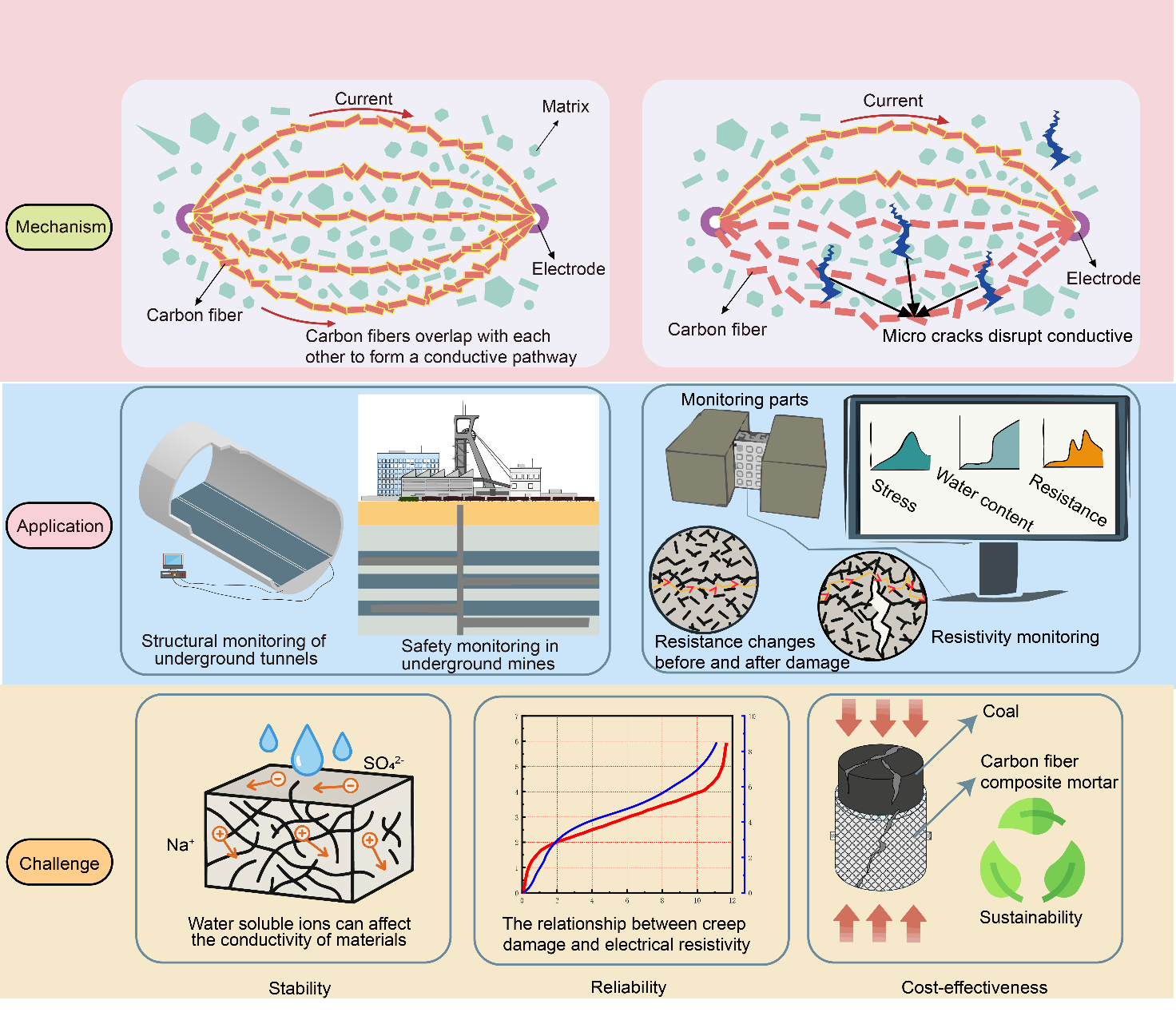
AB  - Amid global warming, energy shortages, and the increasing frequency of extreme climate events, the development of sustainable and intelligent underground infrastructure has become a critical strategy for addressing major societal challenges. Unlike surface structures, underground infrastructures are subjected to high stress, dynamic loading, and groundwater erosion. Under such conditions, traditional cement-based materials are prone to strength degradation, fatigue damage, and permeability failure, which significantly limits the service life and operational safety of underground constructions. Incorporating short carbon fibers into cement-based materials not only enhances their mechanical strength but also enables real-time monitoring of internal stress, deformation, and damage states through changes in the electrical resistivity of the carbon fiber network. The application of this material in underground engineering leverages its dual functions of structural reinforcement and damage monitoring, realizing the concept of "material as a sensor." However, several challenges remain in the practical application of this material. First, groundwater erosion may affect the stability of the mechanical and damage monitoring performance of carbon fiber composites. Second, the reliability of its damage monitoring performance under long-term high-stress environments has yet to be verified. Additionally, large-scale engineering applications must also consider the economic feasibility of the material. Conducting in-depth research in these areas will vigorously promote the large-scale application of carbon fiber composites in high-stress and water-bearing underground environments, providing key technical support for the long-term safe operation of engineering structures.
SN  - 3070-5851
PB  - Institute of Central Computation and Knowledge
LA  - English
ER  -
@article{Ning2026Shaping,
  author = {Shan Ning and Xing Gao and Weibing Zhu and Jiaxing Ding and Guang Xu and Jingmin Xu},
  title = {Shaping the Future of Underground Monitoring with Carbon-fiber Self-sensing Smart Materials},
  journal = {Journal of Advanced Materials Research},
  year = {2026},
  volume = {2},
  number = {1},
  pages = {1-7},
  doi = {10.62762/JAMR.2025.621965},
  url = {https://www.icck.org/article/abs/JAMR.2025.621965},
  abstract = {Amid global warming, energy shortages, and the increasing frequency of extreme climate events, the development of sustainable and intelligent underground infrastructure has become a critical strategy for addressing major societal challenges. Unlike surface structures, underground infrastructures are subjected to high stress, dynamic loading, and groundwater erosion. Under such conditions, traditional cement-based materials are prone to strength degradation, fatigue damage, and permeability failure, which significantly limits the service life and operational safety of underground constructions. Incorporating short carbon fibers into cement-based materials not only enhances their mechanical strength but also enables real-time monitoring of internal stress, deformation, and damage states through changes in the electrical resistivity of the carbon fiber network. The application of this material in underground engineering leverages its dual functions of structural reinforcement and damage monitoring, realizing the concept of "material as a sensor." However, several challenges remain in the practical application of this material. First, groundwater erosion may affect the stability of the mechanical and damage monitoring performance of carbon fiber composites. Second, the reliability of its damage monitoring performance under long-term high-stress environments has yet to be verified. Additionally, large-scale engineering applications must also consider the economic feasibility of the material. Conducting in-depth research in these areas will vigorously promote the large-scale application of carbon fiber composites in high-stress and water-bearing underground environments, providing key technical support for the long-term safe operation of engineering structures.},
  keywords = {smart materials, self-sensing composites, underground engineering monitoring, carbon-fiber reinforcement},
  issn = {3070-5851},
  publisher = {Institute of Central Computation and Knowledge}
}
 Copyright © 2026 by the Author(s). Published by Institute of Central Computation and Knowledge. This article is an open access article distributed under the terms and conditions of the Creative Commons Attribution (CC BY) license (https://creativecommons.org/licenses/by/4.0/), which permits use, sharing, adaptation, distribution and reproduction in any medium or format, as long as you give appropriate credit to the original author(s) and the source, provide a link to the Creative Commons licence, and indicate if changes were made.

Portico
All published articles are preserved here permanently:
https://www.portico.org/publishers/icck/