Volume 1, Issue 1, Journal of Advanced Materials Research
Volume 1, Issue 1, 2025
Submit Manuscript Edit a Special Issue
Article QR Code
Article QR Code
Scan the QR code for reading
Popular articles
Journal of Advanced Materials Research, Volume 1, Issue 1, 2025: 18-36

Open Access | Research Article | 22 December 2025
Muscle-Inspired Anisotropic Hydrogels via Pre-Stretching for Direction-Sensitive Human Motion Monitoring
1 Polymer Materials & Engineering Department, School of Materials Science \& Engineering, Chang’an University, Xi’an 710064, China
* Corresponding Authors: Xi Chen, [email protected] ; Luke Yan, [email protected]
ARK: ark:/57805/jamr.2025.941906
Received: 12 November 2025, Accepted: 17 December 2025, Published: 22 December 2025  
Abstract
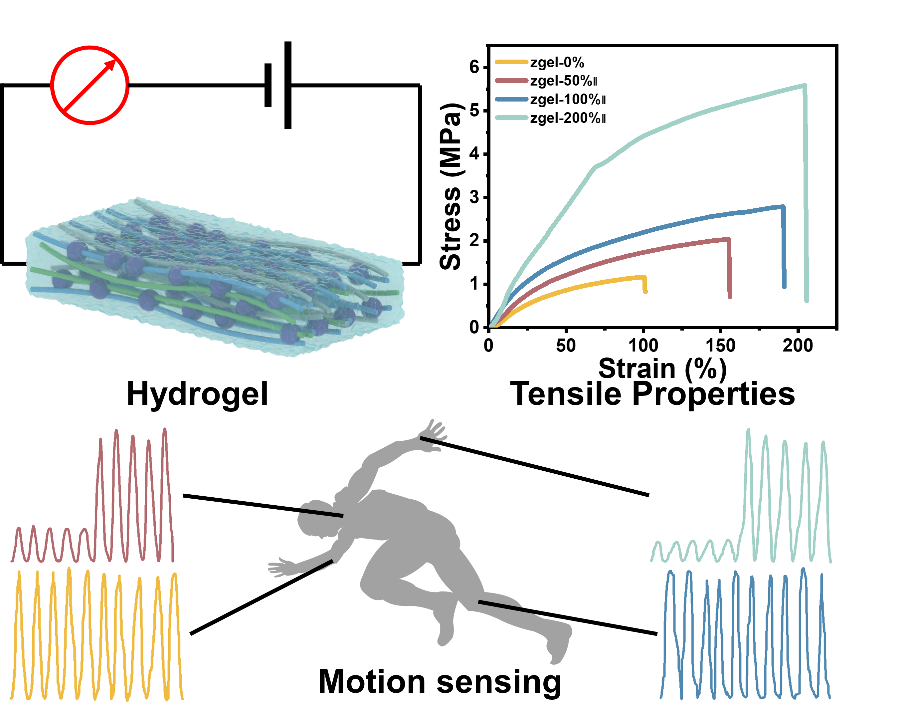
Traditional hydrogels often exhibit disordered molecular structures, resulting in limited mechanical strength, toughness, and functionality, which restrict their practical applications. Here, we engineer an anisotropic $\mathrm{Zr^{4+}}$-crosslinked P(DMA-AA)-CMC hydrogel via pre-stretching to mimic muscle-like alignment. This strategy enhances mechanical strength (5.6 MPa along orientation axis, $1.8\times$ higher than perpendicular) and directional sensitivity through $\mathrm{Zr^{4+}}$-stabilized microstructural ordering. The sensor achieves 303\% $\Delta R/R_0$ at 100\% strain with $2.2\times$ higher sensitivity parallel to pre-stretch direction, enabling precise movement/orientation tracking. It maintains stability over 200 cycles and accurately monitors joint kinematics (e.g., elbow/knee flexion). This biomimetic design advances wearable sensors for human-machine interfaces.

Graphical Abstract
Muscle-Inspired Anisotropic Hydrogels via Pre-Stretching for Direction-Sensitive Human Motion Monitoring

Keywords
anisotropic hydrogel
directional sensing
wearable sensors
human-machine interfaces

Data Availability Statement
Data will be made available on request.

Funding
This work was supported in part by the Innovation Capability Support Program of Shaanxi under Grant 2023-CX-TD-43; in part by the Key Research and Development Program of Shaanxi under Grant2024GX-YBXM-412; in part by the Fundamental Research Funds for the Central Universities, CHD under Grant 300102313208, Grant 300102314105, and Grant 300102314401.

Conflicts of Interest
The authors declare no conflicts of interest.

Ethical Approval and Consent to Participate
Not applicable.

References
  1. Wang, K., Zhang, J., Li, H., Wu, J., Wan, Q., Chen, T., ... & Luo, Y. (2024). Smart hydrogel sensors for health monitoring and early warning. Advanced Sensor Research, 3(9), 2400003.
    [CrossRef]   [Google Scholar]
  2. Jin, Z., Zhao, F., Lei, Y., & Wang, Y. C. (2022). Hydrogel-based triboelectric devices for energy-harvesting and wearable sensing applications. Nano Energy, 95, 106988.
    [CrossRef]   [Google Scholar]
  3. Pinaeva, U., Lairez, D., Oral, O., Faber, A., Clochard, M. C., Wade, T. L., ... & Soulé, A. (2019). Early warning sensors for monitoring mercury in water. Journal of hazardous materials, 376, 37-47.
    [CrossRef]   [Google Scholar]
  4. Liu, D., Huyan, C., Wang, Z., Guo, Z., Zhang, X., Torun, H., ... & Chen, F. (2023). Conductive polymer based hydrogels and their application in wearable sensors: a review. Materials Horizons, 10(8), 2800-2823.
    [CrossRef]   [Google Scholar]
  5. Sun, X., Agate, S., Salem, K. S., Lucia, L., & Pal, L. (2020). Hydrogel-based sensor networks: Compositions, properties, and applications—A review. ACS Applied Bio Materials, 4(1), 140-162.
    [CrossRef]   [Google Scholar]
  6. Zhang, L., Han, C., Luo, W., Chen, X., Chen, X., & Yan, L. (2024). Curving-Stretching Induced Alignment in Hydrogel Actuators for Enhanced Grip Strength and Rapid Response. ACS Applied Materials & Interfaces, 16(41), 56126-56133.
    [CrossRef]   [Google Scholar]
  7. Barhoum, A., Sadak, O., Ramirez, I. A., & Iverson, N. (2023). Stimuli-bioresponsive hydrogels as new generation materials for implantable, wearable, and disposable biosensors for medical diagnostics: Principles, opportunities, and challenges. Advances in Colloid and Interface science, 317, 102920.
    [CrossRef]   [Google Scholar]
  8. Zhao, X., Chen, X., Yuk, H., Lin, S., Liu, X., & Parada, G. (2021). Soft materials by design: unconventional polymer networks give extreme properties. Chemical Reviews, 121(8), 4309-4372.
    [CrossRef]   [Google Scholar]
  9. Montero de Espinosa, L., Meesorn, W., Moatsou, D., & Weder, C. (2017). Bioinspired polymer systems with stimuli-responsive mechanical properties. Chemical reviews, 117(20), 12851-12892.
    [CrossRef]   [Google Scholar]
  10. Wu, J., Yun, Z., Song, W., Yu, T., Xue, W., Liu, Q., & Sun, X. (2024). Highly oriented hydrogels for tissue regeneration: design strategies, cellular mechanisms, and biomedical applications. Theranostics, 14(5), 1982.
    [CrossRef]   [Google Scholar]
  11. Hang, C., Guo, Z., Li, K., Yao, J., Shi, H., Ge, R., ... & Xia, Y. (2025). Anisotropic hydrogel sensors with muscle-like structures based on high-absorbent alginate fibers. Carbohydrate Polymers, 349, 123015.
    [CrossRef]   [Google Scholar]
  12. Zhang, R., Wang, W., Ge, Z., & Luo, C. (2025). Nonswellable and highly sensitive hydrogel for underwater sensing. Journal of Polymer Research, 32(1), 4.
    [CrossRef]   [Google Scholar]
  13. Jiang, H., Jiang, S., Chen, G., & Lan, Y. (2024). Cartilage‐inspired multidirectional strain sensor with high elasticity and anisotropy based on segmented embedded strategy. Advanced Functional Materials, 34(7), 2307313.
    [CrossRef]   [Google Scholar]
  14. Wu, L., Kang, Y., Shi, X., Yuezhen, B., Qu, M., Li, J., & Wu, Z. S. (2023). Natural-wood-inspired ultrastrong anisotropic hybrid hydrogels targeting artificial tendons or ligaments. ACS nano, 17(14), 13522-13532.
    [CrossRef]   [Google Scholar]
  15. Chen, Z., Wang, H., Cao, Y., Chen, Y., Akkus, O., Liu, H., & Cao, C. C. (2023). Bio-inspired anisotropic hydrogels and their applications in soft actuators and robots. Matter, 6(11), 3803-3837.
    [CrossRef]   [Google Scholar]
  16. Wei, P., Chen, T., Chen, G., Hou, K., & Zhu, M. (2021). Ligament-inspired tough and anisotropic fibrous gel belt with programed shape deformations via dynamic stretching. ACS applied materials & interfaces, 13(16), 19291-19300.
    [CrossRef]   [Google Scholar]
  17. Ye, S., Ma, W., & Fu, G. (2022). A novel nature-inspired anisotropic hydrogel with programmable shape deformations. Chemical Engineering Journal, 450, 137908.
    [CrossRef]   [Google Scholar]
  18. Wang, S., Lei, L., Tian, Y., Ning, H., Hu, N., Wu, P., Jiang, H., Zhang, L., Luo, X., & Liu, F. (2024). Strong, tough and anisotropic bioinspired hydrogels. Materials Horizons, 11(9), 2131–2142.
    [CrossRef]   [Google Scholar]
  19. Lin, H., Wang, R., Xu, S., Li, X., & Song, S. (2023). Tendon-inspired anisotropic hydrogels with excellent mechanical properties for strain sensors. Langmuir, 39(17), 6069-6077.
    [CrossRef]   [Google Scholar]
  20. Duan, S., Wu, S., Hua, M., Wu, D., Yan, Y., Zhu, X., & He, X. (2021). Tendon-inspired anti-freezing tough gels. Iscience, 24(9).
    [CrossRef]   [Google Scholar]
  21. Luo, C., Huang, M., Sun, X., Wei, N., Shi, H., Li, H., ... & Sun, J. (2022). Super-strong, nonswellable, and biocompatible hydrogels inspired by human tendons. ACS Applied Materials & Interfaces, 14(2), 2638-2649.
    [CrossRef]   [Google Scholar]
  22. Wang, Q., Zhang, Q., Wang, G., Wang, Y., Ren, X., & Gao, G. (2021). Muscle-inspired anisotropic hydrogel strain sensors. ACS Applied Materials & Interfaces, 14(1), 1921-1928.
    [CrossRef]   [Google Scholar]
  23. Zhang, Y., Kou, K., Ji, T., Huang, Z., Zhang, S., Zhang, S., & Wu, G. (2019). Preparation of ionic liquid-coated graphene nanosheets/PTFE nanocomposite for stretchable, flexible conductor via a pre-stretch processing. Nanomaterials, 10(1), 40.
    [CrossRef]   [Google Scholar]
  24. Lin, H., Yuan, W., Shao, H., Zhao, C., Zhang, W., Ma, S., ... & Song, S. (2024). Muscle-inspired anisotropic hydrogel strain sensors with ultra-strong mechanical properties and improved sensing capabilities for human motion detection and Morse code transmission. European Polymer Journal, 202, 112642.
    [CrossRef]   [Google Scholar]
  25. Ghosh, A., Pandit, S., Kumar, S., Pradhan, D., & Das, R. K. (2024). Human muscle inspired anisotropic and dynamic metal ion-coordinated mechanically robust, stretchable and swelling-resistant hydrogels for underwater motion sensing and flexible supercapacitor application. ACS Applied Materials & Interfaces, 16(45), 62743-62761.
    [CrossRef]   [Google Scholar]
  26. Kurhade, R. R., Shaikh, M. S., Nagulwar, V., & Kale, M. A. (2025). Advancements in carboxymethyl cellulose (CMC) modifications and their diverse biomedical applications: a comprehensive review. International Journal of Polymeric Materials and Polymeric Biomaterials, 74(11), 1043-1067.
    [CrossRef]   [Google Scholar]
  27. Kang, J., & Yun, S. I. (2022). Double-network hydrogel films based on cellulose derivatives and K-carrageenan with enhanced mechanical strength and superabsorbent properties. Gels, 9(1), 20.
    [CrossRef]   [Google Scholar]
  28. Wei, S., Qu, G., Luo, G., Huang, Y., Zhang, H., Zhou, X., ... & Kong, T. (2018). Scalable and automated fabrication of conductive tough-hydrogel microfibers with ultrastretchability, 3D printability, and stress sensitivity. ACS Applied Materials & Interfaces, 10(13), 11204-11212.
    [CrossRef]   [Google Scholar]
  29. Park, N., & Kim, J. (2021). Anisotropic hydrogels with a multiscale hierarchical structure exhibiting high strength and toughness for mimicking tendons. ACS Applied Materials & Interfaces, 14(3), 4479–4489.
    [CrossRef]   [Google Scholar]
  30. Liu, H., Wang, X., Cao, Y., Yang, Y., Yang, Y., Gao, Y., ... & Wu, D. (2020). Freezing-tolerant, highly sensitive strain and pressure sensors assembled from ionic conductive hydrogels with dynamic cross-links. ACS Applied Materials & Interfaces, 12(22), 25334-25344.
    [CrossRef]   [Google Scholar]
  31. Aaryashree, Sahoo, S., Walke, P., Nayak, S. K., Rout, C. S., & Late, D. J. (2021). Recent developments in self-powered smart chemical sensors for wearable electronics. Nano Research, 14(11), 3669–3689.
    [CrossRef]   [Google Scholar]
  32. Wang, X., Guo, C., Pi, M., Li, M., Yang, X., Lu, H., Cui, W., & Ran, R. (2022). Significant roles of ions in enhancing and functionalizing anisotropic hydrogels. ACS Applied Materials & Interfaces, 14(45), 51318–51328.
    [CrossRef]   [Google Scholar]
  33. Chen, Z., Liu, J., Chen, Y., Zheng, X., Liu, H., & Li, H. (2020). Multiple-stimuli-responsive and cellulose conductive ionic hydrogel for smart wearable devices and thermal actuators. ACS applied materials & interfaces, 13(1), 1353-1366.
    [CrossRef]   [Google Scholar]
  34. Han, S., Liu, C., Lin, X., Zheng, J., Wu, J., & Liu, C. (2020). Dual conductive network hydrogel for a highly conductive, self-healing, anti-freezing, and non-drying strain sensor. ACS Applied Polymer Materials, 2(2), 996-1005.
    [CrossRef]   [Google Scholar]
  35. Chen, L., Chang, X., Chen, J., & Zhu, Y. (2022). Ultrastretchable, antifreezing, and high-performance strain sensor based on a muscle-inspired anisotropic conductive hydrogel for human motion monitoring and wireless transmission. ACS applied materials & interfaces, 14(38), 43833-43843.
    [CrossRef]   [Google Scholar]
  36. Lin, F., Yang, W., Lu, B., Xu, Y., Chen, J., Zheng, X., ... & Huang, B. (2025). Muscle‐Inspired Robust Anisotropic Cellulose Conductive Hydrogel for Multidirectional Strain Sensors and Implantable Bioelectronics. Advanced Functional Materials, 35(10), 2416419.
    [CrossRef]   [Google Scholar]
  37. She, W., Shen, C., Xue, Z., Yu, J., Zhang, G., & Meng, Q. (2025). Constructing highly selective multidirectional hydrogel strain sensors with a pre-stretching strategy. Journal of Materials Chemistry A.
    [CrossRef]   [Google Scholar]
  38. Li, L., Sun, Y., Ding, J., Wang, C., Xiang, Y., Guo, B., ... & Li, J. (2025). Gelatin-based anisotropic hydrogels for flexible sensors and bio-electrodes. Chemical Engineering Journal, 519, 164901.
    [CrossRef]   [Google Scholar]
  39. Kong, W., Wang, C., Jia, C., Kuang, Y., Pastel, G., Chen, C., ... & Hu, L. (2018). Muscle‐inspired highly anisotropic, strong, ion‐conductive hydrogels. Advanced Materials, 30(39), 1801934.
    [CrossRef]   [Google Scholar]
  40. Zhang, X., Crisci, R., Finlay, J. A., Cai, H., Clare, A. S., Chen, Z., & Silberstein, M. N. (2021). Enabling Tunable Hydrophilicity of PDMS via Metal-ligand Coordinated Dynamic Networks.
    [CrossRef]   [Google Scholar]
  41. Jiang, H., Ou, C., Zhang, D., Hu, X., Ma, Y., Wang, M., ... & Xiao, L. (2023). Tough ion-conductive hydrogel with anti-dehydration as a stretchable strain sensor for gesture recognition. ACS Applied Polymer Materials, 5(9), 6828-6841.
    [CrossRef]   [Google Scholar]
  42. Zhong, L., Zhang, Y., Liu, F., Wang, L., Feng, Q., Chen, C., & Xu, Z. (2023). Muscle-inspired anisotropic carboxymethyl cellulose-based double-network conductive hydrogels for flexible strain sensors. International Journal of Biological Macromolecules, 248, 125973.
    [CrossRef]   [Google Scholar]
  43. Liu, S., Wang, X., Peng, Y., Wang, Z., & Ran, R. (2021). Highly stretchable, strain‐sensitive, and antifreezing macromolecular microsphere composite starch‐based hydrogel. Macromolecular Materials and Engineering, 306(9), 2100198.
    [CrossRef]   [Google Scholar]
  44. Sun, Y., Li, X., Zhao, M., Chen, Y., Xu, Y., Wang, K., ... & Zhang, X. (2022). Bioinspired supramolecular nanofiber hydrogel through self-assembly of biphenyl-tripeptide for tissue engineering. Bioactive Materials, 8, 396-408.
    [CrossRef]   [Google Scholar]
  45. Chen, Z., Chen, X., Wang, H., Yang, T., Huang, J., & Guo, Z. (2025). Metal ion mediated conductive hydrogels with low hysteresis and high resilience. Materials Today Physics, 51, 101656.
    [CrossRef]   [Google Scholar]
  46. Liu, Y., Jiang, D., Wu, Z., Jiang, B., & Xu, Q. (2024). Highly conductive and sensitive acrylamide-modified carboxymethyl cellulose/polyvinyl alcohol composite hydrogels for flexible sensors. Sensors and Actuators A: Physical, 370, 115258.
    [CrossRef]   [Google Scholar]
  47. Choi, S., Fan, Z., Im, J., Nguyen, T. L., Park, N., Choi, Y., ... & Kim, J. (2025). Tendon-mimicking anisotropic alginate-based double-network composite hydrogels with enhanced mechanical properties and high impact absorption. Carbohydrate Polymers, 352, 123193.
    [CrossRef]   [Google Scholar]
  48. Panda, P., Maity, P., Dutta, A., & Das, R. K. (2025). Anisotropic Anti-Swelling Hydrogels with Hydrophobic Association and Metal–Ligand Cross-Links for Applications in Underwater Strain Sensing and Anisotropic Actuation. Langmuir, 41(21), 13301-13314.
    [CrossRef]   [Google Scholar]
  49. Zhang, S., Chen, X., Hu, Y., Shi, C., Li, Z., Bai, Z., & Zhou, Y. (2025). High-Strength Poly (vinyl alcohol) Hydrogels with Photo-and Metal-Ion-Induced Cross-Linking. ACS Applied Polymer Materials, 7(21), 14929-14941.
    [CrossRef]   [Google Scholar]
  50. Wang, J., Li, X., & Liu, Y. (2025). Physically entangled hydrogels constructed through pre-stretched backbone provide excellent comprehensive mechanical properties. Small, 21(23), 2501666.
    [CrossRef]   [Google Scholar]
  51. Zhang, X., Lang, B., Yu, W., Jia, L., Zhu, F., Xue, Y., ... & Zheng, Q. (2023). Magnetically induced anisotropic conductive hydrogels for multidimensional strain sensing and magnetothermal physiotherapy. Chemical Engineering Journal, 474, 145832.
    [CrossRef]   [Google Scholar]
  52. Lv, X., Zhang, Q., Li, Z., Gong, K., Gao, B., Wei, H., & Li, P. (2025). Antifreezing, Water Retention, and High‐Stretch Ionic Conductive Hydrogels for Winter Motion Sensing. Journal of Applied Polymer Science, e57130.
    [CrossRef]   [Google Scholar]
  53. Li, Z., Chen, L., Liu, F., & Liu, X. (2025). Chitosan-based hydrogels with stretchable, self-healing, self-adhesive properties for flexible sensing applications. Colloids and Surfaces A: Physicochemical and Engineering Aspects, 138095.
    [CrossRef]   [Google Scholar]
  54. Yu, W., Chen, J., Gao, Q., Guo, Y., Zhang, S., Pan, Y., ... & Wei, R. (2025). Multifunctional PVA/SA-based hydrogels integrating high stretchability, conductivity, and antibacterial activity for human-machine interactive flexible sensors. Chemical Engineering Journal, 164695.
    [CrossRef]   [Google Scholar]
  55. Chen, C., Liu, P., Gu, Y., Pan, W., Liu, Y., Li, X., ... & Shan, X. (2025). Stretchable adhesive eutectic organohydrogel based on gelatin-Quaternized chitosan for wearable human motion monitoring. International Journal of Biological Macromolecules, 146939.
    [CrossRef]   [Google Scholar]
  56. Jiang, H., Lai, J., Zhang, P., Lai, J., Tu, A., Lai, K., & Xiao, L. (2024). Low-Hysteresis Hydrogels with Antidehydration as a Stretchable Strain Sensor for Gesture Recognition. ACS Applied Polymer Materials, 6(19), 11922-11931.
    [CrossRef]   [Google Scholar]

Cite This Article
APA Style
Zhang, L., Yang, Z., Luo, W., Zhao, R., Chen, X., Lu, H., Chen, X., & Yan, L. (2025). Muscle-Inspired Anisotropic Hydrogels via Pre-Stretching for Direction-Sensitive Human Motion Monitoring. Journal of Advanced Materials Research, 1(1), 18–36. https://doi.org/10.62762/JAMR.2025.941906
Export Citation
RIS Format
Compatible with EndNote, Zotero, Mendeley, and other reference managers
RIS format data for reference managers
TY  - JOUR
AU  - Zhang, Lixin
AU  - Yang, Zixuan
AU  - Luo, Weihua
AU  - Zhao, Ruiqi
AU  - Chen, Xushuai
AU  - Lu, Hongming
AU  - Chen, Xi
AU  - Yan, Luke
PY  - 2025
DA  - 2025/12/22
TI  - Muscle-Inspired Anisotropic Hydrogels via Pre-Stretching for Direction-Sensitive Human Motion Monitoring
JO  - Journal of Advanced Materials Research
T2  - Journal of Advanced Materials Research
JF  - Journal of Advanced Materials Research
VL  - 1
IS  - 1
SP  - 18
EP  - 36
DO  - 10.62762/JAMR.2025.941906
UR  - https://www.icck.org/article/abs/JAMR.2025.941906
KW  - anisotropic hydrogel
KW  - directional sensing
KW  - wearable sensors
KW  - human-machine interfaces
AB  - Traditional hydrogels often exhibit disordered molecular structures, resulting in limited mechanical strength, toughness, and functionality, which restrict their practical applications. Here, we engineer an anisotropic $\mathrm{Zr^{4+}}$-crosslinked P(DMA-AA)-CMC hydrogel via pre-stretching to mimic muscle-like alignment. This strategy enhances mechanical strength (5.6 MPa along orientation axis, $1.8\times$ higher than perpendicular) and directional sensitivity through $\mathrm{Zr^{4+}}$-stabilized microstructural ordering. The sensor achieves 303\% $\Delta R/R_0$ at 100\% strain with $2.2\times$ higher sensitivity parallel to pre-stretch direction, enabling precise movement/orientation tracking. It maintains stability over 200 cycles and accurately monitors joint kinematics (e.g., elbow/knee flexion). This biomimetic design advances wearable sensors for human-machine interfaces.
SN  - 3070-5851
PB  - Institute of Central Computation and Knowledge
LA  - English
ER  - 
BibTeX Format
Compatible with LaTeX, BibTeX, and other reference managers
BibTeX format data for LaTeX and reference managers
@article{Zhang2025MuscleInsp,
  author = {Lixin Zhang and Zixuan Yang and Weihua Luo and Ruiqi Zhao and Xushuai Chen and Hongming Lu and Xi Chen and Luke Yan},
  title = {Muscle-Inspired Anisotropic Hydrogels via Pre-Stretching for Direction-Sensitive Human Motion Monitoring},
  journal = {Journal of Advanced Materials Research},
  year = {2025},
  volume = {1},
  number = {1},
  pages = {18-36},
  doi = {10.62762/JAMR.2025.941906},
  url = {https://www.icck.org/article/abs/JAMR.2025.941906},
  abstract = {Traditional hydrogels often exhibit disordered molecular structures, resulting in limited mechanical strength, toughness, and functionality, which restrict their practical applications. Here, we engineer an anisotropic \$\mathrm{Zr^{4+}}\$-crosslinked P(DMA-AA)-CMC hydrogel via pre-stretching to mimic muscle-like alignment. This strategy enhances mechanical strength (5.6 MPa along orientation axis, \$1.8\times\$ higher than perpendicular) and directional sensitivity through \$\mathrm{Zr^{4+}}\$-stabilized microstructural ordering. The sensor achieves 303\\% \$\Delta R/R\_0\$ at 100\\% strain with \$2.2\times\$ higher sensitivity parallel to pre-stretch direction, enabling precise movement/orientation tracking. It maintains stability over 200 cycles and accurately monitors joint kinematics (e.g., elbow/knee flexion). This biomimetic design advances wearable sensors for human-machine interfaces.},
  keywords = {anisotropic hydrogel, directional sensing, wearable sensors, human-machine interfaces},
  issn = {3070-5851},
  publisher = {Institute of Central Computation and Knowledge}
}

Article Metrics
Citations:

Crossref

0

Scopus

0

Web of Science

0
Article Access Statistics:
Views: 222
PDF Downloads: 75

Publisher's Note
ICCK stays neutral with regard to jurisdictional claims in published maps and institutional affiliations.

Rights and Permissions
CC BY Copyright © 2025 by the Author(s). Published by Institute of Central Computation and Knowledge. This article is an open access article distributed under the terms and conditions of the Creative Commons Attribution (CC BY) license (https://creativecommons.org/licenses/by/4.0/), which permits use, sharing, adaptation, distribution and reproduction in any medium or format, as long as you give appropriate credit to the original author(s) and the source, provide a link to the Creative Commons licence, and indicate if changes were made.
Journal of Advanced Materials Research

Journal of Advanced Materials Research

ISSN: 3070-5851 (Online)

Email: [email protected]

Portico

Portico

All published articles are preserved here permanently:
https://www.portico.org/publishers/icck/