-
CiteScore
-
Impact Factor
Volume 2, Issue 1, Journal of Chemical Engineering and Renewable Fuels
Volume 2, Issue 1, 2026
Submit Manuscript Edit a Special Issue
Article QR Code
Article QR Code
Scan the QR code for reading
Popular articles
Journal of Chemical Engineering and Renewable Fuels, Volume 2, Issue 1, 2026: 1-5

Open Access | Perspective | 24 October 2025
Bridging Refinery and Biorefinery: Modular Hydrotreating Pathways for Co-Processing Refractory Streams and Bio-Oils
1 Mexican Institute of Petroleum (Instituto Mexicano del Petróleo), Eje Central Lázaro Cárdenas Norte 152, San Bartolo Atepehuacan, Gustavo A. Madero, 07730 Mexico City, Mexico
* Corresponding Author: Francisco Morales-Leal, [email protected]
Received: 31 July 2025, Accepted: 11 August 2025, Published: 24 October 2025  
Abstract
Integrating biomass-derived oils into existing petroleum refineries is one of the fastest routes toward large-scale deployment of renewable liquid fuels. Yet co-processing bio-oils with refractory fossil streams, such as vacuum gas oil, cycle oils or coker gas oils, poses persistent hurdles: their high oxygen content, thermal instability and heteroatom-rich matrices accelerate catalyst fouling and drive hydrogen consumption. This Perspective argues that a modular hydrotreating strategy, in which tailored pretreatment, grading and active catalyst beds are arranged as interchangeable cartridges, offers a pragmatic path to bridge refinery and biorefinery operations. Drawing from recent continuous slurry hydrocracking, fixed-bed co-hydrotreating and digital-twin studies, it outlines how modular bed architecture, advanced slurry catalysts and adaptive control schemes could unlock feed flexibility while extending catalyst life by ~40% and cutting greenhouse-gas footprints by ~25% relative to standalone units. Finally, a short-term R&D agenda linking accelerated deactivation testing, machine-learning-guided feed classification and life-cycle assessment benchmarks aimed is proposed at meeting 2030 renewable-diesel targets.

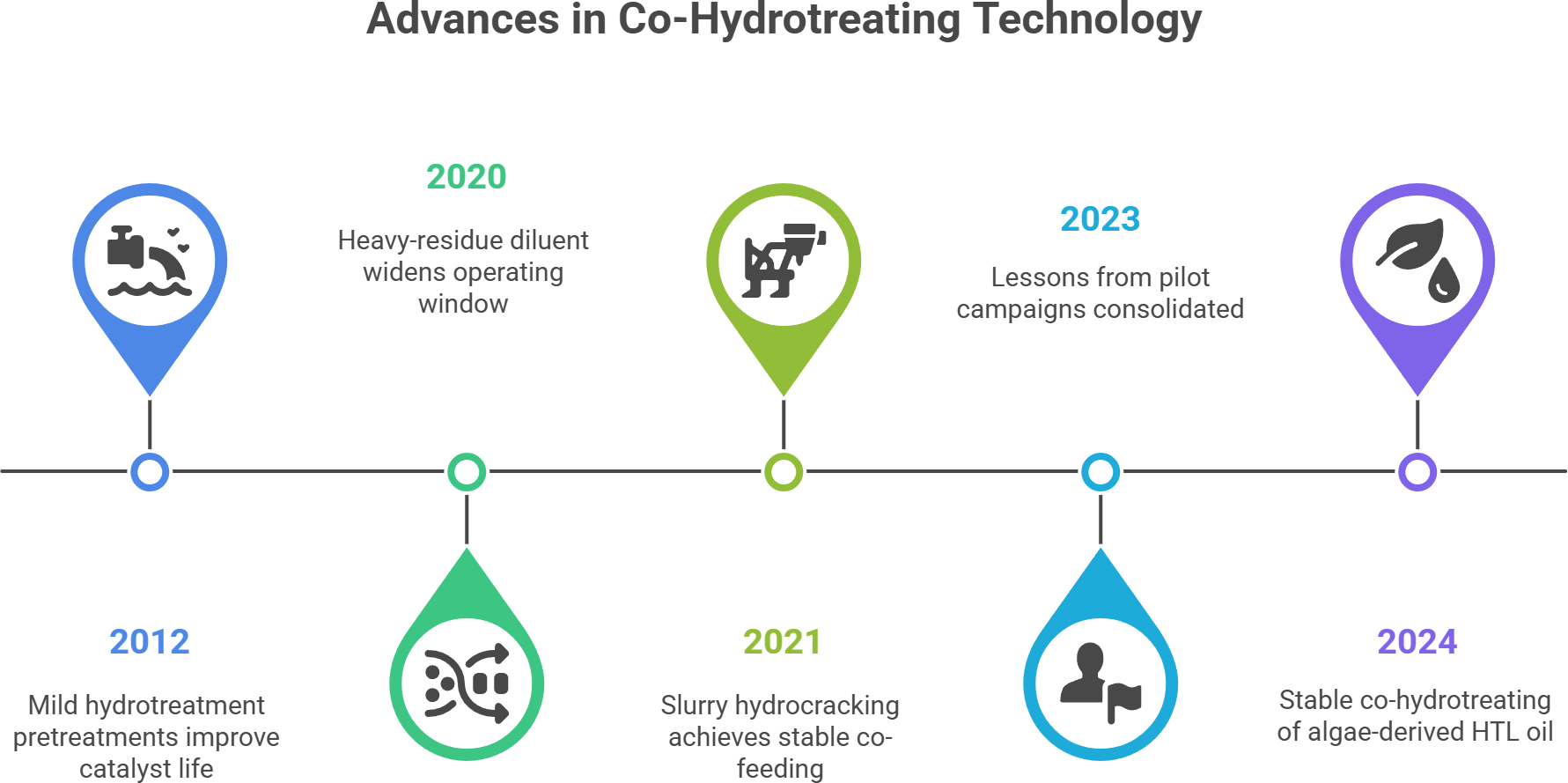
Graphical Abstract
Bridging Refinery and Biorefinery: Modular Hydrotreating Pathways for Co-Processing Refractory Streams and Bio-Oils

Keywords
co-processing
hydrotreating
bio-oil
vacuum gas oil
modular refinery
catalyst deactivation

Data Availability Statement
Not applicable.

Funding
This work was supported without any funding.

Conflicts of Interest
The author declares no conflicts of interest.

Ethical Approval and Consent to Participate
Not applicable.

References
  1. Bergvall, N., Molinder, R., Johansson, A.-C., Sandström, L., & Weiland, F. (2021). Continuous slurry hydrocracking of biobased fast pyrolysis oil. Energy & Fuels, 35(3), 2303-2312.
    [CrossRef]   [Google Scholar]
  2. Bergvall, N., Sandström, L., Weiland, F., & Öhrman, O. G. W. (2020). Corefining of fast pyrolysis bio-oil with vacuum residue and vacuum gas oil in a continuous slurry hydrocracking process. Energy & Fuels, 34(8), 9879-9891.
    [CrossRef]   [Google Scholar]
  3. Al-Sabawi, M., & Chen, J. (2012). Hydroprocessing of biomass-derived oils and their blends with petroleum feedstocks: a review. Energy & Fuels, 26(6), 3891-3896.
    [CrossRef]   [Google Scholar]
  4. Badoga, S., Alvarez-Majmutov, A., Xing, T., Gieleciak, R., & Chen, J. (2020). Co-processing of hydrothermal liquefaction biocrude with vacuum gas oil through hydrotreating and hydrocracking to produce low-carbon fuels. Energy & Fuels, 35(18), 14589-14602.
    [CrossRef]   [Google Scholar]
  5. Ghosh, P., Andrews, A. T., Quann, R. J., & Halbert, T. R. (2009). Detailed kinetic model for the hydro-desulfurization of FCC naphtha. Energy & Fuels, 23(12), 5743-5759.
    [CrossRef]   [Google Scholar]
  6. Yildiz, G., & Prins, W. (2022). Perspectives of biomass catalytic fast pyrolysis for co-refining: Review and correlation of literature data from continuously operated setups. Energy & Fuels, 36(19), 12300-12312.
    [CrossRef]   [Google Scholar]
  7. Badoga, S., Alvarez-Majmutov, A., Rodriguez, J. K., Gieleciak, R., & Chen, J. (2023). Coprocessing partially hydrodeoxygenated hydrothermal liquefaction biocrude from forest residue in the vacuum gas oil hydrocracking process. Energy & Fuels, 37(1), 678-690.
    [CrossRef]   [Google Scholar]
  8. Santosa, D. M., Kutnyakov, I. V., Flake, M. D., & Wang, H. (2022). Coprocessing biomass fast pyrolysis and catalytic fast pyrolysis oils with vacuum gas oil in refinery hydroprocessing. Energy & Fuels, 36(20), 12641-12650.
    [CrossRef]   [Google Scholar]
  9. Lindfors, C., Elliot, D. C., Prins, W., Oasmaa, A., & Lehtonen, J. (2022). Co-processing of biocrudes in oil refineries. Energy & Fuels, 37(2), 799-804.
    [CrossRef]   [Google Scholar]
  10. Wu, L., Li, L., Wang, Y., & Zheng, L. (2020). Techno-economic analysis of co-processing hydrothermal-liquefaction biocrude with vacuum gas oil in existing refineries. Energy Conversion and Management, 226, 113376.
    [CrossRef]   [Google Scholar]
  11. Alvarez-Majmutov, A., Badoga, S., Singh, D., McGinn, P., Gieleciak, R., & Chen, J. (2024). Coprocessing hydrothermal liquefaction biocrude from algae with vacuum gas oil using hydrotreating. Energy & Fuels, 38(16), 15421-15430.
    [CrossRef]   [Google Scholar]

Cite This Article
APA Style
Morales-Leal, F. (2025). Bridging Refinery and Biorefinery: Modular Hydrotreating Pathways for Co-Processing Refractory Streams and Bio-Oils. Journal of Chemical Engineering and Renewable Fuels, 2(1), 1–5. https://doi.org/10.62762/JCERF.2025.769005
Export Citation
RIS Format
Compatible with EndNote, Zotero, Mendeley, and other reference managers
RIS format data for reference managers
TY  - JOUR
AU  - Morales-Leal, Francisco
PY  - 2025
DA  - 2025/10/24
TI  - Bridging Refinery and Biorefinery: Modular Hydrotreating Pathways for Co-Processing Refractory Streams and Bio-Oils
JO  - Journal of Chemical Engineering and Renewable Fuels
T2  - Journal of Chemical Engineering and Renewable Fuels
JF  - Journal of Chemical Engineering and Renewable Fuels
VL  - 2
IS  - 1
SP  - 1
EP  - 5
DO  - 10.62762/JCERF.2025.769005
UR  - https://www.icck.org/article/abs/JCERF.2025.769005
KW  - co-processing
KW  - hydrotreating
KW  - bio-oil
KW  - vacuum gas oil
KW  - modular refinery
KW  - catalyst deactivation
AB  - Integrating biomass-derived oils into existing petroleum refineries is one of the fastest routes toward large-scale deployment of renewable liquid fuels. Yet co-processing bio-oils with refractory fossil streams, such as vacuum gas oil, cycle oils or coker gas oils, poses persistent hurdles: their high oxygen content, thermal instability and heteroatom-rich matrices accelerate catalyst fouling and drive hydrogen consumption. This Perspective argues that a modular hydrotreating strategy, in which tailored pretreatment, grading and active catalyst beds are arranged as interchangeable cartridges, offers a pragmatic path to bridge refinery and biorefinery operations. Drawing from recent continuous slurry hydrocracking, fixed-bed co-hydrotreating and digital-twin studies, it outlines how modular bed architecture, advanced slurry catalysts and adaptive control schemes could unlock feed flexibility while extending catalyst life by ~40% and cutting greenhouse-gas footprints by ~25% relative to standalone units. Finally, a short-term R&D agenda linking accelerated deactivation testing, machine-learning-guided feed classification and life-cycle assessment benchmarks aimed is proposed at meeting 2030 renewable-diesel targets.
SN  - 3070-1058
PB  - Institute of Central Computation and Knowledge
LA  - English
ER  - 
BibTeX Format
Compatible with LaTeX, BibTeX, and other reference managers
BibTeX format data for LaTeX and reference managers
@article{MoralesLeal2025Bridging,
  author = {Francisco Morales-Leal},
  title = {Bridging Refinery and Biorefinery: Modular Hydrotreating Pathways for Co-Processing Refractory Streams and Bio-Oils},
  journal = {Journal of Chemical Engineering and Renewable Fuels},
  year = {2025},
  volume = {2},
  number = {1},
  pages = {1-5},
  doi = {10.62762/JCERF.2025.769005},
  url = {https://www.icck.org/article/abs/JCERF.2025.769005},
  abstract = {Integrating biomass-derived oils into existing petroleum refineries is one of the fastest routes toward large-scale deployment of renewable liquid fuels. Yet co-processing bio-oils with refractory fossil streams, such as vacuum gas oil, cycle oils or coker gas oils, poses persistent hurdles: their high oxygen content, thermal instability and heteroatom-rich matrices accelerate catalyst fouling and drive hydrogen consumption. This Perspective argues that a modular hydrotreating strategy, in which tailored pretreatment, grading and active catalyst beds are arranged as interchangeable cartridges, offers a pragmatic path to bridge refinery and biorefinery operations. Drawing from recent continuous slurry hydrocracking, fixed-bed co-hydrotreating and digital-twin studies, it outlines how modular bed architecture, advanced slurry catalysts and adaptive control schemes could unlock feed flexibility while extending catalyst life by ~40\% and cutting greenhouse-gas footprints by ~25\% relative to standalone units. Finally, a short-term R\&D agenda linking accelerated deactivation testing, machine-learning-guided feed classification and life-cycle assessment benchmarks aimed is proposed at meeting 2030 renewable-diesel targets.},
  keywords = {co-processing, hydrotreating, bio-oil, vacuum gas oil, modular refinery, catalyst deactivation},
  issn = {3070-1058},
  publisher = {Institute of Central Computation and Knowledge}
}

Article Metrics
Citations:

Crossref

0

Scopus

0

Web of Science

0
Article Access Statistics:
Views: 390
PDF Downloads: 80

Publisher's Note
ICCK stays neutral with regard to jurisdictional claims in published maps and institutional affiliations.

Rights and Permissions
CC BY Copyright © 2025 by the Author(s). Published by Institute of Central Computation and Knowledge. This article is an open access article distributed under the terms and conditions of the Creative Commons Attribution (CC BY) license (https://creativecommons.org/licenses/by/4.0/), which permits use, sharing, adaptation, distribution and reproduction in any medium or format, as long as you give appropriate credit to the original author(s) and the source, provide a link to the Creative Commons licence, and indicate if changes were made.
Journal of Chemical Engineering and Renewable Fuels

Journal of Chemical Engineering and Renewable Fuels

ISSN: 3070-1058 (Online)

Email: [email protected]

Portico

Portico

All published articles are preserved here permanently:
https://www.portico.org/publishers/icck/