

From Data-Driven to Geology-Informed Learning: Geometry-Aware Graph Transformer Learning for Geo-Energy Systems




Article Information
Abstract
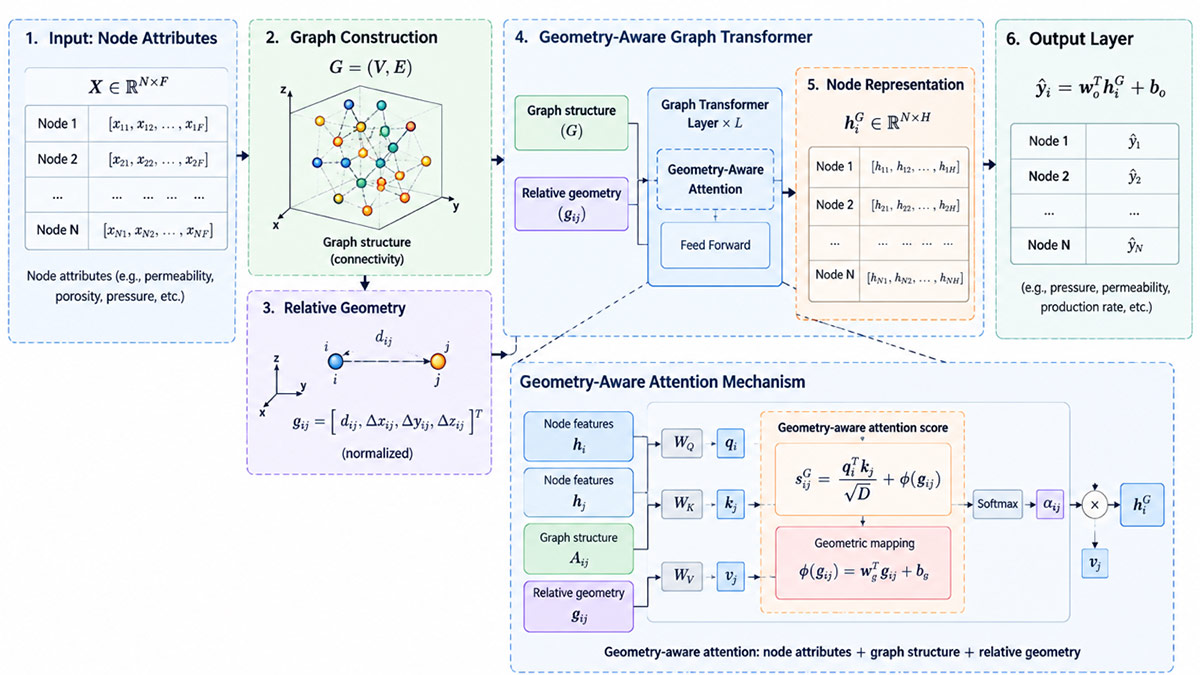
Geo-energy systems involve heterogeneous subsurface properties, irregular spatial structures, and complex interactions. Conventional data-driven models either treat observations independently or rely on graph connectivity without explicitly encoding relative geometry, which limits their ability to distinguish spatially different configurations. This study develops a Geometry-Aware Graph Transformer (GAGT) that integrates node attributes, graph structure, and relative geometric information through a learnable geometric bias in the attention mechanism. A controlled synthetic experiment with 300 irregularly distributed three-dimensional nodes compares a multilayer perceptron (MLP), a Graph Transformer (GT), and GAGT under identical settings. Across 10 random seeds, GAGT achieved a mean absolute error (MAE) of 0.1569, a root mean square error (RMSE) of 0.2152, and a coefficient of determination ($R^2$) of 0.8678, reducing MAE and RMSE by 35.77% and 33.95%, respectively, relative to GT. In this controlled setting, explicit geometry therefore carries predictive information that graph connectivity alone does not provide. GAGT can serve as a geometry-aware representation layer between purely data-driven learning and more comprehensive geology-informed modeling; validation with real geological data and physically constrained simulations is still required.
Graphical Abstract
Keywords
Data Availability Statement
Funding
Conflicts of Interest
AI Use Statement
Ethical Approval and Consent to Participate
References
- LeCun, Y., Bengio, Y., & Hinton, G. (2015). Deep learning. Nature, 521(7553), 436-444.
[CrossRef] [Google Scholar] - Dramsch, J. S. (2020). 70 years of machine learning in geoscience in review. Advances in Geophysics, 61, 1-55.
[CrossRef] [Google Scholar] - Zhao, T., Wang, S., Ouyang, C., Chen, M., Liu, C., Zhang, J., ... & Wang, L. (2024). Artificial intelligence for geoscience: Progress, challenges, and perspectives. The Innovation, 5(5), 100691.
[CrossRef] [Google Scholar] - Yan, B., Harp, D. R., Chen, B., Hoteit, H., & Pawar, R. J. (2022). A gradient-based deep neural network model for simulating multiphase flow in porous media. Journal of Computational Physics, 463, 111277.
[CrossRef] [Google Scholar] - Okoroafor, E. R., Smith, C. M., Ochie, K. I., Nwosu, C. J., Gudmundsdottir, H., & Aljubran, M. J. (2022). Machine learning in subsurface geothermal energy: Two decades in review. Geothermics, 102, 102401.
[CrossRef] [Google Scholar] - Al-Fakih, A., Abdulraheem, A., & Kaka, S. (2024). Application of machine learning and deep learning in geothermal resource development: Trends and perspectives. Deep Underground Science and Engineering, 3(3), 286-301.
[CrossRef] [Google Scholar] - Mao, J., & Jahanbani Ghahfarokhi, A. (2024). A review of intelligent decision-making strategy for geological CO$_2$ storage: Insights from reservoir engineering. Geoenergy Science and Engineering, 240, 212951.
[CrossRef] [Google Scholar] - Hu, X., Xie, J., Li, X., Han, J., Zhao, Z., & Ghorbani, H. (2025). Predicting hydrocarbon reservoir quality in deepwater sedimentary systems using sequential deep learning techniques. Geomechanics and Geophysics for Geo-Energy and Geo-Resources, 11(1), 96.
[CrossRef] [Google Scholar] - Deng, C., Wang, Y., Mi, W., Xie, X., Sun, X., & Ghorbani, H. (2025). Deep learning-driven analysis of petrophysical dynamics in pay zone quality and reservoir characterization. Natural Resources Research, 34(4), 2047-2066.
[CrossRef] [Google Scholar] - Ghorbani, H., Hazbeh, O., Rajabi, M., Tabasi, S., Lajmorak, S., Ahmadi Alvar, M., & Radwan, A. E. (2025). Prediction of formation shear wave velocity using a new hybrid deep learning algorithm. Physics and Chemistry of the Earth, Parts A/B/C, 140, 104063.
[CrossRef] [Google Scholar] - Zhao, L., Liu, J., Xu, M., Zhu, Z., Chen, Y., & Geng, J. (2024). Rock-physics-guided machine learning for shear sonic log prediction. Geophysics, 89(1), D75-D87.
[CrossRef] [Google Scholar] - Zheng, T., Sun, C., Zhang, J., Ye, J., Rui, X., & Wang, Z. (2024). A multi-aggregator graph neural network for backbone exaction of fracture networks. Computational Geosciences, 28(3), 537-549.
[CrossRef] [Google Scholar] - Strait, J. D., Moran, K. R., Hyman, J. D., Viswanathan, H. S., Sweeney, M. R., & Stauffer, P. H. (2023). Fracture network flow prediction with uncertainty using physics-informed graph features. Computational Geosciences, 27(6), 1111-1132.
[CrossRef] [Google Scholar] - Srinivasan, G., Hyman, J. D., Osthus, D. A., Moore, B. A., O’Malley, D., Karra, S., ... & Viswanathan, H. S. (2018). Quantifying topological uncertainty in fractured systems using graph theory and machine learning. Scientific reports, 8(1), 11665.
[CrossRef] [Google Scholar] - Valera, M., Guo, Z., Kelly, P., Matz, S., Cantu, V. A., Percus, A. G., ... & Viswanathan, H. S. (2018). Machine learning for graph-based representations of three-dimensional discrete fracture networks. Computational Geosciences, 22(3), 695-710.
[CrossRef] [Google Scholar] - Liu, W., & Pyrcz, M. J. (2023). Physics-informed graph neural network for spatial-temporal production forecasting. Geoenergy Science and Engineering, 223, 211486.
[CrossRef] [Google Scholar] - Li, J., Liu, W., Yu, M., & Xu, W. (2023). Reservoir production prediction based on improved graph attention network. IEEE Access, 12, 50044-50056.
[CrossRef] [Google Scholar] - Tang, H., & Durlofsky, L. J. (2024). Graph network surrogate model for subsurface flow optimization. Journal of Computational Physics, 512, 113132.
[CrossRef] [Google Scholar] - Ju, X., Hamon, F. P., Wen, G., Kanfar, R., Araya-Polo, M., & Tchelepi, H. A. (2024). Learning CO2 plume migration in faulted reservoirs with Graph Neural Networks. Computers & Geosciences, 193, 105711.
[CrossRef] [Google Scholar] - Cova, D., & Liu, Y. (2023). Shear wave velocity prediction using bidirectional recurrent gated graph convolutional network with total information embeddings. Frontiers in Earth Science, 11, 1101601.
[CrossRef] [Google Scholar] - Chen, Z., Zhang, D., Li, J., Hui, G., & Zhou, R. (2024). Prediction of production indicators of fractured-vuggy reservoirs based on improved Graph Attention Network. Engineering Applications of Artificial Intelligence, 129, 107540.
[CrossRef] [Google Scholar] - Tariq, Z., Ali, M., Yekeen, N., Baban, A., Yan, B., Sun, S., & Hoteit, H. (2023). Enhancing wettability prediction in the presence of organics for hydrogen geo-storage through data-driven machine learning modeling of rock/H$_2$/brine systems. Fuel, 354, 129354.
[CrossRef] [Google Scholar] - Bronstein, M. M., Bruna, J., LeCun, Y., Szlam, A., & Vandergheynst, P. (2017). Geometric deep learning: Going beyond Euclidean data. IEEE Signal Processing Magazine, 34(4), 18-42.
[CrossRef] [Google Scholar] - Zhou, J., Cui, G., Hu, S., Zhang, Z., Yang, C., Liu, Z., ... & Sun, M. (2020). Graph neural networks: A review of methods and applications. AI open, 1, 57-81.
[CrossRef] [Google Scholar] - Alzahrani, M. K., Shapoval, A., Chen, Z., & Rahman, S. S. (2023). Pore-GNN: A graph neural network-based framework for predicting flow properties of porous media from micro-CT images. Advances in Geo-Energy Research, 10(1), 39-55.
[CrossRef] [Google Scholar] - Vaswani, A., Shazeer, N., Parmar, N., Uszkoreit, J., Jones, L., Gomez, A. N., ... & Polosukhin, I. (2017). Attention is all you need. Advances in neural information processing systems, 30.
[CrossRef] [Google Scholar] - Ying, C., Cai, T., Luo, S., Zheng, S., Ke, G., He, D., ... & Liu, T. Y. (2021). Do transformers really perform badly for graph representation?. Advances in neural information processing systems, 34, 28877-28888.
[Google Scholar] - Rampášek, L., Galkin, M., Dwivedi, V. P., Luu, A. T., Wolf, G., & Beaini, D. (2022). Recipe for a general, powerful, scalable graph transformer. Advances in neural information processing systems, 35, 14501-14515.
[CrossRef] [Google Scholar] - Raissi, M., Perdikaris, P., & Karniadakis, G. E. (2019). Physics-informed neural networks: A deep learning framework for solving forward and inverse problems involving nonlinear partial differential equations. Journal of Computational physics, 378, 686-707.
[CrossRef] [Google Scholar] - Karniadakis, G. E., Kevrekidis, I. G., Lu, L., Perdikaris, P., Wang, S., & Yang, L. (2021). Physics-informed machine learning. Nature Reviews Physics, 3(6), 422-440.
[CrossRef] [Google Scholar] - Wu, T., Wang, Q., Zhang, Y., Ying, R., Cao, K., Sosic, R., ... & Leskovec, J. (2022, August). Learning large-scale subsurface simulations with a hybrid graph network simulator. In Proceedings of the 28th ACM SIGKDD conference on knowledge discovery and data mining (pp. 4184-4194).
[CrossRef] [Google Scholar] - Fuchs, F., Worrall, D., Fischer, V., & Welling, M. (2020). Se (3)-transformers: 3d roto-translation equivariant attention networks. Advances in neural information processing systems, 33, 1970-1981.
[Google Scholar] - Zhao, H., Jiang, L., Jia, J., Torr, P. H., & Koltun, V. (2021). Point transformer. In Proceedings of the IEEE/CVF international conference on computer vision (pp. 16259-16268).
[CrossRef] [Google Scholar] - Satorras, V. G., Hoogeboom, E., & Welling, M. (2021, July). E (n) equivariant graph neural networks. In International conference on machine learning (pp. 9323-9332). PMLR. https://proceedings.mlr.press/v139/satorras21a.html
[Google Scholar]
Cite This Article
TY  - JOUR
AU  - Li, Jinghan
PY  - 2026
DA  - 2026/10/22
TI  - From Data-Driven to Geology-Informed Learning: Geometry-Aware Graph Transformer Learning for Geo-Energy Systems
JO  - Journal of Geo-Energy and Environment
T2  - Journal of Geo-Energy and Environment
JF  - Journal of Geo-Energy and Environment
VL  - 3
IS  - 1
SP  - 72
EP  - 83
DO  - 10.62762/JGEE.2026.158449
UR  - https://www.icck.org/article/abs/JGEE.2026.158449
KW  - geo-energy systems
KW  - geometry-aware learning
KW  - graph Transformer
KW  - subsurface modeling
KW  - geology-informed artificial intelligence
AB  - Geo-energy systems involve heterogeneous subsurface properties, irregular spatial structures, and complex interactions. Conventional data-driven models either treat observations independently or rely on graph connectivity without explicitly encoding relative geometry, which limits their ability to distinguish spatially different configurations. This study develops a Geometry-Aware Graph Transformer (GAGT) that integrates node attributes, graph structure, and relative geometric information through a learnable geometric bias in the attention mechanism. A controlled synthetic experiment with 300 irregularly distributed three-dimensional nodes compares a multilayer perceptron (MLP), a Graph Transformer (GT), and GAGT under identical settings. Across 10 random seeds, GAGT achieved a mean absolute error (MAE) of 0.1569, a root mean square error (RMSE) of 0.2152, and a coefficient of determination ($R^2$) of 0.8678, reducing MAE and RMSE by 35.77% and 33.95%, respectively, relative to GT. In this controlled setting, explicit geometry therefore carries predictive information that graph connectivity alone does not provide. GAGT can serve as a geometry-aware representation layer between purely data-driven learning and more comprehensive geology-informed modeling; validation with real geological data and physically constrained simulations is still required.
SN  - 3069-3268
PB  - Institute of Central Computation and Knowledge
LA  - English
ER  -
@article{Li2026From,
  author = {Jinghan Li},
  title = {From Data-Driven to Geology-Informed Learning: Geometry-Aware Graph Transformer Learning for Geo-Energy Systems},
  journal = {Journal of Geo-Energy and Environment},
  year = {2026},
  volume = {3},
  number = {1},
  pages = {72-83},
  doi = {10.62762/JGEE.2026.158449},
  url = {https://www.icck.org/article/abs/JGEE.2026.158449},
  abstract = {Geo-energy systems involve heterogeneous subsurface properties, irregular spatial structures, and complex interactions. Conventional data-driven models either treat observations independently or rely on graph connectivity without explicitly encoding relative geometry, which limits their ability to distinguish spatially different configurations. This study develops a Geometry-Aware Graph Transformer (GAGT) that integrates node attributes, graph structure, and relative geometric information through a learnable geometric bias in the attention mechanism. A controlled synthetic experiment with 300 irregularly distributed three-dimensional nodes compares a multilayer perceptron (MLP), a Graph Transformer (GT), and GAGT under identical settings. Across 10 random seeds, GAGT achieved a mean absolute error (MAE) of 0.1569, a root mean square error (RMSE) of 0.2152, and a coefficient of determination (\$R^2\$) of 0.8678, reducing MAE and RMSE by 35.77\% and 33.95\%, respectively, relative to GT. In this controlled setting, explicit geometry therefore carries predictive information that graph connectivity alone does not provide. GAGT can serve as a geometry-aware representation layer between purely data-driven learning and more comprehensive geology-informed modeling; validation with real geological data and physically constrained simulations is still required.},
  keywords = {geo-energy systems, geometry-aware learning, graph Transformer, subsurface modeling, geology-informed artificial intelligence},
  issn = {3069-3268},
  publisher = {Institute of Central Computation and Knowledge}
}
Article Metrics
Publisher's Note
ICCK stays neutral with regard to jurisdictional claims in published maps and institutional affiliations.
Rights and Permissions
 Copyright © 2026 by the Author(s). Published by Institute of Central Computation and Knowledge. This article is an open access article distributed under the terms and conditions of the Creative Commons Attribution (CC BY) license (https://creativecommons.org/licenses/by/4.0/), which permits use, sharing, adaptation, distribution and reproduction in any medium or format, as long as you give appropriate credit to the original author(s) and the source, provide a link to the Creative Commons licence, and indicate if changes were made.


Portico
