

Journal of Geo-Energy and Environment
ISSN: 3069-3268 (Online)
Email: [email protected]

 Submit Manuscript
Edit a Special Issue
Submit Manuscript
Edit a Special Issue


TY  - JOUR
AU  - Abraham, Ema
AU  - Azuoko, George-Best
AU  - Usman, Ayatu
AU  - Onwe, Ikechukwu
AU  - Ikeazota, Iheanyi
AU  - Afuwai, Cyril
AU  - Obande, Ene
AU  - Elom, Stanley
AU  - Onwe, Rock
PY  - 2026
DA  - 2026/03/05
TI  - A Machine Learning Framework for the Investigation of Energy-Critical Mineralized Geologic Structures from Gravity and Magnetic Datasets: Implications for Sustainable Exploration
JO  - Journal of Geo-Energy and Environment
T2  - Journal of Geo-Energy and Environment
JF  - Journal of Geo-Energy and Environment
VL  - 2
IS  - 2
SP  - 95
EP  - 117
DO  - 10.62762/JGEE.2026.309205
UR  - https://www.icck.org/article/abs/JGEE.2026.309205
KW  - energy-critical minerals
KW  - mineral resources
KW  - magnetic
KW  - gravity
KW  - machine learning
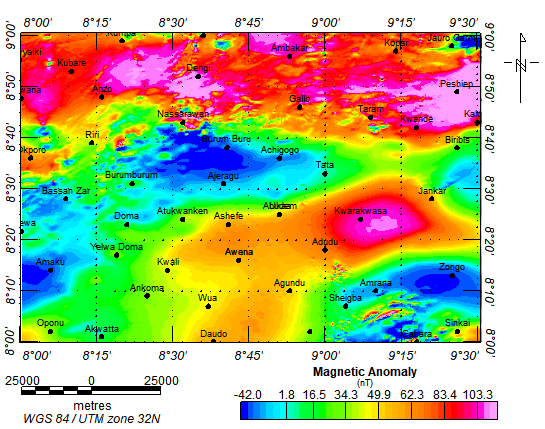
AB  - Mineral exploration faces challenges from complex geological architectures and subtle geophysical expressions of mineralization. This study proposes a joint gravity–magnetic machine learning framework integrating magnetic anomaly, analytic signal, gravity, and Source Parameter Imaging depth estimates to enhance mineralization prediction in Nigeria's Middle Benue Trough and adjoining basement terrain. Five supervised algorithms were evaluated, with Random Forest achieving the highest performance (accuracy=0.954, precision=0.889, recall=0.819, macro-F1=0.850, ROC-AUC=0.978). Correlation analysis revealed low feature redundancy, while unsupervised clustering confirmed structural partitions consistent with mapped fault systems. Ablation studies identified analytic signal as the most influential predictor; however, gravity and depth features contributed essential complementary information, increasing predictive accuracy by over 10% when combined with magnetic data. The resulting mineralized structure map aligns with conventional interpretations while delineating previously unrecognized targets in subdued magnetic response areas. This framework provides an objective, geologically defensible tool for energy-critical mineral targeting, demonstrating substantial improvements over traditional methods while minimizing environmental disturbance through enhanced exploration efficiency. The approach is directly applicable to sustainable resource development in similar terranes worldwide.
SN  - 3069-3268
PB  - Institute of Central Computation and Knowledge
LA  - English
ER  -
@article{Abraham2026A,
  author = {Ema Abraham and George-Best Azuoko and Ayatu Usman and Ikechukwu Onwe and Iheanyi Ikeazota and Cyril Afuwai and Ene Obande and Stanley Elom and Rock Onwe},
  title = {A Machine Learning Framework for the Investigation of Energy-Critical Mineralized Geologic Structures from Gravity and Magnetic Datasets: Implications for Sustainable Exploration},
  journal = {Journal of Geo-Energy and Environment},
  year = {2026},
  volume = {2},
  number = {2},
  pages = {95-117},
  doi = {10.62762/JGEE.2026.309205},
  url = {https://www.icck.org/article/abs/JGEE.2026.309205},
  abstract = {Mineral exploration faces challenges from complex geological architectures and subtle geophysical expressions of mineralization. This study proposes a joint gravity–magnetic machine learning framework integrating magnetic anomaly, analytic signal, gravity, and Source Parameter Imaging depth estimates to enhance mineralization prediction in Nigeria's Middle Benue Trough and adjoining basement terrain. Five supervised algorithms were evaluated, with Random Forest achieving the highest performance (accuracy=0.954, precision=0.889, recall=0.819, macro-F1=0.850, ROC-AUC=0.978). Correlation analysis revealed low feature redundancy, while unsupervised clustering confirmed structural partitions consistent with mapped fault systems. Ablation studies identified analytic signal as the most influential predictor; however, gravity and depth features contributed essential complementary information, increasing predictive accuracy by over 10\% when combined with magnetic data. The resulting mineralized structure map aligns with conventional interpretations while delineating previously unrecognized targets in subdued magnetic response areas. This framework provides an objective, geologically defensible tool for energy-critical mineral targeting, demonstrating substantial improvements over traditional methods while minimizing environmental disturbance through enhanced exploration efficiency. The approach is directly applicable to sustainable resource development in similar terranes worldwide.},
  keywords = {energy-critical minerals, mineral resources, magnetic, gravity, machine learning},
  issn = {3069-3268},
  publisher = {Institute of Central Computation and Knowledge}
}
 Copyright © 2026 by the Author(s). Published by Institute of Central Computation and Knowledge. This article is an open access article distributed under the terms and conditions of the Creative Commons Attribution (CC BY) license (https://creativecommons.org/licenses/by/4.0/), which permits use, sharing, adaptation, distribution and reproduction in any medium or format, as long as you give appropriate credit to the original author(s) and the source, provide a link to the Creative Commons licence, and indicate if changes were made.

Portico
All published articles are preserved here permanently:
https://www.portico.org/publishers/icck/