

Reservoir Characteristics and Controlling Factors of the Upper Permian Changxing Formation Reef‑Shoal Carbonate Reservoirs in the Huanglongchang Structure, Eastern Sichuan Basin


Article Information
Abstract
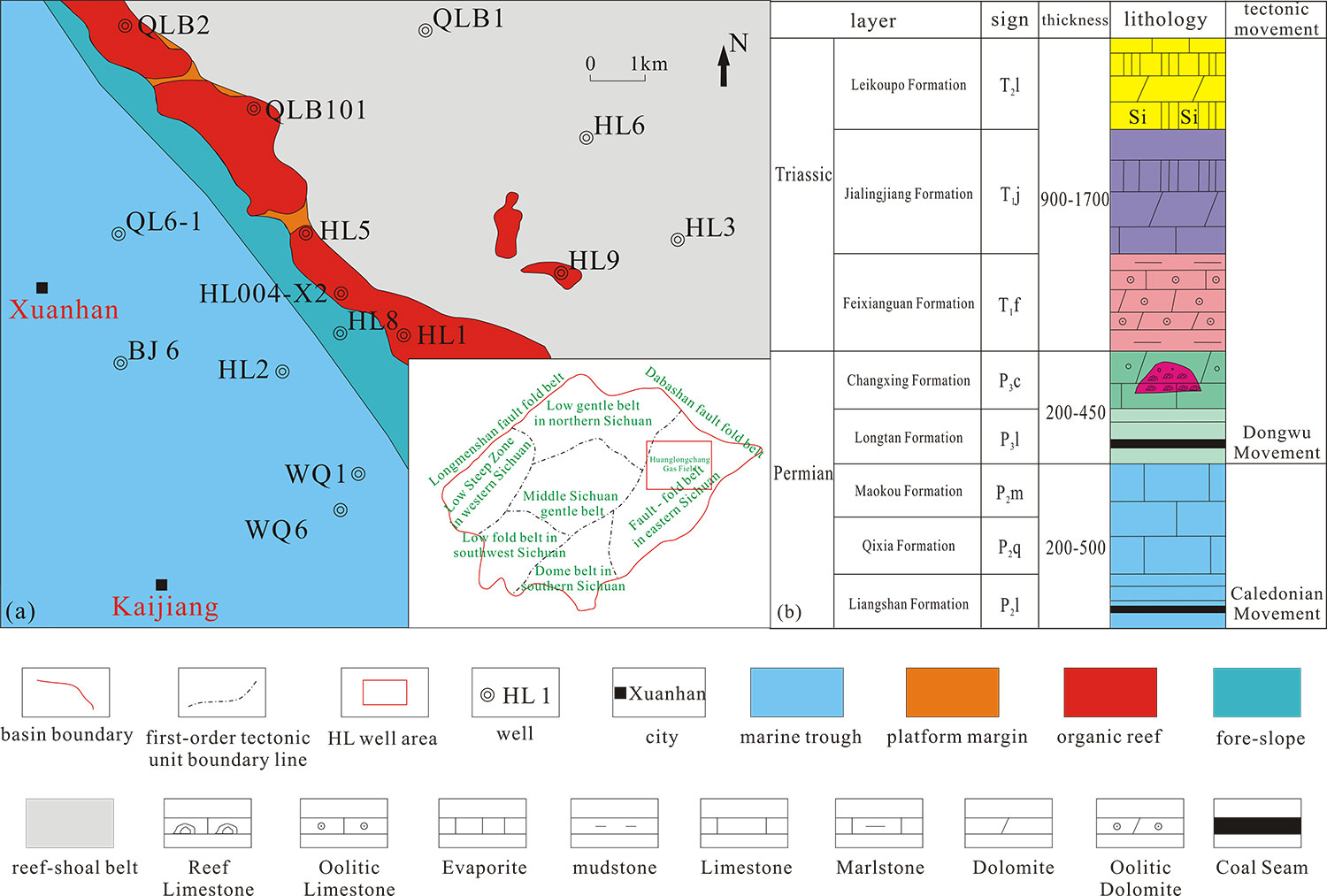
The Upper Permian Changxing Formation reef-shoal carbonates in the Huanglongchang Structure, eastern Sichuan Basin, are important gas reservoirs, yet their characteristics and controlling mechanisms remain poorly understood. We integrated 481 core samples and 126 cast thin sections from 8 wells with logging, petrophysical, and structural data to characterize reservoir properties and controls. The results show that: (1) Reservoirs are dominated by oolitic, reef breccia, and rudstone dolomites, with secondary dissolution pores as the main storage space. They exhibit low porosity, low permeability, and strong heterogeneity, with porosity of 4%-12% and permeability of 0.1-10 mD. (2) The thermogenic dry gas contains 92.86%-97.41% methane. CaCl$_2$-type formation water has an average TDS of 110.15 g/L, indicating a strongly confined accumulation environment. (3) Platform-margin reef-shoal facies are most favorable for reservoir development, particularly back-reef shoals, with an average effective porosity of 8.75%. (4) Multi-stage dolomitization and dissolution are the principal constructive diagenetic processes. Burial dolomitization creates a compaction-resistant intercrystalline pore framework, while karstification and burial dissolution enlarge storage space. Yanshanian and Himalayan fractures further enhance permeability, with fracture intensity increasing toward structural highs and greater fold curvature. Therefore, overlap zones of platform-margin reef-shoal bodies and structural highs are most favorable for high-quality reservoirs. These results establish a coupled model of ``sedimentary facies constraint-diagenetic modification-tectonic fracture enhancement'' and provide guidance for reef gas exploration around the Kaijiang-Liangping Trough.
Graphical Abstract
Keywords
Data Availability Statement
Funding
Conflicts of Interest
AI Use Statement
Ethical Approval and Consent to Participate
References
- Wilson, J. L. (1976). Carbonate facies in geologic history. Mineralogical Magazine, 40(315), 804.
[CrossRef] [Google Scholar] - Schlager, W. (2005). Carbonate Sedimentology and Sequence Stratigraphy (Concepts in Sedimentology and Paleontology 8). SEPM.
[CrossRef] [Google Scholar] - Noyahr, C. V., Weissenberger, J. A., Harris, N. B., & Banks, J. (2023). A facies-and sequence stratigraphy-based reservoir model for a carbonate reef complex: South Swan Hills oil pool, Alberta. Marine and Petroleum Geology, 152, 106226.
[CrossRef] [Google Scholar] - Janjuhah, H. T., Salim, A. M. A., Alansari, A., & Ghosh, D. P. (2018). Presence of microporosity in Miocene carbonate platform, Central Luconia, offshore Sarawak, Malaysia. Arabian Journal of Geosciences, 11(9), 204.
[CrossRef] [Google Scholar] - Ma, Y., Zhang, S., Guo, T., Zhu, G., Cai, X., & Li, M. (2008). Petroleum geology of the Puguang sour gas field in the Sichuan Basin, SW China. Marine and petroleum geology, 25(4-5), 357-370.
[CrossRef] [Google Scholar] - Hong, H. T., Wang, Y. G., & Yang, T. Q. (2008). Sedimentary facies of Changxing Formation and distribution of organic reef gas reservoirs in northern Sichuan Basin. Natural Gas Industry, 28(1), 38-41. https://trqgy.paperonce.org/#/digest?ArticleID=3552
[Google Scholar] - Yongsheng, M. A., Chuanlong, M. O. U., Qinyin, T. A. N., Qian, Y. U., & Ruihua, W. A. N. G. (2007). Reef-bank features and their constraint to reservoirs of natural gas, from Permian Changxing Formation to Triassic Feixianguan Formation in Daxian-Xuanhan Area of Sichuan Province, South China. Earth Science Frontiers, 14(1), 182-192.
[CrossRef] [Google Scholar] - Ma, Y., Guo, X., Guo, T., Huang, R., Cai, X., & Li, G. (2007). The Puguang gas field: New giant discovery in the mature Sichuan Basin, southwest China. AAPG bulletin, 91(5), 627-643.
[CrossRef] [Google Scholar] - Wang, Y. S., Xu, M., Yang, Y. N., Xia, Q., Jiang, B., Yang, C., & Zhang, H. (2022). Structural characteristics and deformation evolution of an intra-continental fold-thrust belt in Eastern Sichuan: Insights into analogue sandbox models. Frontiers in Earth Science, 10, 897882.
[CrossRef] [Google Scholar] - Zuo, M., Wang, J., Sun, X., Hu, Z., Bai, Y., Yang, W., & Li, H. (2024). Platform margin belt structure and sedimentation characteristics of Changxing Formation reefs on both sides of the Kaijiang-Liangping trough, eastern Sichuan Basin, China. Open Geosciences, 16(1), 20220615.
[CrossRef] [Google Scholar] - Liu, D., Tang, Y., Yu, J., & Xie, F. (2006). Features of organic reefs in the Upper Permian Changxing Formation and prediction of hidden reefs in the Huanglongchang structure, eastern Sichuan. Geology in China, 33(2), 427-435. http://geochina.cgs.gov.cn/en/article/pdf/preview/20060222.pdf
[Google Scholar] - Zhang, B., Zheng, R., Wang, X., Zheng, C., Wen, H., Luo, Y., & Chi, Y. (2012). Geochemical characteristics and diagenetic systems of dolomite reservoirs of the Changxing Formation in the eastern Sichuan Basin, China. Petroleum Science, 9(2), 141-153.
[CrossRef] [Google Scholar] - Gu, Y., Jiang, Y., Fu, Y., Chen, Z., Zhang, J., Zhou, L., & Jiang, Z. (2019). Hydrocarbon accumulation and main controlling factors of reef-shoal gas reservoirs in Changxing Formation in the complex tectonic area, Eastern Sichuan Basin. Arabian Journal of Geosciences, 12(24), 776.
[CrossRef] [Google Scholar] - Zhao, H., Yi, J., Zhang, H., Zhao, R., Zhang, J., Dai, J., ... & An, H. (2024). Seismic geological characteristics and gas reservoir distribution of Changxing Formation biological bio-reef reservoir in the Longhuichang-Tieshan area, northeastern Sichuan Basin, China. Journal of Natural Gas Geoscience, 9(2), 111-122.
[CrossRef] [Google Scholar] - Li, Y., Wen, H. G., Xu, W. L., & Zhao, S.. (2019). Genesis of Changxing Formation dolomite in Huanglongchang area, northeastern Sichuan Basin. Journal of Chengdu University of Technology: Science & Technology Edition, 46(1), 41-52, 63.
[CrossRef] [Google Scholar] - Embry, A. F., & Klovan, J. E. (1971). A late Devonian reef tract on northeastern Banks Island, NWT. Bulletin of Canadian petroleum geology, 19(4), 730-781.
[CrossRef] [Google Scholar] - Lucia, F. J. (1995). Rock-fabric/petrophysical classification of carbonate pore space for reservoir characterization. AAPG bulletin, 79(9), 1275-1300.
[CrossRef] [Google Scholar] - Singh, K. H., & Joshi, R. M. (Eds.). (2020). Petro-physics and Rock Physics of Carbonate Reservoirs. Springer, Singapore.
[CrossRef] [Google Scholar] - Ellis, D. V., & Singer, J. M. (2008). Well Logging for Earth Scientists (2nd ed.). Springer, Dordrecht.
[CrossRef] [Google Scholar] - Bateman, R. M. (2012). Openhole Log Analysis and Formation Evaluation (2nd ed.). Society of Petroleum Engineers (SPE), Richardson, TX.
[CrossRef] [Google Scholar] - Barros Galvis, N. E. (2018). Geomechanics, Fluid Dynamics and Well Testing, Applied to Naturally Fractured Carbonate Reservoirs. Springer, Cham.
[CrossRef] [Google Scholar] - Long, W. E. N., Bing, L. U. O., Xiao, C. H. E. N., Wenzheng, L. I., Yifeng, L. I. U., Anping, H. U., & Anjiang, S. H. E. N. (2025). Formation and preservation of pores in deep limestone reservoirs: A case study of Upper Permian Changxing Formation, central Sichuan Basin, SW China. Petroleum Exploration and Development, 52(2), 330-345.
[CrossRef] [Google Scholar] - Tan, L., Liu, H., Tang, Y., Luo, B., Zhang, Y., Yang, Y., ... & Yang, X. (2020). Characteristics and mechanism of upper permian reef reservoirs in the Eastern Longgang area, Northeastern Sichuan Basin, China. Petroleum, 6(2), 130-137.
[CrossRef] [Google Scholar] - Machel, H. G. (2004). Concepts and models of dolomitization: a critical reappraisal. Geological Society, London, Special Publications, 235(1), 7-63.
[CrossRef] [Google Scholar] - Huang, S., Zhao, Z., Yue, A., Jiang, H., Tian, X., Jiang, Q., ... & Song, H. (2024). Differences in gas sources of the Changxing–Feixianguan formations around the Kaijiang-Liangping Trough and favorable exploration directions for coal-formed gas generated by the Upper Permian Longtan Formation, Sichuan Basin, China. Journal of Natural Gas Geoscience, 9(5), 321-331.
[CrossRef] [Google Scholar] - Li, H., Qin, Q. R., Zhang, B. J., Ge, X. Y., Hu, X., Fan, C. H., & Tang, H. M. (2020). Tectonic fracture formation and distribution in ultradeep marine carbonate gas reservoirs: A case study of the Maokou Formation in the Jiulongshan Gas Field, Sichuan Basin, Southwest China. Energy & Fuels, 34(11), 14132-14146.
[CrossRef] [Google Scholar] - Loucks, R. G. (1999). Paleocave carbonate reservoirs: Origins, burial-depth modifications, spatial complexity, and reservoir implications. AAPG bulletin, 83(11), 1795-1834.
[CrossRef] [Google Scholar] - Budd, D. A., Frost III, E. L., Huntington, K. W., & Allwardt, P. F. (2013). Syndepositional deformation features in high-relief carbonate platforms: long-lived conduits for diagenetic fluids. Journal of Sedimentary Research, 83(1), 12-36.
[CrossRef] [Google Scholar] - Wang, H., Zhou, Q., Zhou, W., Zhang, Y., & He, J. (2021). Carbonate platform reef-shoal reservoir architecture study and characteristic evaluation: A case of S field in Turkmenistan. Energies, 15(1), 226.
[CrossRef] [Google Scholar]
Cite This Article
TY  - JOUR
AU  - Pan, Liao
AU  - Qin, Qirong
AU  - Wang, Shilin
AU  - Li, Hening
AU  - Luo, Mei
PY  - 2026
DA  - 2026/09/30
TI  - Reservoir Characteristics and Controlling Factors of the Upper Permian Changxing Formation Reef‑Shoal Carbonate Reservoirs in the Huanglongchang Structure, Eastern Sichuan Basin
JO  - Journal of Geo-Energy and Environment
T2  - Journal of Geo-Energy and Environment
JF  - Journal of Geo-Energy and Environment
VL  - 3
IS  - 1
SP  - 28
EP  - 47
DO  - 10.62762/JGEE.2026.460493
UR  - https://www.icck.org/article/abs/JGEE.2026.460493
KW  - Northeastern Sichuan Basin
KW  - Huanglongchang structure
KW  - Changxing Formation
KW  - Reservoir Characteristics
KW  - Controlling Factors
AB  - The Upper Permian Changxing Formation reef-shoal carbonates in the Huanglongchang Structure, eastern Sichuan Basin, are important gas reservoirs, yet their characteristics and controlling mechanisms remain poorly understood. We integrated 481 core samples and 126 cast thin sections from 8 wells with logging, petrophysical, and structural data to characterize reservoir properties and controls. The results show that: (1) Reservoirs are dominated by oolitic, reef breccia, and rudstone dolomites, with secondary dissolution pores as the main storage space. They exhibit low porosity, low permeability, and strong heterogeneity, with porosity of 4%-12% and permeability of 0.1-10 mD. (2) The thermogenic dry gas contains 92.86%-97.41% methane. CaCl$_2$-type formation water has an average TDS of 110.15 g/L, indicating a strongly confined accumulation environment. (3) Platform-margin reef-shoal facies are most favorable for reservoir development, particularly back-reef shoals, with an average effective porosity of 8.75%. (4) Multi-stage dolomitization and dissolution are the principal constructive diagenetic processes. Burial dolomitization creates a compaction-resistant intercrystalline pore framework, while karstification and burial dissolution enlarge storage space. Yanshanian and Himalayan fractures further enhance permeability, with fracture intensity increasing toward structural highs and greater fold curvature. Therefore, overlap zones of platform-margin reef-shoal bodies and structural highs are most favorable for high-quality reservoirs. These results establish a coupled model of ``sedimentary facies constraint-diagenetic modification-tectonic fracture enhancement'' and provide guidance for reef gas exploration around the Kaijiang-Liangping Trough.
SN  - 3069-3268
PB  - Institute of Central Computation and Knowledge
LA  - English
ER  -
@article{Pan2026Reservoir,
  author = {Liao Pan and Qirong Qin and Shilin Wang and Hening Li and Mei Luo},
  title = {Reservoir Characteristics and Controlling Factors of the Upper Permian Changxing Formation Reef‑Shoal Carbonate Reservoirs in the Huanglongchang Structure, Eastern Sichuan Basin},
  journal = {Journal of Geo-Energy and Environment},
  year = {2026},
  volume = {3},
  number = {1},
  pages = {28-47},
  doi = {10.62762/JGEE.2026.460493},
  url = {https://www.icck.org/article/abs/JGEE.2026.460493},
  abstract = {The Upper Permian Changxing Formation reef-shoal carbonates in the Huanglongchang Structure, eastern Sichuan Basin, are important gas reservoirs, yet their characteristics and controlling mechanisms remain poorly understood. We integrated 481 core samples and 126 cast thin sections from 8 wells with logging, petrophysical, and structural data to characterize reservoir properties and controls. The results show that: (1) Reservoirs are dominated by oolitic, reef breccia, and rudstone dolomites, with secondary dissolution pores as the main storage space. They exhibit low porosity, low permeability, and strong heterogeneity, with porosity of 4\%-12\% and permeability of 0.1-10 mD. (2) The thermogenic dry gas contains 92.86\%-97.41\% methane. CaCl\$\_2\$-type formation water has an average TDS of 110.15 g/L, indicating a strongly confined accumulation environment. (3) Platform-margin reef-shoal facies are most favorable for reservoir development, particularly back-reef shoals, with an average effective porosity of 8.75\%. (4) Multi-stage dolomitization and dissolution are the principal constructive diagenetic processes. Burial dolomitization creates a compaction-resistant intercrystalline pore framework, while karstification and burial dissolution enlarge storage space. Yanshanian and Himalayan fractures further enhance permeability, with fracture intensity increasing toward structural highs and greater fold curvature. Therefore, overlap zones of platform-margin reef-shoal bodies and structural highs are most favorable for high-quality reservoirs. These results establish a coupled model of ``sedimentary facies constraint-diagenetic modification-tectonic fracture enhancement'' and provide guidance for reef gas exploration around the Kaijiang-Liangping Trough.},
  keywords = {Northeastern Sichuan Basin, Huanglongchang structure, Changxing Formation, Reservoir Characteristics, Controlling Factors},
  issn = {3069-3268},
  publisher = {Institute of Central Computation and Knowledge}
}
Article Metrics
Publisher's Note
ICCK stays neutral with regard to jurisdictional claims in published maps and institutional affiliations.
Rights and Permissions
 Copyright © 2026 by the Author(s). Published by Institute of Central Computation and Knowledge. This article is an open access article distributed under the terms and conditions of the Creative Commons Attribution (CC BY) license (https://creativecommons.org/licenses/by/4.0/), which permits use, sharing, adaptation, distribution and reproduction in any medium or format, as long as you give appropriate credit to the original author(s) and the source, provide a link to the Creative Commons licence, and indicate if changes were made.


Portico
