Volume 2, Issue 1, ICCK Journal of Image Analysis and Processing
Volume 2, Issue 1, 2026
Submit Manuscript Edit a Special Issue
Article QR Code
Article QR Code
Scan the QR code for reading
Popular articles
ICCK Journal of Image Analysis and Processing, Volume 2, Issue 1, 2026: 17-26

Open Access | Research Article | 25 January 2026
Generalized $L_p$-Norm Based Non-Local Means Denoising
1 Department of Mathematics, Birla Institute of Technology and Science, Pilani – Hyderabad Campus, Hyderabad 500078, India
* Corresponding Author: Jagan Mohan Jonnalagadda, [email protected]
ARK: ark:/57805/jiap.2025.744487
Received: 19 December 2025, Accepted: 22 January 2026, Published: 25 January 2026  
Abstract
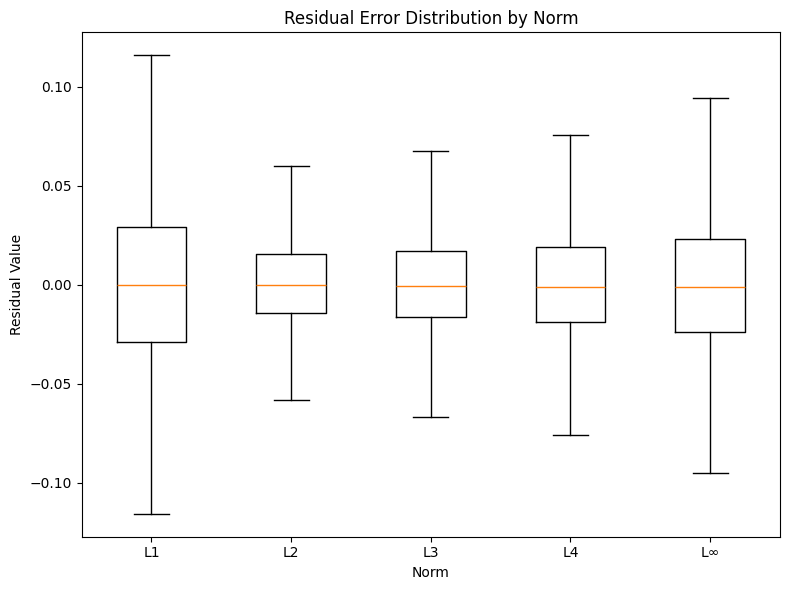
Non-local means (NL-means) is a state-of-the-art image denoising algorithm that leverages self-similarity by averaging similar patches weighted by the classic $L_2$-norm distance. In this work, we extend the similarity measure to arbitrary $L_p$-norms ($1 \le p \le \infty$) and investigate their impact on denoising performance. We implement and evaluate NL-means with $p = 1, 2, 3, 4, \infty$ and compare via quantitative metrics (MSE, MAE, PSNR, SSIM), residual analysis, and visual inspection. Experiments on the \emph{Lena} image corrupted with AWGN ($\sigma = 20$), a widely used benchmark setting in the denoising literature, show that while $L_2$-norm remains optimal overall, other norms offer nuanced trade-offs in edge preservation and robustness. Our analysis demonstrates that $L_1$-norm offers superior impulse noise resilience, while higher norms like $L_3$ and $L_4$ exhibit enhanced structure preservation in gradient-rich regions. Additionally, we present a parameter sensitivity study showing how the optimal filtering parameter $h$ varies across different $L_p$-norms, and analyze computational complexity trade-offs. These findings, which are consistent with the general theoretical properties of $L_p$-norms, provide insights into optimizing the NL-means algorithm for specific image characteristics and noise distributions.

Graphical Abstract
Generalized $L_p$-Norm Based Non-Local Means Denoising

Keywords
non-local means
image denoising
norm
quantitative metrics
residual analysis

Data Availability Statement
The data and code supporting the findings of this study are available at the following repository: https://github.com/YashGupta3003/nonlocal-means-lp

Funding
This work was supported without any funding.

Conflicts of Interest
The authors declare no conflicts of interest.

AI Use Statement
The authors declare that no generative AI was used in the preparation of this manuscript.

Ethical Approval and Consent to Participate
Not applicable.

References
  1. Buades, A., Coll, B., & Morel, J. M. (2011). Non-local Means Denoising. Image processing on line, 1, 208-212.
    [CrossRef]   [Google Scholar]
  2. Dutta, J., Leahy, R. M., & Li, Q. (2013). Non-local means denoising of dynamic PET images. PloS one, 8(12), e81390.
    [CrossRef]   [Google Scholar]
  3. Manjón, J. V., Carbonell-Caballero, J., Lull, J. J., García-Martí, G., Martí-Bonmatí, L., & Robles, M. (2008). MRI denoising using non-local means. Medical image analysis, 12(4), 514-523.
    [CrossRef]   [Google Scholar]
  4. Froment, J. (2014). Parameter-free fast pixel-wise non-local means denoising. Image Processing On Line, 4, 300-326.
    [CrossRef]   [Google Scholar]
  5. Arabi, H., & Zaidi, H. (2021). Non-local mean denoising using multiple PET reconstructions. Annals of nuclear medicine, 35(2), 176-186.
    [CrossRef]   [Google Scholar]
  6. Tasdizen, T. (2008). Principal components for non-local means image denoising. In 2008 15th IEEE International Conference on Image Processing (pp. 1728-1731). IEEE.
    [CrossRef]   [Google Scholar]
  7. Liu, Y. L., Wang, J., Chen, X., Guo, Y. W., & Peng, Q. S. (2008). A robust and fast non-local means algorithm for image denoising. Journal of computer science and technology, 23(2), 270-279.
    [CrossRef]   [Google Scholar]
  8. Shreyamsha Kumar, B. K. (2013). Image denoising based on non-local means filter and its method noise thresholding. Signal, image and video processing, 7(6), 1211-1227.
    [CrossRef]   [Google Scholar]
  9. Su, Y., Li, Z., Yu, H., & Wang, Z. (2020). Multi-band weighted $L_p$-norm minimization for image denoising. Information Sciences, 537, 162-183.
    [CrossRef]   [Google Scholar]
  10. Buades, A., Coll, B., & Morel, J. M. (2010). Image denoising methods. A new nonlocal principle. SIAM review, 52(1), 113-147.
    [CrossRef]   [Google Scholar]
  11. Zhang, X., Zheng, J., Yan, Y., Zhao, L., & Jiang, R. (2019). Joint weighted tensor schatten $p$-norm and tensor $L_p$-norm minimization for image denoising. IEEE Access, 7, 20273-20280.
    [CrossRef]   [Google Scholar]
  12. Maji, S. K., & Aetesam, H. (2023). Lp-norm-based successive denoising approach for hyperspectral images. Remote Sensing Letters, 14(4), 334-345.
    [CrossRef]   [Google Scholar]
  13. Gabor, D. (1946). Theory of communication. Part 1: The analysis of information. Journal of the Institution of Electrical Engineers-part III: radio and communication engineering, 93(26), 429-441.
    [CrossRef]   [Google Scholar]
  14. Perona, P., & Malik, J. (2002). Scale-space and edge detection using anisotropic diffusion. IEEE Transactions on pattern analysis and machine intelligence, 12(7), 629-639.
    [CrossRef]   [Google Scholar]
  15. Catté, F., Lions, P. L., Morel, J. M., & Coll, T. (1992). Image selective smoothing and edge detection by nonlinear diffusion. SIAM Journal on Numerical analysis, 29(1), 182-193.
    [CrossRef]   [Google Scholar]
  16. Rudin, L. I., Osher, S., & Fatemi, E. (1992). Nonlinear total variation based noise removal algorithms. Physica D: nonlinear phenomena, 60(1-4), 259-268.
    [CrossRef]   [Google Scholar]
  17. Tomasi, C., & Manduchi, R. (1998, January). Bilateral filtering for gray and color images. In Sixth international conference on computer vision (IEEE Cat. No. 98CH36271) (pp. 839-846). IEEE.
    [CrossRef]   [Google Scholar]
  18. Yaroslavsky, L. P. (2012). Digital picture processing: an introduction (Vol. 9). Springer Science & Business Media.
    [CrossRef]   [Google Scholar]
  19. Smith, S. M., & Brady, J. M. (1997). SUSAN—a new approach to low level image processing. International journal of computer vision, 23(1), 45-78.
    [CrossRef]   [Google Scholar]
  20. Buades, A., Coll, B., & Morel, J. M. (2005). A non-local algorithm for image denoising. In 2005 IEEE computer society conference on computer vision and pattern recognition (CVPR'05) (Vol. 2, pp. 60-65). IEEE.
    [CrossRef]   [Google Scholar]
  21. Smith, A. F. M. (1975). Contiguity of Probability Measures: Some Applications in Statistics.
    [CrossRef]   [Google Scholar]

Cite This Article
APA Style
Gupta, Y., & Jonnalagadda, J. M. (2026). Generalized Lp-Norm Based Non-Local Means Denoising. ICCK Journal of Image Analysis and Processing, 2(1), 17–26. https://doi.org/10.62762/JIAP.2025.744487
Export Citation
RIS Format
Compatible with EndNote, Zotero, Mendeley, and other reference managers
RIS format data for reference managers
TY  - JOUR
AU  - Gupta, Yash
AU  - Jonnalagadda, Jagan Mohan
PY  - 2026
DA  - 2026/01/25
TI  - Generalized $L_p$-Norm Based Non-Local Means Denoising
JO  - ICCK Journal of Image Analysis and Processing
T2  - ICCK Journal of Image Analysis and Processing
JF  - ICCK Journal of Image Analysis and Processing
VL  - 2
IS  - 1
SP  - 17
EP  - 26
DO  - 10.62762/JIAP.2025.744487
UR  - https://www.icck.org/article/abs/JIAP.2025.744487
KW  - non-local means
KW  - image denoising
KW  - norm
KW  - quantitative metrics
KW  - residual analysis
AB  - Non-local means (NL-means) is a state-of-the-art image denoising algorithm that leverages self-similarity by averaging similar patches weighted by the classic $L_2$-norm distance. In this work, we extend the similarity measure to arbitrary $L_p$-norms ($1 \le p \le \infty$) and investigate their impact on denoising performance. We implement and evaluate NL-means with $p = 1, 2, 3, 4, \infty$ and compare via quantitative metrics (MSE, MAE, PSNR, SSIM), residual analysis, and visual inspection. Experiments on the \emph{Lena} image corrupted with AWGN ($\sigma = 20$), a widely used benchmark setting in the denoising literature, show that while $L_2$-norm remains optimal overall, other norms offer nuanced trade-offs in edge preservation and robustness. Our analysis demonstrates that $L_1$-norm offers superior impulse noise resilience, while higher norms like $L_3$ and $L_4$ exhibit enhanced structure preservation in gradient-rich regions. Additionally, we present a parameter sensitivity study showing how the optimal filtering parameter $h$ varies across different $L_p$-norms, and analyze computational complexity trade-offs. These findings, which are consistent with the general theoretical properties of $L_p$-norms, provide insights into optimizing the NL-means algorithm for specific image characteristics and noise distributions.
SN  - 3068-6679
PB  - Institute of Central Computation and Knowledge
LA  - English
ER  - 
BibTeX Format
Compatible with LaTeX, BibTeX, and other reference managers
BibTeX format data for LaTeX and reference managers
@article{Gupta2026Generalize,
  author = {Yash Gupta and Jagan Mohan Jonnalagadda},
  title = {Generalized \$L\_p\$-Norm Based Non-Local Means Denoising},
  journal = {ICCK Journal of Image Analysis and Processing},
  year = {2026},
  volume = {2},
  number = {1},
  pages = {17-26},
  doi = {10.62762/JIAP.2025.744487},
  url = {https://www.icck.org/article/abs/JIAP.2025.744487},
  abstract = {Non-local means (NL-means) is a state-of-the-art image denoising algorithm that leverages self-similarity by averaging similar patches weighted by the classic \$L\_2\$-norm distance. In this work, we extend the similarity measure to arbitrary \$L\_p\$-norms (\$1 \le p \le \infty\$) and investigate their impact on denoising performance. We implement and evaluate NL-means with \$p = 1, 2, 3, 4, \infty\$ and compare via quantitative metrics (MSE, MAE, PSNR, SSIM), residual analysis, and visual inspection. Experiments on the \emph{Lena} image corrupted with AWGN (\$\sigma = 20\$), a widely used benchmark setting in the denoising literature, show that while \$L\_2\$-norm remains optimal overall, other norms offer nuanced trade-offs in edge preservation and robustness. Our analysis demonstrates that \$L\_1\$-norm offers superior impulse noise resilience, while higher norms like \$L\_3\$ and \$L\_4\$ exhibit enhanced structure preservation in gradient-rich regions. Additionally, we present a parameter sensitivity study showing how the optimal filtering parameter \$h\$ varies across different \$L\_p\$-norms, and analyze computational complexity trade-offs. These findings, which are consistent with the general theoretical properties of \$L\_p\$-norms, provide insights into optimizing the NL-means algorithm for specific image characteristics and noise distributions.},
  keywords = {non-local means, image denoising, norm, quantitative metrics, residual analysis},
  issn = {3068-6679},
  publisher = {Institute of Central Computation and Knowledge}
}

Article Metrics
Citations:

Crossref

0

Scopus

0

Web of Science

0
Article Access Statistics:
Views: 51
PDF Downloads: 13

Publisher's Note
ICCK stays neutral with regard to jurisdictional claims in published maps and institutional affiliations.

Rights and Permissions
CC BY Copyright © 2026 by the Author(s). Published by Institute of Central Computation and Knowledge. This article is an open access article distributed under the terms and conditions of the Creative Commons Attribution (CC BY) license (https://creativecommons.org/licenses/by/4.0/), which permits use, sharing, adaptation, distribution and reproduction in any medium or format, as long as you give appropriate credit to the original author(s) and the source, provide a link to the Creative Commons licence, and indicate if changes were made.
ICCK Journal of Image Analysis and Processing

ICCK Journal of Image Analysis and Processing

ISSN: 3068-6679 (Online)

Email: [email protected]

Portico

Portico

All published articles are preserved here permanently:
https://www.portico.org/publishers/icck/