

Deployment Challenges of Bayesian Network–Based Learning Path Recommendation in Real Classroom Settings




Article Information
Abstract
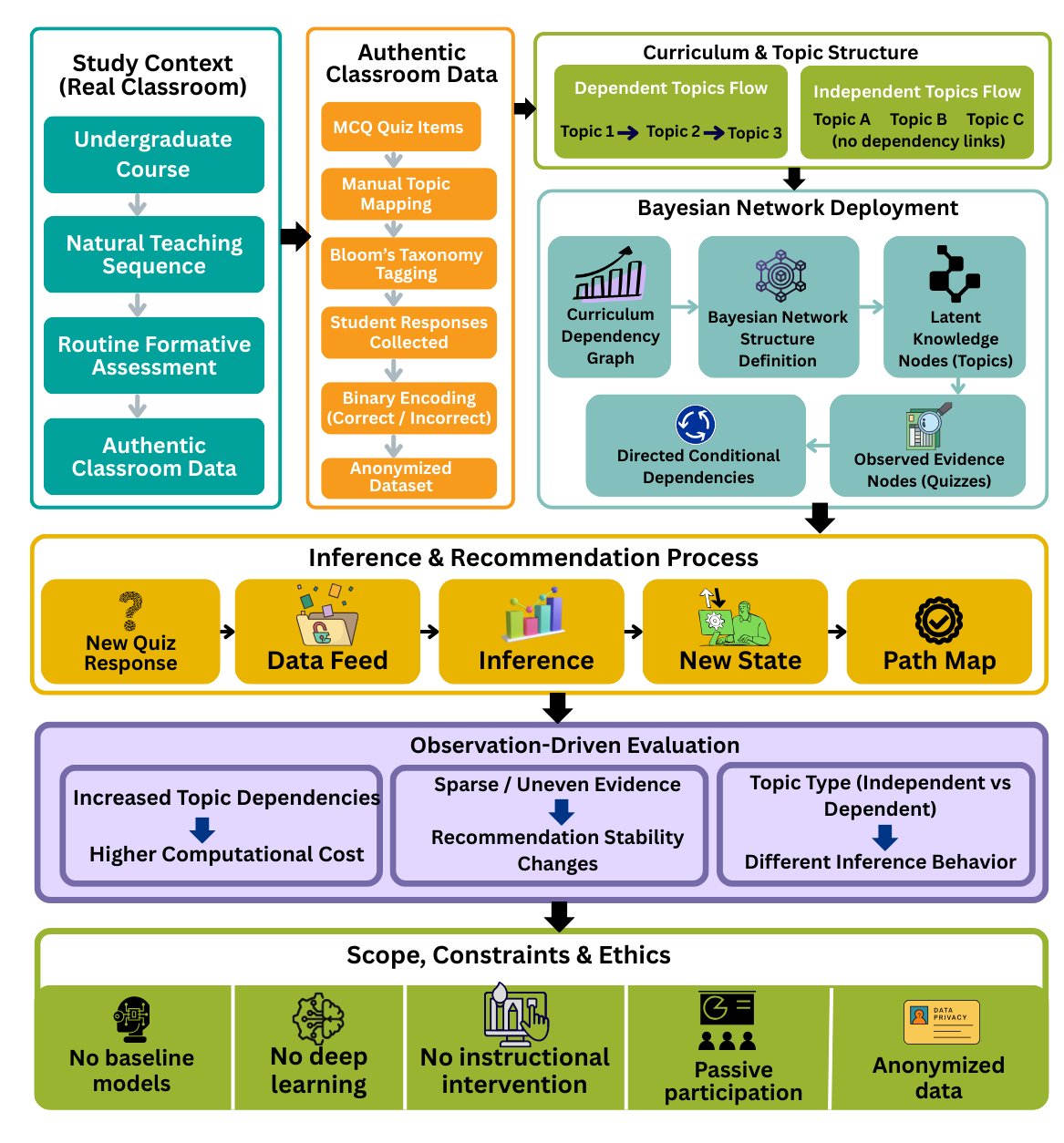
Bayesian Network (BN)–based Learning Path Recommendation (LPR) systems are widely adopted in personalized education for modeling uncertainty and providing interpretable learner representations. However, existing studies predominantly evaluate these systems under controlled settings that assume balanced data, simplified curricula, and unconstrained resources. Consequently, limited empirical understanding exists regarding their performance in authentic classrooms. This study addresses this gap by examining the real-world deployment of a BN-based LPR system using naturally occurring classroom data. The system is evaluated using 426,004 quiz responses collected across 19 formative assessments, reflecting routine instructional practice. Two curricular configurations were examined: an independent-topic structure with no explicit dependencies, and a prerequisite-based structure where mastery depended on prior knowledge. Rather than focusing on predictive accuracy, the study investigates operational feasibility, including structural complexity and memory consumption. From a software-engineering perspective, the central problem addressed is the scalability and inference feasibility of BN-based LPR systems under curriculum dependencies and real-world resource constraints. Results show that BN inference remains stable and computationally tractable for independent topics. In contrast, prerequisite-based modeling substantially increases network density, memory requirements, and inference variability, in some cases causing deployment failures under standard resources. Sparse assessment coverage at higher cognitive levels further undermines recommendation stability. This work provides a deployment-oriented perspective that complements performance-centric research and emphasizes the need for deployment-sensitive evaluation beyond accuracy-focused assessment in real classrooms.
Graphical Abstract
Keywords
Data Availability Statement
Funding
Conflicts of Interest
AI Use Statement
Ethical Approval and Consent to Participate
References
- Li, J., Chang, Y., Liu, S., Cai, C., Zhou, Q., Cai, X., ... & Liu, Y. (2024). Higher Education in China during the Pandemic: Analyzing Online Self-Learning Motivation Using Bayesian Networks. Sustainability, 16(17), 7330.
[CrossRef] [Google Scholar] - Talha. (2025, April 19). AI-Ready Large-Scale Student Performance Dataset: Quiz Assessments, Bloom's Taxonomy & ML Applications [Data set]. Zenodo.
[CrossRef] [Google Scholar] - Akhtar, A., & Akhtar, S. (2025). Requirements Elicitation in Transition: A Review of Conventional and Contemporary Approaches. ICCK Journal of Software Engineering, 1(1), 32-45.
[CrossRef] [Google Scholar] - Conati, C., Barral, O., Putnam, V., & Rieger, L. (2021). Toward personalized XAI: A case study in intelligent tutoring systems. Artificial intelligence, 298, 103503.
[CrossRef] [Google Scholar] - Hooshyar, D., & Druzdzel, M. J. (2024). Memory-Based Dynamic Bayesian Networks for Learner Modeling: Towards Early Prediction of Learners' Performance in Computational Thinking. Education Sciences, 14(8), 917.
[CrossRef] [Google Scholar] - Paleyes, A., Urma, R. G., & Lawrence, N. D. (2022). Challenges in deploying machine learning: a survey of case studies. ACM computing surveys, 55(6), 1-29.
[CrossRef] [Google Scholar] - Holstein, K., & Aleven, V. (2022). Designing for human–AI complementarity in K-12 education. Ai Magazine, 43(2), 239-248.
[CrossRef] [Google Scholar] - Luo, G., Gu, H., Dong, X., & Zhou, D. (2025). HA-LPR: A highly adaptive learning path recommendation. Education and Information Technologies, 30(10), 14597-14627.
[CrossRef] [Google Scholar] - Mavrikis, M., & Margeti, M. (2025). Review of mathematics education in the age of artificial intelligence.
[CrossRef] [Google Scholar] - Aftab, S. (2025). Software Engineering in the Era of Intelligence, Security, and Automation. ICCK Journal of Software Engineering, 1(1), 1.
[CrossRef] [Google Scholar] - Akhtar, S., & Aftab, S. (2025). Towards AI-Augmented Software Engineering: A Theoretical Framework. ICCK Journal of Software Engineering, 1(2), 124.
[CrossRef] [Google Scholar] - Zheng, Y., Wang, D., Zhang, J., Li, Y., Xu, Y., Zhao, Y., & Zheng, Y. (2025). A unified framework for personalized learning pathway recommendation in e-learning contexts. Education and Information Technologies, 30(6), 7911-7948.
[CrossRef] [Google Scholar] - Bin, Q., Zuhairi, M. F., & Morcos, J. (2024). A comprehensive study on personalized learning recommendation in e-learning system. IEEE Access, 12, 100446-100482.
[CrossRef] [Google Scholar] - Pelánek, R. (2017). Bayesian knowledge tracing, logistic models, and beyond: an overview of learner modeling techniques. User modeling and user-adapted interaction, 27(3), 313-350.
[CrossRef] [Google Scholar] - Martínez-Martínez, A., Gómez-Cambronero, Á., Montoliu, R., & Remolar, I. (2025). Towards the Adoption of Recommender Systems in Online Education: A Framework and Implementation. Big Data and Cognitive Computing, 9(10), 259.
[CrossRef] [Google Scholar] - Mohammadi, M., Tajik, E., Martinez-Maldonado, R., Sadiq, S., Tomaszewski, W., & Khosravi, H. (2025). Artificial intelligence in multimodal learning analytics: A systematic literature review. Computers and Education: Artificial Intelligence, 8, 100426.
[CrossRef] [Google Scholar] - Wiley, K., Dimitriadis, Y., & Linn, M. (2024). A human‐centred learning analytics approach for developing contextually scalable K‐12 teacher dashboards. British Journal of Educational Technology, 55(3), 845-885.
[CrossRef] [Google Scholar] - Haldar, S., Sengupta, S., & Das, A. K. (2025). Personalized Learning Path Recommendation using Graph Reinforcement Learning. Procedia Computer Science, 258, 3480–3489.
[CrossRef] [Google Scholar] - Yang, Q., & Liang, C. (2025). A Second-Classroom Personalized Learning Path Recommendation System Based on Large Language Model Technology. Applied Sciences, 15(14), 7655.
[CrossRef] [Google Scholar] - Ma, Y., Wang, L., Zhang, J., Liu, F., & Jiang, Q. (2023). A Personalized Learning Path Recommendation Method Incorporating Multi-Algorithm. Applied Sciences, 13(10), 5946.
[CrossRef] [Google Scholar] - Zhang, F., Feng, X., & Wang, Y. (2024). Personalized process–type learning path recommendation based on process mining and deep knowledge tracing. Knowledge-Based Systems, 303, 112431.
[CrossRef] [Google Scholar] - Zhou, L. Y., & Wang, Y. Y. (2025). Simulation of personalized english learning path recommendation system based on knowledge graph and deep reinforcement learning. Scientific Reports, 15(1), 34554.
[CrossRef] [Google Scholar] - Nguyen, D. T., & Nguyen, T. M. T. (2024, November). A Knowledge Map Mining-Based Personalized Learning Path Recommendation Solution for English Learning. In KDIR (pp. 48-59).
[CrossRef] [Google Scholar] - Sun, C., Huang, S., Sun, B., & Chu, S. (2025). Personalized learning path planning for higher education based on deep generative models and quantum machine learning: a multimodal learning analysis method integrating transformer, adversarial training and quantum state classification. Discover Artificial Intelligence, 5(1), 29.
[CrossRef] [Google Scholar] - Li, X., & Zhang, B. (2024). Personalized Learning Path Recommendation Algorithm for English Listening Learning. Journal of Electrical Systems, 20(6s), 2188–2199.
[CrossRef] [Google Scholar] - Cheng, X., Zhang, Z., Wang, J., Fang, L., He, C., Guan, Q., ... & Luo, W. (2025). GraphRAG-Induced Dual Knowledge Structure Graphs for Personalized Learning Path Recommendation. arXiv preprint arXiv:2506.22303.
[Google Scholar] - Abu-Rasheed, H., Jumbo, C., Al Amin, R., Weber, C., Wiese, V., Obermaisser, R., & Fathi, M. (2025, April). LLM-assisted knowledge graph completion for curriculum and domain modelling in personalized higher education recommendations. In 2025 ieee global engineering education conference (educon) (pp. 1-5). IEEE.
[CrossRef] [Google Scholar] - Gul, R., Kanwal, S., & Khan, S. S. (2020). Preferences of the teachers in employing revised blooms taxonomy in their instructions. sjesr, 3(2), 258-266.
[CrossRef] [Google Scholar] - Krathwohl, D. R. (2002). A Revision of Bloom's Taxonomy: An Overview. Theory Into Practice, 41(4), 212–218.
[CrossRef] [Google Scholar] - bnlearn documentation. (n.d.). BNLearn's Documentation. Retrieved January 14, 2026, from https://erdogant.github.io/bnlearn/pages/html/index.html
[Google Scholar] - Kuhlmane, S., Grasevic, D., Bakery, R. S., Scotte, G., & Siemens, G. (2025). Learning Analytics and Impact on Personalized Student Learning. Journal of Teaching and Learning, 2(1), 27-50.
[CrossRef] [Google Scholar] - Baker, R. S. (2019). Challenges for the future of educational data mining: The Baker learning analytics prizes. Journal of educational data mining, 11(1), 1-17.
[CrossRef] [Google Scholar] - Käser, T., & Schwartz, D. L. (2020). Modeling and analyzing inquiry strategies in open-ended learning environments. International Journal of Artificial Intelligence in Education, 30(3), 504-535.
[CrossRef] [Google Scholar] - Zhang, N., Biswas, G., & Hutchins, N. (2022). Measuring and analyzing students’ strategic learning behaviors in open-ended learning environments. International Journal of Artificial Intelligence in Education, 32(4), 931-970.
[CrossRef] [Google Scholar] - Cukurova, M. (2025). The interplay of learning, analytics and artificial intelligence in education: A vision for hybrid intelligence. British Journal of Educational Technology, 56(2), 469-488.
[CrossRef] [Google Scholar]
Cite This Article
TY  - JOUR
AU  - Mansoor, Muhammad Talha
PY  - 2026
DA  - 2026/03/16
TI  - Deployment Challenges of Bayesian Network–Based Learning Path Recommendation in Real Classroom Settings
JO  - ICCK Journal of Software Engineering
T2  - ICCK Journal of Software Engineering
JF  - ICCK Journal of Software Engineering
VL  - 2
IS  - 1
SP  - 71
EP  - 84
DO  - 10.62762/JSE.2025.490810
UR  - https://www.icck.org/article/abs/JSE.2025.490810
KW  - bayesian networks
KW  - learning path recommendation
KW  - real-world deployment
KW  - curriculum dependency
KW  - adaptive learning systems
KW  - educational data mining
KW  - computational feasibility
AB  - Bayesian Network (BN)–based Learning Path Recommendation (LPR) systems are widely adopted in personalized education for modeling uncertainty and providing interpretable learner representations. However, existing studies predominantly evaluate these systems under controlled settings that assume balanced data, simplified curricula, and unconstrained resources. Consequently, limited empirical understanding exists regarding their performance in authentic classrooms. This study addresses this gap by examining the real-world deployment of a BN-based LPR system using naturally occurring classroom data. The system is evaluated using 426,004 quiz responses collected across 19 formative assessments, reflecting routine instructional practice. Two curricular configurations were examined: an independent-topic structure with no explicit dependencies, and a prerequisite-based structure where mastery depended on prior knowledge. Rather than focusing on predictive accuracy, the study investigates operational feasibility, including structural complexity and memory consumption. From a software-engineering perspective, the central problem addressed is the scalability and inference feasibility of BN-based LPR systems under curriculum dependencies and real-world resource constraints. Results show that BN inference remains stable and computationally tractable for independent topics. In contrast, prerequisite-based modeling substantially increases network density, memory requirements, and inference variability, in some cases causing deployment failures under standard resources. Sparse assessment coverage at higher cognitive levels further undermines recommendation stability. This work provides a deployment-oriented perspective that complements performance-centric research and emphasizes the need for deployment-sensitive evaluation beyond accuracy-focused assessment in real classrooms.
SN  - 3069-1834
PB  - Institute of Central Computation and Knowledge
LA  - English
ER  -
@article{Mansoor2026Deployment,
  author = {Muhammad Talha Mansoor},
  title = {Deployment Challenges of Bayesian Network–Based Learning Path Recommendation in Real Classroom Settings},
  journal = {ICCK Journal of Software Engineering},
  year = {2026},
  volume = {2},
  number = {1},
  pages = {71-84},
  doi = {10.62762/JSE.2025.490810},
  url = {https://www.icck.org/article/abs/JSE.2025.490810},
  abstract = {Bayesian Network (BN)–based Learning Path Recommendation (LPR) systems are widely adopted in personalized education for modeling uncertainty and providing interpretable learner representations. However, existing studies predominantly evaluate these systems under controlled settings that assume balanced data, simplified curricula, and unconstrained resources. Consequently, limited empirical understanding exists regarding their performance in authentic classrooms. This study addresses this gap by examining the real-world deployment of a BN-based LPR system using naturally occurring classroom data. The system is evaluated using 426,004 quiz responses collected across 19 formative assessments, reflecting routine instructional practice. Two curricular configurations were examined: an independent-topic structure with no explicit dependencies, and a prerequisite-based structure where mastery depended on prior knowledge. Rather than focusing on predictive accuracy, the study investigates operational feasibility, including structural complexity and memory consumption. From a software-engineering perspective, the central problem addressed is the scalability and inference feasibility of BN-based LPR systems under curriculum dependencies and real-world resource constraints. Results show that BN inference remains stable and computationally tractable for independent topics. In contrast, prerequisite-based modeling substantially increases network density, memory requirements, and inference variability, in some cases causing deployment failures under standard resources. Sparse assessment coverage at higher cognitive levels further undermines recommendation stability. This work provides a deployment-oriented perspective that complements performance-centric research and emphasizes the need for deployment-sensitive evaluation beyond accuracy-focused assessment in real classrooms.},
  keywords = {bayesian networks, learning path recommendation, real-world deployment, curriculum dependency, adaptive learning systems, educational data mining, computational feasibility},
  issn = {3069-1834},
  publisher = {Institute of Central Computation and Knowledge}
}
Article Metrics
Publisher's Note
ICCK stays neutral with regard to jurisdictional claims in published maps and institutional affiliations.
Rights and Permissions
 Copyright © 2026 by the Author(s). Published by Institute of Central Computation and Knowledge. This article is an open access article distributed under the terms and conditions of the Creative Commons Attribution (CC BY) license (https://creativecommons.org/licenses/by/4.0/), which permits use, sharing, adaptation, distribution and reproduction in any medium or format, as long as you give appropriate credit to the original author(s) and the source, provide a link to the Creative Commons licence, and indicate if changes were made.


Portico
