
The Role of “Reintegrative Shaming” in Juvenile Criminal Justice



Article Information
Abstract
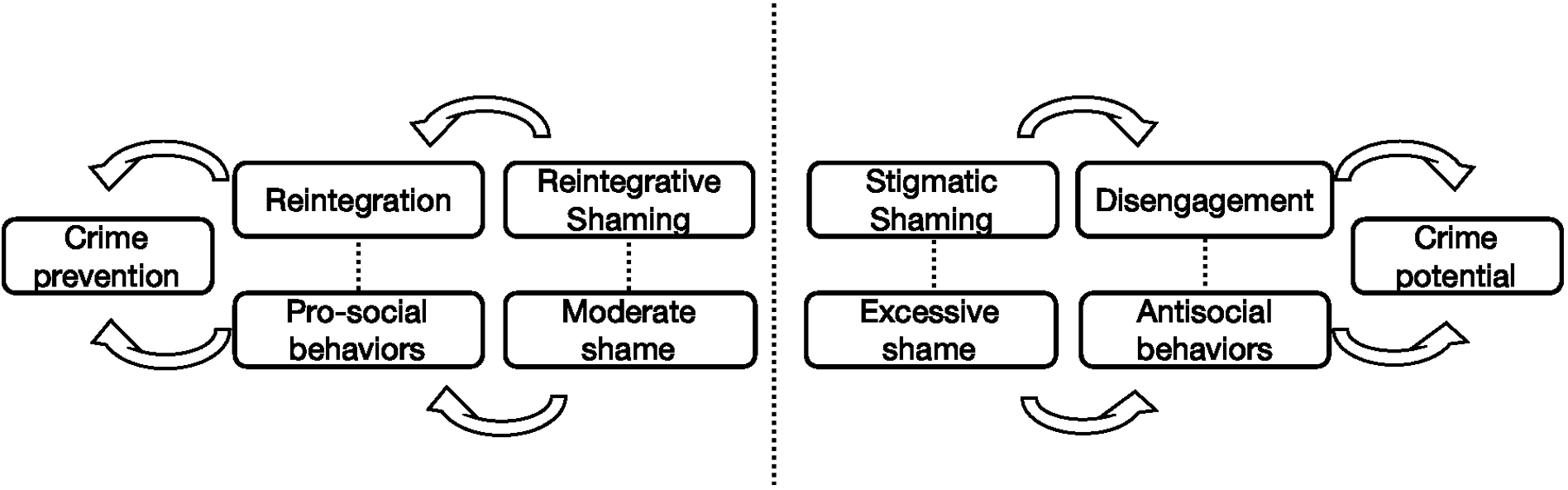
Taking China as an example, “Reintegrative Shaming” can provide new ideas for the progress of juvenile criminal justice, especially educational correction. Although “Reintegrative Shaming” is often regarded as a philosophy of law, it is not only a theory but also a feasible method supported by psychological evidence. The emotional experience of shame has a moderating effect on the behavioral habits of minors, and appropriate forgiveness can help avoid the negative effects of excessive shame. In order to effectively apply “Reintegrative Shaming” in juvenile criminal justice, it is necessary to rationalize the conduct of exhortatory meetings and to give due consideration to the participants.
Graphical Abstract
Keywords
Data Availability Statement
Funding
Conflicts of Interest
Ethical Approval and Consent to Participate
References
- Yin, X., & Zhao, R. (2024). Policing juvenile delinquency in China: Exploring the influence of officer-related individual and organizational factors on discretionary police decision-making. Children and Youth Services Review, 158, 107459.
[CrossRef] [Google Scholar] - Zhao, R., Zhang, H., & Liu, J. (2015). China’s juvenile justice: A system in transition. Juvenile justice: International perspectives, models, and trends, 137-162.
[Google Scholar] - Shek, D. T., Leung, K. H., Dou, D., & Zhu, X. (2022). Family functioning and adolescent delinquency in mainland China: positive youth development attributes as a mediator. Frontiers in psychiatry, 13, 883439.
[CrossRef] [Google Scholar] - Braithwaite, J. (1989). Crime, shame and reintegration. Cambridge University Press.
[Google Scholar] - Johnstone, G. (2013). Restorative justice: Ideas, values, debates. Routledge.
[Google Scholar] - Wu, Z., & Wu, S. (2023). The past, present, and future of restorative justice in the Chinese Mainland: A systematic review of Chinese literature. Asian Journal of Criminology, 18(2), 89-112.
[CrossRef] [Google Scholar] - Tracy, J. L., & Robins, R. W. (2004). " Putting the Self Into Self-Conscious Emotions: A Theoretical Model". Psychological inquiry, 15(2), 103-125.
[CrossRef] [Google Scholar] - Lewis, H. B. (1971). Shame and guilt in neurosis. Psychoanalytic review, 58(3), 419.
[Google Scholar] - Tracy, J. L., Robins, R. W., & Tangney, J. P. (2007). The self-conscious emotions. New York: Guilford.
[Google Scholar] - Mills, R. S. (2005). Taking stock of the developmental literature on shame. Developmental review, 25(1), 26-63.
[CrossRef] [Google Scholar] - Hundt, N. E., & Holohan, D. R. (2012). The role of shame in distinguishing perpetrators of intimate partner violence in US veterans. Journal of Traumatic Stress, 25(2), 191-197.
[CrossRef] [Google Scholar] - Stuewig, J., Tangney, J. P., Kendall, S., Folk, J. B., Meyer, C. R., & Dearing, R. L. (2015). Children’s proneness to shame and guilt predict risky and illegal behaviors in young adulthood. Child Psychiatry & Human Development, 46, 217-227.
[CrossRef] [Google Scholar] - De France, K., Lanteigne, D., Glozman, J., & Hollenstein, T. (2017). A new measure of the expression of shame: The shame code. Journal of Child and Family Studies, 26, 769-780.
[CrossRef] [Google Scholar] - Eisenberger, N. I., Lieberman, M. D., & Williams, K. D. (2003). Does rejection hurt? An fMRI study of social exclusion. Science, 302(5643), 290-292.
[CrossRef] [Google Scholar] - Hay, C. (2001). An exploratory test of Braithwaite's reintegrative shaming theory. Journal of Research in Crime and Delinquency, 38(2), 132-153.
[CrossRef] [Google Scholar] - Pranis, K., Bazemore, G., Umbreit, M., & Lipkin, R. (1998). Guide for implementing the balanced and restorative justice model. NCJ, (1667887). Retrieved from https://www.ojjdp.gov/pubs/implementing/ack.html
[Google Scholar] - Aripin, Z. (2020). Implementation Of Laws On The Criminal Jurisdiction System Using A Restorative Justice Approach (A Case Study at'Aisyiyah Legal Aid Institute, Central Java). Law and Justice, 5(2), 145-160.
[CrossRef] [Google Scholar] - Krisberg, B. (2005). Juvenile justice: Redeeming our children. Sage.
[Google Scholar] - Harris, N. (2006). Reintegrative shaming, shame, and criminal justice. Journal of social issues, 62(2), 327-346.
[CrossRef] [Google Scholar] - Morris, A. (2002). Critiquing the critics: A brief response to critics of restorative justice. British Journal of Criminology, 42(3), 596-615.
[CrossRef] [Google Scholar]
Cited By (1)
-
Tali Gal, Ruthy Lowenstein Lazar. Beyond the Adversarial Rivalry: A Developmental Rights‐Based Model for Minor‐on‐Minor Crime, Part 2.
Behavioral Sciences & the Law, 2026 , 44 (5).
[CrossRef]
Cite This Article
TY  - JOUR
AU  - Shi, Mengyi
PY  - 2024
DA  - 2024/09/30
TI  - The Role of “Reintegrative Shaming” in Juvenile Criminal Justice
JO  - Journal of Social Systems and Policy Analysis
T2  - Journal of Social Systems and Policy Analysis
JF  - Journal of Social Systems and Policy Analysis
VL  - 1
IS  - 3
SP  - 83
EP  - 88
DO  - 10.62762/JSSPA.2024.909972
UR  - https://www.icck.org/article/abs/jsspa.2024.909972
KW  - reintegrative shaming
KW  - juvenile criminal justice
KW  - crime prevention
AB  - Taking China as an example, “Reintegrative Shaming” can provide new ideas for the progress of juvenile criminal justice, especially educational correction. Although “Reintegrative Shaming” is often regarded as a philosophy of law, it is not only a theory but also a feasible method supported by psychological evidence. The emotional experience of shame has a moderating effect on the behavioral habits of minors, and appropriate forgiveness can help avoid the negative effects of excessive shame. In order to effectively apply “Reintegrative Shaming” in juvenile criminal justice, it is necessary to rationalize the conduct of exhortatory meetings and to give due consideration to the participants.
SN  - 3068-5540
PB  - Institute of Central Computation and Knowledge
LA  - English
ER  -
@article{Shi2024The,
  author = {Mengyi Shi},
  title = {The Role of “Reintegrative Shaming” in Juvenile Criminal Justice},
  journal = {Journal of Social Systems and Policy Analysis},
  year = {2024},
  volume = {1},
  number = {3},
  pages = {83-88},
  doi = {10.62762/JSSPA.2024.909972},
  url = {https://www.icck.org/article/abs/jsspa.2024.909972},
  abstract = {Taking China as an example, “Reintegrative Shaming” can provide new ideas for the progress of juvenile criminal justice, especially educational correction. Although “Reintegrative Shaming” is often regarded as a philosophy of law, it is not only a theory but also a feasible method supported by psychological evidence. The emotional experience of shame has a moderating effect on the behavioral habits of minors, and appropriate forgiveness can help avoid the negative effects of excessive shame. In order to effectively apply “Reintegrative Shaming” in juvenile criminal justice, it is necessary to rationalize the conduct of exhortatory meetings and to give due consideration to the participants.},
  keywords = {reintegrative shaming, juvenile criminal justice, crime prevention},
  issn = {3068-5540},
  publisher = {Institute of Central Computation and Knowledge}
}
Article Metrics
Publisher's Note
ICCK stays neutral with regard to jurisdictional claims in published maps and institutional affiliations.
Rights and Permissions
 Copyright © 2024 by the Author(s). Published by Institute of Central Computation and Knowledge. This article is an open access article distributed under the terms and conditions of the Creative Commons Attribution (CC BY) license (https://creativecommons.org/licenses/by/4.0/), which permits use, sharing, adaptation, distribution and reproduction in any medium or format, as long as you give appropriate credit to the original author(s) and the source, provide a link to the Creative Commons licence, and indicate if changes were made.


Portico
