
Knowledge Mapping Analysis of Research Hotspots and Development Trends in Green Consumption in China—A CiteSpace-Based Study



Article Information
Abstract
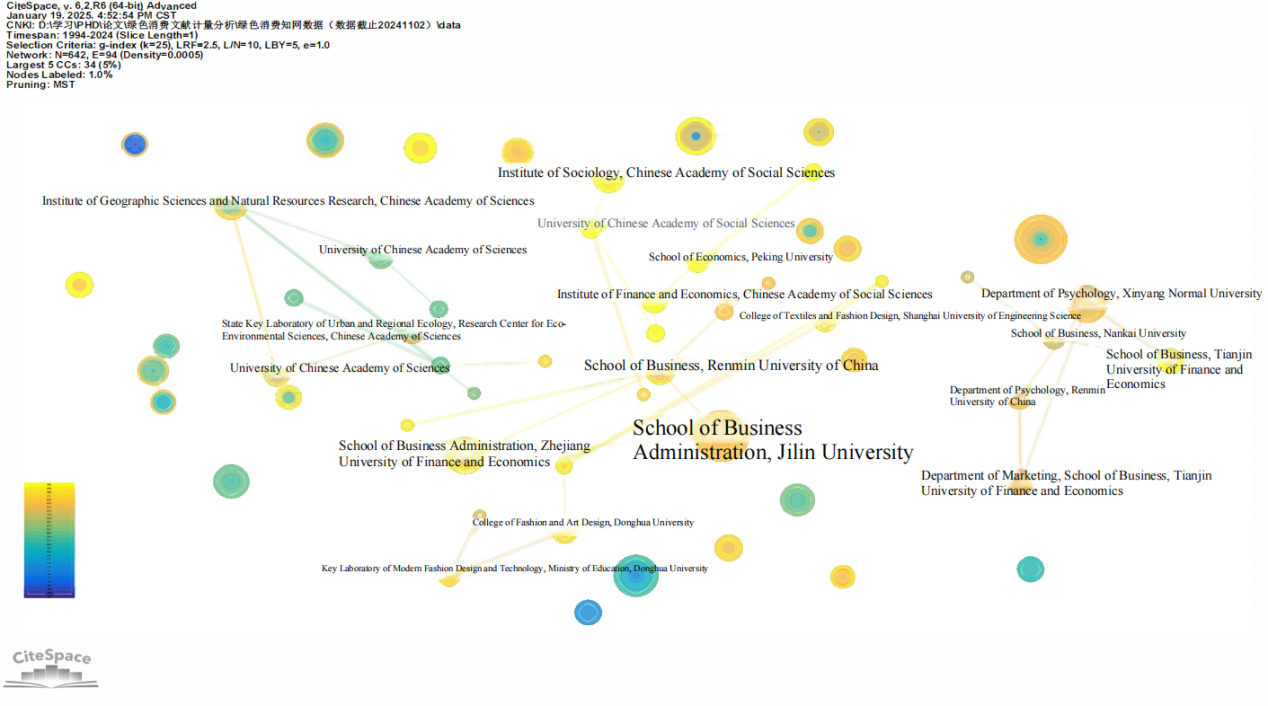
The global sustainability paradigm, catalyzed by environmental degradation since the 1960s, has positioned green consumption as a critical strategy to reconcile economic growth with ecological preservation. While international scholarship extensively explores this field, China's unique socioeconomic trajectory---marked by rapid industrialization, centralized governance, and the ``dual carbon'' (carbon peak and neutrality) targets---necessitates a dedicated investigation into its indigenous knowledge system. Leveraging CiteSpace, this scientometric study systematically analyzes 2,793 core journal articles from the Chinese National Knowledge Infrastructure (CNKI, 1994--2024) to map the intellectual evolution of green consumption research. Key findings reveal three developmental phases: initial conceptualization (1994--2000), rapid expansion (2001--2011), and thematic stabilization (2012--2024). Cluster analyses identify dominant research foci, including green marketing, circular economy, and ecological civilization, with emerging frontiers in carbon neutrality and digital economy. Despite high scholarly output, collaboration networks exhibit sparse connectivity (density = 0.0004--0.0005), reflecting structural barriers in China's academic evaluation system that prioritizes first-author publications over interdisciplinary synergy. Methodologically, this study advances a systematic knowledge map to guide future research and policy formulation, emphasizing the synergistic potential of digital innovation and green finance in implementing sustainable consumption. The findings underscore China's policy-driven research paradigm, contrasting with Western market-centric approaches, and provide actionable insights for global sustainability governance.
Graphical Abstract
Keywords
Data Availability Statement
Funding
Conflicts of Interest
Ethical Approval and Consent to Participate
References
- Chen, C. (2014). The citespace manual. College of Computing and Informatics, 1(1), 1-84.
[Google Scholar] - Chen, C. (2017). Science mapping: a systematic review of the literature. Journal of data and information science, 2(2).
[CrossRef] [Google Scholar] - MacArthur, E. (2015). Towards a circular economy: business rationale for an accelerated transition. Greener Manag International, 20, 3.
[Google Scholar] - A European green deal. (n.d.). European Commission. Retrieved from https://commission.europa.eu/strategy-and-policy/priorities-2019-2024/european-green-deal_en
[Google Scholar] - Fetting, C. (2020). The European green deal. ESDN Report, December, 2(9), 53.
[Google Scholar] - Hawken, P., Lovins, A. B., & Lovins, L. H. (2013). Natural capitalism: The next industrial revolution. Routledge.
[Google Scholar] - Change, O. C. (2007). Intergovernmental panel on climate change. World Meteorological Organization, 52(1-43), 1.
[Google Scholar] - Jackson, T. (2009). Prosperity without growth: Economics for a finite planet. Routledge.
[Google Scholar] - Li, N., Qin, Y., Dai, D., Wang, P., Shi, M., Gao, J., ... & Xu, R. (2022). Transdermal delivery of therapeutic compounds with nanotechnological approaches in psoriasis. Frontiers in bioengineering and biotechnology, 9, 804415.
[CrossRef] [Google Scholar] - Artacho-Ramírez, M. A., Pacheco-Blanco, B., Cloquell-Ballester, V. A., Vicent, M., & Celades, I. (2020). Quick wins workshop and companies profiling to analyze industrial symbiosis potential. Valenciaport’s cluster as case study. Sustainability, 12(18), 7495.
[CrossRef] [Google Scholar] - MacArthur, E. (2013). Towards the circular economy. Journal of industrial ecology, 2(1), 23-44.
[Google Scholar] - Li, J., Takehiko, M., Nishikizawa, S., Suwanteep, K., & Yan, L. City-Level Analysis of Driving Factors and Peak of Energy-Related Industrial Co2 Emissions in Shandong Province, China.
[Google Scholar] - Peattie, K. (2001). Towards sustainability: the third age of green marketing. The marketing review, 2(2), 129-146.
[CrossRef] [Google Scholar] - Quan, W., Chen, B., & Shu, F. (2017). Publish or impoverish: An investigation of the monetary reward system of science in China (1999-2016). Aslib Journal of Information Management, 69(5), 486-502.
[CrossRef] [Google Scholar] - Zhi, Q., & Meng, T. (2016). Funding allocation, inequality, and scientific research output: an empirical study based on the life science sector of Natural Science Foundation of China. Scientometrics, 106, 603-628.
[CrossRef] [Google Scholar] - Thaler, R. H., & Sunstein, C. R. (2009). Nudge: Improving decisions about health, wealth, and happiness. Penguin.
[Google Scholar] - Declaration, R. (1992). Rio declaration on environment and development.
[Google Scholar] - Wang, Y., Guo, C. H., Chen, X. J., Jia, L. Q., Guo, X. N., Chen, R. S., ... & Wang, H. D. (2021). Carbon peak and carbon neutrality in China: Goals, implementation path and prospects. China Geology, 4(4), 720-746.
[CrossRef] [Google Scholar] - Zhao, X., Ma, X., Chen, B., Shang, Y., & Song, M. (2022). Challenges toward carbon neutrality in China: Strategies and countermeasures. Resources, Conservation and Recycling, 176, 105959.
[CrossRef] [Google Scholar] - Zupic, I., & Čater, T. (2015). Bibliometric methods in management and organization. Organizational research methods, 18(3), 429-472.
[CrossRef] [Google Scholar]
Cite This Article
TY  - JOUR
AU  - Zhang, Wentao
AU  - Wang, Chunsheng
AU  - Zhang, Yan
PY  - 2025
DA  - 2025/06/30
TI  - Knowledge Mapping Analysis of Research Hotspots and Development Trends in Green Consumption in China—A CiteSpace-Based Study
JO  - Journal of Social Systems and Policy Analysis
T2  - Journal of Social Systems and Policy Analysis
JF  - Journal of Social Systems and Policy Analysis
VL  - 2
IS  - 2
SP  - 94
EP  - 104
DO  - 10.62762/JSSPA.2025.119215
UR  - https://www.icck.org/article/abs/jsspa.2025.119215
KW  - green consumption
KW  - sustainable consumption
KW  - knowledge mapping
KW  - CiteSpace
KW  - digital innovation
AB  - The global sustainability paradigm, catalyzed by environmental degradation since the 1960s, has positioned green consumption as a critical strategy to reconcile economic growth with ecological preservation. While international scholarship extensively explores this field, China's unique socioeconomic trajectory---marked by rapid industrialization, centralized governance, and the ``dual carbon'' (carbon peak and neutrality) targets---necessitates a dedicated investigation into its indigenous knowledge system. Leveraging CiteSpace, this scientometric study systematically analyzes 2,793 core journal articles from the Chinese National Knowledge Infrastructure (CNKI, 1994--2024) to map the intellectual evolution of green consumption research. Key findings reveal three developmental phases: initial conceptualization (1994--2000), rapid expansion (2001--2011), and thematic stabilization (2012--2024). Cluster analyses identify dominant research foci, including green marketing, circular economy, and ecological civilization, with emerging frontiers in carbon neutrality and digital economy. Despite high scholarly output, collaboration networks exhibit sparse connectivity (density = 0.0004--0.0005), reflecting structural barriers in China's academic evaluation system that prioritizes first-author publications over interdisciplinary synergy. Methodologically, this study advances a systematic knowledge map to guide future research and policy formulation, emphasizing the synergistic potential of digital innovation and green finance in implementing sustainable consumption. The findings underscore China's policy-driven research paradigm, contrasting with Western market-centric approaches, and provide actionable insights for global sustainability governance.
SN  - 3068-5540
PB  - Institute of Central Computation and Knowledge
LA  - English
ER  -
@article{Zhang2025Knowledge,
  author = {Wentao Zhang and Chunsheng Wang and Yan Zhang},
  title = {Knowledge Mapping Analysis of Research Hotspots and Development Trends in Green Consumption in China—A CiteSpace-Based Study},
  journal = {Journal of Social Systems and Policy Analysis},
  year = {2025},
  volume = {2},
  number = {2},
  pages = {94-104},
  doi = {10.62762/JSSPA.2025.119215},
  url = {https://www.icck.org/article/abs/jsspa.2025.119215},
  abstract = {The global sustainability paradigm, catalyzed by environmental degradation since the 1960s, has positioned green consumption as a critical strategy to reconcile economic growth with ecological preservation. While international scholarship extensively explores this field, China's unique socioeconomic trajectory---marked by rapid industrialization, centralized governance, and the ``dual carbon'' (carbon peak and neutrality) targets---necessitates a dedicated investigation into its indigenous knowledge system. Leveraging CiteSpace, this scientometric study systematically analyzes 2,793 core journal articles from the Chinese National Knowledge Infrastructure (CNKI, 1994--2024) to map the intellectual evolution of green consumption research. Key findings reveal three developmental phases: initial conceptualization (1994--2000), rapid expansion (2001--2011), and thematic stabilization (2012--2024). Cluster analyses identify dominant research foci, including green marketing, circular economy, and ecological civilization, with emerging frontiers in carbon neutrality and digital economy. Despite high scholarly output, collaboration networks exhibit sparse connectivity (density = 0.0004--0.0005), reflecting structural barriers in China's academic evaluation system that prioritizes first-author publications over interdisciplinary synergy. Methodologically, this study advances a systematic knowledge map to guide future research and policy formulation, emphasizing the synergistic potential of digital innovation and green finance in implementing sustainable consumption. The findings underscore China's policy-driven research paradigm, contrasting with Western market-centric approaches, and provide actionable insights for global sustainability governance.},
  keywords = {green consumption, sustainable consumption, knowledge mapping, CiteSpace, digital innovation},
  issn = {3068-5540},
  publisher = {Institute of Central Computation and Knowledge}
}
Article Metrics
Publisher's Note
ICCK stays neutral with regard to jurisdictional claims in published maps and institutional affiliations.
Rights and Permissions
 Copyright © 2025 by the Author(s). Published by Institute of Central Computation and Knowledge. This article is an open access article distributed under the terms and conditions of the Creative Commons Attribution (CC BY) license (https://creativecommons.org/licenses/by/4.0/), which permits use, sharing, adaptation, distribution and reproduction in any medium or format, as long as you give appropriate credit to the original author(s) and the source, provide a link to the Creative Commons licence, and indicate if changes were made.


Portico
