
Volume 3, Issue 1, Journal of Social Systems and Policy Analysis
Volume 3, Issue 1, 2026
Submit Manuscript Edit a Special Issue
Article QR Code
Article QR Code
Scan the QR code for reading
Popular articles
Journal of Social Systems and Policy Analysis, Volume 3, Issue 1, 2026: 45-54

Open Access | Research Article | 02 March 2026
The Transformation, Challenges, and Reinvention of China's Design Education Model in the AIGC Era
1 School of Innovation Design, City University of Macau, Macau 999078, Chin
2 School of Design, Art and Media, Qingdao Institute of Technology, Qingdao 266000, China
* Corresponding Author: Yifan Yang, [email protected]
ARK: ark:/57805/jsspa.2025.202588
Received: 12 August 2025, Accepted: 30 August 2025, Published: 02 March 2026  
Abstract
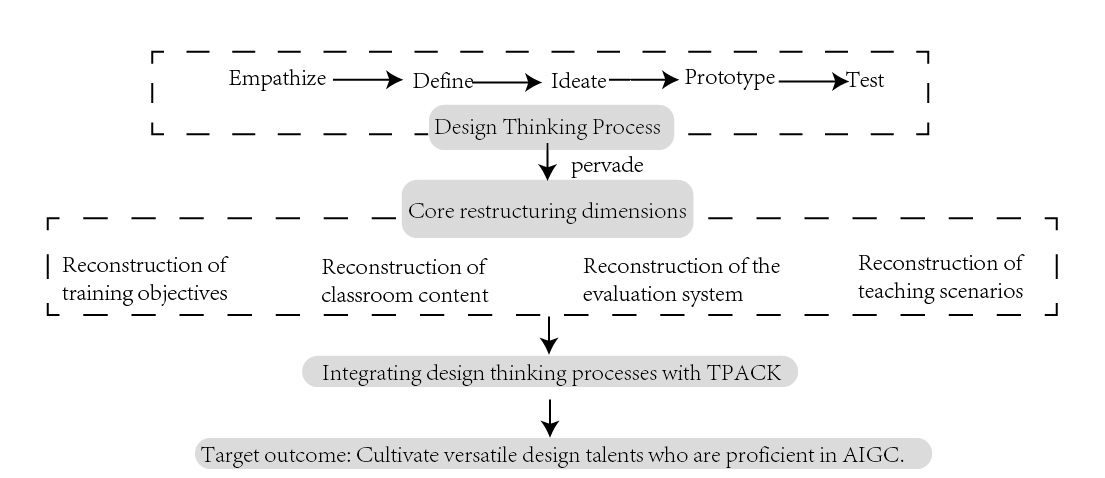
With the paradigm shift driven by Artificial Intelligence Generated Content (AIGC) technology, the design industry is undergoing unprecedented transformation and reconstruction. China's traditional design education model faces severe challenges, as long-standing emphases on hand-drawing skills and mastery of classical software increasingly fail to meet the evolving demands of the AIGC era. This paper proposes that design education must undergo a comprehensive Four-Dimensional Reconstruction encompassing four key dimensions: educational objectives, curriculum system, assessment mechanisms, and pedagogical environments. Drawing on a systematic literature review, the study develops a conceptual model aimed at cultivating design talents equipped with AI literacy, critical thinking, and interdisciplinary integration capabilities. The findings indicate that design education in the AIGC era requires not merely technological updates, nor isolated reforms in educational philosophy, teaching methods, or evaluation systems, but rather a holistic, all-dimensional reconstruction to align with the profound changes in the field.

Graphical Abstract
The Transformation, Challenges, and Reinvention of China's Design Education Model in the AIGC Era

Keywords
AIGC
artificial intelligenc
design education
educational transformation
four-dimensional reconstruction model

Data Availability Statement
Data will be made available on request.

Funding
This work was supported without any funding.

Conflicts of Interest
The authors declare no conflicts of interest.

AI Use Statement
The authors declare that no generative AI was used in the preparation of this manuscript.

Ethical Approval and Consent to Participate
Not applicable.

References
  1. Wang, Y., Wang, Z., & Mu, R. (2024). Modern design thinking and AIGC intervention. In Design Studies and Intelligence Engineering (pp. 850–862). IOS Press.
    [CrossRef]   [Google Scholar]
  2. Sheng, Y. (2024). Exploring the coexisting relationship between artificial intelligence-generated content (AIGC) and designer. Applied Computer Engineering, 34(1), 23–30.
    [Google Scholar]
  3. Huang, Z., Fu, X., & Zhao, J. (2025). Research on AIGC-Integrated Design Education for Sustainable Teaching: An Empirical Analysis Based on the TAM and TPACK Models. Sustainability, 17(12), 5497.
    [CrossRef]   [Google Scholar]
  4. Luo, Y., & Wang, L. (2023, September). Crisis and responses to design and design education in the AIGC era. In ICEKIM 2023: Proceedings of the 4th International Conference on Education, Knowledge and Information Management, ICEKIM 2023, May 26–28, 2023, Nanjing, China (Vol. 469). European Alliance for Innovation.
    [Google Scholar]
  5. Chen, C., Wu, Z., Lai, Y., Ou, W., Liao, T., & Zheng, Z. (2023). Challenges and remedies to privacy and security in AIGC: Exploring the potential of privacy computing, blockchain, and beyond. arXiv preprint arXiv:2306.00419.
    [Google Scholar]
  6. Koehler, M., & Mishra, P. (2009). What is technological pedagogical content knowledge (TPACK)?. Contemporary issues in technology and teacher education, 9(1), 60-70.
    [Google Scholar]
  7. Fabri, M. (2015, August). Thinking with a new purpose: Lessons learned from teaching design thinking skills to creative technology students. In Design, User Experience, and Usability: Design Discourse: 4th International Conference, DUXU 2015, Held as Part of HCI International 2015, Los Angeles, CA, USA, August 2–7, 2015, Proceedings, Part I (pp. 32-43). Cham: Springer International Publishing.
    [CrossRef]   [Google Scholar]
  8. Koh, J. H. L., Chai, C. S., Benjamin, W., & Hong, H. Y. (2015). Technological pedagogical content knowledge (TPACK) and design thinking: A framework to support ICT lesson design for 21st century learning. The Asia-Pacific Education Researcher, 24(3), 535–543.
    [CrossRef]   [Google Scholar]
  9. Felix, A., Moreeng, B., & Mosia, M. (2014). Design Thinking: An Alternative for Educational ICT Integration Training?. Journal of Educational Technology, 2(2), 24–45.
    [CrossRef]   [Google Scholar]
  10. Ge, H., & Chen, X. (2024). Exploring Factors Influencing the Integration of AI Drawing Tools in Art and Design Education. ASRI. Arte y Sociedad. Revista de Investigación en Artes y Humanidad digitales., (26), 108-128.
    [CrossRef]   [Google Scholar]
  11. Zhou, Y., & Chen, C. H. (2025). Examining the Impact of Large Language Models on Design: Functions, Strengths, Limitations, and Roles. Design and Artificial Intelligence, 100017.
    [CrossRef]   [Google Scholar]
  12. Xuefang, X., & Xueling, H. (2025). Innovative Paradigm and Optimization Mechanism for High-Quality Development of Digital Cultural Industries Driven by New Quality Productive Forces. Contemporary Social Sciences, 10(4), 38-58.
    [CrossRef]   [Google Scholar]

Cite This Article
APA Style
Yang, Y., Fu, R., & Xiang, L. (2026). The Transformation, Challenges, and Reinvention of China’s Design Education Model in the AIGC Era. Journal of Social Systems and Policy Analysis, 3(1), 45–54. https://doi.org/10.62762/JSSPA.2025.202588
Export Citation
RIS Format
Compatible with EndNote, Zotero, Mendeley, and other reference managers
RIS format data for reference managers
TY  - JOUR
AU  - Yang, Yifan
AU  - Fu, Ruoyu
AU  - Xiang, Liqun
PY  - 2026
DA  - 2026/03/02
TI  - The Transformation, Challenges, and Reinvention of China's Design Education Model in the AIGC Era
JO  - Journal of Social Systems and Policy Analysis
T2  - Journal of Social Systems and Policy Analysis
JF  - Journal of Social Systems and Policy Analysis
VL  - 3
IS  - 1
SP  - 45
EP  - 54
DO  - 10.62762/JSSPA.2025.202588
UR  - https://www.icck.org/article/abs/JSSPA.2025.202588
KW  - AIGC
KW  - artificial intelligenc
KW  - design education
KW  - educational transformation
KW  - four-dimensional reconstruction model
AB  - With the paradigm shift driven by Artificial Intelligence Generated Content (AIGC) technology, the design industry is undergoing unprecedented transformation and reconstruction. China's traditional design education model faces severe challenges, as long-standing emphases on hand-drawing skills and mastery of classical software increasingly fail to meet the evolving demands of the AIGC era. This paper proposes that design education must undergo a comprehensive Four-Dimensional Reconstruction encompassing four key dimensions: educational objectives, curriculum system, assessment mechanisms, and pedagogical environments. Drawing on a systematic literature review, the study develops a conceptual model aimed at cultivating design talents equipped with AI literacy, critical thinking, and interdisciplinary integration capabilities. The findings indicate that design education in the AIGC era requires not merely technological updates, nor isolated reforms in educational philosophy, teaching methods, or evaluation systems, but rather a holistic, all-dimensional reconstruction to align with the profound changes in the field.
SN  - 3068-5540
PB  - Institute of Central Computation and Knowledge
LA  - English
ER  - 
BibTeX Format
Compatible with LaTeX, BibTeX, and other reference managers
BibTeX format data for LaTeX and reference managers
@article{Yang2026The,
  author = {Yifan Yang and Ruoyu Fu and Liqun Xiang},
  title = {The Transformation, Challenges, and Reinvention of China's Design Education Model in the AIGC Era},
  journal = {Journal of Social Systems and Policy Analysis},
  year = {2026},
  volume = {3},
  number = {1},
  pages = {45-54},
  doi = {10.62762/JSSPA.2025.202588},
  url = {https://www.icck.org/article/abs/JSSPA.2025.202588},
  abstract = {With the paradigm shift driven by Artificial Intelligence Generated Content (AIGC) technology, the design industry is undergoing unprecedented transformation and reconstruction. China's traditional design education model faces severe challenges, as long-standing emphases on hand-drawing skills and mastery of classical software increasingly fail to meet the evolving demands of the AIGC era. This paper proposes that design education must undergo a comprehensive Four-Dimensional Reconstruction encompassing four key dimensions: educational objectives, curriculum system, assessment mechanisms, and pedagogical environments. Drawing on a systematic literature review, the study develops a conceptual model aimed at cultivating design talents equipped with AI literacy, critical thinking, and interdisciplinary integration capabilities. The findings indicate that design education in the AIGC era requires not merely technological updates, nor isolated reforms in educational philosophy, teaching methods, or evaluation systems, but rather a holistic, all-dimensional reconstruction to align with the profound changes in the field.},
  keywords = {AIGC, artificial intelligenc, design education, educational transformation, four-dimensional reconstruction model},
  issn = {3068-5540},
  publisher = {Institute of Central Computation and Knowledge}
}

Article Metrics
Citations:

Crossref

0

Scopus

0

Web of Science

0
Article Access Statistics:
Views: 28
PDF Downloads: 10

Publisher's Note
ICCK stays neutral with regard to jurisdictional claims in published maps and institutional affiliations.

Rights and Permissions
CC BY Copyright © 2026 by the Author(s). Published by Institute of Central Computation and Knowledge. This article is an open access article distributed under the terms and conditions of the Creative Commons Attribution (CC BY) license (https://creativecommons.org/licenses/by/4.0/), which permits use, sharing, adaptation, distribution and reproduction in any medium or format, as long as you give appropriate credit to the original author(s) and the source, provide a link to the Creative Commons licence, and indicate if changes were made.
Journal of Social Systems and Policy Analysis

Journal of Social Systems and Policy Analysis

ISSN: 3068-5540 (Online)

Email: [email protected]

Portico

Portico

All published articles are preserved here permanently:
https://www.portico.org/publishers/icck/