Volume 2, Issue 4, Journal of Social Systems and Policy Analysis
Volume 2, Issue 4, 2025
Submit Manuscript Edit a Special Issue
Article QR Code
Article QR Code
Scan the QR code for reading
Popular articles
Journal of Social Systems and Policy Analysis, Volume 2, Issue 4, 2025: 192-202

Open Access | Research Article | 17 December 2025
The Role of Central Bank Independence and Policy Transparency in Inflation Targeting: A Comparative Empirical Analysis of Five Countries
1 School of Economics, Jiangsu Normal University Kewen College, Xuzhou 221116, China
* Corresponding Author: Zhiming Song, [email protected]
ARK: ark:/57805/jsspa.2025.547905
Received: 02 August 2025, Accepted: 28 August 2025, Published: 17 December 2025  
Abstract
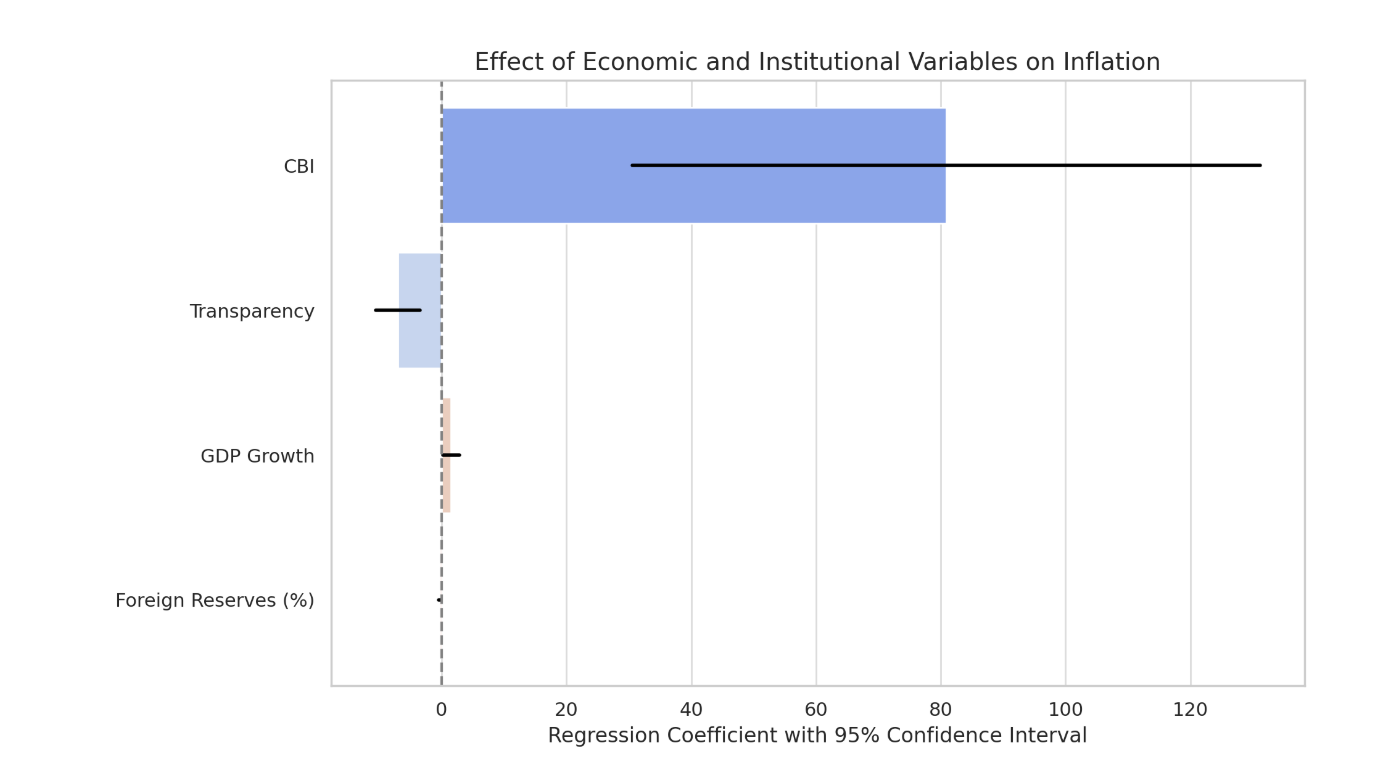
Inflation targeting has become a cornerstone framework for contemporary monetary policy governance, yet its effectiveness varies significantly across countries. This study employs panel data from five countries—New Zealand, Canada, South Korea, Poland, and South Africa—over the period 2010 to 2020 to empirically examine the impact mechanisms of central bank independence and policy transparency on inflation dynamics. The findings indicate that institutional independence of central banks significantly contributes to curbing inflation levels, enhancing policy credibility and implementation stability. Meanwhile, policy transparency effectively reduces inflation volatility by stabilizing public expectations and strengthening market communication. Macroeconomic control variables, including the share of foreign exchange reserves and GDP growth rate, also play a moderating role in inflation fluctuations. Regression results reveal that the two core variables are statistically significant at the 1% level, with robust explanatory power of the model. Further analysis incorporating institutional heterogeneity demonstrates path-dependent differences in policy design and outcomes between developed and transition economies. Building on these findings, this paper proposes relevant policy recommendations that underscore the importance of strengthening central bank independence, enhancing policy transparency, improving exchange rate management frameworks, and promoting the gradual implementation of inflation targeting—particularly for emerging economies such as China. The conclusions provide theoretical support and empirical evidence for optimizing monetary policy institutions and macroeconomic regulation strategies.

Graphical Abstract
The Role of Central Bank Independence and Policy Transparency in Inflation Targeting: A Comparative Empirical Analysis of Five Countries

Keywords
inflation targeting
central bank independence
policy transparency
monetary policy
international comparison
external shocks

Data Availability Statement
Data will be made available on request.

Funding
This work was supported by the 2025 College Student Innovation and Entrepreneurship Training Program Project under Grant 202513988003.

Conflicts of Interest
The author declares no conflicts of interest.

Ethical Approval and Consent to Participate
Not applicable.

References
  1. Epstein, G. (2007). Central banks, inflation targeting and employment creation (Vol. 2). International Labour Office.
    [Google Scholar]
  2. Mishkin, F. S., & Schmidt-Hebbel, K. (2006). Does inflation targeting make a difference?. Documentos de Trabajo (Banco Central de Chile), (404), 1.
    [Google Scholar]
  3. Neumann, M. J. M., & Hagen, J. von. (2002). Does inflation targeting matter? Review of Economic Studies, 69(1), 175–195.
    [Google Scholar]
  4. Jonas, J., & Mishkin, F. S. (2004). Inflation targeting in transition economies experience and prospects. In The Inflation-Targeting Debate (pp. 353-422). University of Chicago Press.
    [Google Scholar]
  5. Pavasuthipaisit, R. (2010). Should inflation-targeting central banks respond to exchange rate movements?. Journal of International Money and Finance, 29(3), 460-485.
    [CrossRef]   [Google Scholar]
  6. Dai, M. (2006). Inflation-targeting under a managed exchange rate: The case of the Chinese central bank. Journal of Chinese Economic and Business Studies, 4(3), 199-219.
    [CrossRef]   [Google Scholar]
  7. Zhang, C. (2007). Low Inflation, Pass‐through, and a Discrete Inflation‐targeting Framework for Monetary Policy in China. China & World Economy, 15(2), 59-73.
    [CrossRef]   [Google Scholar]
  8. Tuladhar, M. A. (2005). Governance Structures and Decision-Making Roles in Inflation-Targeting Central Banks. IMF Working Papers, (2005/183).
    [Google Scholar]
  9. Woodford, M. (2013). Forward guidance in inflation-targeting central banks. Brookings Papers on Economic Activity, 44(1), 1–45.
    [CrossRef]   [Google Scholar]
  10. Montes, G. C., & Gea, C. (2018). Central bank transparency, inflation targeting and monetary policy: a panel data approach. Journal of Economic studies, 45(6), 1159-1174.
    [CrossRef]   [Google Scholar]
  11. Krušković, B. D. (2022). Central bank intervention in the inflation targeting. Journal of Central Banking Theory and Practice, 11(1), 67-85.
    [CrossRef]   [Google Scholar]
  12. Gosselin, M. (2007). Central bank performance under inflation targeting: Institutional quality and outcomes. International Economics Journal, 21(2), 145–163.
    [CrossRef]   [Google Scholar]
  13. Ardakani, O. M., & Kishor, N. K. (2018). Examining the success of the central banks in inflation targeting countries: the dynamics of the inflation gap and institutional characteristics. Studies in Nonlinear Dynamics & Econometrics, 22(1).
    [CrossRef]   [Google Scholar]
  14. Cukierman, A., Webb, S. B., & Neyapti, B. (1992). Measuring the independence of central banks and its effect on policy outcomes. World Bank Economic Review, 6(3), 353–398.
    [CrossRef]   [Google Scholar]
  15. Garriga, A. C. (2016). Central bank independence in the world: A new data set. International Interactions, 42(5), 849–868.
    [CrossRef]   [Google Scholar]
  16. Dincer, N. N., & Eichengreen, B. (2014). Central Bank Transparency and Independence: Updates and New Measures. International Journal of Central Banking, 10(1), 189-259.
    [Google Scholar]
  17. World Bank. (2023). World Development Indicators (WDI) [Data set]. The World Bank Group. Retrieved December 15, 2025, from https://databank.worldbank.org/source/world-development-indicators
    [Google Scholar]
  18. International Monetary Fund. (2025, November 9). World Economic Outlook (WEO) [Data set]. International Monetary Fund. Retrieved December 15, 2025, from https://www.imf.org/en/publications/weo
    [Google Scholar]
  19. International Monetary Fund. (2023). International Financial Statistics [Data set]. Retrieved December 15, 2025, from https://data.imf.org.
    [Google Scholar]
  20. Reserve Bank of New Zealand, Bank of Canada, South African Reserve Bank – various annual reports (2010–2020).
    [Google Scholar]
  21. Arellano, M., & Bond, S. (1991). Some tests of specification for panel data: Monte Carlo evidence and an application to employment equations. The review of economic studies, 58(2), 277-297.
    [CrossRef]   [Google Scholar]
  22. Krušković, B. (2020). Exchange rate targeting versus inflation targeting: Empirical analysis of the impact on employment and economic growth. Journal of Central Banking Theory and Practice, 9(2), 67-85.
    [CrossRef]   [Google Scholar]
  23. Svensson, L. E. (2009). Transparency under Flexible Inflation Targeting: Experiences and Challenges (No. 7213). CEPR Discussion Papers.
    [Google Scholar]
  24. Wooldridge, J. M. (2010). Econometric Analysis of Cross Section and Panel Data (2nd ed.). MIT Press.
    [Google Scholar]

Cite This Article
APA Style
Song, Z. (2025). The Role of Central Bank Independence and Policy Transparency in Inflation Targeting: A Comparative Empirical Analysis of Five Countries. Journal of Social Systems and Policy Analysis, 2(4), 192–202. https://doi.org/10.62762/JSSPA.2025.547905
Export Citation
RIS Format
Compatible with EndNote, Zotero, Mendeley, and other reference managers
RIS format data for reference managers
TY  - JOUR
AU  - Song, Zhiming
PY  - 2025
DA  - 2025/12/17
TI  - The Role of Central Bank Independence and Policy Transparency in Inflation Targeting: A Comparative Empirical Analysis of Five Countries
JO  - Journal of Social Systems and Policy Analysis
T2  - Journal of Social Systems and Policy Analysis
JF  - Journal of Social Systems and Policy Analysis
VL  - 2
IS  - 4
SP  - 192
EP  - 202
DO  - 10.62762/JSSPA.2025.547905
UR  - https://www.icck.org/article/abs/JSSPA.2025.547905
KW  - inflation targeting
KW  - central bank independence
KW  - policy transparency
KW  - monetary policy
KW  - international comparison
KW  - external shocks
AB  - Inflation targeting has become a cornerstone framework for contemporary monetary policy governance, yet its effectiveness varies significantly across countries. This study employs panel data from five countries—New Zealand, Canada, South Korea, Poland, and South Africa—over the period 2010 to 2020 to empirically examine the impact mechanisms of central bank independence and policy transparency on inflation dynamics. The findings indicate that institutional independence of central banks significantly contributes to curbing inflation levels, enhancing policy credibility and implementation stability. Meanwhile, policy transparency effectively reduces inflation volatility by stabilizing public expectations and strengthening market communication. Macroeconomic control variables, including the share of foreign exchange reserves and GDP growth rate, also play a moderating role in inflation fluctuations. Regression results reveal that the two core variables are statistically significant at the 1% level, with robust explanatory power of the model. Further analysis incorporating institutional heterogeneity demonstrates path-dependent differences in policy design and outcomes between developed and transition economies. Building on these findings, this paper proposes relevant policy recommendations that underscore the importance of strengthening central bank independence, enhancing policy transparency, improving exchange rate management frameworks, and promoting the gradual implementation of inflation targeting—particularly for emerging economies such as China. The conclusions provide theoretical support and empirical evidence for optimizing monetary policy institutions and macroeconomic regulation strategies.
SN  - 3068-5540
PB  - Institute of Central Computation and Knowledge
LA  - English
ER  - 
BibTeX Format
Compatible with LaTeX, BibTeX, and other reference managers
BibTeX format data for LaTeX and reference managers
@article{Song2025The,
  author = {Zhiming Song},
  title = {The Role of Central Bank Independence and Policy Transparency in Inflation Targeting: A Comparative Empirical Analysis of Five Countries},
  journal = {Journal of Social Systems and Policy Analysis},
  year = {2025},
  volume = {2},
  number = {4},
  pages = {192-202},
  doi = {10.62762/JSSPA.2025.547905},
  url = {https://www.icck.org/article/abs/JSSPA.2025.547905},
  abstract = {Inflation targeting has become a cornerstone framework for contemporary monetary policy governance, yet its effectiveness varies significantly across countries. This study employs panel data from five countries—New Zealand, Canada, South Korea, Poland, and South Africa—over the period 2010 to 2020 to empirically examine the impact mechanisms of central bank independence and policy transparency on inflation dynamics. The findings indicate that institutional independence of central banks significantly contributes to curbing inflation levels, enhancing policy credibility and implementation stability. Meanwhile, policy transparency effectively reduces inflation volatility by stabilizing public expectations and strengthening market communication. Macroeconomic control variables, including the share of foreign exchange reserves and GDP growth rate, also play a moderating role in inflation fluctuations. Regression results reveal that the two core variables are statistically significant at the 1\% level, with robust explanatory power of the model. Further analysis incorporating institutional heterogeneity demonstrates path-dependent differences in policy design and outcomes between developed and transition economies. Building on these findings, this paper proposes relevant policy recommendations that underscore the importance of strengthening central bank independence, enhancing policy transparency, improving exchange rate management frameworks, and promoting the gradual implementation of inflation targeting—particularly for emerging economies such as China. The conclusions provide theoretical support and empirical evidence for optimizing monetary policy institutions and macroeconomic regulation strategies.},
  keywords = {inflation targeting, central bank independence, policy transparency, monetary policy, international comparison, external shocks},
  issn = {3068-5540},
  publisher = {Institute of Central Computation and Knowledge}
}

Article Metrics
Citations:

Crossref

0

Scopus

0

Web of Science

0
Article Access Statistics:
Views: 434
PDF Downloads: 83

Publisher's Note
ICCK stays neutral with regard to jurisdictional claims in published maps and institutional affiliations.

Rights and Permissions
CC BY Copyright © 2025 by the Author(s). Published by Institute of Central Computation and Knowledge. This article is an open access article distributed under the terms and conditions of the Creative Commons Attribution (CC BY) license (https://creativecommons.org/licenses/by/4.0/), which permits use, sharing, adaptation, distribution and reproduction in any medium or format, as long as you give appropriate credit to the original author(s) and the source, provide a link to the Creative Commons licence, and indicate if changes were made.
Journal of Social Systems and Policy Analysis

Journal of Social Systems and Policy Analysis

ISSN: 3068-5540 (Online)

Email: [email protected]

Portico

Portico

All published articles are preserved here permanently:
https://www.portico.org/publishers/icck/