

Curriculum Philosophy, Textbook Content, and Assessment Mechanisms of Primary and Secondary Science Education in Singapore


Article Information
Abstract
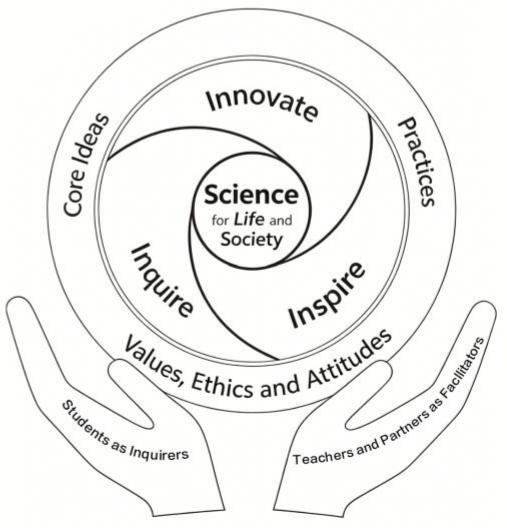
Singapore’s primary and secondary science education is widely recognized for its high performance through systemic reform. The synergistic innovation of its curriculum philosophy, textbook content, and assessment mechanisms warrants in-depth investigation. In terms of curriculum philosophy, Singapore has accomplished a value shift from being “driven by national needs” to “serving life and society,” embodying holistic education as scientific practice through the “3‘IN’” framework. The construction of textbook resources has transcended the boundaries of traditional print media, establishing a four-in-one ecosystem comprising “textbooks, activity books, digital platforms, and inquiry kits,” and relies on a spiral curriculum to facilitate the cognitive progression of cross-cutting concepts. The assessment mechanisms have undergone a paradigm shift from norm-referenced to standards-referenced testing. Through an achievement level grading system, Full Subject-Based Banding, and process-oriented feedback empowered by artificial intelligence, excessive competition is mitigated while individual growth is fostered. Singapore’s practice demonstrates that deep reform of primary and secondary science education depends on promoting a shift in curriculum philosophy from knowledge-based to competency-based approaches, constructing a multi-dimensional textbook system to bridge the gap between in-school and out-of-school learning, and reshaping the educative function of assessment so that it genuinely becomes a dialogic tool for fostering students’ scientific inquiry and value cultivation.
Graphical Abstract
Keywords
Data Availability Statement
Funding
Conflicts of Interest
AI Use Statement
Ethical Approval and Consent to Participate
References
- Sjöström, J., & Eilks, I. (2018). Reconsidering different visions of scientific literacy and science education based on the concept of Bildung. In Cognition, metacognition, and culture in STEM education: Learning, teaching and assessment (pp. 65-88). Cham: Springer International Publishing.
[CrossRef] [Google Scholar] - National Research Council, Board on Science Education, & Committee on a Conceptual Framework for New K-12 Science Education Standards. (2012). A framework for K-12 science education: Practices, crosscutting concepts, and core ideas. national academies press.
[CrossRef] [Google Scholar] - OECD. (2023). PISA 2022 results (Volume I): The state of learning and equity in education (pp. 45-47). OECD Publishing.
[CrossRef] [Google Scholar] - Von Davier, M., Kennedy, A., Reynolds, K., Fishbein, B., Khorramdel, L., Aldrich, C., ... & Yin, L. (2024). TIMSS 2023 international results in mathematics and science. Boston College, TIMSS & PIRLS International Study Center, 10. https://www.iea.nl/publications/timss-2023-international-report
[Google Scholar] - Toh, S. Q., Teo, T. W., & Ong, Y. S. (2021). Students' views, attitudes, identity, self-concept, and career decisions: Results from an evaluation study of a STEM program in Singapore. In STEM Education from Asia (pp. 144-163). Routledge. https://www.taylorfrancis.com/chapters/edit/10.4324/9781003099888-8
[Google Scholar] - Poon, C. L., Lee, Y. J., Tan, A. L., & Lim, S. S. (2012). Knowing inquiry as practice and theory: Developing a pedagogical framework with elementary school teachers. Research in Science Education, 42(2), 303-327.
[CrossRef] [Google Scholar] - Wong, M. K. D., Wan, D., & Lee, Y. J. (2024). A road less travelled?: coherence and coverage of integrated science in Singapore. Research in Science & Technological Education, 42(3), 848-866.
[CrossRef] [Google Scholar] - Vinodhen, V. (2025). From Colony to Nation: The Growth of Science and Biology Education in Singapore (1959–1978). Southeast Asia Development Research, 1(2), 49-63.
[CrossRef] [Google Scholar] - Poon, C. L. (2014). Five decades of science education in Singapore. In Inquiry into the Singapore science classroom: Research and practices (pp. 1-25). Singapore: Springer Singapore.
[CrossRef] [Google Scholar] - Deng, Z., & Gopinathan, S. (2016). PISA and high-performing education systems: Explaining Singapore’s education success. Comparative education, 52(4), 449-472.
[CrossRef] [Google Scholar] - Tan, K. C. D., Teo, T. W., & Poon, C. L. (2016). Singapore science education. In Science education research and practice in Asia: Challenges and opportunities (pp. 155-174). Singapore: Springer Singapore.
[CrossRef] [Google Scholar] - Rose, R. C. (2025). What does STEM look like in Singapore? A Literature Review Analysis of Curriculum Development, Education Framework, Classroom Practices, and Policies in Singapore. Journal of STEM Education: Innovations and Research, 26(1), 38-42.
[CrossRef] [Google Scholar] - James Long, S. C., & Bae, Y. (2018). Action research: First-year primary school science teachers’ conceptions on and enactment of science inquiry in Singapore. Asia-Pacific Science Education, 4(1), 2.
[CrossRef] [Google Scholar] - Ministry of Education, Singapore. (2025, April 4). What you need to know about Full SBB. Retrieved May 11, 2026, from https://www.moe.gov.sg/news/edtalks/what-you-need-to-know-about-full-sbb
[Google Scholar] - Tan, C. (2025). An analysis of attainment grouping policy in Singapore. British Educational Research Journal, 51(1), 394-415.
[CrossRef] [Google Scholar] - Tan, A. L. (2018). Journey of science teacher education in Singapore: Past, present and future. Asia-Pacific Science Education, 4(1), 1.
[CrossRef] [Google Scholar] - National Institute of Education, Nanyang Technological University. (2025, July 24). Primary school science lessons Sparkle with refreshed syllabus and new resource kits. Retrieved May 11, 2026, from https://www.ntu.edu.sg/nie/news-events/news/detail/primary-school-science-lessons-sparkle-with-refreshed-syllabus-and-new-resource-kits
[Google Scholar] - Alison, C. S. M., Kyoko, U., & Hironari, N. (2019, July). Student learning space: the integration of curriculum and technology in Singapore. In Proceedings of the 3rd International Conference on Education and Multimedia Technology (pp. 37-40).
[CrossRef] [Google Scholar] - Ministry of Education, Singapore. (2026, May 11). Artificial intelligence in education. Retrieved May 12, 2026, from https://www.moe.gov.sg/education-in-sg/educational-technology-journey/edtech-masterplan/artificial-intelligence-in-education
[Google Scholar] - GovTech Singapore. (2025, December 9). Inside Singapore's digital classroom: How AI is supporting teachers and students. Retrieved May 11, 2026, from https://www.tech.gov.sg/technews/inside-singapore-digital-classroom-how-ai-is-supporting-teachers-and-students/
[Google Scholar] - Takeshita, N., & Terada, M. (2026). A study of science education in junior high schools in Japan and Singapore: Through comparison and analysis of curricula and textbooks. JSSE Research Report, 40(4), 31-36.
[CrossRef] [Google Scholar] - Wong, H. M., Kwek, D., & Tan, K. (2020). Changing assessments and the examination culture in Singapore: A review and analysis of Singapore’s assessment policies. Asia Pacific Journal of Education, 40(4), 433-457.
[CrossRef] [Google Scholar] - Lam, K., Shin, L. W., Pang, A., & Cheang, T. K. (2025). Assessment and Examination Policies in the Singapore Education System. In Fundamentals of Assessment (pp. 17-30). Routledge. https://www.taylorfrancis.com/chapters/edit/10.4324/9781003534648-3
[Google Scholar] - Ng, P. T. (2025). Learning in an era of uncertainty in Singapore: diversity, lifelong learning, inspiration and paradigm shift. Educational research for policy and practice, 24(1), 121-127.
[CrossRef] [Google Scholar] - GovTech Singapore. (2025, January 21). AI in education: Transforming Singapore's education system with student learning space. Retrieved May 11, 2026, from https://www.tech.gov.sg/technews/ai-in-education-transforming-singapore-education-system-with-student-learning-space/
[Google Scholar] - Lee, Y. J. (2018). Primary Science Education in Singapore. In Primary Science Education in East Asia: A Critical Comparison of Systems and Strategies (pp. 157-176). Springer International Publishing.
[CrossRef] [Google Scholar]
Cite This Article
TY  - JOUR
AU  - Liu, Yinping
AU  - Chen, Cheng
PY  - 2026
DA  - 2026/07/03
TI  - Curriculum Philosophy, Textbook Content, and Assessment Mechanisms of Primary and Secondary Science Education in Singapore
JO  - Journal of Social Systems and Policy Analysis
T2  - Journal of Social Systems and Policy Analysis
JF  - Journal of Social Systems and Policy Analysis
VL  - 3
IS  - 3
SP  - 121
EP  - 131
DO  - 10.62762/JSSPA.2026.685895
UR  - https://www.icck.org/article/abs/JSSPA.2026.685895
KW  - Singapore
KW  - science education
KW  - curriculum philosophy
KW  - textbook content
KW  - assessment mechanism
AB  - Singapore’s primary and secondary science education is widely recognized for its high performance through systemic reform. The synergistic innovation of its curriculum philosophy, textbook content, and assessment mechanisms warrants in-depth investigation. In terms of curriculum philosophy, Singapore has accomplished a value shift from being “driven by national needs” to “serving life and society,” embodying holistic education as scientific practice through the “3‘IN’” framework. The construction of textbook resources has transcended the boundaries of traditional print media, establishing a four-in-one ecosystem comprising “textbooks, activity books, digital platforms, and inquiry kits,” and relies on a spiral curriculum to facilitate the cognitive progression of cross-cutting concepts. The assessment mechanisms have undergone a paradigm shift from norm-referenced to standards-referenced testing. Through an achievement level grading system, Full Subject-Based Banding, and process-oriented feedback empowered by artificial intelligence, excessive competition is mitigated while individual growth is fostered. Singapore’s practice demonstrates that deep reform of primary and secondary science education depends on promoting a shift in curriculum philosophy from knowledge-based to competency-based approaches, constructing a multi-dimensional textbook system to bridge the gap between in-school and out-of-school learning, and reshaping the educative function of assessment so that it genuinely becomes a dialogic tool for fostering students’ scientific inquiry and value cultivation.
SN  - 3068-5540
PB  - Institute of Central Computation and Knowledge
LA  - English
ER  -
@article{Liu2026Curriculum,
  author = {Yinping Liu and Cheng Chen},
  title = {Curriculum Philosophy, Textbook Content, and Assessment Mechanisms of Primary and Secondary Science Education in Singapore},
  journal = {Journal of Social Systems and Policy Analysis},
  year = {2026},
  volume = {3},
  number = {3},
  pages = {121-131},
  doi = {10.62762/JSSPA.2026.685895},
  url = {https://www.icck.org/article/abs/JSSPA.2026.685895},
  abstract = {Singapore’s primary and secondary science education is widely recognized for its high performance through systemic reform. The synergistic innovation of its curriculum philosophy, textbook content, and assessment mechanisms warrants in-depth investigation. In terms of curriculum philosophy, Singapore has accomplished a value shift from being “driven by national needs” to “serving life and society,” embodying holistic education as scientific practice through the “3‘IN’” framework. The construction of textbook resources has transcended the boundaries of traditional print media, establishing a four-in-one ecosystem comprising “textbooks, activity books, digital platforms, and inquiry kits,” and relies on a spiral curriculum to facilitate the cognitive progression of cross-cutting concepts. The assessment mechanisms have undergone a paradigm shift from norm-referenced to standards-referenced testing. Through an achievement level grading system, Full Subject-Based Banding, and process-oriented feedback empowered by artificial intelligence, excessive competition is mitigated while individual growth is fostered. Singapore’s practice demonstrates that deep reform of primary and secondary science education depends on promoting a shift in curriculum philosophy from knowledge-based to competency-based approaches, constructing a multi-dimensional textbook system to bridge the gap between in-school and out-of-school learning, and reshaping the educative function of assessment so that it genuinely becomes a dialogic tool for fostering students’ scientific inquiry and value cultivation.},
  keywords = {Singapore, science education, curriculum philosophy, textbook content, assessment mechanism},
  issn = {3068-5540},
  publisher = {Institute of Central Computation and Knowledge}
}
Article Metrics
Publisher's Note
ICCK stays neutral with regard to jurisdictional claims in published maps and institutional affiliations.
Rights and Permissions
 Copyright © 2026 by the Author(s). Published by Institute of Central Computation and Knowledge. This article is an open access article distributed under the terms and conditions of the Creative Commons Attribution (CC BY) license (https://creativecommons.org/licenses/by/4.0/), which permits use, sharing, adaptation, distribution and reproduction in any medium or format, as long as you give appropriate credit to the original author(s) and the source, provide a link to the Creative Commons licence, and indicate if changes were made.

Portico
