

Organizational Justice and Turnover Intention in Logistics Employees: A Social Exchange Theory Perspective with the Mediating Role of Burnout


Article Information
Abstract
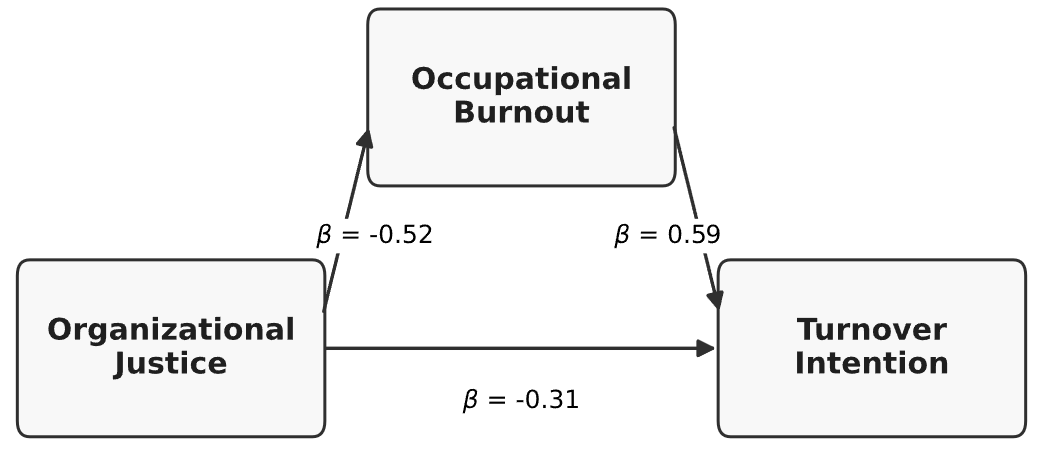
Employee turnover remains a critical challenge in labor-intensive service industries such as logistics. Drawing on social exchange theory and the job demands–resources (JD–R) model, this study examines the relationship between organizational justice and turnover intention, with occupational burnout as a mediating mechanism. A cross-sectional survey was conducted among 428 logistics employees in China, and the data were analyzed using structural equation modeling and bootstrapping techniques. The results indicate that organizational justice is negatively associated with both occupational burnout and turnover intention, while burnout is positively related to turnover intention. Furthermore, burnout partially mediates the relationship between organizational justice and turnover intention. This study contributes to the literature by clarifying the psychological mechanism linking fairness perceptions to employee withdrawal in high-demand service contexts. The findings highlight the importance of enhancing organizational justice and reducing burnout to improve employee retention in logistics enterprises.
Graphical Abstract
Keywords
Data Availability Statement
Funding
Conflicts of Interest
AI Use Statement
Ethical Approval and Consent to Participate
References
- Griffeth, R. W., Hom, P. W., & Gaertner, S. (2000). A meta-analysis of antecedents and correlates of employee turnover. Journal of Management, 26(3), 463–488.
[CrossRef] [Google Scholar] - Mobley, W. H. (1977). Intermediate linkages in the relationship between job satisfaction and employee turnover. Journal of applied psychology, 62(2), 237.
[CrossRef] [Google Scholar] - Colquitt, J. A., Conlon, D. E., Wesson, M. J., Porter, C. O., & Ng, K. Y. (2001). Justice at the millennium: a meta-analytic review of 25 years of organizational justice research. Journal of applied psychology, 86(3), 425.
[CrossRef] [Google Scholar] - Greenberg, J. (1990). Organizational justice: Yesterday, today, and tomorrow. Journal of Management, 16(2), 399–432.
[CrossRef] [Google Scholar] - Elovainio, M., Kivimäki, M., & Vahtera, J. (2002). Organizational justice: Evidence of a new psychosocial predictor of health. American Journal of Public Health, 92(1), 105–108.
[CrossRef] [Google Scholar] - Cropanzano, R., Bowen, D. E., & Gilliland, S. W. (2007). The management of organizational justice. Academy of management perspectives, 21(4), 34-48.
[CrossRef] [Google Scholar] - Maslach, C., & Jackson, S. E. (1981). The measurement of experienced burnout. Journal of Occupational Behavior, 2(2), 99–113.
[CrossRef] [Google Scholar] - Maslach, C., Jackson, S. E., & Leiter, M. P. (1997). Maslach burnout inventory. Scarecrow Education. https://psycnet.apa.org/record/1997-09146-011
[Google Scholar] - Leiter, M. P., & Maslach, C. (2009). Nurse turnover: the mediating role of burnout. Journal of nursing management, 17(3), 331-339.
[CrossRef] [Google Scholar] - Lee, R. T., & Ashforth, B. E. (1996). A meta-analytic examination of the correlates of the three dimensions of job burnout. Journal of applied Psychology, 81(2), 123.
[CrossRef] [Google Scholar] - Wright, T. A., & Cropanzano, R. (1998). Emotional exhaustion as a predictor of job performance and voluntary turnover. Journal of Applied Psychology, 83(3), 486–493.
[CrossRef] [Google Scholar] - Bakker, A. B., & Demerouti, E. (2017). Job demands–resources theory: Taking stock and looking forward. Journal of occupational health psychology, 22(3), 273.
[CrossRef] [Google Scholar] - Demerouti, E., Bakker, A. B., Nachreiner, F., & Schaufeli, W. B. (2001). The job demands–resources model of burnout. Journal of Applied Psychology, 86(3), 499–512.
[CrossRef] [Google Scholar] - Bakker, A. B., & Demerouti, E. (2007). The job demands–resources model: State of the art. Journal of Managerial Psychology, 22(3), 309–328.
[CrossRef] [Google Scholar] - Hair, J. F., Black, W. C., Babin, B. J., & Anderson, R. E. (2019). Multivariate data analysis (8th ed.). Cengage. https://researchdiscovery.drexel.edu/esploro/outputs/book/Multivariate-data-analysis/991019295303204721
[Google Scholar] - Kline, R. B. (2023). Principles and practice of structural equation modeling. Guilford publications.
[Google Scholar] - Preacher, K. J., & Hayes, A. F. (2008). Asymptotic and resampling strategies for assessing mediation. Behavior Research Methods, 40(3), 879–891.
[CrossRef] [Google Scholar] - Elovainio, M., Kivimäki, M., & Helkama, K. (2001). Organizational justice evaluations, job control, and occupational strain. Journal of applied psychology, 86(3), 418.
[CrossRef] [Google Scholar] - Colquitt, J. A. (2001). On the dimensionality of organizational justice: A construct validation of a measure. Journal of Applied Psychology, 86(3), 386–400.
[CrossRef] [Google Scholar] - Mobley, W. H., Griffeth, R. W., Hand, H. H., & Meglino, B. M. (1979). Review and conceptual analysis of the employee turnover process. Psychological Bulletin, 86(3), 493–522.
[CrossRef] [Google Scholar] - Fornell, C., & Larcker, D. F. (1981). Evaluating structural equation models with unobservable variables and measurement error. Journal of marketing research, 18(1), 39-50.
[CrossRef] [Google Scholar] - Blau, P. M. (1964). Exchange and power in social life. Wiley.
[CrossRef] [Google Scholar]
Cite This Article
TY  - JOUR
AU  - Li, Qian
AU  - Li, Peilin
PY  - 2026
DA  - 2026/08/12
TI  - Organizational Justice and Turnover Intention in Logistics Employees: A Social Exchange Theory Perspective with the Mediating Role of Burnout
JO  - Journal of Social Systems and Policy Analysis
T2  - Journal of Social Systems and Policy Analysis
JF  - Journal of Social Systems and Policy Analysis
VL  - 3
IS  - 3
SP  - 132
EP  - 142
DO  - 10.62762/JSSPA.2026.906178
UR  - https://www.icck.org/article/abs/JSSPA.2026.906178
KW  - organizational justice
KW  - occupational burnout
KW  - turnover intention
KW  - social exchange theory
KW  - JD–R model
KW  - logistics enterprises
AB  - Employee turnover remains a critical challenge in labor-intensive service industries such as logistics. Drawing on social exchange theory and the job demands–resources (JD–R) model, this study examines the relationship between organizational justice and turnover intention, with occupational burnout as a mediating mechanism. A cross-sectional survey was conducted among 428 logistics employees in China, and the data were analyzed using structural equation modeling and bootstrapping techniques. The results indicate that organizational justice is negatively associated with both occupational burnout and turnover intention, while burnout is positively related to turnover intention. Furthermore, burnout partially mediates the relationship between organizational justice and turnover intention. This study contributes to the literature by clarifying the psychological mechanism linking fairness perceptions to employee withdrawal in high-demand service contexts. The findings highlight the importance of enhancing organizational justice and reducing burnout to improve employee retention in logistics enterprises.
SN  - 3068-5540
PB  - Institute of Central Computation and Knowledge
LA  - English
ER  -
@article{Li2026Organizati,
  author = {Qian Li and Peilin Li},
  title = {Organizational Justice and Turnover Intention in Logistics Employees: A Social Exchange Theory Perspective with the Mediating Role of Burnout},
  journal = {Journal of Social Systems and Policy Analysis},
  year = {2026},
  volume = {3},
  number = {3},
  pages = {132-142},
  doi = {10.62762/JSSPA.2026.906178},
  url = {https://www.icck.org/article/abs/JSSPA.2026.906178},
  abstract = {Employee turnover remains a critical challenge in labor-intensive service industries such as logistics. Drawing on social exchange theory and the job demands–resources (JD–R) model, this study examines the relationship between organizational justice and turnover intention, with occupational burnout as a mediating mechanism. A cross-sectional survey was conducted among 428 logistics employees in China, and the data were analyzed using structural equation modeling and bootstrapping techniques. The results indicate that organizational justice is negatively associated with both occupational burnout and turnover intention, while burnout is positively related to turnover intention. Furthermore, burnout partially mediates the relationship between organizational justice and turnover intention. This study contributes to the literature by clarifying the psychological mechanism linking fairness perceptions to employee withdrawal in high-demand service contexts. The findings highlight the importance of enhancing organizational justice and reducing burnout to improve employee retention in logistics enterprises.},
  keywords = {organizational justice, occupational burnout, turnover intention, social exchange theory, JD–R model, logistics enterprises},
  issn = {3068-5540},
  publisher = {Institute of Central Computation and Knowledge}
}
Article Metrics
Publisher's Note
ICCK stays neutral with regard to jurisdictional claims in published maps and institutional affiliations.
Rights and Permissions
 Copyright © 2026 by the Author(s). Published by Institute of Central Computation and Knowledge. This article is an open access article distributed under the terms and conditions of the Creative Commons Attribution (CC BY) license (https://creativecommons.org/licenses/by/4.0/), which permits use, sharing, adaptation, distribution and reproduction in any medium or format, as long as you give appropriate credit to the original author(s) and the source, provide a link to the Creative Commons licence, and indicate if changes were made.


Portico
