-
CiteScore
-
Impact Factor
Volume 1, Issue 2, Next-Generation Computing Systems and Technologies
Volume 1, Issue 2, 2025
Submit Manuscript Edit a Special Issue
Article QR Code
Article QR Code
Scan the QR code for reading
Popular articles
Next-Generation Computing Systems and Technologies, Volume 1, Issue 2, 2025: 54-61

Open Access | Research Article | 07 December 2025
AI-driven Data Management of Traditional Tunisian Nutritional Dishes: A Cultural Heritage Conservation
1 Laboratory Ecochimie, Department of Biological and Chemical Engineering, National Institute of Applied Sciences and Technology, University of Carthage, Tunis, Tunisia
2 Department of Technics, Higher Institute of Animation for Youth and Culture, University of Tunis, Tunisia
* Corresponding Author: Olfa Rebai, [email protected]
Received: 02 September 2025, Accepted: 12 October 2025, Published: 07 December 2025  
Abstract
The potential loss of traditional Tunisian dishes threatens the sustainability of valuable cultural and nutritional traditions. To help preserve this rich heritage, a conversational AI system has been developed that employs advanced language processing and machine learning techniques to bring Tunisia’s culinary traditions to life in a digital space. Multilingual transformer models have been adapted to understand Tunisian dialects and combined with a detailed Food Heritage Knowledge Graph, allowing personalized, interactive access to authentic recipes and the stories behind them. A hybrid dialogue system operated by a chatbot has been implemented to ensure smooth, meaningful conversations that respect cultural sensitivities and build user trust and engagement.Despite challenges such as dialect diversity and limited data, it is demonstrated that modern AI can effectively capture and share complex cultural knowledge. Plans are underway to expand dialect support through federated learning and to improve contextual understanding with smarter memory models. Overall, this project highlights how technology and tradition can be connected through AI, supporting cultural preservation, promoting gastronomic tourism, and encouraging healthier eating habits in Tunisia.

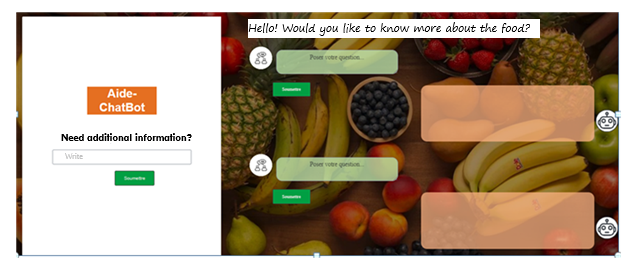
Graphical Abstract
AI-driven Data Management of Traditional Tunisian Nutritional Dishes: A Cultural Heritage Conservation

Keywords
cultural heritage preservation
nutritional data systems
natural language processing
interactive platform
food heritage digitization

Data Availability Statement
Data will be made available on request.

Funding
This work was partly supported by the PRIMA Programme, funded by the European Union, under Grant Agreement No. 2132 (Project: PROMEDLIFE).

Conflicts of Interest
The authors declare no conflicts of interest.

Ethical Approval and Consent to Participate
Not applicable.

References
  1. Food and Agriculture Organization of the United Nations. (2019). The state of the world's biodiversity for food and agriculture. J. Bélanger & D. Pilling (Eds.). FAO Commission on Genetic Resources for Food and Agriculture Assessments.
    [CrossRef]   [Google Scholar]
  2. Tsakiraki, M., Grammatikopoulou, M. G., Stylianou, C., & Tsigga, M. (2011). Nutrition transition and health status of Cretan women: evidence from two generations. Public Health Nutrition, 14(5), 793–800.
    [CrossRef]   [Google Scholar]
  3. Sirdey, N., Bricas, N., & Camara, A. D. (2021). Les systèmes alimentaires en Afrique sub-saharienne. Caractérisation et spécificités. Grain de sel, (81), 6-7.
    [Google Scholar]
  4. Sharma, H. (2025). Applications of Artificial Intelligence and Machine Learning in the Preservation and Analysis of Heritage Structures: A Comprehensive Review. Archives of Computational Methods in Engineering, 1-33.
    [CrossRef]   [Google Scholar]
  5. Ababneh, A. (2025). Preserving Intangible Cultural Heritage: Review Approaches and Tools for Documentation. University of Sharjah Journal for Humanities & Social Sciences, 22(2).
    [CrossRef]   [Google Scholar]
  6. Xu, W., Dainoff, M. J., Ge, L., & Gao, Z. (2023). Transitioning to human interaction with AI systems: New challenges and opportunities for HCI professionals to enable human-centered AI. International Journal of Human–Computer Interaction, 39(3), 494-518.
    [CrossRef]   [Google Scholar]
  7. Zhou, L., Gao, J., Li, D., & Shum, H. Y. (2020). The design and implementation of xiaoice, an empathetic social chatbot. Computational Linguistics, 46(1), 53-93.
    [CrossRef]   [Google Scholar]
  8. Gharbi, A., Boudiche, S., & Ameur, M. (2024). FOOD HABITS AND DIETARY PATTERNS OF THE TUNISIAN POPULATION. European journal of economics and management sciences, (3), 16-28.
    [CrossRef]   [Google Scholar]
  9. Biggi, C., Biasini, B., Ogrinc, N., Strojnik, L., Endrizzi, I., Menghi, L., ... & Menozzi, D. (2024). Drivers and Barriers Influencing Adherence to the Mediterranean Diet: A Comparative Study across Five Countries. Nutrients, 16(15), 2405.
    [CrossRef]   [Google Scholar]
  10. Balkaya, M., & Baykal, G. E. (2025, April). Exploring the Nexus of Technology and Food Practices in Young Adults: A Value-Sensitive Design Perspective towards Human-Food Interaction. In Proceedings of the 2025 CHI Conference on Human Factors in Computing Systems (pp. 1-16).
    [CrossRef]   [Google Scholar]
  11. Manning, L., Brewer, S., Craigon, P. J., Frey, J., Gutierrez, A., Jacobs, N., ... & Pearson, S. (2022). Artificial intelligence and ethics within the food sector: Developing a common language for technology adoption across the supply chain. Trends in Food Science & Technology, 125, 33-42.
    [CrossRef]   [Google Scholar]
  12. Del Soldato, E., & Massari, S. (2024). Creativity and digital strategies to support food cultural heritage in Mediterranean rural areas. EuroMed Journal of Business, 19(1), 113-137.
    [CrossRef]   [Google Scholar]
  13. Tsatsanashvili, A. (2024). Artificial Intelligence In The Protection Of Intangible Cultural Heritage. European Journal of Transformation Studies, 12(1), 163-178. https://czasopisma.bg.ug.edu.pl/index.php/journal-transformation/article/view/11837
    [Google Scholar]
  14. Floridi, L., Cowls, J., Beltrametti, M., Chatila, R., Chazerand, P., Dignum, V., ... & Vayena, E. (2018). AI4People—An ethical framework for a good AI society: Opportunities, risks, principles, and recommendations. Minds and Machines, 28(4), 689–707.
    [CrossRef]   [Google Scholar]
  15. El Ati, J. A. L. I. L. A., Béji, C. H. I. R. A. Z., Farhat, A., Haddad, S., Cherif, S., Trabelsi, T., ... & Delpeuch, F. (2007). Table de composition des aliments tunisiens. Tunis: INNTA.
    [Google Scholar]
  16. Manida, M. (2022). The future of food and agriculture trends and challenges. Agriculture & Food E-Newsletter, 4(2), 27-29.
    [Google Scholar]
  17. Judijanto, L., & Vandika, A. Y. (2025). Emerging Research Trends in Natural Language Processing for Multilingual AI. The Eastasouth Journal of Information System and Computer Science, 2(03), 187-199.
    [CrossRef]   [Google Scholar]
  18. Bocklisch, T., Faulkner, J., Pawlowski, N., & Nichol, A. (2017). Rasa: Open source language understanding and dialogue management. arXiv preprint arXiv:1712.05181.
    [Google Scholar]
  19. Masmoudi, A., Aridhi, N., & Belguith, L. H. (2025). Pre-trained Model Sentiment Analysis of Tunisian Telecommunications Operators’ Comments on Social Media. Computación y Sistemas, 29(3).
    [CrossRef]   [Google Scholar]
  20. Rajabi, E., George, A. N., & Kumar, K. (2024). The role of knowledge graphs in chatbots. The Electronic Library, 42(3), 483-497.
    [CrossRef]   [Google Scholar]
  21. Jain, A., & Singhal, A. (2022). Personalized food recommendation—state of art and review. Ambient communications and computer systems: Proceedings of RACCCS 2021, 153-164.
    [CrossRef]   [Google Scholar]
  22. Antoun, W., Baly, F., & Hajj, H. (2020). AraBERT: Transformer-based model for Arabic language understanding. arXiv preprint arXiv:2003.00104.
    [Google Scholar]
  23. Tudor Car, L., Dhinagaran, D. A., Kyaw, B. M., Kowatsch, T., Joty, S., Theng, Y. L., & Atun, R. (2020). Conversational agents in health care: scoping review and conceptual analysis. Journal of medical Internet research, 22(8), e17158.
    [CrossRef]   [Google Scholar]
  24. Shim, H., Oh, K. T., O’Malley, C., Jun, J. Y., & Shi, C. K. (2024). Heritage values, digital storytelling, and heritage communication: the exploration of cultural heritage sites in virtual environments. Digital Creativity, 35(2), 171-197.
    [CrossRef]   [Google Scholar]
  25. Othmani, W. (2021). Intangible heritage as a social construction of authenticity: the example of Tunisian cuisine. Via. Tourism Review, (19).
    [CrossRef]   [Google Scholar]
  26. Kusal, S., Patil, S., Choudrie, J., Kotecha, K., Mishra, S., & Abraham, A. (2022). AI-based conversational agents: a scoping review from technologies to future directions. IEEE Access, 10, 92337-92356.
    [CrossRef]   [Google Scholar]
  27. Dew, K. N., Turner, A. M., Choi, Y. K., Bosold, A., & Kirchhoff, K. (2018). Development of machine translation technology for assisting health communication: A systematic review. Journal of biomedical informatics, 85, 56-67.
    [CrossRef]   [Google Scholar]

Cite This Article
APA Style
Rebai, O., Charni, M., Aribi, H. B., Temessek, M. B., Fattouch, S., & Raboudi, F. (2025). AI-driven Data Management of Traditional Tunisian Nutritional Dishes: A Cultural Heritage Conservation. Next-Generation Computing Systems and Technologies, 1(2), 54–61. https://doi.org/10.62762/NGCST.2025.714702
Export Citation
RIS Format
Compatible with EndNote, Zotero, Mendeley, and other reference managers
RIS format data for reference managers
TY  - JOUR
AU  - Rebai, Olfa
AU  - Charni, Maram
AU  - Aribi, Hiba Ben
AU  - Temessek, Malek Ben
AU  - Fattouch, Sami
AU  - Raboudi, Faten
PY  - 2025
DA  - 2025/12/07
TI  - AI-driven Data Management of Traditional Tunisian Nutritional Dishes: A Cultural Heritage Conservation
JO  - Next-Generation Computing Systems and Technologies
T2  - Next-Generation Computing Systems and Technologies
JF  - Next-Generation Computing Systems and Technologies
VL  - 1
IS  - 2
SP  - 54
EP  - 61
DO  - 10.62762/NGCST.2025.714702
UR  - https://www.icck.org/article/abs/NGCST.2025.714702
KW  - cultural heritage preservation
KW  - nutritional data systems
KW  - natural language processing
KW  - interactive platform
KW  - food heritage digitization
AB  - The potential loss of traditional Tunisian dishes threatens the sustainability of valuable cultural and nutritional traditions. To help preserve this rich heritage, a conversational AI system has been developed that employs advanced language processing and machine learning techniques to bring Tunisia’s culinary traditions to life in a digital space. Multilingual transformer models have been adapted to understand Tunisian dialects and combined with a detailed Food Heritage Knowledge Graph, allowing personalized, interactive access to authentic recipes and the stories behind them. A hybrid dialogue system operated by a chatbot has been implemented to ensure smooth, meaningful conversations that respect cultural sensitivities and build user trust and engagement.Despite challenges such as dialect diversity and limited data, it is demonstrated that modern AI can effectively capture and share complex cultural knowledge. Plans are underway to expand dialect support through federated learning and to improve contextual understanding with smarter memory models. Overall, this project highlights how technology and tradition can be connected through AI, supporting cultural preservation, promoting gastronomic tourism, and encouraging healthier eating habits in Tunisia.
SN  - pending
PB  - Institute of Central Computation and Knowledge
LA  - English
ER  - 
BibTeX Format
Compatible with LaTeX, BibTeX, and other reference managers
BibTeX format data for LaTeX and reference managers
@article{Rebai2025AIdriven,
  author = {Olfa Rebai and Maram Charni and Hiba Ben Aribi and Malek Ben Temessek and Sami Fattouch and Faten Raboudi},
  title = {AI-driven Data Management of Traditional Tunisian Nutritional Dishes: A Cultural Heritage Conservation},
  journal = {Next-Generation Computing Systems and Technologies},
  year = {2025},
  volume = {1},
  number = {2},
  pages = {54-61},
  doi = {10.62762/NGCST.2025.714702},
  url = {https://www.icck.org/article/abs/NGCST.2025.714702},
  abstract = {The potential loss of traditional Tunisian dishes threatens the sustainability of valuable cultural and nutritional traditions. To help preserve this rich heritage, a conversational AI system has been developed that employs advanced language processing and machine learning techniques to bring Tunisia’s culinary traditions to life in a digital space. Multilingual transformer models have been adapted to understand Tunisian dialects and combined with a detailed Food Heritage Knowledge Graph, allowing personalized, interactive access to authentic recipes and the stories behind them. A hybrid dialogue system operated by a chatbot has been implemented to ensure smooth, meaningful conversations that respect cultural sensitivities and build user trust and engagement.Despite challenges such as dialect diversity and limited data, it is demonstrated that modern AI can effectively capture and share complex cultural knowledge. Plans are underway to expand dialect support through federated learning and to improve contextual understanding with smarter memory models. Overall, this project highlights how technology and tradition can be connected through AI, supporting cultural preservation, promoting gastronomic tourism, and encouraging healthier eating habits in Tunisia.},
  keywords = {cultural heritage preservation, nutritional data systems, natural language processing, interactive platform, food heritage digitization},
  issn = {pending},
  publisher = {Institute of Central Computation and Knowledge}
}

Article Metrics
Citations:

Crossref

0

Scopus

0

Web of Science

0
Article Access Statistics:
Views: 63
PDF Downloads: 20

Publisher's Note
ICCK stays neutral with regard to jurisdictional claims in published maps and institutional affiliations.

Rights and Permissions
CC BY Copyright © 2025 by the Author(s). Published by Institute of Central Computation and Knowledge. This article is an open access article distributed under the terms and conditions of the Creative Commons Attribution (CC BY) license (https://creativecommons.org/licenses/by/4.0/), which permits use, sharing, adaptation, distribution and reproduction in any medium or format, as long as you give appropriate credit to the original author(s) and the source, provide a link to the Creative Commons licence, and indicate if changes were made.
Next-Generation Computing Systems and Technologies

Next-Generation Computing Systems and Technologies

ISSN: pending (Online)

Email: [email protected]

Portico

Portico

All published articles are preserved here permanently:
https://www.portico.org/publishers/icck/