

Decoding Cold-Induced Ca$^{2+}$ Signals: the CaM/CML-CBP Sensor Network in Plant Cold Tolerance and Its Functional Dissection by CRISPR-Cas9/Cas12a Genome Editing




Article Information
Abstract
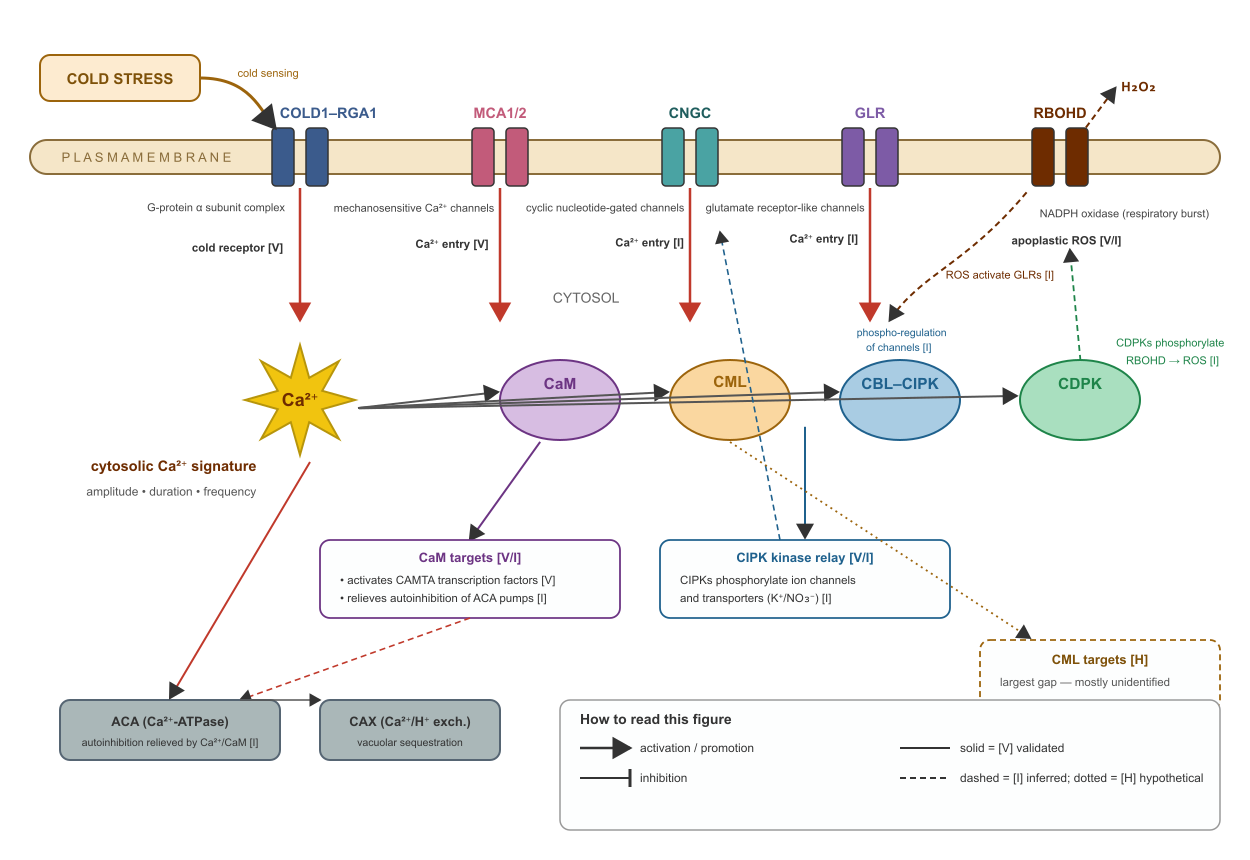
Cold stress limits the geographical distribution and the yield of crops, and climate variability is raising the frequency of chilling and freezing events. Within seconds of cold perception, plant cells generate cytosolic Ca$^{2+}$ transients, the so-called Ca$^{2+}$ signatures, whose information content is read by Ca$^{2+}$ sensor proteins. This review synthesises current knowledge of the sensor network formed by calmodulins (CaMs), calmodulin-like proteins (CMLs) and their downstream calmodulin-binding proteins (CBPs), with a focus on cold stress. Because the literature mixes genetically validated interactions with plausible but untested ones, every reported interaction is graded here as validated [V], inferred [I] or hypothetical [H]. We argue that cold-associated Ca$^{2+}$ decoding is better described as a distributed network than as a linear CaM-CML-CBP cascade. The strongest genetic support exists for the CAMTA-CBF module that lies downstream of Ca$^{2+}$/CaM; by contrast, placing CRLK proteins upstream of the MEKK1-MKK2-MPK4 pathway, and linking that branch to ICE1 turnover, remains a working model assembled from separate studies. Evidence for CBL-CIPK and CML-dependent branches is thinner and context dependent. We then discuss how CRISPR-Cas9, Cas12a and transcriptional-regulation tools can be used to test these gaps, bearing in mind that editing outcomes, pleiotropy and regeneration capacity differ between species and target loci.
Graphical Abstract
Keywords
Data Availability Statement
Funding
Conflicts of Interest
AI Use Statement
Ethical Approval and Consent to Participate
References
- Yadav, S. K. (2010). Cold stress tolerance mechanisms in plants. A review. Agronomy for Sustainable Development, 30(3), 515-527.
[CrossRef] [Google Scholar] - Ding, Y., Shi, Y., & Yang, S. (2019). Advances and challenges in uncovering cold tolerance regulatory mechanisms in plants. New Phytologist, 222(4), 1690-1704.
[CrossRef] [Google Scholar] - Hannah, M. A., Heyer, A. G., & Hincha, D. K. (2005). A global survey of gene regulation during cold acclimation in Arabidopsis thaliana. PLoS Genetics, 1(2), e26.
[CrossRef] [Google Scholar] - Zhu, J. K. (2016). Abiotic stress signaling and responses in plants. Cell, 167(2), 313-324.
[CrossRef] [Google Scholar] - Knight, H., Trewavas, A. J., & Knight, M. R. (1996). Cold calcium signaling in Arabidopsis involves two cellular pools and a change in calcium signature after acclimation. The Plant Cell, 8(3), 489-503.
[CrossRef] [Google Scholar] - Wilkins, K. A., Matthus, E., Swarbreck, S. M., & Davies, J. M. (2016). Calcium-mediated abiotic stress signaling in roots. Frontiers in Plant Science, 7, 1296.
[CrossRef] [Google Scholar] - Yuan, P., Yang, T., & Poovaiah, B. W. (2018). Calcium signaling-mediated plant response to cold stress. International Journal of Molecular Sciences, 19(12), 3896.
[CrossRef] [Google Scholar] - Li, Y., Liu, Y., Jin, L., & Peng, R. (2022). Crosstalk between Ca$^{2+$ and other regulators assists plants in responding to abiotic stress. Plants, 11(10), 1351.
[CrossRef] [Google Scholar] - McCormack, E., Tsai, Y. C., & Braam, J. (2005). Handling calcium signaling: arabidopsis CaMs and CMLs. Trends in plant science, 10(8), 383-389.
[CrossRef] [Google Scholar] - Bender, K. W., & Snedden, W. A. (2013). Calmodulin-related proteins step out from the shadow of their namesake. Plant physiology, 163(2), 486-495.
[CrossRef] [Google Scholar] - Day, I. S., Reddy, V. S., Shad Ali, G., & Reddy, A. S. N. (2002). Analysis of EF-hand-containing proteins in Arabidopsis. Genome Biology, 3(10), research0056-1.
[CrossRef] [Google Scholar] - Zielinski, R. E. (1998). Calmodulin and calmodulin-binding proteins in plants. Annual Review of Plant Physiology and Plant Molecular Biology, 49(1), 697-725.
[CrossRef] [Google Scholar] - Bouché, N., Yellin, A., Snedden, W. A., & Fromm, H. (2005). Plant-specific calmodulin-binding proteins. Annual Review of Plant Biology, 56(1), 435-466.
[CrossRef] [Google Scholar] - Popescu, S. C., Popescu, G. V., Bachan, S., Zhang, Z., Seay, M., Gerstein, M., Snyder, M., & Dinesh-Kumar, S. P. (2007). Differential binding of calmodulin-related proteins to their targets revealed through high-density Arabidopsis protein microarrays. Proceedings of the National Academy of Sciences, 104(11), 4730-4735.
[CrossRef] [Google Scholar] - Ma, Y., Dai, X., Xu, Y., Luo, W., Zheng, X., Zeng, D., Pan, Y., Lin, X., Liu, H., Zhang, D., Xiao, J., Guo, X., Xu, S., Niu, Y., Jin, J., Zhang, H., Xu, X., Li, L., Wang, W., ... & Chong, K. (2015). COLD1 confers chilling tolerance in rice. Cell, 160(6), 1209-1221.
[CrossRef] [Google Scholar] - Mori, K., Renhu, N., Naito, M., Nakamura, A., Shiba, H., Yamamoto, T., Suzaki, T., Iida, H., & Miura, K. (2018). Ca$^{2+$-permeable mechanosensitive channels MCA1 and MCA2 mediate cold-induced cytosolic Ca$^{2+$ increase and cold tolerance in Arabidopsis. Scientific Reports, 8(1), 550.
[CrossRef] [Google Scholar] - Li, H., Jiang, X., Lv, X., Ahammed, G. J., Guo, Z., Qi, Z., Yu, J., & Zhou, Y. (2019). Tomato GLR3.3 and GLR3.5 mediate cold acclimation-induced chilling tolerance by regulating apoplastic H$_{2$O$_{2$ production and redox homeostasis. Plant, Cell & Environment, 42(12), 3326-3339.
[CrossRef] [Google Scholar] - Kudla, J., Becker, D., Grill, E., Hedrich, R., Hippler, M., Kummer, U., Parniske, M., Romeis, T., & Schumacher, K. (2018). Advances and current challenges in calcium signaling. New Phytologist, 218(2), 414-431.
[CrossRef] [Google Scholar] - Doherty, C. J., Van Buskirk, H. A., Myers, S. J., & Thomashow, M. F. (2009). Roles for Arabidopsis CAMTA transcription factors in cold-regulated gene expression and freezing tolerance. The Plant Cell, 21(3), 972-984.
[CrossRef] [Google Scholar] - Kim, Y., Park, S., Gilmour, S. J., & Thomashow, M. F. (2013). Roles of CAMTA transcription factors and salicylic acid in configuring the low-temperature transcriptome and freezing tolerance of Arabidopsis. The Plant Journal, 75(3), 364-376.
[CrossRef] [Google Scholar] - Du, L., Ali, G. S., Simons, K. A., Hou, J., Yang, T., Reddy, A. S. N., & Poovaiah, B. W. (2009). Ca$^{2+$/calmodulin regulates salicylic-acid-mediated plant immunity. Nature, 457(7233), 1154-1158.
[CrossRef] [Google Scholar] - Yang, T., Chaudhuri, S., Yang, L., Du, L., & Poovaiah, B. W. (2010). A calcium/calmodulin-regulated member of the receptor-like kinase family confers cold tolerance in plants. Journal of Biological Chemistry, 285(10), 7119-7126.
[CrossRef] [Google Scholar] - Yang, T., Shad Ali, G., Yang, L., Du, L., Reddy, A. S. N., & Poovaiah, B. W. (2010). Calcium/calmodulin-regulated receptor-like kinase CRLK1 interacts with MEKK1 in plants. Plant Signaling & Behavior, 5(8), 991-994.
[CrossRef] [Google Scholar] - Zhao, C., Wang, P., Si, T., Hsu, C. C., Wang, L., Zayed, O., Yu, Z., Zhu, Y., Dong, J., Tao, W. A., & Zhu, J. K. (2017). MAP kinase cascades regulate the cold response by modulating ICE1 protein stability. Developmental cell, 43(5), 618-629.
[CrossRef] [Google Scholar] - Huang, C., Ding, S., Zhang, H., Du, H., & An, L. (2011). CIPK7 is involved in cold response by interacting with CBL1 in Arabidopsis thaliana. Plant Science, 181(1), 57-64.
[CrossRef] [Google Scholar] - Gao, Y., & Zhang, G. (2019). A calcium sensor calcineurin B-like 9 negatively regulates cold tolerance via calcium signaling in Arabidopsis thaliana. Plant Signaling & Behavior, 14(3), e1573099.
[CrossRef] [Google Scholar] - Kim, K. N., Cheong, Y. H., Grant, J. J., Pandey, G. K., & Luan, S. (2003). CIPK3, a calcium sensor-associated protein kinase that regulates abscisic acid and cold signal transduction in Arabidopsis. The Plant Cell, 15(2), 411-423.
[CrossRef] [Google Scholar] - Delk, N. A., Johnson, K. A., Chowdhury, N. I., & Braam, J. (2005). CML24, regulated in expression by diverse stimuli, encodes a potential Ca$^{2+$ sensor that functions in responses to abscisic acid, daylength, and ion stress. Plant Physiology, 139(1), 240-253.
[CrossRef] [Google Scholar] - Ranty, B., Aldon, D., Cotelle, V., Galaud, J. P., Thuleau, P., & Mazars, C. (2016). Calcium sensors as key hubs in plant responses to biotic and abiotic stresses. Frontiers in Plant Science, 7, 327.
[CrossRef] [Google Scholar] - Lin, R., Song, J., Tang, M., Wang, L., Yu, J., & Zhou, Y. (2023). CALMODULIN6 negatively regulates cold tolerance by attenuating ICE1-dependent stress responses in tomato. Plant Physiology, 193(3), 2105-2121.
[CrossRef] [Google Scholar] - Aldon, D., Mbengue, M., Mazars, C., & Galaud, J. P. (2018). Calcium signalling in plant biotic interactions. International journal of molecular sciences, 19(3), 665.
[CrossRef] [Google Scholar] - Vats, S., Kumawat, S., Kumar, V., Patil, G. B., Joshi, T., Sonah, H., Sharma, T. R., & Deshmukh, R. (2019). Genome editing in plants: exploration of technological advancements and challenges. Cells, 8(11), 1386.
[CrossRef] [Google Scholar] - Zetsche, B., Gootenberg, J. S., Abudayyeh, O. O., Slaymaker, I. M., Makarova, K. S., Essletzbichler, P., Volz, S. E., Joung, J., van der Oost, J., Regev, A., Koonin, E. V., & Zhang, F. (2015). Cpf1 is a single RNA-guided endonuclease of a class 2 CRISPR-Cas system. cell, 163(3), 759-771.
[CrossRef] [Google Scholar] - Hwarari, D., Radani, Y., Ke, Y., Chen, J., & Yang, L. (2024). CRISPR/Cas genome editing in plants: mechanisms, applications, and overcoming bottlenecks. Functional & Integrative Genomics, 24(2), 50.
[CrossRef] [Google Scholar]
Cite This Article
TY  - JOUR
AU  - Dargiri, Soheila Aghaei
AU  - Movahedi, Ali
PY  - 2026
DA  - 2026/11/18
TI  - Decoding Cold-Induced Ca$^{2+}$ Signals: the CaM/CML-CBP Sensor Network in Plant Cold Tolerance and Its Functional Dissection by CRISPR-Cas9/Cas12a Genome Editing
JO  - Plant Innovation Journal
T2  - Plant Innovation Journal
JF  - Plant Innovation Journal
VL  - 2
IS  - 1
SP  - 1
EP  - 12
DO  - 10.62762/PIJ.2026.351999
UR  - https://www.icck.org/article/abs/pij.2026.351999
KW  - Calcium signalling
KW  - calmodulin
KW  - calmodulin-like protein
KW  - calmodulin-binding protein
KW  - cold stress
KW  - CRISPR-Cas9
KW  - CRISPR-Cas12a
AB  - Cold stress limits the geographical distribution and the yield of crops, and climate variability is raising the frequency of chilling and freezing events. Within seconds of cold perception, plant cells generate cytosolic Ca$^{2+}$ transients, the so-called Ca$^{2+}$ signatures, whose information content is read by Ca$^{2+}$ sensor proteins. This review synthesises current knowledge of the sensor network formed by calmodulins (CaMs), calmodulin-like proteins (CMLs) and their downstream calmodulin-binding proteins (CBPs), with a focus on cold stress. Because the literature mixes genetically validated interactions with plausible but untested ones, every reported interaction is graded here as validated [V], inferred [I] or hypothetical [H]. We argue that cold-associated Ca$^{2+}$ decoding is better described as a distributed network than as a linear CaM-CML-CBP cascade. The strongest genetic support exists for the CAMTA-CBF module that lies downstream of Ca$^{2+}$/CaM; by contrast, placing CRLK proteins upstream of the MEKK1-MKK2-MPK4 pathway, and linking that branch to ICE1 turnover, remains a working model assembled from separate studies. Evidence for CBL-CIPK and CML-dependent branches is thinner and context dependent. We then discuss how CRISPR-Cas9, Cas12a and transcriptional-regulation tools can be used to test these gaps, bearing in mind that editing outcomes, pleiotropy and regeneration capacity differ between species and target loci.
SN  - 3142-7596
PB  - Institute of Central Computation and Knowledge
LA  - English
ER  -
@article{Dargiri2026Decoding,
  author = {Soheila Aghaei Dargiri and Ali Movahedi},
  title = {Decoding Cold-Induced Ca\$^{2+}\$ Signals: the CaM/CML-CBP Sensor Network in Plant Cold Tolerance and Its Functional Dissection by CRISPR-Cas9/Cas12a Genome Editing},
  journal = {Plant Innovation Journal},
  year = {2026},
  volume = {2},
  number = {1},
  pages = {1-12},
  doi = {10.62762/PIJ.2026.351999},
  url = {https://www.icck.org/article/abs/pij.2026.351999},
  abstract = {Cold stress limits the geographical distribution and the yield of crops, and climate variability is raising the frequency of chilling and freezing events. Within seconds of cold perception, plant cells generate cytosolic Ca\$^{2+}\$ transients, the so-called Ca\$^{2+}\$ signatures, whose information content is read by Ca\$^{2+}\$ sensor proteins. This review synthesises current knowledge of the sensor network formed by calmodulins (CaMs), calmodulin-like proteins (CMLs) and their downstream calmodulin-binding proteins (CBPs), with a focus on cold stress. Because the literature mixes genetically validated interactions with plausible but untested ones, every reported interaction is graded here as validated [V], inferred [I] or hypothetical [H]. We argue that cold-associated Ca\$^{2+}\$ decoding is better described as a distributed network than as a linear CaM-CML-CBP cascade. The strongest genetic support exists for the CAMTA-CBF module that lies downstream of Ca\$^{2+}\$/CaM; by contrast, placing CRLK proteins upstream of the MEKK1-MKK2-MPK4 pathway, and linking that branch to ICE1 turnover, remains a working model assembled from separate studies. Evidence for CBL-CIPK and CML-dependent branches is thinner and context dependent. We then discuss how CRISPR-Cas9, Cas12a and transcriptional-regulation tools can be used to test these gaps, bearing in mind that editing outcomes, pleiotropy and regeneration capacity differ between species and target loci.},
  keywords = {Calcium signalling, calmodulin, calmodulin-like protein, calmodulin-binding protein, cold stress, CRISPR-Cas9, CRISPR-Cas12a},
  issn = {3142-7596},
  publisher = {Institute of Central Computation and Knowledge}
}
Article Metrics
Publisher's Note
ICCK stays neutral with regard to jurisdictional claims in published maps and institutional affiliations.
Rights and Permissions
 Copyright © 2026 by the Author(s). Published by Institute of Central Computation and Knowledge. This article is an open access article distributed under the terms and conditions of the Creative Commons Attribution (CC BY) license (https://creativecommons.org/licenses/by/4.0/), which permits use, sharing, adaptation, distribution and reproduction in any medium or format, as long as you give appropriate credit to the original author(s) and the source, provide a link to the Creative Commons licence, and indicate if changes were made.

