
Volume 1, Issue 2, Sustainable Energy Control and Optimization
Volume 1, Issue 2, 2025
Submit Manuscript Edit a Special Issue
Article QR Code
Article QR Code
Scan the QR code for reading
Popular articles
Sustainable Energy Control and Optimization, Volume 1, Issue 2, 2025: 61-66

Open Access | Research Article | 23 December 2025
Applications of Curve Fitting Techniques in Inertia Estimation of Power System
1 Department of Electrical Engineering, National Institute of Technology Warangal, Telangana 506004, India
* Corresponding Author: Syed Shahbazuddin, [email protected]
ARK: ark:/57805/seco.2025.672523
Received: 28 September 2025, Accepted: 02 October 2025, Published: 23 December 2025  
Abstract
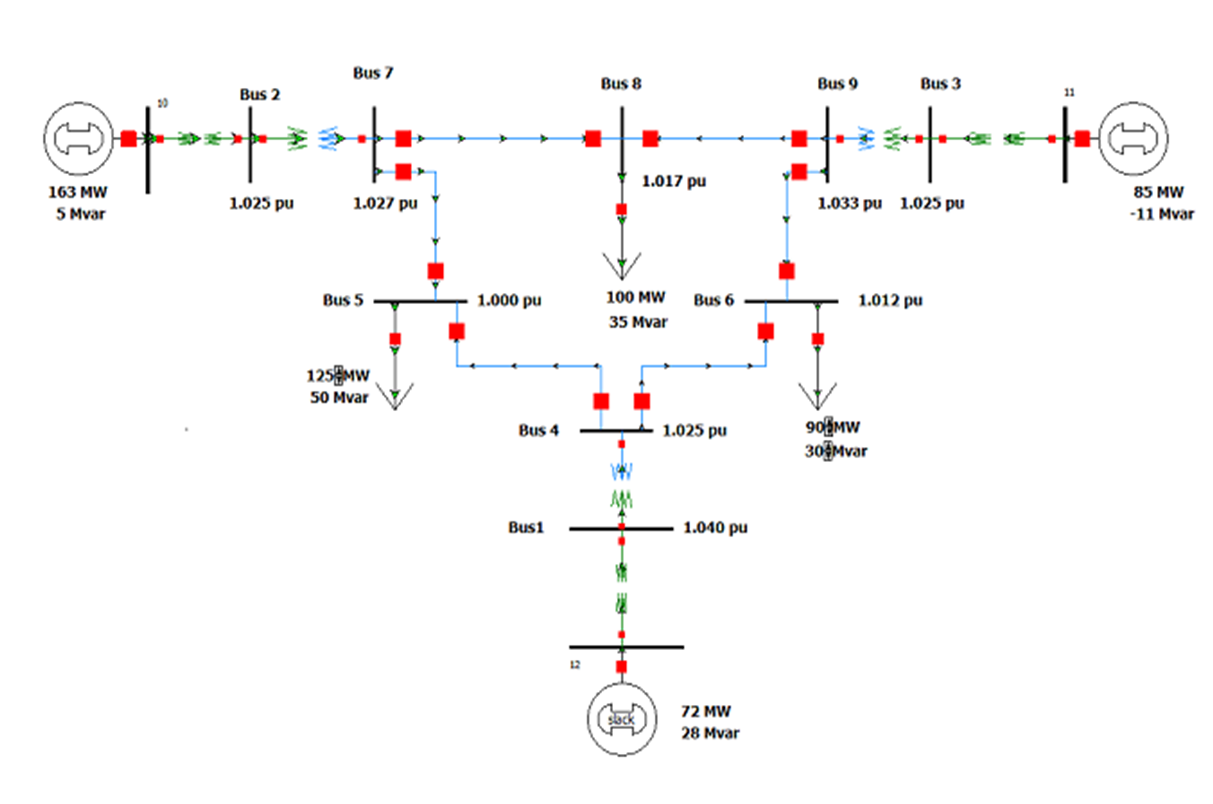
The integration of renewable energy sources (RES) into modern power systems is transforming the traditional reliance on synchronous generators, leading to a greener energy portfolio while posing significant challenges to system stability due to reduced inertia. Diminished system inertia results in elevated rates of change of frequency (RoCoF) and larger frequency deviations, potentially culminating in blackouts. Accurate inertia estimation is paramount for implementing virtual inertia control and enhancing frequency support services. This study investigates curve-fitting techniques, with a focus on polynomial fitting, for inertia estimation. Simulations are conducted on a modified IEEE 9-bus system incorporating dynamic models. Transient events involve 10% and 20% load increases at t = 10 s. Results demonstrate that fifth-order polynomials yield the minimum errors (e.g., 9.61% for the 10% load case), with robustness to data loss maintaining errors below 2% for up to 20–30% data reduction.

Graphical Abstract
Applications of Curve Fitting Techniques in Inertia Estimation of Power System

Keywords
curve fitting
frequency stability
IEEE test systems
polynomial fitting
power system inertia
renewable energy sources

Data Availability Statement
Data will be made available on request.

Funding
This work was supported without any funding.

Conflicts of Interest
The authors declare no conflicts of interest.

Ethical Approval and Consent to Participate
Not applicable.

References
  1. Gorbunov, A., Peng, J. C. H., Bialek, J. W., & Vorobev, P. (2022). Can center-of-inertia model be identified from ambient frequency measurements?. IEEE Transactions on Power Systems, 37(3), 2459-2462.
    [CrossRef]   [Google Scholar]
  2. Suvorov, A., Askarov, A., Kievets, A., & Rudnik, V. (2022). A comprehensive assessment of the state-of-the-art virtual synchronous generator models. Electric Power Systems Research, 209, 108054.
    [CrossRef]   [Google Scholar]
  3. Long, B., Zeng, W., Rodriguez, J., Guerrero, J. M., & Chong, K. T. (2021). Voltage regulation enhancement of DC-MG based on power accumulator battery test system: MPC-controlled virtual inertia approach. IEEE Transactions on Smart Grid, 13(1), 71-81.
    [CrossRef]   [Google Scholar]
  4. Phurailatpam, C., Rather, Z. H., Bahrani, B., & Doolla, S. (2019). Measurement-based estimation of inertia in AC microgrids. IEEE Transactions on Sustainable Energy, 11(3), 1975-1984.
    [CrossRef]   [Google Scholar]
  5. Inoue, T., Taniguchi, H., Ikeguchi, Y., & Yoshida, K. (2002). Estimation of power system inertia constant and capacity of spinning-reserve support generators using measured frequency transients. IEEE Transactions on Power Systems, 12(1), 136-143.
    [CrossRef]   [Google Scholar]
  6. Syed, S., Sahu, M. K., & Badar, A. Q. H. (2025). Inertia estimation through local frequency measurements and convolutional neural networks. In 2025 IEEE 1st International Conference on Smart and Sustainable Developments in Electrical Engineering (SSDEE) (pp. 1–6).
    [CrossRef]   [Google Scholar]
  7. Cao, X., Stephen, B., Abdulhadi, I. F., Booth, C. D., & Burt, G. M. (2015). Switching Markov Gaussian models for dynamic power system inertia estimation. IEEE Transactions on Power Systems, 31(5), 3394-3403.
    [CrossRef]   [Google Scholar]
  8. Swaminathan, G. V., Vasudevan, K. R., Ramachandaramurthy, V. K., & Periasamy, S. (2022). Design of virtual inertia controller for DC microgrid using zero placement technique. Electric Power Components and Systems, 50(14-15), 762-775.
    [CrossRef]   [Google Scholar]
  9. Shahbazuddin, S., Badar, A. Q., Yang, C. M., & Elsisi, M. (2025, June). Enhancing Power System Inertia Estimation through Advanced Neural Networks. In 2025 IEEE Industry Applications Society Annual Meeting (IAS) (pp. 1-8). IEEE.
    [CrossRef]   [Google Scholar]
  10. Wall, P., Gonzalez-Longatt, F., & Terzija, V. (2012). Estimation of generator inertia available during a disturbance. In IEEE Power and Energy Society General Meeting (pp. 1–8).
    [CrossRef]   [Google Scholar]
  11. Kerdphol, T., Watanabe, M., Mitani, Y., & Ngamroo, I. (2022). Inertia assessment from transient measurements: Recent perspective from Japanese WAMS. IEEE Access, 10, 66332-66344.
    [CrossRef]   [Google Scholar]
  12. Wang, B., Sun, H., Li, W., Yang, C., Wei, W., Zhao, B., & Xu, S. (2022). Power system inertia estimation method based on maximum frequency deviation. IET Renewable Power Generation, 16(3), 622-633.
    [CrossRef]   [Google Scholar]
  13. Ashton, P. M., Taylor, G. A., Carter, A. M., Bradley, M. E., & Hung, W. (2013, July). Application of phasor measurement units to estimate power system inertial frequency response. In 2013 IEEE Power & Energy Society General Meeting (pp. 1-5). IEEE.
    [CrossRef]   [Google Scholar]
  14. Dowrah, P., Lian, K. M., Sangma, J. D., Dkhar, F., & Affijulla, S. (2021, October). Estimation techniques for power system inertia: A simulation oriented review. In 2021 IEEE Mysore Sub Section International Conference (MysuruCon) (pp. 36-41). IEEE.
    [CrossRef]   [Google Scholar]
  15. Xu, Z., Ma, J., Gao, Y., Li, Y., Yu, H., & Wang, L. (2023). Inertia identification and analysis for high-power-electronic-penetrated power system based on measurement data. Energies, 16(10), 4101.
    [CrossRef]   [Google Scholar]
  16. Prabhakar, K., Jain, S. K., & Padhy, P. K. (2024). Investigations on application of curve fitting in power system inertia estimation. Smart Science, 12(3), 423–444.
    [CrossRef]   [Google Scholar]
  17. Kundur, P. (2007). Power system stability. Power system stability and control, 10(1), 7-1.
    [Google Scholar]
  18. Anderson, P. M., & Fouad, A. A. (2008). Power system control and stability. John Wiley & Sons.
    [Google Scholar]

Cite This Article
APA Style
Badar, A. Q. H., Mazumdar, B., & Shahbazuddin, S. (2025). Applications of Curve Fitting Techniques in Inertia Estimation of Power System. Sustainable Energy Control and Optimization, 1(2), 61–66. https://doi.org/10.62762/SECO.2025.672523
Export Citation
RIS Format
Compatible with EndNote, Zotero, Mendeley, and other reference managers
RIS format data for reference managers
TY  - JOUR
AU  - Badar, Altaf Q. H.
AU  - Mazumdar, Bijon
AU  - Shahbazuddin, Syed
PY  - 2025
DA  - 2025/12/23
TI  - Applications of Curve Fitting Techniques in Inertia Estimation of Power System
JO  - Sustainable Energy Control and Optimization
T2  - Sustainable Energy Control and Optimization
JF  - Sustainable Energy Control and Optimization
VL  - 1
IS  - 2
SP  - 61
EP  - 66
DO  - 10.62762/SECO.2025.672523
UR  - https://www.icck.org/article/abs/SECO.2025.672523
KW  - curve fitting
KW  - frequency stability
KW  - IEEE test systems
KW  - polynomial fitting
KW  - power system inertia
KW  - renewable energy sources
AB  - The integration of renewable energy sources (RES) into modern power systems is transforming the traditional reliance on synchronous generators, leading to a greener energy portfolio while posing significant challenges to system stability due to reduced inertia. Diminished system inertia results in elevated rates of change of frequency (RoCoF) and larger frequency deviations, potentially culminating in blackouts. Accurate inertia estimation is paramount for implementing virtual inertia control and enhancing frequency support services. This study investigates curve-fitting techniques, with a focus on polynomial fitting, for inertia estimation. Simulations are conducted on a modified IEEE 9-bus system incorporating dynamic models. Transient events involve 10% and 20% load increases at t = 10 s. Results demonstrate that fifth-order polynomials yield the minimum errors (e.g., 9.61% for the 10% load case), with robustness to data loss maintaining errors below 2% for up to 20–30% data reduction.
SN  - 3068-7330
PB  - Institute of Central Computation and Knowledge
LA  - English
ER  - 
BibTeX Format
Compatible with LaTeX, BibTeX, and other reference managers
BibTeX format data for LaTeX and reference managers
@article{Badar2025Applicatio,
  author = {Altaf Q. H. Badar and Bijon Mazumdar and Syed Shahbazuddin},
  title = {Applications of Curve Fitting Techniques in Inertia Estimation of Power System},
  journal = {Sustainable Energy Control and Optimization},
  year = {2025},
  volume = {1},
  number = {2},
  pages = {61-66},
  doi = {10.62762/SECO.2025.672523},
  url = {https://www.icck.org/article/abs/SECO.2025.672523},
  abstract = {The integration of renewable energy sources (RES) into modern power systems is transforming the traditional reliance on synchronous generators, leading to a greener energy portfolio while posing significant challenges to system stability due to reduced inertia. Diminished system inertia results in elevated rates of change of frequency (RoCoF) and larger frequency deviations, potentially culminating in blackouts. Accurate inertia estimation is paramount for implementing virtual inertia control and enhancing frequency support services. This study investigates curve-fitting techniques, with a focus on polynomial fitting, for inertia estimation. Simulations are conducted on a modified IEEE 9-bus system incorporating dynamic models. Transient events involve 10\% and 20\% load increases at t = 10 s. Results demonstrate that fifth-order polynomials yield the minimum errors (e.g., 9.61\% for the 10\% load case), with robustness to data loss maintaining errors below 2\% for up to 20–30\% data reduction.},
  keywords = {curve fitting, frequency stability, IEEE test systems, polynomial fitting, power system inertia, renewable energy sources},
  issn = {3068-7330},
  publisher = {Institute of Central Computation and Knowledge}
}

Article Metrics
Citations:

Crossref

0

Scopus

0

Web of Science

0
Article Access Statistics:
Views: 171
PDF Downloads: 77

Publisher's Note
ICCK stays neutral with regard to jurisdictional claims in published maps and institutional affiliations.

Rights and Permissions
CC BY Copyright © 2025 by the Author(s). Published by Institute of Central Computation and Knowledge. This article is an open access article distributed under the terms and conditions of the Creative Commons Attribution (CC BY) license (https://creativecommons.org/licenses/by/4.0/), which permits use, sharing, adaptation, distribution and reproduction in any medium or format, as long as you give appropriate credit to the original author(s) and the source, provide a link to the Creative Commons licence, and indicate if changes were made.
Sustainable Energy Control and Optimization

Sustainable Energy Control and Optimization

ISSN: 3068-7330 (Online)

Email: [email protected]

Portico

Portico

All published articles are preserved here permanently:
https://www.portico.org/publishers/icck/