
Volume 2, Issue 2, ICCK Transactions on Advanced Computing and Systems
Volume 2, Issue 2, 2026
Submit Manuscript Edit a Special Issue
Article QR Code
Article QR Code
Scan the QR code for reading
Popular articles
ICCK Transactions on Advanced Computing and Systems, Volume 2, Issue 2, 2026: 107-115

Open Access | Research Article | 11 February 2026
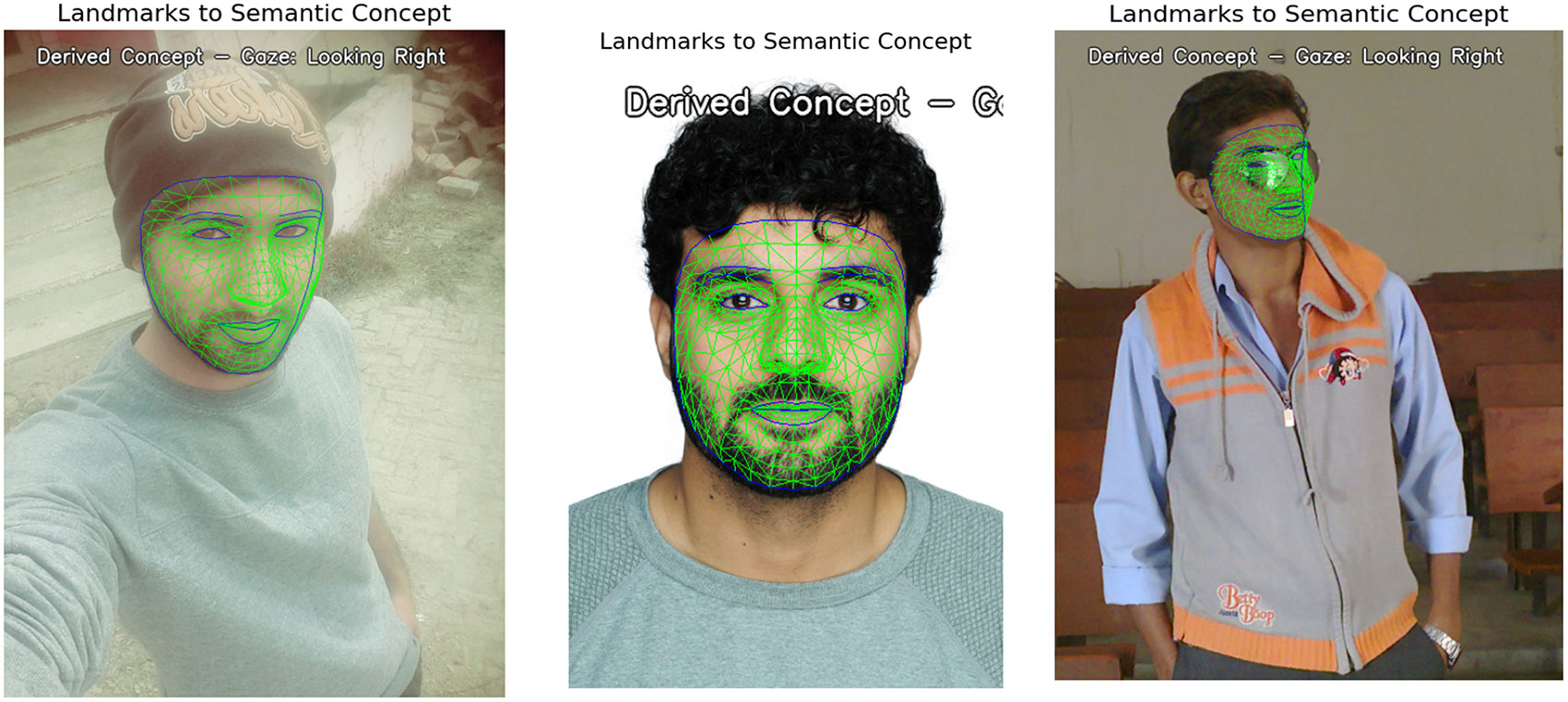
GeoGaze: A Real-time, Lightweight Gaze Estimation Framework via Geometric Landmark Analysis
1 School of Computer Science and Technology, Chongqing University of Posts and Telecommunications, Chongqing 400065, China
2 Department of Computer Science, University of Okara, Okara 56300, Pakistan
* Corresponding Author: Muhammad Imran Khalid, [email protected]
ARK: ark:/57805/tacs.2025.798133
Received: 17 August 2025, Accepted: 22 September 2025, Published: 11 February 2026  
Abstract
Gaze estimation plays a vital role in human-computer interaction, driver monitoring, and psychological analysis. While state-of-the-art appearance-based methods achieve high accuracy using deep learning, they often demand substantial computational resources, including GPU acceleration and extensive training, limiting their use in resource-constrained or real-time scenarios. This paper introduces GeoGaze, a novel, lightweight, training-free framework that infers categorical gaze direction (“Left”, “Center”, “Right”) solely from geometric analysis of facial landmarks. Leveraging the high-precision 478-point face mesh and iris landmarks provided by MediaPipe, GeoGaze computes a simple normalized iris-to-eye-corner ratio and applies intuitive thresholds, eliminating the need for model training or GPU support. Evaluated on a simulated 1,500-image dataset (SGDD-1500), GeoGaze delivers competitive directional classification accuracy while achieving real-time performance (~66 FPS on CPU), outperforming typical deep learning baselines by more than an order of magnitude in speed. These results position GeoGaze as an efficient, interpretable alternative for edge devices and applications where precise angular gaze is unnecessary and directional intent suffices.

Graphical Abstract
GeoGaze: A Real-time, Lightweight Gaze Estimation Framework via Geometric Landmark Analysis

Keywords
machine learning
deep learning
face direction
student monitoring

Data Availability Statement
Data will be made available on request.

Funding
This work was supported without any funding.

Conflicts of Interest
The authors declare no conflicts of interest.

AI Use Statement
The authors declare that no generative AI was used in the preparation of this manuscript.

Ethical Approval and Consent to Participate
This study does not involve human participants, animal experiments, or any personally identifiable data. Therefore, ethical approval and informed consent were not required.

References
  1. Kleinke, C. L. (1986). Gaze and eye contact: A research review. Psychological Bulletin, 100(1), 78.
    [CrossRef]   [Google Scholar]
  2. Baron-Cohen, S. (1995). Mindblindness: An essay on autism and theory of mind. MIT Press.
    [Google Scholar]
  3. Majaranta, P., & Räihä, K. J. (2002). Twenty years of eye typing: Systems and design issues. In Proceedings of the 2002 symposium on Eye tracking research & applications (pp. 15-22).
    [CrossRef]   [Google Scholar]
  4. Ji, Q., & Yang, X. (2002). Real-time eye, gaze, and face pose tracking for monitoring driver vigilance. Real-Time Imaging, 8(5), 357-377.
    [CrossRef]   [Google Scholar]
  5. Patil, S., Chen, Y., & Rosing, T. S. (2015, December). GazeTube: Gaze-Based adaptive video playback for bandwidth and power optimizations. In 2015 IEEE Global Communications Conference (GLOBECOM) (pp. 1-6). IEEE.
    [CrossRef]   [Google Scholar]
  6. Duchowski, A. T., & Duchowski, A. T. (2017). Eye tracking methodology: Theory and practice. Springer.
    [CrossRef]   [Google Scholar]
  7. Jacob, R. J., & Karn, K. S. (2003). Eye tracking in human-computer interaction and usability research: Ready to deliver the promises. In The mind's eye (pp. 573-605). North-Holland.
    [CrossRef]   [Google Scholar]
  8. Wedel, M., & Pieters, R. (2008). A review of eye-tracking research in marketing. In Review of marketing research (pp. 123-147).
    [Google Scholar]
  9. Hansen, D. W., & Ji, Q. (2010). In the eye of the beholder: A survey of models for eyes and gaze. IEEE Transactions on Pattern Analysis and Machine Intelligence, 32(3), 478-500.
    [CrossRef]   [Google Scholar]
  10. Funes-Mora, K. A., & Odobez, J. M. (2016). Gaze estimation in the 3D space using RGB-D sensors: towards head-pose and user invariance. International Journal of Computer Vision, 118(2), 194-216.
    [CrossRef]   [Google Scholar]
  11. Zhu, Z., & Ji, Q. (2007). Novel eye gaze tracking techniques under natural head movement. IEEE Transactions on biomedical engineering, 54(12), 2246-2260.
    [CrossRef]   [Google Scholar]
  12. Bhatt, A., Watanabe, K., Dengel, A., & Ishimaru, S. (2024). Appearance-based gaze estimation with deep neural networks: From data collection to evaluation. International Journal of Activity and Behavior Computing, 2024(1), 1-15.
    [CrossRef]   [Google Scholar]
  13. Liang, Y., & Lee, J. D. (2014). A hybrid Bayesian Network approach to detect driver cognitive distraction. Transportation research part C: emerging technologies, 38, 146-155.
    [CrossRef]   [Google Scholar]
  14. Krafka, K., Khosla, A., Kellnhofer, P., Kannan, H., Bhandarkar, S., Matusik, W., & Torralba, A. (2016, June). Eye Tracking for Everyone. In 2016 IEEE Conference on Computer Vision and Pattern Recognition (CVPR) (pp. 2176-2184). IEEE.
    [CrossRef]   [Google Scholar]
  15. Zhang, X., Sugano, Y., Fritz, M., & Bulling, A. (2015, June). Appearance-based gaze estimation in the wild. In 2015 IEEE Conference on Computer Vision and Pattern Recognition (CVPR) (pp. 4511-4520). IEEE.
    [CrossRef]   [Google Scholar]
  16. Zhang, X., Sugano, Y., Fritz, M., & Bulling, A. (2017, July). It’s Written All Over Your Face: Full-Face Appearance-Based Gaze Estimation. In 2017 IEEE Conference on Computer Vision and Pattern Recognition Workshops (CVPRW) (pp. 2299-2308). IEEE.
    [CrossRef]   [Google Scholar]
  17. Fischer, T., Chang, H. J., & Demiris, Y. (2018, September). RT-GENE: Real-Time Eye Gaze Estimation in Natural Environments. In European Conference on Computer Vision (pp. 339-357). Cham: Springer International Publishing.
    [CrossRef]   [Google Scholar]
  18. Sugano, Y., Matsushita, Y., & Sato, Y. (2014, June). Learning-by-Synthesis for Appearance-Based 3D Gaze Estimation. In 2014 IEEE Conference on Computer Vision and Pattern Recognition (pp. 1821-1828). IEEE.
    [CrossRef]   [Google Scholar]
  19. Kellnhofer, P., Recasens, A., Stent, S., Matusik, W., & Torralba, A. (2019, October). Gaze360: Physically Unconstrained Gaze Estimation in the Wild. In 2019 IEEE/CVF International Conference on Computer Vision (ICCV) (pp. 6911-6920). IEEE.
    [CrossRef]   [Google Scholar]
  20. Bodini, M. (2019). A review of facial landmark extraction in 2D images and videos using deep learning. Big Data and Cognitive Computing, 3(1), 14.
    [CrossRef]   [Google Scholar]
  21. Cheng, Y., Wang, H., Bao, Y., & Lu, F. (2024). Appearance-based gaze estimation with deep learning: A review and benchmark. IEEE Transactions on Pattern Analysis and Machine Intelligence, 46(12), 7509-7528.
    [CrossRef]   [Google Scholar]
  22. Ye, E. E., Ye, J. E., Ye, J., Ye, J., & Ye, R. (2023). Low-cost Geometry-based Eye Gaze Detection using Facial Landmarks Generated through Deep Learning. arXiv preprint arXiv:2401.00406.
    [Google Scholar]
  23. Wood, E., Baltrušaitis, T., Morency, L. P., Robinson, P., & Bulling, A. (2016, March). Learning an appearance-based gaze estimator from one million synthesised images. In Proceedings of the ninth biennial ACM symposium on eye tracking research & applications (pp. 131-138).
    [CrossRef]   [Google Scholar]
  24. Sesma, L., Villanueva, A., & Cabeza, R. (2012, March). Evaluation of pupil center-eye corner vector for gaze estimation using a web cam. In Proceedings of the symposium on eye tracking research and applications (pp. 217-220).
    [CrossRef]   [Google Scholar]
  25. Valenti, R., Sebe, N., & Gevers, T. (2011). Combining head pose and eye location information for gaze estimation. IEEE Transactions on Image Processing, 21(2), 802-815.
    [CrossRef]   [Google Scholar]
  26. Yan, G., & Grishchenko, I. (2022). Model Card: MediaPipe Face Mesh V2. Google. Retrieved from https://storage.googleapis.com/mediapipe-assets/Model%20Card%20MediaPipe%20Face%20Mesh%20V2.pdf
    [Google Scholar]
  27. Zhao, R., Wang, Y., Luo, S., Shou, S., & Tang, P. (2024). Gaze-swin: Enhancing gaze estimation with a hybrid cnn-transformer network and dropkey mechanism. Electronics, 13(2), 328.
    [CrossRef]   [Google Scholar]
  28. Chen, J., & Ji, Q. (2011, June). Probabilistic gaze estimation without active personal calibration. In CVPR 2011 (pp. 609-616). IEEE.
    [CrossRef]   [Google Scholar]
  29. Huang, Q., Veeraraghavan, A., & Sabharwal, A. (2017). Tabletgaze: dataset and analysis for unconstrained appearance-based gaze estimation in mobile tablets. Machine Vision and Applications, 28(5), 445-461.
    [CrossRef]   [Google Scholar]
  30. Wang, K., & Ji, Q. (2017, October). Real Time Eye Gaze Tracking with 3D Deformable Eye-Face Model. In 2017 IEEE International Conference on Computer Vision (ICCV) (pp. 1003-1011). IEEE.
    [CrossRef]   [Google Scholar]
  31. Bazarevsky, V., Kartynnik, Y., Vakunov, A., Raveendran, K., & Grundmann, M. (2019). Blazeface: Sub-millisecond neural face detection on mobile gpus. arXiv preprint arXiv:1907.05047.
    [Google Scholar]
  32. Zhang, X., Park, S., Beeler, T., Bradley, D., Tang, S., & Hilliges, O. (2020, August). Eth-xgaze: A large scale dataset for gaze estimation under extreme head pose and gaze variation. In European conference on computer vision (pp. 365-381). Cham: Springer International Publishing.
    [CrossRef]   [Google Scholar]

Cite This Article
APA Style
Khalid, M. I., Komal, A., Hussain, N., Idrees, M., Wagan, A. A., & Hussain, S. A. (2026). GeoGaze: A Real-time, Lightweight Gaze Estimation Framework via Geometric Landmark Analysis. ICCK Transactions on Advanced Computing and Systems, 2(2), 107–115. https://doi.org/10.62762/TACS.2025.798133
Export Citation
RIS Format
Compatible with EndNote, Zotero, Mendeley, and other reference managers
RIS format data for reference managers
TY  - JOUR
AU  - Khalid, Muhammad Imran
AU  - Komal, Asma
AU  - Hussain, Nasir
AU  - Idrees, Muhammad
AU  - Wagan, Atif Ali
AU  - Hussain, Syed Akif
PY  - 2026
DA  - 2026/02/11
TI  - GeoGaze: A Real-time, Lightweight Gaze Estimation Framework via Geometric Landmark Analysis
JO  - ICCK Transactions on Advanced Computing and Systems
T2  - ICCK Transactions on Advanced Computing and Systems
JF  - ICCK Transactions on Advanced Computing and Systems
VL  - 2
IS  - 2
SP  - 107
EP  - 115
DO  - 10.62762/TACS.2025.798133
UR  - https://www.icck.org/article/abs/TACS.2025.798133
KW  - machine learning
KW  - deep learning
KW  - face direction
KW  - student monitoring
AB  - Gaze estimation plays a vital role in human-computer interaction, driver monitoring, and psychological analysis. While state-of-the-art appearance-based methods achieve high accuracy using deep learning, they often demand substantial computational resources, including GPU acceleration and extensive training, limiting their use in resource-constrained or real-time scenarios. This paper introduces GeoGaze, a novel, lightweight, training-free framework that infers categorical gaze direction (“Left”, “Center”, “Right”) solely from geometric analysis of facial landmarks. Leveraging the high-precision 478-point face mesh and iris landmarks provided by MediaPipe, GeoGaze computes a simple normalized iris-to-eye-corner ratio and applies intuitive thresholds, eliminating the need for model training or GPU support. Evaluated on a simulated 1,500-image dataset (SGDD-1500), GeoGaze delivers competitive directional classification accuracy while achieving real-time performance (~66 FPS on CPU), outperforming typical deep learning baselines by more than an order of magnitude in speed. These results position GeoGaze as an efficient, interpretable alternative for edge devices and applications where precise angular gaze is unnecessary and directional intent suffices.
SN  - 3068-7969
PB  - Institute of Central Computation and Knowledge
LA  - English
ER  - 
BibTeX Format
Compatible with LaTeX, BibTeX, and other reference managers
BibTeX format data for LaTeX and reference managers
@article{Khalid2026GeoGaze,
  author = {Muhammad Imran Khalid and Asma Komal and Nasir Hussain and Muhammad Idrees and Atif Ali Wagan and Syed Akif Hussain},
  title = {GeoGaze: A Real-time, Lightweight Gaze Estimation Framework via Geometric Landmark Analysis},
  journal = {ICCK Transactions on Advanced Computing and Systems},
  year = {2026},
  volume = {2},
  number = {2},
  pages = {107-115},
  doi = {10.62762/TACS.2025.798133},
  url = {https://www.icck.org/article/abs/TACS.2025.798133},
  abstract = {Gaze estimation plays a vital role in human-computer interaction, driver monitoring, and psychological analysis. While state-of-the-art appearance-based methods achieve high accuracy using deep learning, they often demand substantial computational resources, including GPU acceleration and extensive training, limiting their use in resource-constrained or real-time scenarios. This paper introduces GeoGaze, a novel, lightweight, training-free framework that infers categorical gaze direction (“Left”, “Center”, “Right”) solely from geometric analysis of facial landmarks. Leveraging the high-precision 478-point face mesh and iris landmarks provided by MediaPipe, GeoGaze computes a simple normalized iris-to-eye-corner ratio and applies intuitive thresholds, eliminating the need for model training or GPU support. Evaluated on a simulated 1,500-image dataset (SGDD-1500), GeoGaze delivers competitive directional classification accuracy while achieving real-time performance (~66 FPS on CPU), outperforming typical deep learning baselines by more than an order of magnitude in speed. These results position GeoGaze as an efficient, interpretable alternative for edge devices and applications where precise angular gaze is unnecessary and directional intent suffices.},
  keywords = {machine learning, deep learning, face direction, student monitoring},
  issn = {3068-7969},
  publisher = {Institute of Central Computation and Knowledge}
}

Article Metrics
Citations:

Crossref

0

Scopus

0

Web of Science

0
Article Access Statistics:
Views: 26
PDF Downloads: 6

Publisher's Note
ICCK stays neutral with regard to jurisdictional claims in published maps and institutional affiliations.

Rights and Permissions
CC BY Copyright © 2026 by the Author(s). Published by Institute of Central Computation and Knowledge. This article is an open access article distributed under the terms and conditions of the Creative Commons Attribution (CC BY) license (https://creativecommons.org/licenses/by/4.0/), which permits use, sharing, adaptation, distribution and reproduction in any medium or format, as long as you give appropriate credit to the original author(s) and the source, provide a link to the Creative Commons licence, and indicate if changes were made.
ICCK Transactions on Advanced Computing and Systems

ICCK Transactions on Advanced Computing and Systems

ISSN: 3068-7969 (Online)

Email: [email protected]

Portico

Portico

All published articles are preserved here permanently:
https://www.portico.org/publishers/icck/