
Advanced Hyperelliptic Curve-Based Authentication Protocols for Secure Internet of Drones Communication







Article Information
Abstract
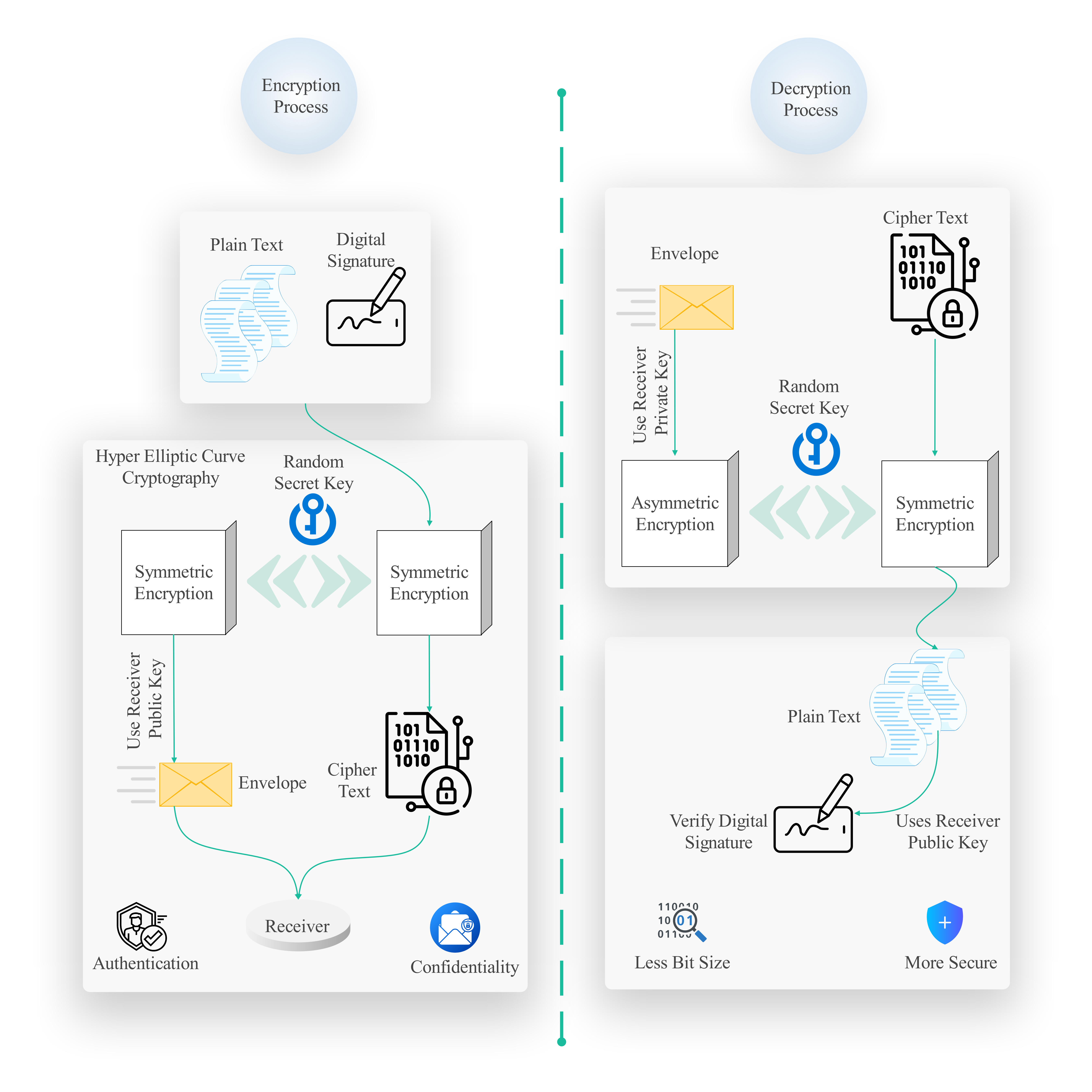
The concept of an Internet of Drones (IoD) is becoming increasingly important in various domains, including surveillance and logistics. Effective communication between the interconnected systems is the essence of the Internet of Drones, however, due to the resource constraints of drones and the dynamic nature of the operating environment, security of communication within IoD networks is indeed the top priority. Considering these challenges on the part of IoD communication, a novel Hyperelliptic Curve Cryptography (HECC)-based authentication protocol is proposed in this paper to secure the data exchange between drones and their control servers and to ensure efficient communication. The proposed HECC protocol is compared with three existing protocols, Elliptic curve cryptography-based protocol with public secure authentication scheme (ECCCPSAS), Non-linear wireless unmanned aerial systems authentication scheme (NLWUAS), and the Multi-Agent System (MAS). The comparison is made among average performance metrics such as communication overhead, packet delivery ratio, throughput, and end-to-end delay. The experimental outcome assures that the HECC protocol outperforms the other protocols in terms of all metrics. The HECC-based authentication protocol reduces communication overhead by up to 30% and end-to-end delay to 75 ms while achieving a 95% packet delivery ratio and 8 Mbps throughput, outperforming ECCCPSAS, NLWUAS, and MAS across all evaluated metrics. These results confirm that HECC is a viable cryptographic solution for resource-constrained IoD deployments. Future work will focus on real-world protocol deployment and integration with quantum-resistant algorithms.
Graphical Abstract
Keywords
Data Availability Statement
Funding
Conflicts of Interest
Ethical Approval and Consent to Participate
References
- Berini, A. D. E., Ferrag, M. A., Farou, B., & Seridi, H. (2023). HCALA: Hyperelliptic curve-based anonymous lightweight authentication scheme for Internet of Drones. Pervasive and Mobile Computing, 92, 101798.
[CrossRef] [Google Scholar] - Bera, B., Saha, S., Das, A. K., Kumar, N., Lorenz, P., & Alazab, M. (2020). Blockchain-envisioned secure data delivery and collection scheme for 5g-based iot-enabled internet of drones environment. IEEE Transactions on Vehicular Technology, 69(8), 9097-9111.
[CrossRef] [Google Scholar] - Adeniyi, A. E., Jimoh, R. G., & Awotunde, J. B. (2024). A systematic review on elliptic curve cryptography algorithm for internet of things: Categorization, application areas, and security. Computers and Electrical Engineering, 118, 109330.
[CrossRef] [Google Scholar] - Hussain, S., Chaudhry, S. A., Alomari, O. A., Alsharif, M. H., Khan, M. K., & Kumar, N. (2021). Amassing the security: An ECC-based authentication scheme for Internet of Drones. IEEE Systems Journal, 15(3), 4431-4438.
[CrossRef] [Google Scholar] - Tanveer, M., Alasmary, H., Kumar, N., & Nayak, A. (2023). SAAF-IoD: Secure and anonymous authentication framework for the Internet of Drones. IEEE Transactions on Vehicular Technology, 73(1), 232-244.
[CrossRef] [Google Scholar] - Mekdad, Y., Aris, A., Babun, L., El Fergougui, A., Conti, M., Lazzeretti, R., & Uluagac, A. S. (2023). A survey on security and privacy issues of UAVs. Computer networks, 224, 109626.
[CrossRef] [Google Scholar] - Tan, Y., Wang, J., Liu, J., & Kato, N. (2022). Blockchain-assisted distributed and lightweight authentication service for industrial unmanned aerial vehicles. IEEE Internet of Things Journal, 9(18), 16928-16940.
[CrossRef] [Google Scholar] - Sharma, J., & Mehra, P. S. (2023). Secure communication in IOT-based UAV networks: A systematic survey. Internet of Things, 23, 100883.
[CrossRef] [Google Scholar] - Hawashin, D., Nemer, M., Gebreab, S. A., Salah, K., Jayaraman, R., Khan, M. K., & Damiani, E. (2024). Blockchain applications in UAV industry: Review, opportunities, and challenges. Journal of Network and Computer Applications, 230, 103932.
[CrossRef] [Google Scholar] - Yahuza, M., Idris, M. Y. I., Ahmedy, I. B., Wahab, A. W. A., Nandy, T., Noor, N. M., & Bala, A. (2021). Internet of drones security and privacy issues: Taxonomy and open challenges. IEEE Access, 9, 57243-57270.
[CrossRef] [Google Scholar] - Abdelmaboud, A. (2021). The internet of drones: Requirements, taxonomy, recent advances, and challenges of research trends. Sensors, 21(17), 5718.
[CrossRef] [Google Scholar] - Ma, R., Cao, J., He, S., Zhang, Y., Niu, B., & Li, H. (2023). A UAV-assisted UE access authentication scheme for 5G/6G network. IEEE Transactions on Network and Service Management, 21(2), 2426-2444.
[CrossRef] [Google Scholar] - Shen, A., Luo, J., Ning, J., Li, Y., Wang, Z., & Duo, B. (2023). Safeguarding UAV networks against active eavesdropping: An elevation angle-distance trade-off for secrecy enhancement. Drones, 7(2), 109.
[CrossRef] [Google Scholar] - Tsao, K. Y., Girdler, T., & Vassilakis, V. G. (2022). A survey of cyber security threats and solutions for UAV communications and flying ad-hoc networks. Ad hoc networks, 133, 102894.
[CrossRef] [Google Scholar] - Pirayesh, J., Giaretta, A., Conti, M., & Keshavarzi, P. (2022). A PLS-HECC-based device authentication and key agreement scheme for smart home networks. Computer Networks, 216, 109077.
[CrossRef] [Google Scholar] - Alsumayt, A., Nagy, N., Alsharyofi, S., Al Ibrahim, N., Al-Rabie, R., Alahmadi, R., ... & Alahmadi, A. A. (2024). Detecting denial of service attacks (DoS) over the Internet of Drones (IoD) based on machine learning. Sci, 6(3), 56.
[CrossRef] [Google Scholar] - Hadi, H. J., Cao, Y., Nisa, K. U., Jamil, A. M., & Ni, Q. (2023). A comprehensive survey on security, privacy issues and emerging defence technologies for UAVs. Journal of Network and Computer Applications, 213, 103607.
[CrossRef] [Google Scholar] - Wang, Z., Li, Y., Wu, S., Zhou, Y., Yang, L., Xu, Y., ... & Pan, Q. (2023). A survey on cybersecurity attacks and defenses for unmanned aerial systems. Journal of Systems Architecture, 138, 102870.
[CrossRef] [Google Scholar] - Arthur, M. P. (2019, August). Detecting signal spoofing and jamming attacks in UAV networks using a lightweight IDS. In 2019 international conference on computer, information and telecommunication systems (CITS) (pp. 1-5). IEEE.
[CrossRef] [Google Scholar] - Rugo, A., Ardagna, C. A., & Ioini, N. E. (2022). A security review in the UAVNet era: Threats, countermeasures, and gap analysis. ACM Computing Surveys (CSUR), 55(1), 1-35.
[CrossRef] [Google Scholar] - Kharchenko, V., & Torianyk, V. (2018, May). Cybersecurity of the internet of drones: Vulnerabilities analysis and imeca based assessment. In 2018 IEEE 9th international conference on dependable systems, services and technologies (DESSERT) (pp. 364-369). IEEE.
[CrossRef] [Google Scholar] - Ko, Y., Kim, J., Duguma, D. G., Astillo, P. V., You, I., & Pau, G. (2021). Drone secure communication protocol for future sensitive applications in military zone. Sensors, 21(6), 2057.
[CrossRef] [Google Scholar] - Derhab, A., Cheikhrouhou, O., Allouch, A., Koubaa, A., Qureshi, B., Ferrag, M. A., ... & Khan, F. A. (2023). Internet of drones security: Taxonomies, open issues, and future directions. Vehicular Communications, 39, 100552.
[CrossRef] [Google Scholar] - Eldosouky, A., Ferdowsi, A., & Saad, W. (2019). Drones in distress: A game-theoretic countermeasure for protecting UAVs against GPS spoofing. IEEE Internet of Things Journal, 7(4), 2840-2854.
[CrossRef] [Google Scholar] - Yaacoub, J. P., Noura, H., Salman, O., & Chehab, A. (2020). Security analysis of drones systems: Attacks, limitations, and recommendations. Internet of Things, 11, 100218.
[CrossRef] [Google Scholar] - Pirayesh, H., & Zeng, H. (2022). Jamming attacks and anti-jamming strategies in wireless networks: A comprehensive survey. IEEE communications surveys & tutorials, 24(2), 767-809.
[CrossRef] [Google Scholar] - Sharma, J., & Mehra, P. S. (2024). HCFAIUN: A novel hyperelliptic curve and fuzzy extractor-based authentication for secure data transmission in IoT-based UAV networks. Vehicular Communications, 49, 100834.
[CrossRef] [Google Scholar] - Hussain, S., Farooq, M., Alzahrani, B. A., Albeshri, A., Alsubhi, K., & Chaudhry, S. A. (2023). An efficient and reliable user access protocol for Internet of Drones. IEEE Access, 11, 59688-59700.
[CrossRef] [Google Scholar] - Nikooghadam, M., Amintoosi, H., Islam, S. H., & Moghadam, M. F. (2021). A provably secure and lightweight authentication scheme for Internet of Drones for smart city surveillance. Journal of Systems Architecture, 115, 101955.
[CrossRef] [Google Scholar] - Lara-Nino, C. A., Diaz-Perez, A., & Morales-Sandoval, M. (2018). Elliptic curve lightweight cryptography: A survey. Ieee Access, 6, 72514-72550.
[CrossRef] [Google Scholar] - Subramani, J., Maria, A., Rajasekaran, A. S., & Lloret, J. (2024). Physically secure and privacy‐preserving blockchain enabled authentication scheme for internet of drones. Security and Privacy, 7(3), e364.
[CrossRef] [Google Scholar] - Tanveer, M., Aldosary, A., Kumar, N., & Aldossari, S. A. (2024). SEAF-IoD: Secure and efficient user authentication framework for the Internet of Drones. Computer Networks, 247, 110449.
[CrossRef] [Google Scholar] - Nair, A. S., & Thampi, S. M. (2023). A location‐aware physical unclonable function and Chebyshev map‐based mutual authentication mechanism for internet of surveillance drones. Concurrency and Computation: Practice and Experience, 35(19), e7564.
[CrossRef] [Google Scholar] - Shah, T. A., Algarni, F., Ullah, I., Abdullah, A. M., Noor, F., & Asghar Khan, M. (2022). Cost‐Efficient Privacy‐Preserving Authentication and Key Management Scheme for Internet of Vehicle Ecosystem. Complexity, 2022(1), 8406649.
[CrossRef] [Google Scholar] - Heidari, A., Navimipour, N. J., & Unal, M. (2023). A secure intrusion detection platform using blockchain and radial basis function neural networks for internet of drones. IEEE Internet of Things Journal, 10(10), 8445-8454.
[CrossRef] [Google Scholar] - Yang, W., Wang, S., Yin, X., Wang, X., & Hu, J. (2022). A review on security issues and solutions of the internet of drones. IEEE Open Journal of the Computer Society, 3, 96-110.
[CrossRef] [Google Scholar] - Zhang, S., Liu, Y., Han, Z., & Yang, Z. (2023). A lightweight authentication protocol for UAVs based on ECC scheme. Drones, 7(5), 315.
[CrossRef] [Google Scholar] - Jan, S. U., Abbasi, I. A., Algarni, F., & Khan, A. S. (2022). A verifiably secure ECC based authentication scheme for securing IoD using FANET. IEEE access, 10, 95321-95343.
[CrossRef] [Google Scholar] - Javed, S., Khan, M. A., Abdullah, A. M., Alsirhani, A., Alomari, A., Noor, F., & Ullah, I. (2022). An efficient authentication scheme using blockchain as a certificate authority for the internet of drones. Drones, 6(10), 264.
[CrossRef] [Google Scholar] - Akram, J., Anaissi, A., Othman, W., Alabdulatif, A., & Akram, A. (2024). Dronessl: Self-supervised multimodal anomaly detection in internet of drone things. IEEE Transactions on Consumer Electronics, 70(1), 4287-4298.
[CrossRef] [Google Scholar]
Cited By (10)
-
Xueting Chen, Qingbin Wang. .
Advanced Intelligent Computing Technology and Applications, 2027 , 16670 .
[CrossRef] -
Juzheng Zhang, Kehao Zhang, Binnan Yan, Hongliang Liu, Yong Pei. .
Advanced Intelligent Computing Technology and Applications, 2027 , 16672 .
[CrossRef] -
Zeeshan Ali Haider, Asim Zeb, A.K.M.Muzahidul Islam, Taj Rahman, Ali Arishi, Inam Ullah. Enhancing IoT security with resource-efficient cryptography: A comprehensive review of lightweight and hybrid algorithms.
Computer Science Review, 2026 , 59 .
[CrossRef] -
Yebo Gu, Xiang Dai, Tao Shen, Hui Li. Lightweight and Trustworthy Authentication and Data Transmission Schemes in the Industrial IoT.
IEEE Internet of Things Journal, 2026 , 13 (4).
[CrossRef] -
Syed Zain Ul Abideen, Inam Ullah, Xiaoshan Bai, Weidong Zhang, Jianqiang Li, Shuzhi Sam Ge. Multi-robot task assignment: A survey of algorithmic approaches, challenges, and future directions.
Computer Science Review, 2026 , 61 .
[CrossRef] -
Kuldashbay Avazov, Kudratjon Zohirov, Umidjon Ruziev, Nabijon Abduazizov, Akmalbek Abdusalomov, Abror Buriboev, Heung Seok Jeon. Cooperative UAV swarms for zero knowledge verification of edge generative AI using trust-aware multiagent learning.
Scientific Reports, 2026 , 16 (1).
[CrossRef] -
Zeeshan Ali Haider, Inam Ullah, Akmalbek Abdusalomov, Mohsin Shah, Muhammad Zubair Khan, Basem Abu Zneid. Edge-intelligent semantic aggregation in blockchain-secured 6G UAV-assisted Internet of vehicles.
Journal of Electronic Science and Technology, 2026 , 24 (1).
[CrossRef] -
Abdullah Alwabli. AI-driven Intelligent Transportation Systems with UAV-assisted communication and IoV integration.
Journal of Engineering Research, 2026 .
[CrossRef] -
Inam Ullah, Zeeshan Ali Haider, Xin Su, Chang Choi, Ali Arishi, Hazrat Bilal. Vehicular communications for autonomous and intelligent transportation systems: a comprehensive survey.
Digital Communications and Networks, 2026 , 12 (8).
[CrossRef] -
Saddam I. D. Bakhat, Inam Ullah, Xiaoshan Bai, Weidong Zhang, Jianqiang Li, Shuzhi Sam Ge. Advancing Multirobot Task Allocation: A Comprehensive Review of Emerging Trends and Challenges.
IEEE Internet of Things Journal, 2026 , 13 (19).
[CrossRef]
Cite This Article
TY  - JOUR
AU  - Haider, Zeeshan Ali
AU  - Fayaz, Muhammad
AU  - Zhang, Yue
AU  - Ali, Ahmad
PY  - 2025
DA  - 2025/07/08
TI  - Advanced Hyperelliptic Curve-Based Authentication Protocols for Secure Internet of Drones Communication
JO  - ICCK Transactions on Advanced Computing and Systems
T2  - ICCK Transactions on Advanced Computing and Systems
JF  - ICCK Transactions on Advanced Computing and Systems
VL  - 1
IS  - 3
SP  - 138
EP  - 153
DO  - 10.62762/TACS.2025.926789
UR  - https://www.icck.org/article/abs/tacs.2025.926789
KW  - hyperelliptic curve cryptography
KW  - internet of drones (IoD)
KW  - authentication protocol
KW  - cryptographic protocols
KW  - drone communication networks
KW  - security in IoD
AB  - The concept of an Internet of Drones (IoD) is becoming increasingly important in various domains, including surveillance and logistics. Effective communication between the interconnected systems is the essence of the Internet of Drones, however, due to the resource constraints of drones and the dynamic nature of the operating environment, security of communication within IoD networks is indeed the top priority. Considering these challenges on the part of IoD communication, a novel Hyperelliptic Curve Cryptography (HECC)-based authentication protocol is proposed in this paper to secure the data exchange between drones and their control servers and to ensure efficient communication. The proposed HECC protocol is compared with three existing protocols, Elliptic curve cryptography-based protocol with public secure authentication scheme (ECCCPSAS), Non-linear wireless unmanned aerial systems authentication scheme (NLWUAS), and the Multi-Agent System (MAS). The comparison is made among average performance metrics such as communication overhead, packet delivery ratio, throughput, and end-to-end delay. The experimental outcome assures that the HECC protocol outperforms the other protocols in terms of all metrics. The HECC-based authentication protocol reduces communication overhead by up to 30% and end-to-end delay to 75 ms while achieving a 95% packet delivery ratio and 8 Mbps throughput, outperforming ECCCPSAS, NLWUAS, and MAS across all evaluated metrics. These results confirm that HECC is a viable cryptographic solution for resource-constrained IoD deployments. Future work will focus on real-world protocol deployment and integration with quantum-resistant algorithms.
SN  - 3068-7969
PB  - Institute of Central Computation and Knowledge
LA  - English
ER  -
@article{Haider2025Advanced,
  author = {Zeeshan Ali Haider and Muhammad Fayaz and Yue Zhang and Ahmad Ali},
  title = {Advanced Hyperelliptic Curve-Based Authentication Protocols for Secure Internet of Drones Communication},
  journal = {ICCK Transactions on Advanced Computing and Systems},
  year = {2025},
  volume = {1},
  number = {3},
  pages = {138-153},
  doi = {10.62762/TACS.2025.926789},
  url = {https://www.icck.org/article/abs/tacs.2025.926789},
  abstract = {The concept of an Internet of Drones (IoD) is becoming increasingly important in various domains, including surveillance and logistics. Effective communication between the interconnected systems is the essence of the Internet of Drones, however, due to the resource constraints of drones and the dynamic nature of the operating environment, security of communication within IoD networks is indeed the top priority. Considering these challenges on the part of IoD communication, a novel Hyperelliptic Curve Cryptography (HECC)-based authentication protocol is proposed in this paper to secure the data exchange between drones and their control servers and to ensure efficient communication. The proposed HECC protocol is compared with three existing protocols, Elliptic curve cryptography-based protocol with public secure authentication scheme (ECCCPSAS), Non-linear wireless unmanned aerial systems authentication scheme (NLWUAS), and the Multi-Agent System (MAS). The comparison is made among average performance metrics such as communication overhead, packet delivery ratio, throughput, and end-to-end delay. The experimental outcome assures that the HECC protocol outperforms the other protocols in terms of all metrics. The HECC-based authentication protocol reduces communication overhead by up to 30\% and end-to-end delay to 75 ms while achieving a 95\% packet delivery ratio and 8 Mbps throughput, outperforming ECCCPSAS, NLWUAS, and MAS across all evaluated metrics. These results confirm that HECC is a viable cryptographic solution for resource-constrained IoD deployments. Future work will focus on real-world protocol deployment and integration with quantum-resistant algorithms.},
  keywords = {hyperelliptic curve cryptography, internet of drones (IoD), authentication protocol, cryptographic protocols, drone communication networks, security in IoD},
  issn = {3068-7969},
  publisher = {Institute of Central Computation and Knowledge}
}
Publisher's Note
ICCK stays neutral with regard to jurisdictional claims in published maps and institutional affiliations.
Rights and Permissions
 Copyright © 2025 by the Author(s). Published by Institute of Central Computation and Knowledge. This article is an open access article distributed under the terms and conditions of the Creative Commons Attribution (CC BY) license (https://creativecommons.org/licenses/by/4.0/), which permits use, sharing, adaptation, distribution and reproduction in any medium or format, as long as you give appropriate credit to the original author(s) and the source, provide a link to the Creative Commons licence, and indicate if changes were made.


Portico
