

Influence of Current-Dependent AC Resistance and Emissivity on Temperature Estimation of a Single-Layer ACSR Conductor



Article Information
Abstract
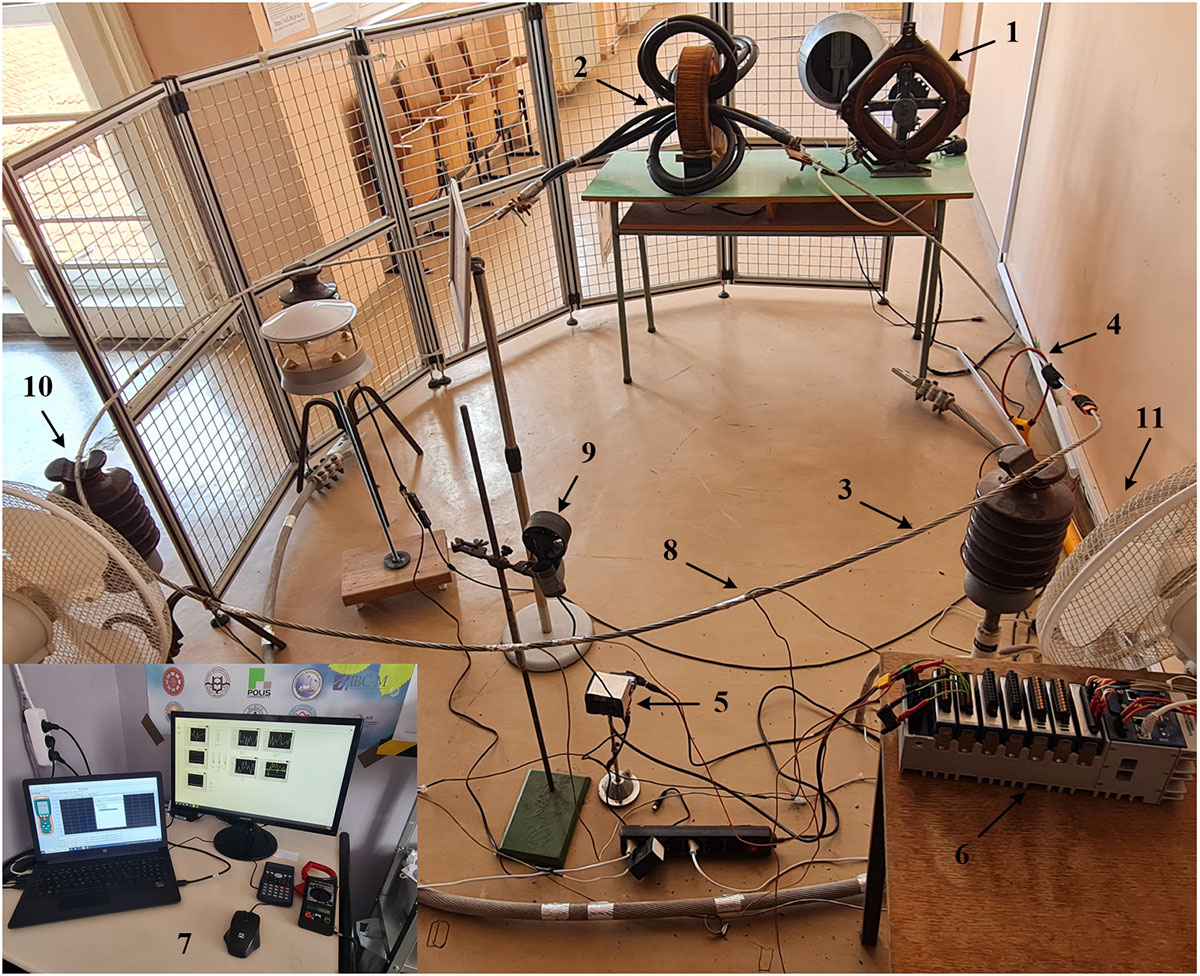
This paper investigates the influence of temperature- and current-dependent variations in alternating current (AC) resistance on the estimation of the operating temperature of aluminium conductor steel-reinforced (ACSR) conductors, with particular emphasis on the differences arising from the use of tabulated and experimentally determined resistance characteristics. Special attention is devoted to the current dependence of AC resistance in the single-layer ACSR conductor 48-AL1/8-ST1A, where pronounced resistance variations occur due to the electromagnetic interaction between the aluminum strands and the steel core. Experimental investigations were conducted under controlled laboratory conditions using a dedicated measurement system capable of the synchronized acquisition of electrical and thermal quantities in real time. Based on the obtained measurements, AC resistance characteristics were determined as functions of both conductor temperature and current, and their influence on conductor temperature estimation was subsequently evaluated. The results demonstrate that neglecting the current dependence of AC resistance may lead to conductor temperature estimation errors of up to approximately 2.5~°C under current loadings close to the rated value, indicating that this effect should not be disregarded in thermal analyses of single-layer ACSR conductors. However, the study also reveals that conductor emissivity has a substantially larger influence on temperature estimation. Specifically, varying the assumed conductor surface emissivity from 0.3 to 0.9 results in calculated conductor temperature differences exceeding 15 °C, significantly outweighing the influence of current-dependent AC resistance. The obtained findings indicate that accurate determination of conductor emissivity is essential for reliable thermal analysis and Dynamic Line Rating (DLR) applications, while the use of experimentally determined AC resistance characteristics further improves the accuracy of conductor temperature and ampacity assessments.
Graphical Abstract
Keywords
Data Availability Statement
Funding
Conflicts of Interest
AI Use Statement
Ethical Approval and Consent to Participate
References
- CIGRE Working Group 22.12. (2002). Thermal behaviour of overhead conductors (Technical Brochure 207). Paris, France: CIGRE. Retrieved from https://www.e-cigre.org/publications/detail/207-thermal-behaviour-of-overhead-conductors.html
[Google Scholar] - Milovanović, M., Jovanović, A., Banjanin, M., Vukašinović, I., Gvozdić, B., Žorić, A., ... & Vukašinović, J. (2026). Experimental Verification of IEEE, CIGRÉ and IEC Thermal Models for Dynamic Line Rating of ACSR Overhead Lines. Electricity, 7(2), 34.
[CrossRef] [Google Scholar] - Fernandez, E., Albizu, I., Bedialauneta, M. T., Mazon, A. J., & Leite, P. T. (2016). Review of dynamic line rating systems for wind power integration. Renewable and Sustainable Energy Reviews, 53, 80-92.
[CrossRef] [Google Scholar] - Abas, N. H., Ab Kadir, M. Z. A., Azis, N., Jasni, J., Ab Aziz, N. F., & Khurshid, Z. M. (2024). Optimizing grid with dynamic line rating of conductors: A comprehensive review. IEEE Access, 12, 9738-9756.
[CrossRef] [Google Scholar] - CIGRE Working Group B2.12. (2008). Alternating current (AC) resistance of helically stranded conductors (CIGRE Technical Brochure No. 345). Paris, France: CIGRE. Retrieved from https://www.e-cigre.org/publications/detail/345-alternating-current-ac-resistance-of-helically-stranded-conductors.html
[Google Scholar] - IEEE Standards Association. (2023). IEEE standard for calculating the current-temperature relationship of bare overhead conductors (IEEE Std 738-2023, Revision of IEEE Std 738-2012). Piscataway, NJ: IEEE.
[CrossRef] [Google Scholar] - CIGRE Working Group B2.43. (2014). Guide for thermal rating calculations of overhead lines (Technical Brochure No. 601). Paris, France: CIGRE. Retrieved from https://www.e-cigre.org/publications/detail/601-guide-for-thermal-rating-calculations-of-overhead-lines.html
[Google Scholar] - International Electrotechnical Commission. (2021). Overhead electrical conductors – Calculation methods for stranded bare conductors (IEC TR 61597:2021). Geneva, Switzerland: IEC. Retrieved from https://webstore.iec.ch/en/publication/61412
[Google Scholar] - Riba, J. R. (2024). The role of AC resistance of bare stranded conductors for developing dynamic line rating approaches. Applied Sciences, 14(19), 8982.
[CrossRef] [Google Scholar] - Meyberg, R. A., Absi Salas, F. M., Domingues, L. A. M., Sens, M. A., Correia de Barros, M. T., & Lima, A. C. (2021). Magnetic properties of an ACSR conductor steel core at temperatures up to 230\(^{\circ\)C and their impact on the transformer effect. IET Science, Measurement & Technology, 15(2), 143-153.
[CrossRef] [Google Scholar] - Morgan, V. T. (2013). The current distribution, resistance and internal inductance of linear power system conductors—A review of explicit equations. IEEE Transactions on Power Delivery, 28(3), 1252-1262.
[CrossRef] [Google Scholar] - Riba, J. R., Liu, Y., Moreno-Eguilaz, M., & Sanllehí, J. (2022). On-line core losses determination in ACSR conductors for DLR applications. Materials, 15(17), 6143.
[CrossRef] [Google Scholar] - Xie, D., Qin, Z., Xie, S., Jiang, J., Bai, F., Li, J., & He, G. (2024). Research on the measurement of AC resistance of overhead transmission lines considering actual operating conditions. Energies, 17(24), 6336.
[CrossRef] [Google Scholar] - Riba, J. R., Liu, Y., & Moreno-Eguilaz, M. (2024). Analyzing the role of emissivity in stranded conductors for overhead power lines. International Journal of Electrical Power & Energy Systems, 159, 110027.
[CrossRef] [Google Scholar] - Milovanović, M. J., Perović, B. D., & Radosavljević, J. N. (2025, June). Development of a LabVIEW-Based Experimental System for Measuring Electrical and Thermal Characteristics of ACSR Conductors. In 2025 14th Mediterranean Conference on Embedded Computing (MECO) (pp. 1-6). IEEE.
[CrossRef] [Google Scholar] - Joint Committee for Guides in Metrology. (2008). Evaluation of measurement data – Guide to the expression of uncertainty in measurement (JCGM 100:2008). Sèvres, France: Bureau International des Poids et Mesures. Available at https://www.bipm.org/documents/20126/2071204/JCGM_100_2008_E.pdf
[Google Scholar]
Cite This Article
TY  - JOUR
AU  - Milovanović, Miloš J.
AU  - Jovanović, Andrijana D.
AU  - Perović, Bojan D.
PY  - 2026
DA  - 2026/08/03
TI  - Influence of Current-Dependent AC Resistance and Emissivity on Temperature Estimation of a Single-Layer ACSR Conductor
JO  - ICCK Transactions on Electric Power Networks and Systems
T2  - ICCK Transactions on Electric Power Networks and Systems
JF  - ICCK Transactions on Electric Power Networks and Systems
VL  - 2
IS  - 3
SP  - 116
EP  - 127
DO  - 10.62762/TEPNS.2026.632689
UR  - https://www.icck.org/article/abs/TEPNS.2026.632689
KW  - alternating current (AC) resistance
KW  - aluminum conductor steel-reinforced (ACSR) conductor
KW  - dynamic line rating (DLR)
KW  - conductor emissivity
AB  - This paper investigates the influence of temperature- and current-dependent variations in alternating current (AC) resistance on the estimation of the operating temperature of aluminium conductor steel-reinforced (ACSR) conductors, with particular emphasis on the differences arising from the use of tabulated and experimentally determined resistance characteristics. Special attention is devoted to the current dependence of AC resistance in the single-layer ACSR conductor 48-AL1/8-ST1A, where pronounced resistance variations occur due to the electromagnetic interaction between the aluminum strands and the steel core. Experimental investigations were conducted under controlled laboratory conditions using a dedicated measurement system capable of the synchronized acquisition of electrical and thermal quantities in real time. Based on the obtained measurements, AC resistance characteristics were determined as functions of both conductor temperature and current, and their influence on conductor temperature estimation was subsequently evaluated. The results demonstrate that neglecting the current dependence of AC resistance may lead to conductor temperature estimation errors of up to approximately 2.5~°C under current loadings close to the rated value, indicating that this effect should not be disregarded in thermal analyses of single-layer ACSR conductors. However, the study also reveals that conductor emissivity has a substantially larger influence on temperature estimation. Specifically, varying the assumed conductor surface emissivity from 0.3 to 0.9 results in calculated conductor temperature differences exceeding 15 °C, significantly outweighing the influence of current-dependent AC resistance. The obtained findings indicate that accurate determination of conductor emissivity is essential for reliable thermal analysis and Dynamic Line Rating (DLR) applications, while the use of experimentally determined AC resistance characteristics further improves the accuracy of conductor temperature and ampacity assessments.
SN  - 3070-2607
PB  - Institute of Central Computation and Knowledge
LA  - English
ER  -
@article{Milovanovi2026Influence,
  author = {Miloš J. Milovanović and Andrijana D. Jovanović and Bojan D. Perović},
  title = {Influence of Current-Dependent AC Resistance and Emissivity on Temperature Estimation of a Single-Layer ACSR Conductor},
  journal = {ICCK Transactions on Electric Power Networks and Systems},
  year = {2026},
  volume = {2},
  number = {3},
  pages = {116-127},
  doi = {10.62762/TEPNS.2026.632689},
  url = {https://www.icck.org/article/abs/TEPNS.2026.632689},
  abstract = {This paper investigates the influence of temperature- and current-dependent variations in alternating current (AC) resistance on the estimation of the operating temperature of aluminium conductor steel-reinforced (ACSR) conductors, with particular emphasis on the differences arising from the use of tabulated and experimentally determined resistance characteristics. Special attention is devoted to the current dependence of AC resistance in the single-layer ACSR conductor 48-AL1/8-ST1A, where pronounced resistance variations occur due to the electromagnetic interaction between the aluminum strands and the steel core. Experimental investigations were conducted under controlled laboratory conditions using a dedicated measurement system capable of the synchronized acquisition of electrical and thermal quantities in real time. Based on the obtained measurements, AC resistance characteristics were determined as functions of both conductor temperature and current, and their influence on conductor temperature estimation was subsequently evaluated. The results demonstrate that neglecting the current dependence of AC resistance may lead to conductor temperature estimation errors of up to approximately 2.5~°C under current loadings close to the rated value, indicating that this effect should not be disregarded in thermal analyses of single-layer ACSR conductors. However, the study also reveals that conductor emissivity has a substantially larger influence on temperature estimation. Specifically, varying the assumed conductor surface emissivity from 0.3 to 0.9 results in calculated conductor temperature differences exceeding 15 °C, significantly outweighing the influence of current-dependent AC resistance. The obtained findings indicate that accurate determination of conductor emissivity is essential for reliable thermal analysis and Dynamic Line Rating (DLR) applications, while the use of experimentally determined AC resistance characteristics further improves the accuracy of conductor temperature and ampacity assessments.},
  keywords = {alternating current (AC) resistance, aluminum conductor steel-reinforced (ACSR) conductor, dynamic line rating (DLR), conductor emissivity},
  issn = {3070-2607},
  publisher = {Institute of Central Computation and Knowledge}
}
Article Metrics
Publisher's Note
ICCK stays neutral with regard to jurisdictional claims in published maps and institutional affiliations.
Rights and Permissions


Portico
