

Towards Installing the First Lunar Microgrid



Article Information
Abstract
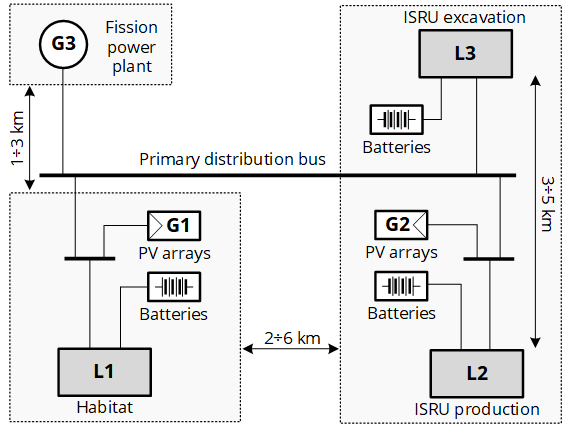
The US National Aeronautics and Space Administration's (NASA) Artemis II lunar flyby mission paved the way for future moon landings and directed research toward installing the first lunar microgrid. NASA predicts that a solar-powered microgrid at the lunar South Pole (LunaGrid) will become operational in 2028 and will interconnect multiple nodes to support the Artemis Base Camp. The architecture of the LunaGrid microgrid will be modular for the integration of several fission reactors (in one nuclear power plant of up to 100 kW). The aim is to ensure a continuous supply of electricity to the Artemis Base Camp by 2030 during the 14-day lunar nights when solar power is not available. In addition, the Russian Federal Space Agency (ROSCOSMOS) and the China National Space Administration (CNSA) plan to install another nuclear power plant and accompanying microgrid on the moon by the mid-2030s to power their International Lunar Research Station (ILRS). It is therefore obvious that a race has already begun between the space superpowers in electrifying the moon. In addition to the components for electricity generation, each of the future lunar microgrids will contain components for transmission, distribution, storage and consumption of electricity, as well as all other devices and equipment that exist in islanded microgrids on Earth. However, current prices for delivery of each of these components, devices and equipment to the moon are more than one million US dollars per kilogram, and each of them will operate there under extreme environmental conditions. Therefore, the electrification of the moon represents a state-of-the-art challenge for all the interested researchers who will further contribute to advancing knowledge on this specific topic.
Graphical Abstract
Keywords
Data Availability Statement
Funding
Conflicts of Interest
AI Use Statement
Ethical Approval and Consent to Participate
References
- Seltikova, E., Haghgoo, N., Tatár, G., Kelly, B., Hughes, N., Benas, A. D., ... & Logeswaran, A. (2025). LUNEX PROSPER: The next generation's blueprint towards a sustainable human presence on the Moon. Acta Astronautica, 235, 170-184.
[CrossRef] [Google Scholar] - Balaram, V. (2023). Potential future alternative resources for rare earth elements: Opportunities and challenges. Minerals, 13(3), 425.
[CrossRef] [Google Scholar] - Ellery, A. (2022). Generating and storing power on the moon using in situ resources. Proceedings of the Institution of Mechanical Engineers, Part G: Journal of Aerospace Engineering, 236(6), 1045-1063.
[CrossRef] [Google Scholar] - Sizentsev, G. A., & Sotnikov, B. I. (2011). The concept of global space system for supplying the earth with the electric power using the lunar resource. Thermal engineering, 58(13), 1114-1118.
[CrossRef] [Google Scholar] - Acker, D., Zamudio-Turcotte, K., Modi, P., Gonfo, D., Varma, K. R., Steinert, M., ... & Klinkner, S. (2025). The ZEUS constellation-paving the way to sustainability on the Moon with Solar Power Satellites-IAC-24, C3, 4, 11, x87582. Acta Astronautica, 235, 320-338.
[CrossRef] [Google Scholar] - Zheng, J., Sun, L., Long, X., Wang, J., Li, C., Mo, Z., ... & Xie, H. (2025). Electricity generation for lunar bases during construction and operation: Key technologies, challenges and development roadmap. Acta Astronautica, 235, 320-338.
[CrossRef] [Google Scholar] - Nuclear Engineering International. (2026, June 1). NASA refocuses Artemis. Retrieved from https://www.neimagazine.com/news/nasa-refocuses-artemis-lunar-strategy/
[Google Scholar] - Baker, H. (2024, March 12). Russia and China announce plan to build shared nuclear reactor on the moon by 2035, 'without humans'. Space.com. Retrieved from https://www.space.com/russia-china-shared-nuclear-reactor-2035-moon
[Google Scholar] - Saha, D., Bazmohammadi, N., Raya-Armenta, J. M., Bintoudi, A. D., Lashab, A., Vasquez, J. C., & Guerrero, J. M. (2021). Space microgrids for future manned lunar bases: A review. IEEE Open Access Journal of Power and Energy, 8, 570-583.
[CrossRef] [Google Scholar] - Chebbo, L., Gultekin, M. A., Bazzi, A., Young, S. A., & Kozak, J. P. (2025). Microgrids for extraterrestrial habitats: A review of technologies, needs, and challenges. IEEE Access, 13, 17473-17494.
[CrossRef] [Google Scholar] - Zdiri, M. A., Khan, B., & Guerrero, J. M. (2026). Microgrids space applications: A comprehensive review and future trends. Applied Energy, 402, 126941.
[CrossRef] [Google Scholar] - Pathak, A. D., Saha, S., Bharti, V. K., Gaikwad, M. M., & Sharma, C. S. (2023). A review on battery technology for space application. Journal of Energy Storage, 61, 106792.
[CrossRef] [Google Scholar] - Eckart, P., & Aldrin, A. (Eds.). (2022). Handbook of lunar base design and development. Springer Cham.
[CrossRef] [Google Scholar] - Guddanti, B., Roychowdhury, R., & Illindala, M. S. (2022, May). Resiliency-based planning for interconnected lunar microgrids using hybrid-edge rewiring. In 2022 IEEE/IAS 58th Industrial and Commercial Power Systems Technical Conference (I&CPS) (pp. 1-5). IEEE.
[CrossRef] [Google Scholar] - Saha, D., Bazmohammadi, N., Raya-Armenta, J. M., Bintoudi, A. D., Lashab, A., Vasquez, J. C., & Guerrero, J. M. (2023). Optimal sizing and siting of PV and battery based space microgrids near the moon’s shackleton crater. IEEE Access, 11, 8701-8717.
[CrossRef] [Google Scholar] - Yao, Y., Adina, N., Zhang, Z., Sunkara, V., & Wang, J. (2023, October). Sizing optimization of power generation and energy storage for lunar microgrids. In 2023 IEEE Energy Conversion Congress and Exposition (ECCE) (pp. 1168-1173). IEEE.
[CrossRef] [Google Scholar] - Weaver, W. W., Wilson, D., Cook, M., & Young, J. (2023). Energy storage requirements for a lunar DC microgrid system. In AIAA SCITECH 2023 Forum (p. 1390).
[CrossRef] [Google Scholar] - Carbone, M. A., Muscatello, M. J., Follo, J. C., Fernandez, X. C., & Csank, J. T. (2023, March). Multi-microgrid transmission control for a lunar surface power system. In 2023 IEEE Aerospace Conference (pp. 1-9). IEEE.
[CrossRef] [Google Scholar] - Marcinkowski, A., Carrio, L., Hilliard, S., Edwards, C., Elhawary, A., Clem, D., ... & Cichan, T. (2023, March). Lunar surface power architecture concepts. In 2023 IEEE Aerospace Conference (pp. 1-19). IEEE.
[CrossRef] [Google Scholar] - Young, J., Wilson, D., Cook, M., & Weaver, W. W. (2023). Supervisory on-line optimal control of an electric power microgrid design for lunar habitation. In AIAA SCITECH 2023 Forum (p. 1391). http://doi.org/10.2514/6.2023-1391
[Google Scholar] - Dow, A. R. R., Darbali-Zamora, R., Palacios II, F., Flicker, J. D., Carbone, M. A., & Csank, J. T. (2023, June). Development of an adaptive droop control method for interconnected lunar DC microgrids using power hardware-in-the-loop. In 2023 IEEE 50th Photovoltaic Specialists Conference (PVSC) (pp. 1-3). IEEE.
[CrossRef] [Google Scholar] - Saude, B., LaSart, N., Blair, J. & Beik, O. (2023). Microgrid-based wind and solar power generation on Moon and Mars. IEEE Transactions on Smart Grid, 14(2), 1329–1332.
[CrossRef] [Google Scholar] - Bui, J. (2023, April 22). Electricity on the moon through reactors. In 32nd Annual Spring Meeting of the NASA-Missouri Space Grant Consortium, (pp. 1–12). https://scholarsmine.mst.edu/nmsgc/2023/full-schedule/24/
[Google Scholar] - Reece, A. (2023, April 22). Using refracted light to put electricity on the moon. In 32nd Annual Spring Meeting of the NASA-Missouri Space Grant Consortium, (pp. 1–9). https://scholarsmine.mst.edu/nmsgc/2023/session_6s/1/
[Google Scholar] - Saha, D., Bazmohammadi, N., Lashab, A., Vasquez, J. C. & Guerrero, J. M. (2024). Power and energy management system of a lunar microgrid - Part I: Modeling power demand of ISRU. IEEE Transactions on Aerospace and Electronic Systems, 60(2), 1364–1375.
[CrossRef] [Google Scholar] - Saha, D., Bazmohammadi, N., Lashab, A., Vasquez, J. C., & Guerrero, J. M. (2023). Power and energy management system of a lunar microgrid—Part II: Optimal sizing and operation of ISRU. IEEE Transactions on Aerospace and Electronic Systems, 60(2), 1376-1385.
[CrossRef] [Google Scholar] - Li, Y. (2024, August). Lunar electrochemistry enabling microgrid energy storage on the Moon. In Electrochemical Society Meeting Abstracts 245 (No. 3, pp. 626). The Electrochemical Society, Inc...
[CrossRef] [Google Scholar] - Hanif, M., & Bazzi, A. (2025, October). Optimal microgrid Sizing for lunar habitats in non-polar regions. In 2025 57th North American Power Symposium (NAPS) (pp. 1-6). IEEE.
[CrossRef] [Google Scholar] - Wang, T., Wang, G., Zhang, D., He, X., Yan, J., & Chen, X. (2025, July). Selection of wire gauge and voltage grade for microgrids in extreme lunar environments. In 2025 8th Asia Conference on Energy and Electrical Engineering (ACEEE) (pp. 353-361). IEEE.
[CrossRef] [Google Scholar] - Weitz, N., Vygoder, M., Bendre, S., Van Bossuyt, D. L., & Cuzner, R. M. (2026). Lunar Microgrid Systems Engineering Methodology for Resilient Design. Systems Engineering, 29(2), 264-296.
[CrossRef] [Google Scholar] - Wahdan, K., Ibrahim, M. I., Elgamal, M., & Eladl, A. A. (2026). Optimal sizing PV-Battery storage fuel cell based space microgrids. Journal of Sustainable Development of Energy, Water & Environment Systems (JSDEWES), 14(2), 1.
[CrossRef] [Google Scholar] - Li, J., Xu, W., Yang, J., Xue, H., Yuan, J., & Wei, T. (2026). Key technological challenges and systemic solutions for lunar base energy systems designed for long-term deployment needs. npj Space Exploration, 2(1), 12.
[CrossRef] [Google Scholar] - MacRobbie, C. J., MacRobbie, M., Sun, M., & Wen, J. Z. (2026). Integration of space based solar power into a scaling lunar ISRU based infrastructure and economy. Energy Conversion and Management: X, 30, 101692.
[CrossRef] [Google Scholar] - Elayyan, Z. (2026, May 29). Rovers, regolith, robots: The blueprint for the moon. Texas A&M University College of Architecture. Retrieved from https://www.arch.tamu.edu/news/2026/06/01/rovers-regolith-robots-the-blueprint-for-the-moon/
[Google Scholar] - The US National Aeronautics and Space Administration (NASA). (2026, June 1). Electrifying the moon. https://ntrs.nasa.gov/api/citations/20230007737/downloads/Csank_P_20230007737_Moon_IAPG_ESWG_MWG_Durham_NH.pdf
[Google Scholar] - The US National Aeronautics and Space Administration (NASA). (2026, June 1). The lunar regolith. https://www.nasa.gov/wp-content/uploads/2019/04/05_1_snoble_thelunarregolith.pdf
[Google Scholar] - Radl, A., Milicevic Neumann, K., Wotruba, H., Clausen, E., & Friedrich, B. (2023). From lunar regolith to oxygen and structural materials: an integrated conceptual design. CEAS Space Journal, 15(4), 585-595.
[CrossRef] [Google Scholar] - Grott, M., Knollenberg, J., & Krause, C. (2010). Apollo lunar heat flow experiment revisited: A critical reassessment of the in situ thermal conductivity determination. Journal of Geophysical Research: Planets, 115(E11).
[CrossRef] [Google Scholar] - Mathew, N., Durga Prasad, K., Mohammad, F., Aasik, V., Vajja, D. P., Ram Prabhu, M., ... & Bhardwaj, A. (2025). Thermal conductivity of high latitude lunar regolith measured by Chandra’s Surface Thermophysical Experiment (ChaSTE) onboard Chandrayaan 3 lander. Scientific Reports, 15(1), 7535.
[CrossRef] [Google Scholar] - Austen, D. H., & Shafirovich, E. (2024). Thermophysical properties of lunar regolith simulant LHS-1 and ice sublimation kinetics in its mixtures with frozen water. Thermochimica Acta, 731, 179648.
[CrossRef] [Google Scholar] - Williams, J. P., Paige, D. A., Greenhagen, B. T., & Sefton-Nash, E. (2017). The global surface temperatures of the Moon as measured by the Diviner Lunar Radiometer Experiment. Icarus, 283, 300-325.
[CrossRef] [Google Scholar] - The US National Aeronautics and Space Administration (NASA). (2026, June 1). Electric power on the moon. https://ntrs.nasa.gov/api/citations/20250000763/downloads/Csank_Pr_LunarSurfacePowerJAXA20250000763.pdf
[Google Scholar] - Nuclear News. (2025, September 2). Nuclear power on the moon: What we’re watching. American Nuclear Society. Retrieved from https://www.ans.org/news/2025-09-02/article-7336/nuclear-power-on-the-moon-what-were-watching/
[Google Scholar] - The US National Aeronautics and Space Administration (NASA). (2026, June 1). Fission Surface Power (FSP) Project update. Retrieved from https://ntrs.nasa.gov/api/citations/20220012909/downloads/IAPG_Fission_Surface_Power_update.pdf
[Google Scholar] - The US National Aeronautics and Space Administration (NASA). (2026, June 1). NASA’s Fission Surface Power (FSP) Project. Retrieved from https://www.nasa.gov/wp-content/uploads/2024/11/lkaldon-fsp-final-tagged.pdf?emrc=6a085a04e2dec
[Google Scholar] - Kim, S., Lim, H., Park-Hwan, S., Kim, M., & Jeong-Weon, J. (2024, December). A simulation of thermoelectric power generation system for lunar habitat. In ASim Conference 2024 (Vol. 5, pp. 1361-1368). IBPSA-Asia.
[CrossRef] [Google Scholar] - Cataldo, R., Zacny, K., & Schmitz, P. (2018). Radioisotope power systems to enable extended lunar science and in-situ resource utilization missions (No. GRC-E-DAA-TN50644). https://ntrs.nasa.gov/citations/20180004489
[Google Scholar] - Mazzotti, M., Sargeant, H. M., Barco, A., Mesalam, R., Watkinson, E. J., Ambrosi, R., & Lavagna, M. (2024). Ice-mining lunar rover using Americium-241 radioisotope power systems. Acta Astronautica, 225, 801-811.
[CrossRef] [Google Scholar] - Brandhorst Jr, H. W. (2012). A laser power beaming architecture for supplying power to the lunar surface. In Moon: Prospective Energy and Material Resources (pp. 599-631). Berlin, Heidelberg: Springer Berlin Heidelberg.
[CrossRef] [Google Scholar] - Astrobotic Technology. (2025, September 29). Honda and Astrobotic establish joint development agreement to explore scalable lunar power solutions. Retrieved from https://www.astrobotic.com/honda-and-astrobotic-establish-joint-development-agreement-to-explore-scalable-lunar-power-solutions/
[Google Scholar]
Cite This Article
TY  - JOUR
AU  - Klimenta, Dardan
PY  - 2026
DA  - 2026/06/23
TI  - Towards Installing the First Lunar Microgrid
JO  - ICCK Transactions on Electric Power Networks and Systems
T2  - ICCK Transactions on Electric Power Networks and Systems
JF  - ICCK Transactions on Electric Power Networks and Systems
VL  - 2
IS  - 2
SP  - 107
EP  - 115
DO  - 10.62762/TEPNS.2026.822786
UR  - https://www.icck.org/article/abs/TEPNS.2026.822786
KW  - electric power component
KW  - electrification
KW  - extreme lunar environment
KW  - lunar microgrid
AB  - The US National Aeronautics and Space Administration's (NASA) Artemis II lunar flyby mission paved the way for future moon landings and directed research toward installing the first lunar microgrid. NASA predicts that a solar-powered microgrid at the lunar South Pole (LunaGrid) will become operational in 2028 and will interconnect multiple nodes to support the Artemis Base Camp. The architecture of the LunaGrid microgrid will be modular for the integration of several fission reactors (in one nuclear power plant of up to 100 kW). The aim is to ensure a continuous supply of electricity to the Artemis Base Camp by 2030 during the 14-day lunar nights when solar power is not available. In addition, the Russian Federal Space Agency (ROSCOSMOS) and the China National Space Administration (CNSA) plan to install another nuclear power plant and accompanying microgrid on the moon by the mid-2030s to power their International Lunar Research Station (ILRS). It is therefore obvious that a race has already begun between the space superpowers in electrifying the moon. In addition to the components for electricity generation, each of the future lunar microgrids will contain components for transmission, distribution, storage and consumption of electricity, as well as all other devices and equipment that exist in islanded microgrids on Earth. However, current prices for delivery of each of these components, devices and equipment to the moon are more than one million US dollars per kilogram, and each of them will operate there under extreme environmental conditions. Therefore, the electrification of the moon represents a state-of-the-art challenge for all the interested researchers who will further contribute to advancing knowledge on this specific topic.
SN  - 3070-2607
PB  - Institute of Central Computation and Knowledge
LA  - English
ER  -
@article{Klimenta2026Towards,
  author = {Dardan Klimenta},
  title = {Towards Installing the First Lunar Microgrid},
  journal = {ICCK Transactions on Electric Power Networks and Systems},
  year = {2026},
  volume = {2},
  number = {2},
  pages = {107-115},
  doi = {10.62762/TEPNS.2026.822786},
  url = {https://www.icck.org/article/abs/TEPNS.2026.822786},
  abstract = {The US National Aeronautics and Space Administration's (NASA) Artemis II lunar flyby mission paved the way for future moon landings and directed research toward installing the first lunar microgrid. NASA predicts that a solar-powered microgrid at the lunar South Pole (LunaGrid) will become operational in 2028 and will interconnect multiple nodes to support the Artemis Base Camp. The architecture of the LunaGrid microgrid will be modular for the integration of several fission reactors (in one nuclear power plant of up to 100 kW). The aim is to ensure a continuous supply of electricity to the Artemis Base Camp by 2030 during the 14-day lunar nights when solar power is not available. In addition, the Russian Federal Space Agency (ROSCOSMOS) and the China National Space Administration (CNSA) plan to install another nuclear power plant and accompanying microgrid on the moon by the mid-2030s to power their International Lunar Research Station (ILRS). It is therefore obvious that a race has already begun between the space superpowers in electrifying the moon. In addition to the components for electricity generation, each of the future lunar microgrids will contain components for transmission, distribution, storage and consumption of electricity, as well as all other devices and equipment that exist in islanded microgrids on Earth. However, current prices for delivery of each of these components, devices and equipment to the moon are more than one million US dollars per kilogram, and each of them will operate there under extreme environmental conditions. Therefore, the electrification of the moon represents a state-of-the-art challenge for all the interested researchers who will further contribute to advancing knowledge on this specific topic.},
  keywords = {electric power component, electrification, extreme lunar environment, lunar microgrid},
  issn = {3070-2607},
  publisher = {Institute of Central Computation and Knowledge}
}
Article Metrics
Publisher's Note
ICCK stays neutral with regard to jurisdictional claims in published maps and institutional affiliations.
Rights and Permissions


Portico
