Multi-Objective Optimization for Emergency Material Dispatch with Backup Centers in Earthquake-Induced Distribution Failures Using Improved NSGA-II


Article Information
Abstract
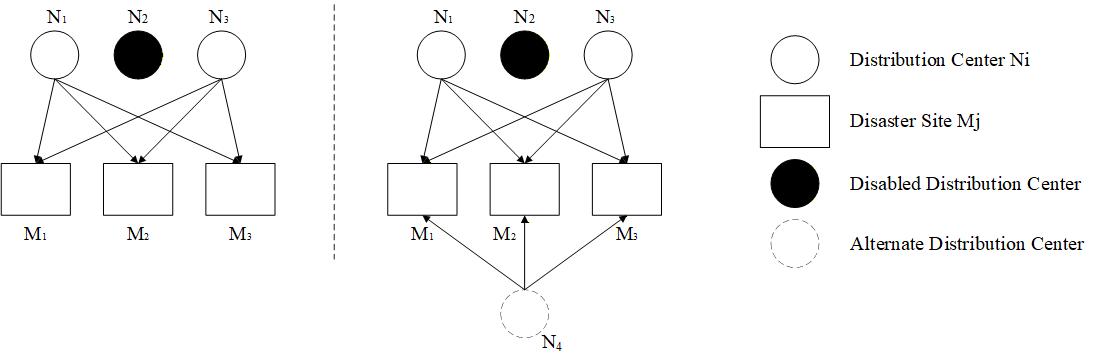
Earthquakes pose significant risks to infrastructure and supply chains, making the timely and fair distribution of emergency relief materials crucial for reducing casualties and economic losses. This study addresses the challenge of optimizing emergency material dispatch under scenarios where distribution centers fail due to earthquake damage, with the aim of improving both the timeliness and fairness of resource allocation during post-disaster recovery. A multi-objective optimization model is developed, which integrates distribution center failures and the activation of backup centers. The model minimizes total dispatch time, maximizes fairness in supply distribution, and reduces unmet demand. The solution is based on a second-generation non-dominated sorting genetic algorithm (NSGA-II), which is tailored to solve the proposed scheduling problem. Case studies, including simulations based on the 2008 Wenchuan earthquake, demonstrate that activating alternative distribution centers when primary centers fail can significantly improve delivery efficiency, fairness in material distribution, and reduce unmet demand. The improved NSGA-II algorithm outperforms the basic NSGA-II in terms of both solution quality and diversity. The findings underscore the importance of optimizing emergency logistics under failure scenarios to improve rescue efficiency and fairness. The model offers a scientifically-grounded approach for decision-making bodies to enhance post-disaster logistics operations, ensuring timely and equitable distribution of resources.
Graphical Abstract
Keywords
Data Availability Statement
Funding
Conflicts of Interest
AI Use Statement
Ethical Approval and Consent to Participate
References
- Toregas, C., Swain, R., ReVelle, C., & Bergman, L. (1971). The location of emergency service facilities. Operations Research, 19(6), 1363-1373.
[CrossRef] [Google Scholar] - Ma, Z., Zhang, J., & Gao, S. (2023). Research on emergency material demand based on urgency and satisfaction under public health emergencies. PLoS One, 18(3), e0282796.
[CrossRef] [Google Scholar] - Long, S., Zhang, D., Liang, Y., Li, S., & Chen, W. (2021). Robust optimization of the multi-objective multi-period location-routing problem for epidemic logistics system with uncertain demand. IEEE Access, 9, 151912-151930.
[CrossRef] [Google Scholar] - Cao, C., Liu, Y., Tang, O., & Gao, X. (2021). A fuzzy bi-level optimization model for multi-period post-disaster relief distribution in sustainable humanitarian supply chains. International Journal of Production Economics, 235, 108081.
[CrossRef] [Google Scholar] - Ergün, S., Usta, P., Alparslan Gök, S. Z., & Weber, G. W. (2023). A game theoretical approach to emergency logistics planning in natural disasters. Annals of Operations Research, 324(1), 855-868.
[CrossRef] [Google Scholar] - Wang, G. (2024). Disaster relief supply chain network planning under uncertainty. Annals of Operations Research, 338(2), 1127-1156.
[CrossRef] [Google Scholar] - Pan, X., Guo, S., Mangla, S. K., Madaan, J., Bo, H., & Song, M. (2025). Robust optimization of emergency material multimodal transport supply chain considering collaborative platform. Annals of Operations Research, 1-42.
[CrossRef] [Google Scholar] - Chen, L. (2024). Comparative study of robust optimization model of multimaterial emergency logistics in an uncertain environment. Managerial and Decision Economics, 45(5), 3386-3402.
[CrossRef] [Google Scholar] - Yu, L., Zhang, C., Jiang, J., Yang, H., & Shang, H. (2021). Reinforcement learning approach for resource allocation in humanitarian logistics. Expert Systems with Applications, 173, 114663.
[CrossRef] [Google Scholar] - Wang, Z., Leng, L., Ding, J., & Zhao, Y. (2023). Study on location-allocation problem and algorithm for emergency supplies considering timeliness and fairness. Computers & Industrial Engineering, 177, 109078.
[CrossRef] [Google Scholar] - Sun, P., Zhao, D., Chen, Q., Yu, X., & Zhu, N. (2025). Distributionally robust optimization for pre-disaster facility location problem with 3D printing. Transportation Research Part E: Logistics and Transportation Review, 193, 103844.
[CrossRef] [Google Scholar] - Sentia, P. D., Abdul Shukor, S., Wahab, A. N. A., & Mukhtar, M. (2023). Logistic distribution in humanitarian supply chain management: A thematic literature review and future research. Annals of Operations Research, 323(1), 175-201.
[CrossRef] [Google Scholar] - Carnero Quispe, M. F., Chambilla Mamani, L. D., Yoshizaki, H. T. Y., & Brito Junior, I. D. (2025). Temporary Facility Location Problem in Humanitarian Logistics: A Systematic Literature Review. Logistics, 9(1), 42.
[CrossRef] [Google Scholar] - Sun, Q., & Liu, S. (2021). Locating abrupt disaster emergency logistics centres using improved artificial bee colony (IABC) algorithm. Science Progress, 104(2), 00368504211016205.
[CrossRef] [Google Scholar] - Ke, G. Y., & Bookbinder, J. H. (2023). Emergency logistics management for hazardous materials with demand uncertainty and link unavailability. Journal of Systems Science and Systems Engineering, 32(2), 175-205.
[CrossRef] [Google Scholar] - Yin, R., & Lu, P. (2022). A cluster-first route-second constructive heuristic method for emergency logistics scheduling in urban transport networks. Sustainability, 14(4), 2301.
[CrossRef] [Google Scholar] - Wang, B. C., Qian, Q. Y., Gao, J. J., Tan, Z. Y., & Zhou, Y. (2021). The optimization of warehouse location and resources distribution for emergency rescue under uncertainty. Advanced Engineering Informatics, 48, 101278.
[CrossRef] [Google Scholar] - Yuan, M., Li, Y., Zhang, L., & Pei, F. (2021). Research on intelligent workshop resource scheduling method based on improved NSGA-II algorithm. Robotics and Computer-Integrated Manufacturing, 71, 102141.
[CrossRef] [Google Scholar] - Snyder, L. V., & Daskin, M. S. (2005). Reliability models for facility location: the expected failure cost case. Transportation Science, 39(3), 400-416.
[CrossRef] [Google Scholar] - Drezner, Z. (1987). Heuristic solution methods for two location problems with unreliable facilities. Journal of the Operational Research Society, 38(6), 509-514.
[CrossRef] [Google Scholar] - Berman, O., Krass, D., & Menezes, M. B. (2007). Facility reliability issues in network p-median problems: Strategic centralization and co-location effects. Operations Research, 55(2), 332-350.
[CrossRef] [Google Scholar] - Zhang, M., Huang, J., & Zhu, J. M. (2012). Reliable facility location problem considering facility failure scenarios. Kybernetes, 41(10), 1440-1461.
[CrossRef] [Google Scholar] - Wang, W., Wu, S., Wang, S., Zhen, L., & Qu, X. (2021). Emergency facility location problems in logistics: Status and perspectives. Transportation Research Part E: Logistics and Transportation Review, 154, 102465.
[CrossRef] [Google Scholar] - Zhang, L., Yuan, N., Wang, J., & Li, J. (2025). Research on location-inventory-routing optimization of emergency logistics based on multiple reliability under uncertainty. Computers & Industrial Engineering, 200, 110826.
[CrossRef] [Google Scholar] - Wang, D., Peng, J., Yang, H., Cheng, T. C. E., & Yang, Y. (2023). Distributionally robust location-allocation with demand and facility disruption uncertainties in emergency logistics. Computers & Industrial Engineering, 184, 109617.
[CrossRef] [Google Scholar] - Sheikholeslami, M., & Zarrinpoor, N. (2024). Designing a robust logistics model for perishable emergency commodities in an epidemic outbreak using lagrangian relaxation: A case of COVID-19. Annals of Operations Research, 343(1), 459-491.
[CrossRef] [Google Scholar] - Sun, W., & Liao, W. (2025). Risk propagation in emergency supply chain during public health events-From a reliability perspective. Heliyon, 11(1).
[CrossRef] [Google Scholar] - Rath, S., & Gutjahr, W. J. (2014). A math-heuristic for the warehouse location–routing problem in disaster relief. Computers & Operations Research, 42, 25-39.
[CrossRef] [Google Scholar]
Cite This Article
TY  - JOUR
AU  - Li, Feng
AU  - Lv, Jiahong
PY  - 2026
DA  - 2026/04/21
TI  - Multi-Objective Optimization for Emergency Material Dispatch with Backup Centers in Earthquake-Induced Distribution Failures Using Improved NSGA-II
JO  - ICCK Transactions on Intelligent Systematics
T2  - ICCK Transactions on Intelligent Systematics
JF  - ICCK Transactions on Intelligent Systematics
VL  - 3
IS  - 2
SP  - 108
EP  - 125
DO  - 10.62762/TIS.2025.202079
UR  - https://www.icck.org/article/abs/TIS.2025.202079
KW  - emergency material dispatch
KW  - distribution center failure
KW  - material distribution fairness
KW  - non-dominated sorting genetic algorithm
AB  - Earthquakes pose significant risks to infrastructure and supply chains, making the timely and fair distribution of emergency relief materials crucial for reducing casualties and economic losses. This study addresses the challenge of optimizing emergency material dispatch under scenarios where distribution centers fail due to earthquake damage, with the aim of improving both the timeliness and fairness of resource allocation during post-disaster recovery. A multi-objective optimization model is developed, which integrates distribution center failures and the activation of backup centers. The model minimizes total dispatch time, maximizes fairness in supply distribution, and reduces unmet demand. The solution is based on a second-generation non-dominated sorting genetic algorithm (NSGA-II), which is tailored to solve the proposed scheduling problem. Case studies, including simulations based on the 2008 Wenchuan earthquake, demonstrate that activating alternative distribution centers when primary centers fail can significantly improve delivery efficiency, fairness in material distribution, and reduce unmet demand. The improved NSGA-II algorithm outperforms the basic NSGA-II in terms of both solution quality and diversity. The findings underscore the importance of optimizing emergency logistics under failure scenarios to improve rescue efficiency and fairness. The model offers a scientifically-grounded approach for decision-making bodies to enhance post-disaster logistics operations, ensuring timely and equitable distribution of resources.
SN  - 3068-5079
PB  - Institute of Central Computation and Knowledge
LA  - English
ER  -
@article{Li2026MultiObjec,
  author = {Feng Li and Jiahong Lv},
  title = {Multi-Objective Optimization for Emergency Material Dispatch with Backup Centers in Earthquake-Induced Distribution Failures Using Improved NSGA-II},
  journal = {ICCK Transactions on Intelligent Systematics},
  year = {2026},
  volume = {3},
  number = {2},
  pages = {108-125},
  doi = {10.62762/TIS.2025.202079},
  url = {https://www.icck.org/article/abs/TIS.2025.202079},
  abstract = {Earthquakes pose significant risks to infrastructure and supply chains, making the timely and fair distribution of emergency relief materials crucial for reducing casualties and economic losses. This study addresses the challenge of optimizing emergency material dispatch under scenarios where distribution centers fail due to earthquake damage, with the aim of improving both the timeliness and fairness of resource allocation during post-disaster recovery. A multi-objective optimization model is developed, which integrates distribution center failures and the activation of backup centers. The model minimizes total dispatch time, maximizes fairness in supply distribution, and reduces unmet demand. The solution is based on a second-generation non-dominated sorting genetic algorithm (NSGA-II), which is tailored to solve the proposed scheduling problem. Case studies, including simulations based on the 2008 Wenchuan earthquake, demonstrate that activating alternative distribution centers when primary centers fail can significantly improve delivery efficiency, fairness in material distribution, and reduce unmet demand. The improved NSGA-II algorithm outperforms the basic NSGA-II in terms of both solution quality and diversity. The findings underscore the importance of optimizing emergency logistics under failure scenarios to improve rescue efficiency and fairness. The model offers a scientifically-grounded approach for decision-making bodies to enhance post-disaster logistics operations, ensuring timely and equitable distribution of resources.},
  keywords = {emergency material dispatch, distribution center failure, material distribution fairness, non-dominated sorting genetic algorithm},
  issn = {3068-5079},
  publisher = {Institute of Central Computation and Knowledge}
}
Article Metrics
Publisher's Note
ICCK stays neutral with regard to jurisdictional claims in published maps and institutional affiliations.
Rights and Permissions


Portico