

Comparative Analysis of Automated Knee Osteoarthritis Severity Classification from X-Ray Images Using CNNs and VGG16 Architecture







Article Information
Abstract
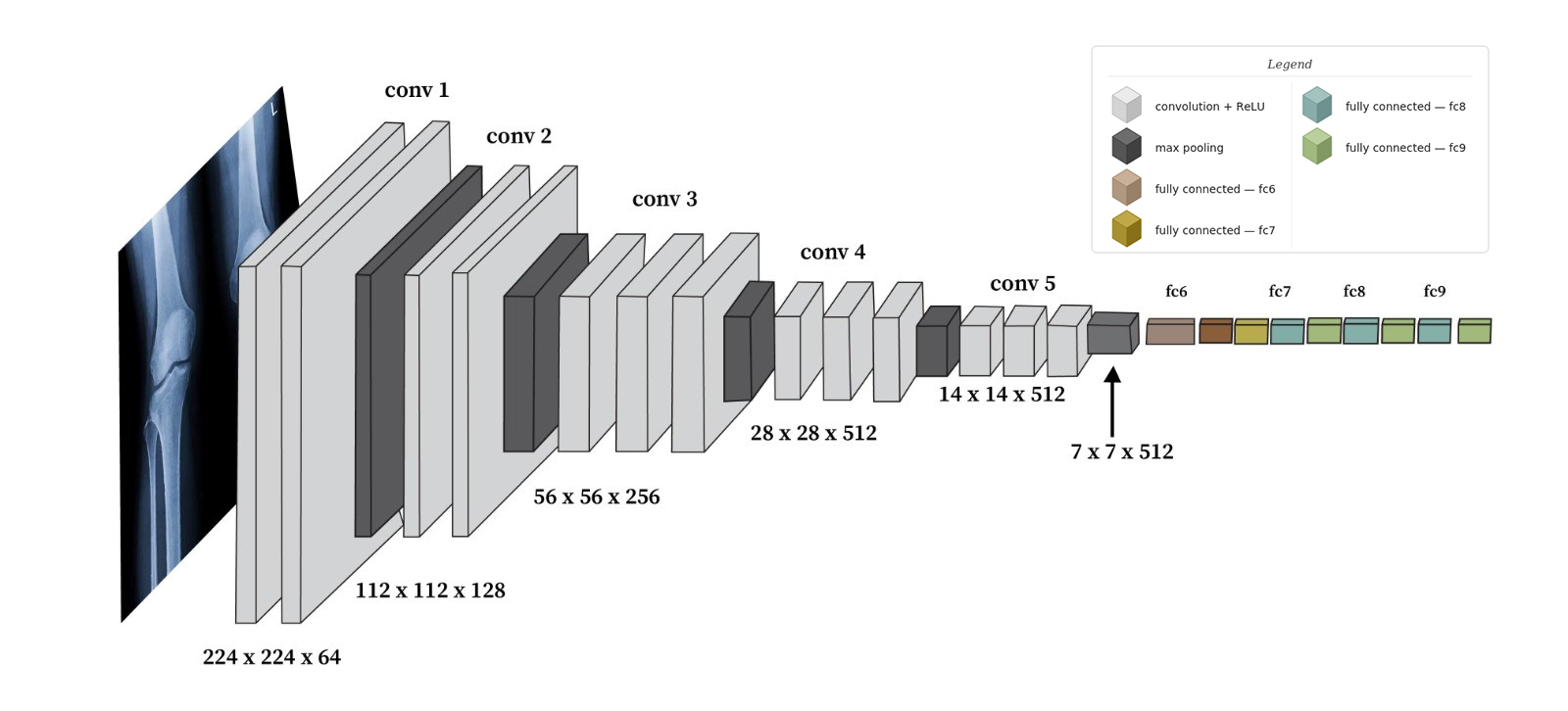
Osteoarthritis (OA) is a degenerative joint disease that primarily affects the knee, causing cartilage deterioration and discomfort. Early diagnosis is crucial for effective management, as it can slow disease progression and improve the quality of life. This study proposes a deep learning approach to automatically sense and classify knee OA severity from X-ray images using Convolutional Neural Networks (CNNs) and the VGG16 model, establishing X-ray imaging as a biomedical sensing modality for automated disease grading. The models were trained on a dataset of knee X-ray images, and performance was evaluated using accuracy, precision, recall, and F1-score. The proposed CNNs model achieved 99% training accuracy and 80% testing accuracy after 50 epochs, while the VGG16 model, after fine-tuning for 20 epochs, reached 99.8% training accuracy and 91% testing accuracy. Additionally, a web app was developed using Streamlit, enabling users to upload knee X-ray images and receive real-time predictions of OA severity. The results demonstrate the effectiveness of CNN and transfer learning with VGG16 in knee OA classification, offering a promising tool for early diagnosis in clinical settings.
Graphical Abstract
Keywords
Data Availability Statement
Funding
Conflicts of Interest
Ethical Approval and Consent to Participate
References
- Abdullah, S. S., & Rajasekaran, M. P. (2022). Automatic detection and classification of knee osteoarthritis using deep learning approach. La radiologia medica, 127(4), 398-406.
[CrossRef] [Google Scholar] - Sikkandar, M. Y., Begum, S. S., Alkathiry, A. A., Alotaibi, M. S. N., & Manzar, M. D. (2022). Automatic Detection and Classification of Human Knee Osteoarthritis Using Convolutional Neural Networks. Computers, Materials & Continua, 70(3).
[CrossRef] [Google Scholar] - Abedin, J., McGuinness, K., O’Connor, N. E., Moran, K., Rebholz-Schuhmann, D., & Newell, J. (2019). Predicting knee osteoarthritis severity: Comparative modeling based on patient’s data and plain X-ray images. Scientific Reports, 9(1), 5761.
[CrossRef] [Google Scholar] - Olsson, S., Akbarian, E., Lind, A., Razavian, A. S., & Gordon, M. (2021). Automating classification of osteoarthritis according to Kellgren-Lawrence in the knee using deep learning in an unfiltered adult population. BMC musculoskeletal disorders, 22, 1-8.
[CrossRef] [Google Scholar] - Ahmed, H. A., & Mohammed, E. A. (2022). Detection and classification of the osteoarthritis in knee joint using transfer learning with convolutional neural networks (CNNs). Iraqi Journal of Science, 5058-5071.
[CrossRef] [Google Scholar] - Tiulpin, A., Thevenot, J., Rahtu, E., Lehenkari, P., & Saarakkala, S. (2018). Automatic knee osteoarthritis diagnosis from plain radiographs: a deep learning-based approach. Scientific reports, 8(1), 1727.
[CrossRef] [Google Scholar] - Cui, A., Li, H., Wang, D., Zhong, J., Chen, Y., & Lu, H. (2020). Global, regional prevalence, incidence and risk factors of knee osteoarthritis in population-based studies. EClinicalMedicine, 29, 100587.
[CrossRef] [Google Scholar] - Brahim, A., Jennane, R., Riad, R., Janvier, T., Khedher, L., Toumi, H., & Lespessailles, E. (2019). A decision support tool for early detection of knee OsteoArthritis using X-ray imaging and machine learning: Data from the OsteoArthritis Initiative. Computerized Medical Imaging and Graphics, 73, 11-18.
[CrossRef] [Google Scholar] - Litjens, G., Kooi, T., Bejnordi, B. E., Setio, A. A. A., Ciompi, F., Ghafoorian, M., ... & Sánchez, C. I. (2017). A survey on deep learning in medical image analysis. Medical image analysis, 42, 60-88.
[CrossRef] [Google Scholar] - Mohammed, A. S., Hasanaath, A. A., Latif, G., & Bashar, A. (2023). Knee osteoarthritis detection and severity classification using residual neural networks on preprocessed x-ray images. Diagnostics, 13(8), 1380.
[CrossRef] [Google Scholar] - Antony, J., McGuinness, K., O’Connor, N. E., & Moran, K. (2016). Quantifying radiographic knee osteoarthritis severity using deep convolutional neural networks. In 2016 23rd International Conference on Pattern Recognition (ICPR) (pp. 1195-1200). IEEE.
[CrossRef] [Google Scholar] - Rawat, A., Dhyani, A., Panwa, D., Bisht, G., Vats, S., & Sharma, V. (2024, July). Knee Osteoarthritis Prediction using Transfer Learning. In 2024 IEEE 3rd World Conference on Applied Intelligence and Computing (AIC) (pp. 1001-1007). IEEE.
[CrossRef] [Google Scholar] - Saini, D., Khosla, A., Chand, T., Chouhan, D. K., & Prakash, M. (2023). Automated knee osteoarthritis severity classification using three‐stage preprocessing method and VGG16 architecture. International Journal of Imaging Systems and Technology, 33(3), 1028-1047.
[CrossRef] [Google Scholar] - Willemink, M. J., Koszek, W. A., Hardell, C., Wu, J., Fleischmann, D., Harvey, H., ... & Lungren, M. P. (2020). Preparing medical imaging data for machine learning. Radiology, 295(1), 4-15.
[CrossRef] [Google Scholar] - Chaugule, S., & Malemath, V. S. (2022). An extreme learning machine-based autoencoder (ELM-AE) for denoising knee X-ray images and grading knee osteoarthritis severity. In International Conference on Recent Trends in Image Processing and Pattern Recognition (pp. 164-175). Springer Nature Switzerland.
[CrossRef] [Google Scholar] - Chen, P., Gao, L., Shi, X., Allen, K., & Yang, L. (2019). Fully automatic knee osteoarthritis severity grading using deep neural networks with a novel ordinal loss. Computerized Medical Imaging and Graphics, 75, 84-92.
[CrossRef] [Google Scholar] - Cueva, J. H., Castillo, D., Espinós-Morató, H., Durán, D., Díaz, P., & Lakshminarayanan, V. (2022). Detection and classification of knee osteoarthritis. Diagnostics, 12(10), 2362.
[CrossRef] [Google Scholar] - Yong, C. W., Teo, K., Murphy, B. P., Hum, Y. C., Tee, Y. K., Xia, K., & Lai, K. W. (2022). Knee osteoarthritis severity classification with ordinal regression module. Multimedia Tools and Applications, 81(29), 41497-41509.
[CrossRef] [Google Scholar] - Yeoh, P. S. Q., Lai, K. W., Goh, S. L., Hasikin, K., Hum, Y. C., Tee, Y. K., & Dhanalakshmi, S. (2021). Emergence of deep learning in knee osteoarthritis diagnosis. Computational intelligence and neuroscience, 2021(1), 4931437.
[CrossRef] [Google Scholar] - Simonyan, K., & Zisserman, A. (2014). Very deep convolutional networks for large-scale image recognition. arXiv preprint arXiv:1409.1556.
[CrossRef] [Google Scholar] - Kora, P., Ooi, C. P., Faust, O., Raghavendra, U., Gudigar, A., Chan, W. Y., ... & Acharya, U. R. (2022). Transfer learning techniques for medical image analysis: A review. Biocybernetics and biomedical engineering, 42(1), 79-107.
[CrossRef] [Google Scholar] - Kim, H. E., Cosa-Linan, A., Santhanam, N., Jannesari, M., Maros, M. E., & Ganslandt, T. (2022). Transfer learning for medical image classification: a literature review. BMC medical imaging, 22(1), 69.
[CrossRef] [Google Scholar] - Pi, S. W., Lee, B. D., Lee, M. S., & Lee, H. J. (2023). Ensemble deep-learning networks for automated osteoarthritis grading in knee X-ray images. Scientific Reports, 13(1), 22887.
[CrossRef] [Google Scholar] - Sharma, G., Anand, V., & Kumar, V. (2023). Classification of osteo-arthritis with the help of deep learning and transfer learning. In 2023 5th International Conference on Inventive Research in Computing Applications (ICIRCA) (pp. 446-452). IEEE.
[CrossRef] [Google Scholar] - Norman, B., Pedoia, V., & Majumdar, S. (2018). Use of 2D U-Net convolutional neural networks for automated cartilage and meniscus segmentation of knee MR imaging data to determine relaxometry and morphometry. Radiology, 288(1), 177-185.
[CrossRef] [Google Scholar] - Bayramoglu, N., Tiulpin, A., Hirvasniemi, J., Nieminen, M. T., & Saarakkala, S. (2020). Adaptive segmentation of knee radiographs for selecting the optimal ROI in texture analysis. Osteoarthritis and cartilage, 28(7), 941-952.
[CrossRef] [Google Scholar] - Tiulpin, A., & Saarakkala, S. (2020). Automatic grading of individual knee osteoarthritis features in plain radiographs using deep convolutional neural networks. Diagnostics, 10(11), 932.
[CrossRef] [Google Scholar] - Rehman, A., Raza, A., Alamri, F. S., Alghofaily, B., & Saba, T. (2023). Transfer learning-based smart features engineering for osteoarthritis diagnosis from knee X-ray images. IEEE Access, 11, 71326–71338.
[CrossRef] [Google Scholar] - Johnson, J. M., & Khoshgoftaar, T. M. (2019). Survey on deep learning with class imbalance. Journal of big data, 6(1), 27.
[CrossRef] [Google Scholar] - Guida, C., Zhang, M., & Shan, J. (2021). Knee osteoarthritis classification using 3D CNN and MRI. Applied Sciences, 11(11), 5196.
[CrossRef] [Google Scholar] - Arunkumar, M., Aarthi, R., & Selvagananathv, J. (2024, December). Deep Learning with 3D CNN for Knee Osteoarthritis Detection and Classification. In 2024 International Conference on System, Computation, Automation and Networking (ICSCAN) (pp. 1-6). IEEE.
[CrossRef] [Google Scholar] - Mahum, R., Rehman, S. U., Meraj, T., Rauf, H. T., Irtaza, A., El-Sherbeeny, A. M., & El-Meligy, M. A. (2021). A novel hybrid approach based on deep cnn features to detect knee osteoarthritis. Sensors, 21(18), 6189.
[CrossRef] [Google Scholar] - Yoon, J. S., Yon, C. J., Lee, D., Lee, J. J., Kang, C. H., Kang, S. B., ... & Chang, C. B. (2023). Assessment of a novel deep learning-based software developed for automatic feature extraction and grading of radiographic knee osteoarthritis. BMC musculoskeletal disorders, 24(1), 869.
[CrossRef] [Google Scholar] - Khalid, A., Senan, E. M., Al-Wagih, K., Ali Al-Azzam, M. M., & Alkhraisha, Z. M. (2023). Hybrid techniques of X-ray analysis to predict knee osteoarthritis grades based on fusion features of CNN and handcrafted. Diagnostics, 13(9), 1609.
[CrossRef] [Google Scholar]
Cited By (4)
-
T.R. Chenthil, A. Devi, K. Mahalakshmi, Velmurugan V, Ms Maheswari D, S. Ohmshankar. .
2026 Contemporary Computing Innovations Conference (CCIC), 2026 .
[CrossRef] -
Sugiyanto Sugiyanto, Fatimah Fatimah, Hermina Sukmaningtyas, Wahyu Setya Budi, Harimat Hendarwan, Ika Saptarini, Julaeha Julaeha, Kartika Afrida Fauzia. Integrating semi-automated radiographic analysis and biomarkers for detecting knee osteoarthritis: cross-sectional study in Central Java, Indonesia.
Egyptian Journal of Radiology and Nuclear Medicine, 2026 , 57 (1).
[CrossRef] -
Xu Wang, Zhaoshui He, Hao Liang, Jing Guo, Zhijie Lin, Liqiang Zhang, Xingfang Pan. APCA-Net: Adaptive Patch-Correlation Attention Network for Vision-Based Human Hand Acupoint Detection in Acupuncture.
IEEE Transactions on Human-Machine Systems, 2026 , 56 (3).
[CrossRef] -
Chengpeng Tian, Yuanyuan Peng, Yan Xi, Bin Tang, Qingkai Ma, Na Cheng, Zhen Liang, Kai Xu. A parallel hybrid convolutional state space network with multi-attention mechanisms for retinal vessel segmentation.
Biomedical Signal Processing and Control, 2026 , 116 .
[CrossRef]
Cite This Article
TY  - JOUR
AU  - Iqbal, Sundas
AU  - Ali, Danish
AU  - Rafique, Sumaria
AU  - Bagga, Kajol
AU  - Rahman, Atif Ur
AU  - Khan, Salman
PY  - 2025
DA  - 2025/03/25
TI  - Comparative Analysis of Automated Knee Osteoarthritis Severity Classification from X-Ray Images Using CNNs and VGG16 Architecture
JO  - ICCK Transactions on Sensing, Communication, and Control
T2  - ICCK Transactions on Sensing, Communication, and Control
JF  - ICCK Transactions on Sensing, Communication, and Control
VL  - 2
IS  - 1
SP  - 36
EP  - 47
DO  - 10.62762/TSCC.2025.378503
UR  - https://www.icck.org/article/abs/TSCC.2025.378503
KW  - knee osteoarthritis
KW  - biomedical sensing
KW  - transfer learning
KW  - convolutional neural networks
KW  - deep learning
AB  - Osteoarthritis (OA) is a degenerative joint disease that primarily affects the knee, causing cartilage deterioration and discomfort. Early diagnosis is crucial for effective management, as it can slow disease progression and improve the quality of life. This study proposes a deep learning approach to automatically sense and classify knee OA severity from X-ray images using Convolutional Neural Networks (CNNs) and the VGG16 model, establishing X-ray imaging as a biomedical sensing modality for automated disease grading. The models were trained on a dataset of knee X-ray images, and performance was evaluated using accuracy, precision, recall, and F1-score. The proposed CNNs model achieved 99% training accuracy and 80% testing accuracy after 50 epochs, while the VGG16 model, after fine-tuning for 20 epochs, reached 99.8% training accuracy and 91% testing accuracy. Additionally, a web app was developed using Streamlit, enabling users to upload knee X-ray images and receive real-time predictions of OA severity. The results demonstrate the effectiveness of CNN and transfer learning with VGG16 in knee OA classification, offering a promising tool for early diagnosis in clinical settings.
SN  - 3068-9287
PB  - Institute of Central Computation and Knowledge
LA  - English
ER  -
@article{Iqbal2025Comparativ,
  author = {Sundas Iqbal and Danish Ali and Sumaria Rafique and Kajol Bagga and Atif Ur Rahman and Salman Khan},
  title = {Comparative Analysis of Automated Knee Osteoarthritis Severity Classification from X-Ray Images Using CNNs and VGG16 Architecture},
  journal = {ICCK Transactions on Sensing, Communication, and Control},
  year = {2025},
  volume = {2},
  number = {1},
  pages = {36-47},
  doi = {10.62762/TSCC.2025.378503},
  url = {https://www.icck.org/article/abs/TSCC.2025.378503},
  abstract = {Osteoarthritis (OA) is a degenerative joint disease that primarily affects the knee, causing cartilage deterioration and discomfort. Early diagnosis is crucial for effective management, as it can slow disease progression and improve the quality of life. This study proposes a deep learning approach to automatically sense and classify knee OA severity from X-ray images using Convolutional Neural Networks (CNNs) and the VGG16 model, establishing X-ray imaging as a biomedical sensing modality for automated disease grading. The models were trained on a dataset of knee X-ray images, and performance was evaluated using accuracy, precision, recall, and F1-score. The proposed CNNs model achieved 99\% training accuracy and 80\% testing accuracy after 50 epochs, while the VGG16 model, after fine-tuning for 20 epochs, reached 99.8\% training accuracy and 91\% testing accuracy. Additionally, a web app was developed using Streamlit, enabling users to upload knee X-ray images and receive real-time predictions of OA severity. The results demonstrate the effectiveness of CNN and transfer learning with VGG16 in knee OA classification, offering a promising tool for early diagnosis in clinical settings.},
  keywords = {knee osteoarthritis, biomedical sensing, transfer learning, convolutional neural networks, deep learning},
  issn = {3068-9287},
  publisher = {Institute of Central Computation and Knowledge}
}
Publisher's Note
ICCK stays neutral with regard to jurisdictional claims in published maps and institutional affiliations.
Rights and Permissions


Portico
