

LBSD-YOLO: A Lightweight YOLOv10-Based Network with Multi-Attention Enhancement for Bridge Surface Defect Detection


Article Information
Abstract
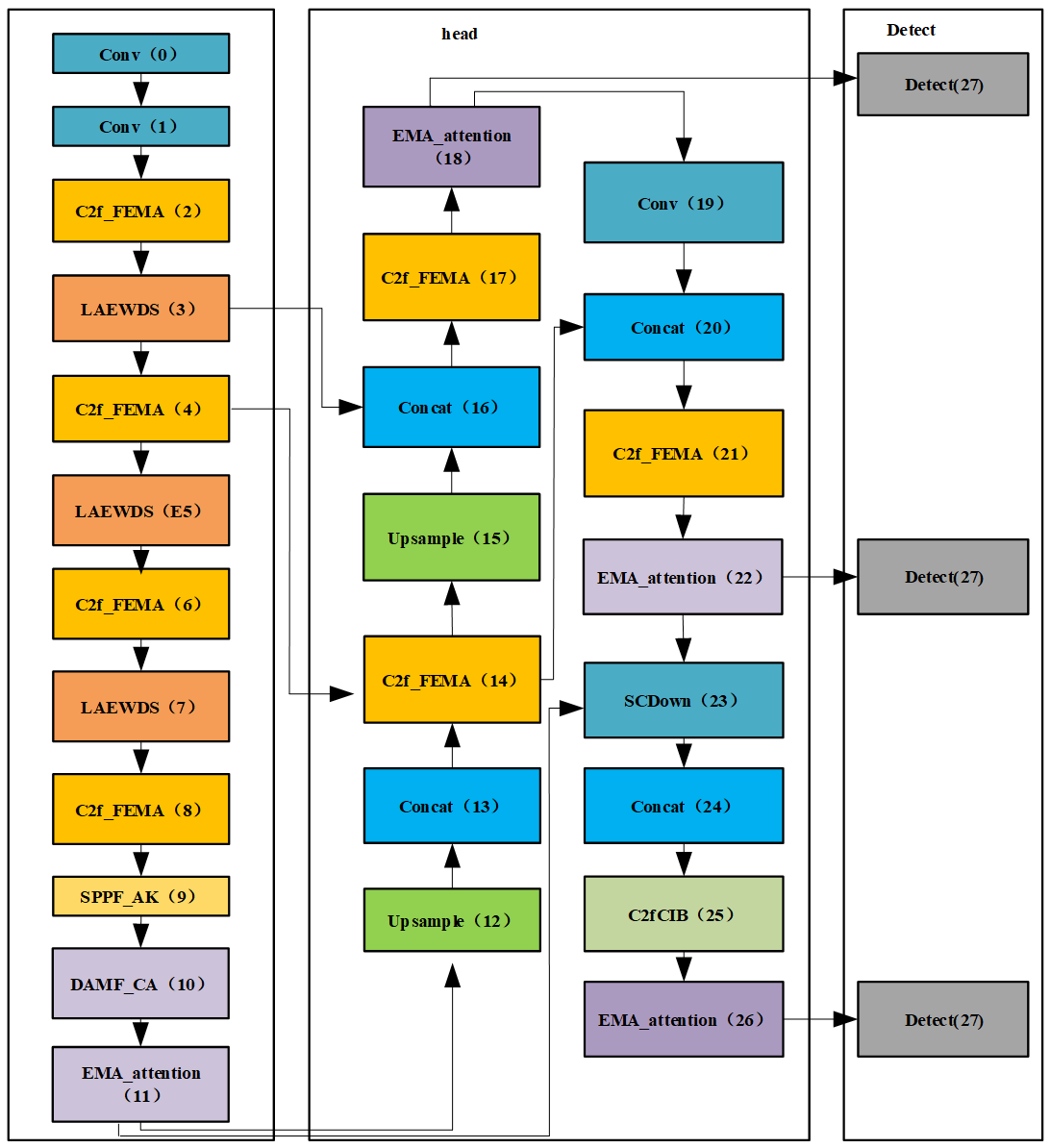
Bridge surface defect detection plays a critical role in ensuring traffic safety and facilitating infrastructure maintenance. A lightweight object detection network based on YOLOv10, termed LBSD-YOLO, is developed to achieve high detection accuracy while maintaining high efficiency for deployment on resource-constrained devices. The proposed framework consists of three main components: a feature extraction backbone, a feature fusion neck, and a detection head. In the backbone, the C2f\_FEMA (C2f with Feature Enhancement and Multi-branch Attention) module and the LAEDS (Lightweight Adaptive Encoder–Decoder for Sampling) spatial attention module are incorporated to enhance multi-scale feature representation.The neck incorporates multi-scale feature fusion with an Efficient Multi-scale Attention (EMA) mechanism. In the detection head, a lightweight DP-Head structure is developed, variant integrated with the DAMF\_CA coordinate attention for improved channel and spatial focus. Experiments are conducted on the self-built BDD-1234 dataset, which contains 6,617 high-resolution images covering six common bridge defect categories (cracks, spalling, exposed reinforcement, rust stains, efflorescence, and delamination). Compared to the baseline YOLOv10s, LBSD-YOLO reduces model size from 16.6 MB to 9.6 MB (42.2% reduction), computational complexity from 21.4 GFLOPs to 17.3 GFLOPs (19.2% reduction), and parameters from 7.2 M to 4.6 M (36.1% reduction), while achieving comparable detection performance (mAP@50 of 64.1% vs. 65.5%). The results demonstrate that LBSD-YOLO offers an efficient and accurate solution for real-time bridge defect detection on portable devices.
Graphical Abstract
Keywords
Data Availability Statement
Funding
Conflicts of Interest
AI Use Statement
Ethical Approval and Consent to Participate
References
- Ren, S., He, K., Girshick, R., & Sun, J. (2016). Faster R-CNN: Towards real-time object detection with region proposal networks. IEEE transactions on pattern analysis and machine intelligence, 39(6), 1137-1149.
[CrossRef] [Google Scholar] - Liu, W., Anguelov, D., Erhan, D., Szegedy, C., Reed, S., Fu, C. Y., & Berg, A. C. (2016, September). Ssd: Single shot multibox detector. In European conference on computer vision (pp. 21-37). Cham: Springer International Publishing.
[CrossRef] [Google Scholar] - Li, R., Yu, J., Li, F., Yang, R., Wang, Y., & Peng, Z. (2023). Automatic bridge crack detection using Unmanned aerial vehicle and Faster R-CNN. Construction and Building Materials, 362, 129659.
[CrossRef] [Google Scholar] - Redmon, J., Divvala, S., Girshick, R., & Farhadi, A. (2016). You only look once: Unified, real-time object detection. In Proceedings of the IEEE conference on computer vision and pattern recognition (pp. 779-788).
[CrossRef] [Google Scholar] - Meng, Q., Hu, L., Wan, D., Li, M., Wu, H., Qi, X., & Tian, Y. (2023). Image-based concrete cracks identification under complex background with lightweight convolutional neural network. KSCE journal of civil engineering, 27(12), 5231-5242.
[CrossRef] [Google Scholar] - Spencer Jr, B. F., Hoskere, V., & Narazaki, Y. (2019). Advances in computer vision-based civil infrastructure inspection and monitoring. Engineering, 5(2), 199-222.
[CrossRef] [Google Scholar] - Guan, B., & Li, J. (2024, April). Lightweight detection network for bridge defects based on model pruning and knowledge distillation. In Structures (Vol. 62, p. 106276). Elsevier.
[CrossRef] [Google Scholar] - Luo, Y., Ling, J., Wang, J., Zhang, H., Chen, F., Xiao, X., & Lu, N. (2025). SFW-YOLO: A lightweight multi-scale dynamic attention network for weld defect detection in steel bridge inspection. Measurement, 253, 117608.
[CrossRef] [Google Scholar] - Yang, Y., Li, L., Yao, G., Du, H., Chen, Y., & Wu, L. (2024). An modified intelligent real-time crack detection method for bridge based on improved target detection algorithm and transfer learning. Frontiers in Materials, 11, 1351938.
[CrossRef] [Google Scholar] - Wang, Q., Wu, B., Zhu, P., Li, P., Zuo, W., & Hu, Q. (2020, June). ECA-Net: Efficient Channel Attention for Deep Convolutional Neural Networks. In 2020 IEEE/CVF Conference on Computer Vision and Pattern Recognition (CVPR) (pp. 11531-11539). IEEE.
[CrossRef] [Google Scholar] - Chen, L., Yao, H., Fu, J., & Ng, C. T. (2023). The classification and localization of crack using lightweight convolutional neural network with CBAM. Engineering Structures, 275, 115291.
[CrossRef] [Google Scholar] - Girshick, R. (2015). Fast R-CNN. In Proceedings of the IEEE International Conference on Computer Vision (pp. 1440-1448).
[CrossRef] [Google Scholar] - Girshick, R., Donahue, J., Darrell, T., & Malik, J. (2014, June). Rich Feature Hierarchies for Accurate Object Detection and Semantic Segmentation. In Proceedings of the 2014 IEEE Conference on Computer Vision and Pattern Recognition (pp. 580-587).
[CrossRef] [Google Scholar] - Zhang, C., Peng, N., Yan, J., Wang, L., Chen, Y., Zhou, Z., & Zhu, Y. (2024). A novel YOLOv10-DECA model for real-time detection of concrete cracks. Buildings, 14(10), 3230.
[CrossRef] [Google Scholar] - Ouyang, D., He, S., Zhang, G., Luo, M., Guo, H., Zhan, J., & Huang, Z. (2023, June). Efficient multi-scale attention module with cross-spatial learning. In ICASSP 2023-2023 IEEE international conference on acoustics, speech and signal processing (ICASSP) (pp. 1-5). IEEE.
[CrossRef] [Google Scholar] - Xiong, C., Zayed, T., Jiang, X., Alfalah, G., & Abelkader, E. M. (2024). A novel model for instance segmentation and quantification of bridge surface cracks—The YOLOv8-AFPN-MPD-IoU. Sensors, 24(13), 4288.
[CrossRef] [Google Scholar] - Du, F. J., & Jiao, S. J. (2022). Improvement of lightweight convolutional neural network model based on YOLO algorithm and its research in pavement defect detection. Sensors, 22(9), 3537.
[CrossRef] [Google Scholar] - Wang, A., Chen, H., Liu, L., Chen, K., Lin, Z., Han, J., & Ding, G. (2024, December). YOLOv10: real-time end-to-end object detection. In Proceedings of the 38th International Conference on Neural Information Processing Systems (pp. 107984-108011).
[Google Scholar] - Chen, G., Choi, W., Yu, X., Han, T., & Chandraker, M. (2017). Learning efficient object detection models with knowledge distillation. Advances in neural information processing systems, 30.
[Google Scholar] - Chen, J., Wen, Y., Nanehkaran, Y. A., Zhang, D., & Zeb, A. (2023). Multiscale attention networks for pavement defect detection. IEEE transactions on instrumentation and measurement, 72, 1-12.
[CrossRef] [Google Scholar] - Xu, W., Li, X., Ji, Y., Li, S., & Cui, C. (2024). BD-YOLOv8s: enhancing bridge defect detection with multidimensional attention and precision reconstruction. Scientific Reports, 14(1), 18673.
[CrossRef] [Google Scholar] - Wang, C. Y., Bochkovskiy, A., & Liao, H. Y. M. (2023, June). YOLOv7: Trainable Bag-of-Freebies Sets New State-of-the-Art for Real-Time Object Detectors. In 2023 IEEE/CVF Conference on Computer Vision and Pattern Recognition (CVPR) (pp. 7464-7475). IEEE.
[CrossRef] [Google Scholar] - Zhao, Y., Lv, W., Xu, S., Wei, J., Wang, G., Dang, Q., ... & Chen, J. (2024, June). DETRs Beat YOLOs on Real-time Object Detection. In 2024 IEEE/CVF Conference on Computer Vision and Pattern Recognition (CVPR) (pp. 16965-16974). IEEE.
[CrossRef] [Google Scholar] - Qin, Z., Zhang, P., Wu, F., & Li, X. (2021, October). FcaNet: Frequency Channel Attention Networks. In 2021 IEEE/CVF International Conference on Computer Vision (ICCV) (pp. 763-772). IEEE.
[CrossRef] [Google Scholar] - Yang, L., Zhang, R. Y., Li, L., & Xie, X. (2021, July). Simam: A simple, parameter-free attention module for convolutional neural networks. In International conference on machine learning (pp. 11863-11874). PMLR.
[Google Scholar] - Woo, S., Park, J., Lee, J. Y., & Kweon, I. S. (2018). Cbam: Convolutional block attention module. In Proceedings of the European Conference on Computer Vision (ECCV) (pp. 3-19).
[CrossRef] [Google Scholar]
Cite This Article
TY  - JOUR
AU  - Ji, Rengdong
AU  - Xu, Yunlong
AU  - Wang, Xiaoyan
AU  - Zhuang, Liyun
AU  - Zhang, Xiaojun
AU  - Tang, Xiu
AU  - Shi, Jiaxin
PY  - 2026
DA  - 2026/03/10
TI  - LBSD-YOLO: A Lightweight YOLOv10-Based Network with Multi-Attention Enhancement for Bridge Surface Defect Detection
JO  - ICCK Transactions on Sensing, Communication, and Control
T2  - ICCK Transactions on Sensing, Communication, and Control
JF  - ICCK Transactions on Sensing, Communication, and Control
VL  - 3
IS  - 1
SP  - 39
EP  - 53
DO  - 10.62762/TSCC.2025.718989
UR  - https://www.icck.org/article/abs/TSCC.2025.718989
KW  - bridge surface defect detection
KW  - lightweight object detection
KW  - LBSD-YOLO
AB  - Bridge surface defect detection plays a critical role in ensuring traffic safety and facilitating infrastructure maintenance. A lightweight object detection network based on YOLOv10, termed LBSD-YOLO, is developed to achieve high detection accuracy while maintaining high efficiency for deployment on resource-constrained devices. The proposed framework consists of three main components: a feature extraction backbone, a feature fusion neck, and a detection head. In the backbone, the C2f\_FEMA (C2f with Feature Enhancement and Multi-branch Attention) module and the LAEDS (Lightweight Adaptive Encoder–Decoder for Sampling) spatial attention module are incorporated to enhance multi-scale feature representation.The neck incorporates multi-scale feature fusion with an Efficient Multi-scale Attention (EMA) mechanism. In the detection head, a lightweight DP-Head structure is developed, variant integrated with the DAMF\_CA coordinate attention for improved channel and spatial focus. Experiments are conducted on the self-built BDD-1234 dataset, which contains 6,617 high-resolution images covering six common bridge defect categories (cracks, spalling, exposed reinforcement, rust stains, efflorescence, and delamination). Compared to the baseline YOLOv10s, LBSD-YOLO reduces model size from 16.6 MB to 9.6 MB (42.2% reduction), computational complexity from 21.4 GFLOPs to 17.3 GFLOPs (19.2% reduction), and parameters from 7.2 M to 4.6 M (36.1% reduction), while achieving comparable detection performance (mAP@50 of 64.1% vs. 65.5%). The results demonstrate that LBSD-YOLO offers an efficient and accurate solution for real-time bridge defect detection on portable devices.
SN  - 3068-9287
PB  - Institute of Central Computation and Knowledge
LA  - English
ER  -
@article{Ji2026LBSDYOLO,
  author = {Rengdong Ji and Yunlong Xu and Xiaoyan Wang and Liyun Zhuang and Xiaojun Zhang and Xiu Tang and Jiaxin Shi},
  title = {LBSD-YOLO: A Lightweight YOLOv10-Based Network with Multi-Attention Enhancement for Bridge Surface Defect Detection},
  journal = {ICCK Transactions on Sensing, Communication, and Control},
  year = {2026},
  volume = {3},
  number = {1},
  pages = {39-53},
  doi = {10.62762/TSCC.2025.718989},
  url = {https://www.icck.org/article/abs/TSCC.2025.718989},
  abstract = {Bridge surface defect detection plays a critical role in ensuring traffic safety and facilitating infrastructure maintenance. A lightweight object detection network based on YOLOv10, termed LBSD-YOLO, is developed to achieve high detection accuracy while maintaining high efficiency for deployment on resource-constrained devices. The proposed framework consists of three main components: a feature extraction backbone, a feature fusion neck, and a detection head. In the backbone, the C2f\\_FEMA (C2f with Feature Enhancement and Multi-branch Attention) module and the LAEDS (Lightweight Adaptive Encoder–Decoder for Sampling) spatial attention module are incorporated to enhance multi-scale feature representation.The neck incorporates multi-scale feature fusion with an Efficient Multi-scale Attention (EMA) mechanism. In the detection head, a lightweight DP-Head structure is developed, variant integrated with the DAMF\\_CA coordinate attention for improved channel and spatial focus. Experiments are conducted on the self-built BDD-1234 dataset, which contains 6,617 high-resolution images covering six common bridge defect categories (cracks, spalling, exposed reinforcement, rust stains, efflorescence, and delamination). Compared to the baseline YOLOv10s, LBSD-YOLO reduces model size from 16.6 MB to 9.6 MB (42.2\% reduction), computational complexity from 21.4 GFLOPs to 17.3 GFLOPs (19.2\% reduction), and parameters from 7.2 M to 4.6 M (36.1\% reduction), while achieving comparable detection performance (mAP@50 of 64.1\% vs. 65.5\%). The results demonstrate that LBSD-YOLO offers an efficient and accurate solution for real-time bridge defect detection on portable devices.},
  keywords = {bridge surface defect detection, lightweight object detection, LBSD-YOLO},
  issn = {3068-9287},
  publisher = {Institute of Central Computation and Knowledge}
}
Article Metrics
Publisher's Note
ICCK stays neutral with regard to jurisdictional claims in published maps and institutional affiliations.
Rights and Permissions


Portico
