Volume 2, Issue 1, ICCK Transactions on Swarm and Evolutionary Learning
Volume 2, Issue 1, 2026
Submit Manuscript Edit a Special Issue
Article QR Code
Article QR Code
Scan the QR code for reading
Popular articles
ICCK Transactions on Swarm and Evolutionary Learning, Volume 2, Issue 1, 2026: 1-18

Free to Read | Research Article | 31 January 2026
DCT-SVD Based Hybrid Approach for Digital Watermarking of Medical Images
1 Industrial Engineering, Institute of Science and Technology, Necmettin Erbakan University, Konya 42090, Turkey
2 Computer Engineering, Faculty of Engineering, Necmettin Erbakan University, Konya 42090, Turkey
* Corresponding Author: Murat Karakoyun, [email protected]
ARK: ark:/57805/tsel.2025.219908
Received: 30 September 2025, Accepted: 27 November 2025, Published: 31 January 2026  
Abstract
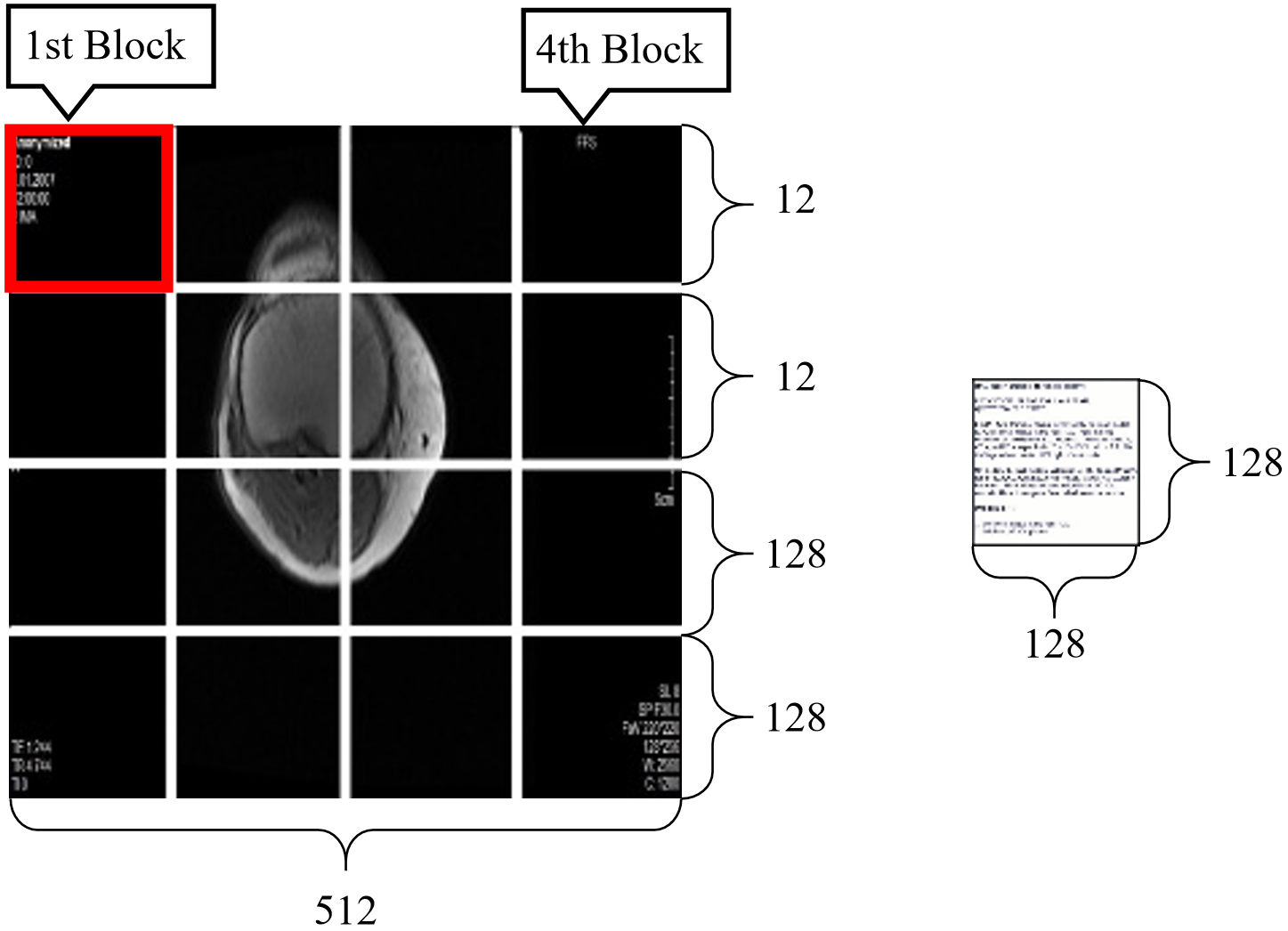
This study addresses invisible watermarking techniques aimed at preserving patient privacy during the sharing of medical images. Digital watermarking is a significant method for protecting the confidentiality of patient data by securely embedding personal information into medical images. In this study, three different strategies were developed and compared using a DCT-SVD-based hybrid invisible watermarking technique. In the first method, the host image and the watermark were of the same size, and direct embedding was applied. In the second method, the host image was divided into sixteen 128x128 blocks, and the watermark was segmented accordingly and embedded into each block individually. In the third and proposed method, non-diagnostic regions of the image—referred to as dead zones—were automatically detected, and the watermark was embedded only into these areas. This approach preserved the relevant medical data while minimizing image distortion. When the scaling factor was set to 0.01, PSNR values exceeded 40 for most images, and SSIM values were above 0.9. The results demonstrated that the proposed method outperformed the other two in terms of both imperceptibility and robustness.

Graphical Abstract
DCT-SVD Based Hybrid Approach for Digital Watermarking of Medical Images

Keywords
digital watermarking
DCT
SVD
medical images
patient privacy
image processing

Data Availability Statement
Data will be made available on request.

Funding
This work was supported without any funding.

Conflicts of Interest
The authors declare no conflicts of interest.

AI Use Statement
The authors declare that no generative AI was used in the preparation of this manuscript.

Ethical Approval and Consent to Participate
Not applicable.

References
  1. Solachidis, V., & Pitas, L. (2001). Circularly symmetric watermark embedding in 2-D DFT domain. IEEE transactions on image processing, 10(11), 1741-1753.
    [CrossRef]   [Google Scholar]
  2. Mohammed, A. A., Jebur, B. A., & Younus, K. M. (2021, May). Hybrid DCT-SVD based digital watermarking scheme with chaotic encryption for medical images. In IOP Conference Series: Materials Science and Engineering (Vol. 1152, No. 1, p. 012025). IOP Publishing.
    [CrossRef]   [Google Scholar]
  3. Zain, J. M., & Clarke, M. (2011). Reversible region of non-interest (RONI) watermarking for authentication of DICOM images. arXiv preprint arXiv:1101.1603.
    [Google Scholar]
  4. Karakış, R., & Gurkahraman, K. (2021). TIBBİ GÖRÜNTÜLERİN GÜVENLİĞİ İÇİN İLGİ OLMAYAN BÖLGELERDE KENAR TABANLI DAMGALAMA. Adıyaman Üniversitesi Mühendislik Bilimleri Dergisi, 8(14), 154–168.
    [Google Scholar]
  5. Mamuti, M., & Kazan, S. (2019). A novel digital image watermarking scheme for medical image. Int J Comput Sci Mob Comput, 8(4), 198-203.
    [Google Scholar]
  6. Alghoniemy, M., & Tewfik, A. H. (2004). Geometric invariance in image watermarking. IEEE Transactions on Image Processing, 13(2), 145-153.
    [CrossRef]   [Google Scholar]
  7. Aslantas, V. (2009). SVD and DWT-SVD domain robust watermarking using differential evolution algorithm. In Advances in Electrical Engineering and Computational Science (pp. 147-159). Dordrecht: Springer Netherlands.
    [CrossRef]   [Google Scholar]
  8. Aslantas, V., Dogan, A. L., & Ozturk, S. (2008, June). DWT-SVD based image watermarking using particle swarm optimizer. In 2008 IEEE international conference on multimedia and expo (pp. 241-244). IEEE.
    [CrossRef]   [Google Scholar]
  9. Aslantas, V., & Oz, A. Diferansiyel Gelişim Algoritması İle Tekil Değer Ayrışımına Dayalı Resim Damgalama. ISC Turkey, 3-5.
    [Google Scholar]
  10. Furat, M., & Oral, M. (2007). Digital image watermarking based on a relation between spatial and frequency domains. In 5th International Conference on Electrical and Electornics Engineering (ELECO 2007).
    [Google Scholar]
  11. Dogan, S., Tuncer, T., Avci, E., & Gulten, A. (2011). A robust color image watermarking with Singular Value Decomposition method. Advances in Engineering Software, 42(6), 336–346.
    [CrossRef]   [Google Scholar]
  12. Ustubioglu, A., & Ulutas, G. (2017). A new medical image watermarking technique with finer tamper localization. Journal of digital imaging, 30(6), 665-680.
    [CrossRef]   [Google Scholar]
  13. Priyanka, & Maheshkar, S. (2017). Region-based hybrid medical image watermarking for secure telemedicine applications. Multimedia Tools and Applications, 76(3), 3617-3647.
    [CrossRef]   [Google Scholar]
  14. Yıldız, S., Üstünsoy, F., & Sayan, H. H. (2023). Digital image watermarking with hybrid structure of DWT, DCT, SVD techniques and the optimization with BFO algorithm. Politeknik Dergisi, 27(3), 857-871.
    [CrossRef]   [Google Scholar]
  15. Yang, H. Y., Wang, X. Y., Niu, P. P., & Wang, A. L. (2015). Robust color image watermarking using geometric invariant quaternion polar harmonic transform. ACM Transactions on Multimedia Computing, Communications, and Applications (TOMM), 11(3), 1-26.
    [CrossRef]   [Google Scholar]
  16. Balcı, D., Karakış, R., & Güler, İ. (2020). Tıbbi DICOM Veri Güvenliğinde Hibrit Yöntemlerin Kullanılması. Düzce Üniversitesi Bilim ve Teknoloji Dergisi, 8(2), 1295–1306.
    [CrossRef]   [Google Scholar]
  17. OKEDIRAN, O. O. (2019). A security scheme for patient information Privacy in digital medical imaging. University of Pitesti Scientific Bulletin Series: Electronics and Computer Science, 19(2), 13-24.
    [Google Scholar]
  18. Karakış, R., Güllü, M. K., Çavusoğlu, Ü., Kaçar, S., & Pehlivan, İ. (2015). A novel fuzzy logic-based image steganography method to ensure medical data security. Computers in biology and medicine, 67, 172–183.
    [CrossRef]   [Google Scholar]
  19. Hore, A., & Ziou, D. (2010, August). Image quality metrics: PSNR vs. SSIM. In 2010 20th international conference on pattern recognition (pp. 2366-2369). IEEE.
    [CrossRef]   [Google Scholar]
  20. Kurban, R., & Bozpolat, H. (2022). Ayrık Kosinüs Dönüşümü DC Bileşenleri Ve Çoklu-Adaptif Ölçekleme Faktörleri Kullanılarak Dayanıklı Görüntü Damgalama. Eskişehir Osmangazi Üniversitesi Mühendislik ve Mimarlık Fakültesi Dergisi, 30(2), 190–200.
    [CrossRef]   [Google Scholar]
  21. Gomez-Coronel, S. L., Mascorro-Cano, J. A., Cedillo-Hernandez, M., Cedillo-Hernandez, A., Nakano-Miyatake, M., & Perez-Meana, H. (2023). A robust and secure watermarking approach based on hermite transform and SVD-DCT. Applied Sciences, 13(14), 8430.
    [CrossRef]   [Google Scholar]
  22. Karakoyun, M. (2023). The comparison of the effects of thresholding methods on segmentation using the moth flame optimization algorithm. Journal of Engineering Sciences, 26(2), 517–531.
    [Google Scholar]

Cite This Article
APA Style
Aksu, E., &Karakoyun, M.(2026). DCT-SVDBasedHybridApproach for Digital Watermarking of Medical Images. ICCK Transactions on Swarm and Evolutionary Learning, 2(1), 1–18. https://doi.org/10.62762/TSEL.2025.219908
Export Citation
RIS Format
Compatible with EndNote, Zotero, Mendeley, and other reference managers
RIS format data for reference managers
TY  - JOUR
AU  - Aksu, Emine
AU  - Karakoyun, Murat
PY  - 2026
DA  - 2026/01/31
TI  - DCT-SVD Based Hybrid Approach for Digital Watermarking of Medical Images
JO  - ICCK Transactions on Swarm and Evolutionary Learning
T2  - ICCK Transactions on Swarm and Evolutionary Learning
JF  - ICCK Transactions on Swarm and Evolutionary Learning
VL  - 2
IS  - 1
SP  - 1
EP  - 18
DO  - 10.62762/TSEL.2025.219908
UR  - https://www.icck.org/article/abs/TSEL.2025.219908
KW  - digital watermarking
KW  - DCT
KW  - SVD
KW  - medical images
KW  - patient privacy
KW  - image processing
AB  - This study addresses invisible watermarking techniques aimed at preserving patient privacy during the sharing of medical images. Digital watermarking is a significant method for protecting the confidentiality of patient data by securely embedding personal information into medical images. In this study, three different strategies were developed and compared using a DCT-SVD-based hybrid invisible watermarking technique. In the first method, the host image and the watermark were of the same size, and direct embedding was applied. In the second method, the host image was divided into sixteen 128x128 blocks, and the watermark was segmented accordingly and embedded into each block individually. In the third and proposed method, non-diagnostic regions of the image—referred to as dead zones—were automatically detected, and the watermark was embedded only into these areas. This approach preserved the relevant medical data while minimizing image distortion. When the scaling factor was set to 0.01, PSNR values exceeded 40 for most images, and SSIM values were above 0.9. The results demonstrated that the proposed method outperformed the other two in terms of both imperceptibility and robustness.
SN  - 3069-2962
PB  - Institute of Central Computation and Knowledge
LA  - English
ER  - 
BibTeX Format
Compatible with LaTeX, BibTeX, and other reference managers
BibTeX format data for LaTeX and reference managers
@article{Aksu2026DCTSVD,
  author = {Emine Aksu and Murat Karakoyun},
  title = {DCT-SVD Based Hybrid Approach for Digital Watermarking of Medical Images},
  journal = {ICCK Transactions on Swarm and Evolutionary Learning},
  year = {2026},
  volume = {2},
  number = {1},
  pages = {1-18},
  doi = {10.62762/TSEL.2025.219908},
  url = {https://www.icck.org/article/abs/TSEL.2025.219908},
  abstract = {This study addresses invisible watermarking techniques aimed at preserving patient privacy during the sharing of medical images. Digital watermarking is a significant method for protecting the confidentiality of patient data by securely embedding personal information into medical images. In this study, three different strategies were developed and compared using a DCT-SVD-based hybrid invisible watermarking technique. In the first method, the host image and the watermark were of the same size, and direct embedding was applied. In the second method, the host image was divided into sixteen 128x128 blocks, and the watermark was segmented accordingly and embedded into each block individually. In the third and proposed method, non-diagnostic regions of the image—referred to as dead zones—were automatically detected, and the watermark was embedded only into these areas. This approach preserved the relevant medical data while minimizing image distortion. When the scaling factor was set to 0.01, PSNR values exceeded 40 for most images, and SSIM values were above 0.9. The results demonstrated that the proposed method outperformed the other two in terms of both imperceptibility and robustness.},
  keywords = {digital watermarking, DCT, SVD, medical images, patient privacy, image processing},
  issn = {3069-2962},
  publisher = {Institute of Central Computation and Knowledge}
}

Article Metrics
Citations:

Crossref

0

Scopus

0

Web of Science

0
Article Access Statistics:
Views: 72
PDF Downloads: 11

Publisher's Note
ICCK stays neutral with regard to jurisdictional claims in published maps and institutional affiliations.

Rights and Permissions
Institute of Central Computation and Knowledge (ICCK) or its licensor (e.g. a society or other partner) holds exclusive rights to this article under a publishing agreement with the author(s) or other rightsholder(s); author self-archiving of the accepted manuscript version of this article is solely governed by the terms of such publishing agreement and applicable law.
ICCK Transactions on Swarm and Evolutionary Learning

ICCK Transactions on Swarm and Evolutionary Learning

ISSN: 3069-2962 (Online)

Email: [email protected]

Portico

Portico

All published articles are preserved here permanently:
https://www.portico.org/publishers/icck/