

Investigation on the Feasibility to Produce Jet-A1 Aviation Fuel by Co-hydroprocessing Petroleum Kerosene with POME and Cardanol


Article Information
Abstract
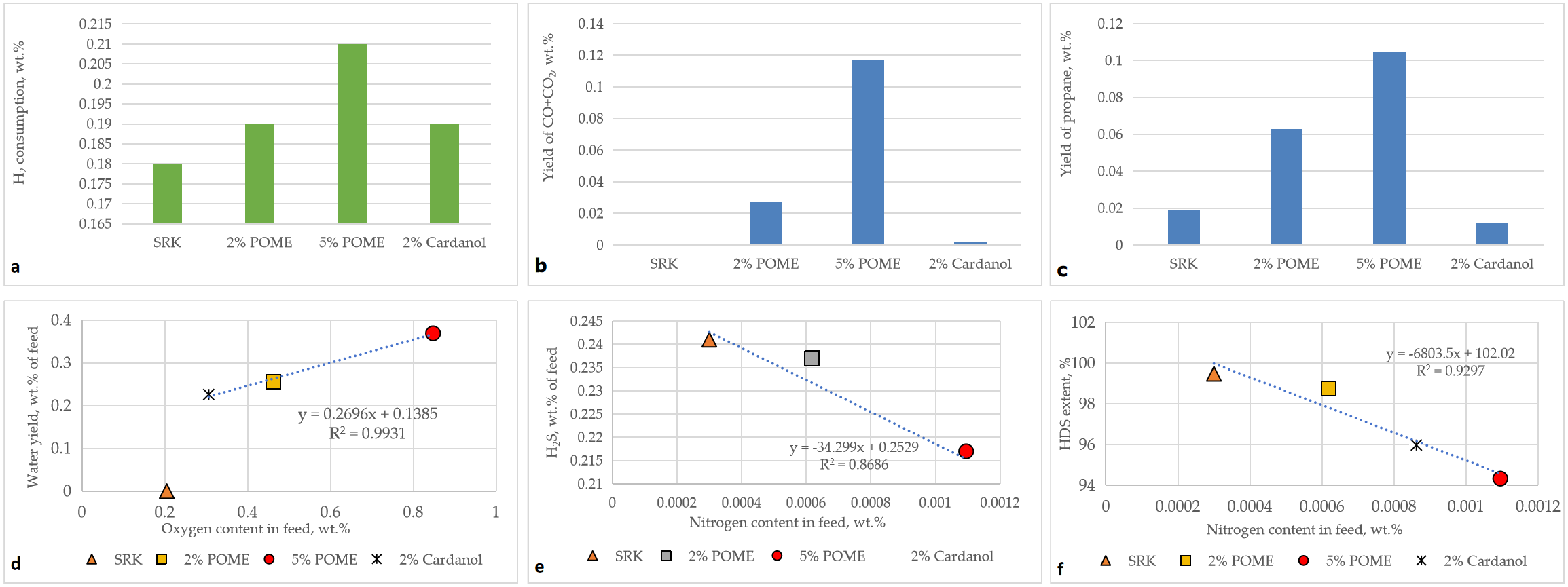
Petroleum kerosene (SRK) and its blends with the bio-components palm oil mill effluent (POME) and cardanol in amount of 2 and 5\% were hydrotreated on commercial Co-Mo catalyst in a laboratory trickle bed reactor at temperature of 290°C, liquid hourly space velocity (LHSV) of 1.28 h$^{-1}$, total pressure of 3.0 MPa, H$_2$/Oil ratio of 290 Nm$^3$/Nm$^3$ to simulate co-processing aiming at production of sustainable aviation fuel (SAF) in the existing hydrotreating technology employed to manufacture petroleum based Jet-A1 aviation fuel. It was found that increased hydrogen consumption during co-processing bio-feeds was mainly related to hydrodeoxygenation reaction leading to production of H$_2$O. Cardanol, and POME, however exhibited different behavior concerning production of propane (C$_3$) and CO+CO$_2$ with much lower production from Cardanol implying that it contains less free fatty acids, and less lipids than POME. The higher content of nitrogen (~ 50 times in POME, and ~ 100 times in Cardanol) in bio-feeds inhibits the HDS of petroleum kerosene decreasing the amount of H$_2$S generated and leaving higher sulfur content in hydrotreated jet product. POME was found unsuitable for production of jet fuel by co-processing due to the inability to meet the specification of maximum -47°C crystallization temperature. The hydrotreated liquid products from the bio-feeds were found highly corrosive, while the mixtures of hydrotreated SRK with untreated cardanol displayed lack of corrosivity suggesting that the unconverted oxygen containing substances in the liquid co-processed product are more corrosive that the original ones present in the bio-feeds.
Graphical Abstract
Keywords
Data Availability Statement
Funding
Conflicts of Interest
AI Use Statement
Ethical Approval and Consent to Participate
References
- Johansen, C. S., Skov, I. R., & Mati, A. (2026). Exploring the potential for cost-competitive e-SAF in European aviation towards 2050. Energy Reports, 15, 109018.
[CrossRef] [Google Scholar] - Abid, F. I., Inayat, M., Laukkanen, T., Pienihäkkinen, E., Viertiö, T., Sirous-Rezaei, P., ... & Järvinen, M. (2026). Fast pyrolysis pathway for production of sustainable aviation fuel (SAF) from demolition wood: Experimental and process simulation approach. Biomass and Bioenergy, 206, 108603.
[CrossRef] [Google Scholar] - Vaquerizo, L., & Rego-Fernández, D. (2025). Net-zero sustainable aviation fuel (SAF) production via CO2 hydrogenation in low-temperature Fischer-Tropsch synthesis: Process design and alternatives. Journal of CO2 Utilization, 102, 103225.
[CrossRef] [Google Scholar] - Watson, M. J., Machado, P. G., Da Silva, A. V., Saltar, Y., Ribeiro, C. O., Nascimento, C. A. O. D., & Dowling, A. W. (2024). Sustainable aviation fuel technologies, costs, emissions, policies, and markets: A critical review. Journal of Cleaner Production, 449, 141472.
[CrossRef] [Google Scholar] - International Air Transport Association (IATA). (n.d.). Developing Sustainable Aviation Fuel (SAF). Retrieved April 2, 2026, from https://www.iata.org/en/programs/sustainability/sustainable-aviation-fuels/
[Google Scholar] - ASTM Committee D02 on Petroleum Products and Lubricants. (2021). Standard Specification for Aviation Turbine Fuel Containing Synthesized Hydrocarbons. ASTM D7566-21. ASTM International.
[CrossRef] [Google Scholar] - Regulation (EU) 2023/2405 of the European Parliament and of the Council of 18 October 2023 on ensuring a level playing field for sustainable air transport (ReFuelEU Aviation). Retrieved from http://data.europa.eu/eli/reg/2023/2405/2023-10-31
[Google Scholar] - Topsoe. (n.d.). Co-processing: A fast-track to SAF. Retrieved April 2, 2026, from https://www.sustainableaviationfutures.com/saf-spotlight/coprocessing-topsoe
[Google Scholar] - Air BP. (2022, August). The role of co-processing in aviation’s transition to a lower-carbon future. Retrieved April 2, 2026, from https://www.bp.com/en/global/air-bp/news-and-views/views/the-role-of-co-processing-in-aviation-s-transition-to-a-low-carb.html
[Google Scholar] - Perez, M. J. L., & Folić, M. (2024). Co-processing SAF: Standards, incentives and regulation. Biomass Magazine. Retrieved from https://biomassmagazine.com/articles/co-processing-saf-standards-incentives-and-regulation
[Google Scholar] - Gollakota, A. R., Shu, C. M., Sarangi, P. K., Shadangi, K. P., Rakshit, S., Kennedy, J. F., ... & Sharma, M. (2023). Catalytic hydrodeoxygenation of bio-oil and model compounds-Choice of catalysts, and mechanisms. Renewable and Sustainable Energy Reviews, 187, 113700.
[CrossRef] [Google Scholar] - Scaldaferri, C. A., & Pasa, V. M. D. (2019). Green diesel production from upgrading of cashew nut shell liquid. Renewable and Sustainable Energy Reviews, 111, 303-313.
[CrossRef] [Google Scholar] - Al-Sabawi, M., Chen, J., & Ng, S. (2012). Fluid catalytic cracking of biomass-derived oils and their blends with petroleum feedstocks: a review. Energy & Fuels, 26(9), 5355-5372.
[CrossRef] [Google Scholar] - Hua, T., Chunyi, L. I., Chaohe, Y., & Honghong, S. H. A. N. (2008). Alternative processing technology for converting vegetable oils and animal fats to clean fuels and light olefins. Chinese Journal of Chemical Engineering, 16(3), 394-400.
[CrossRef] [Google Scholar]
Cite This Article
TY  - JOUR
AU  - Stratiev, Dicho
AU  - Dinkov, Rosen
AU  - Nedelchev, Angel
AU  - Shishkova, Ivelina
PY  - 2026
DA  - 2026/06/02
TI  - Investigation on the Feasibility to Produce Jet-A1 Aviation Fuel by Co-hydroprocessing Petroleum Kerosene with POME and Cardanol
JO  - Journal of Chemical Engineering and Renewable Fuels
T2  - Journal of Chemical Engineering and Renewable Fuels
JF  - Journal of Chemical Engineering and Renewable Fuels
VL  - 2
IS  - 3
SP  - 71
EP  - 77
DO  - 10.62762/JCERF.2026.810053
UR  - https://www.icck.org/article/abs/JCERF.2026.810053
KW  - sustainable aviation fuel
KW  - co-processing
KW  - corrosion
AB  - Petroleum kerosene (SRK) and its blends with the bio-components palm oil mill effluent (POME) and cardanol in amount of 2 and 5\% were hydrotreated on commercial Co-Mo catalyst in a laboratory trickle bed reactor at temperature of 290°C, liquid hourly space velocity (LHSV) of 1.28 h$^{-1}$, total pressure of 3.0 MPa, H$_2$/Oil ratio of 290 Nm$^3$/Nm$^3$ to simulate co-processing aiming at production of sustainable aviation fuel (SAF) in the existing hydrotreating technology employed to manufacture petroleum based Jet-A1 aviation fuel. It was found that increased hydrogen consumption during co-processing bio-feeds was mainly related to hydrodeoxygenation reaction leading to production of H$_2$O. Cardanol, and POME, however exhibited different behavior concerning production of propane (C$_3$) and CO+CO$_2$ with much lower production from Cardanol implying that it contains less free fatty acids, and less lipids than POME. The higher content of nitrogen (~ 50 times in POME, and ~ 100 times in Cardanol) in bio-feeds inhibits the HDS of petroleum kerosene decreasing the amount of H$_2$S generated and leaving higher sulfur content in hydrotreated jet product. POME was found unsuitable for production of jet fuel by co-processing due to the inability to meet the specification of maximum -47°C crystallization temperature. The hydrotreated liquid products from the bio-feeds were found highly corrosive, while the mixtures of hydrotreated SRK with untreated cardanol displayed lack of corrosivity suggesting that the unconverted oxygen containing substances in the liquid co-processed product are more corrosive that the original ones present in the bio-feeds.
SN  - 3070-1058
PB  - Institute of Central Computation and Knowledge
LA  - English
ER  -
@article{Stratiev2026Investigat,
  author = {Dicho Stratiev and Rosen Dinkov and Angel Nedelchev and Ivelina Shishkova},
  title = {Investigation on the Feasibility to Produce Jet-A1 Aviation Fuel by Co-hydroprocessing Petroleum Kerosene with POME and Cardanol},
  journal = {Journal of Chemical Engineering and Renewable Fuels},
  year = {2026},
  volume = {2},
  number = {3},
  pages = {71-77},
  doi = {10.62762/JCERF.2026.810053},
  url = {https://www.icck.org/article/abs/JCERF.2026.810053},
  abstract = {Petroleum kerosene (SRK) and its blends with the bio-components palm oil mill effluent (POME) and cardanol in amount of 2 and 5\\% were hydrotreated on commercial Co-Mo catalyst in a laboratory trickle bed reactor at temperature of 290°C, liquid hourly space velocity (LHSV) of 1.28 h\$^{-1}\$, total pressure of 3.0 MPa, H\$\_2\$/Oil ratio of 290 Nm\$^3\$/Nm\$^3\$ to simulate co-processing aiming at production of sustainable aviation fuel (SAF) in the existing hydrotreating technology employed to manufacture petroleum based Jet-A1 aviation fuel. It was found that increased hydrogen consumption during co-processing bio-feeds was mainly related to hydrodeoxygenation reaction leading to production of H\$\_2\$O. Cardanol, and POME, however exhibited different behavior concerning production of propane (C\$\_3\$) and CO+CO\$\_2\$ with much lower production from Cardanol implying that it contains less free fatty acids, and less lipids than POME. The higher content of nitrogen (~ 50 times in POME, and ~ 100 times in Cardanol) in bio-feeds inhibits the HDS of petroleum kerosene decreasing the amount of H\$\_2\$S generated and leaving higher sulfur content in hydrotreated jet product. POME was found unsuitable for production of jet fuel by co-processing due to the inability to meet the specification of maximum -47°C crystallization temperature. The hydrotreated liquid products from the bio-feeds were found highly corrosive, while the mixtures of hydrotreated SRK with untreated cardanol displayed lack of corrosivity suggesting that the unconverted oxygen containing substances in the liquid co-processed product are more corrosive that the original ones present in the bio-feeds.},
  keywords = {sustainable aviation fuel, co-processing, corrosion},
  issn = {3070-1058},
  publisher = {Institute of Central Computation and Knowledge}
}
Article Metrics
Publisher's Note
ICCK stays neutral with regard to jurisdictional claims in published maps and institutional affiliations.
Rights and Permissions
 Copyright © 2026 by the Author(s). Published by Institute of Central Computation and Knowledge. This article is an open access article distributed under the terms and conditions of the Creative Commons Attribution (CC BY) license (https://creativecommons.org/licenses/by/4.0/), which permits use, sharing, adaptation, distribution and reproduction in any medium or format, as long as you give appropriate credit to the original author(s) and the source, provide a link to the Creative Commons licence, and indicate if changes were made.


Portico
