

Reinventing Oil Reservoirs: A Subsurface Pathway to Hydrogen and Cleaner Hydrocarbons



Article Information
Abstract
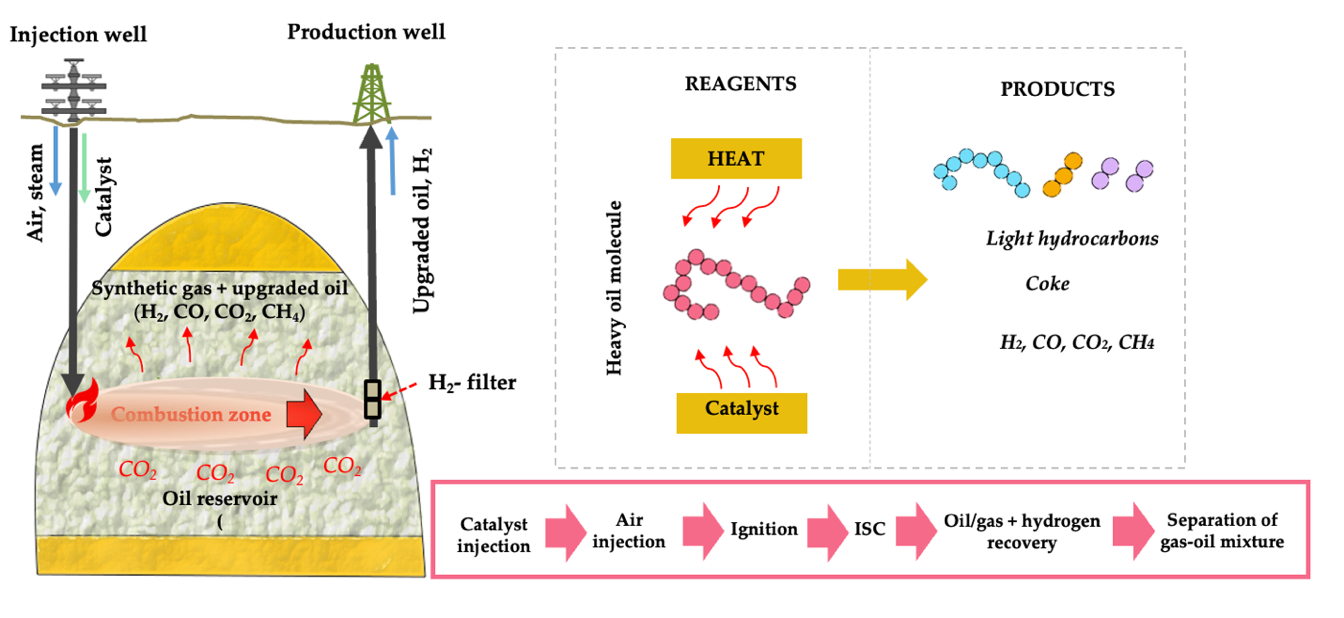
This article explores the emerging concept of in situ hydrogen generation (ISHG) within oil reservoirs as a transformative pathway toward clean energy and hydrocarbon upgrading. With the global energy sector facing decarbonization pressures and limitations of conventional hydrogen production, ISHG offers a promising alternative by turning mature or depleted oil fields into subsurface reactors for hydrogen and upgraded oil co-production. Through thermochemical processes such as in situ combustion (ISC), steam methane reforming (SMR), coke gasification and water-gas shift reactions (WGSR), hydrogen is produced underground while carbon dioxide and by-products remain trapped, minimizing surface emissions. Drawing on recent experimental, modeling, and pilot studies, we discuss advances in reaction mechanisms, numerical simulation, and techno-economic assessments, highlighting both technical opportunities and outstanding challenges. The article provides a forward-looking perspective on how ISHG can repurpose legacy oil infrastructure for a cleaner energy future.
Graphical Abstract
Keywords
Data Availability Statement
Funding
Conflicts of Interest
Ethical Approval and Consent to Participate
References
- Mitrova, T., Melnikov, Y., Chugunov, D., & Glagoleva, A. (2019). Hydrogen economy-the path to low-carbon development. Moscow School of Management SKOLKOVO, 63.
[Google Scholar] - Nnabuife, S. G., Darko, C. K., Obiako, P. C., Kuang, B., Sun, X., & Jenkins, K. (2023). A comparative analysis of different hydrogen production methods and their environmental impact. Clean Technologies, 5(4), 1344–1380.
[CrossRef] [Google Scholar] - Council, H. (2020). Path to hydrogen competitiveness: A cost perspective.
[Google Scholar] - Yuan, C., Afanasev, P., Askarova, A., Popov, E., & Cheremisin, A. (2025). In situ hydrogen generation in subsurface reservoirs of fossil fuels by thermal methods: Reaction mechanisms, kinetics, and catalysis. Applied Energy, 381, 125219.
[CrossRef] [Google Scholar] - Kapadia, P. R., Kallos, M. S., & Gates, I. D. (2011). Potential for hydrogen generation from in situ combustion of Athabasca bitumen. Fuel, 90(6), 2254–2265.
[CrossRef] [Google Scholar] - Agada, S., Geiger, S., Elsheikh, A. H., Mackay, E., & Oladyshkin, S. (2015). Reduced order models for rapid EOR simulation in fractured carbonate reservoirs. Society of Petroleum Engineers - SPE Reservoir Simulation Symposium 2015, 1, 276–296.
[CrossRef] [Google Scholar] - Askarova, A., Afanasev, P., Popov, E., Mikitin, E., & Darishchev, V. (2023). Application of oil in situ combustion for the catalytic methane conversion in the porous medium of the gas reservoir. Journal of Petroleum Science and Engineering, 220(PA), 111256.
[CrossRef] [Google Scholar] - Afanasev, P., Smirnov, A., Ulyanova, A., Popov, E., & Cheremisin, A. (2023). Experimental study of catalytically enhanced cyclic steam-air stimulation for in situ hydrogen generation and heavy oil upgrading. Catalysts, 13(8), 1172.
[CrossRef] [Google Scholar] - Zhao, R., Wang, T., Ren, H., Jiang, N., Li, X., Lv, W., ... & Bai, S. (2024). A strategy for enhanced hydrogen generation: The effect of varying atmospheres on in-situ gasification in heavy oil reservoirs. Applied Energy, 376, 124168.
[CrossRef] [Google Scholar] - Wang, T., Zhao, R., Yang, Y., Ren, H., Lv, W., Xu, H., & Liu, J. (2025). Enhanced Hydrogen-Rich Syngas Production Through In-Situ Heavy Oil Gasification Process Using Nanoscale Nickel Catalyst. Molecules, 30(4), 809.
[CrossRef] [Google Scholar] - Kapadia, P. R., Wang, J. (Jacky), Kallos, M. S., & Gates, I. D. (2013). Practical process design for in situ gasification of bitumen. Applied Energy, 107, 281–296.
[CrossRef] [Google Scholar] - Song, P., Li, Y., Yin, Z., Ifticene, M. A., & Yuan, Q. (2023). Simulation of hydrogen generation via in-situ combustion gasification of heavy oil. International Journal of Hydrogen Energy, 49, 925-936.
[CrossRef] [Google Scholar] - Ikpeka, P. M., & Ugwu, J. O. (2023). In situ hydrogen production from hydrocarbon reservoirs - modelling study. RSC Advances, 13(18), 12100–12113.
[CrossRef] [Google Scholar] - Smith, E. K., Barakat, S. M., Akande, O., Ogbaga, C. C., Okoye, P. U., & Okolie, J. A. (2024). Subsurface combustion and gasification for hydrogen production: Reaction mechanism, techno-economic and lifecycle assessment. Chemical Engineering Journal, 480, 148095.
[CrossRef] [Google Scholar] - Salahshoor, S., & Afzal, S. (2022). Subsurface technologies for hydrogen production from fossil fuel resources: A review and techno-economic analysis. International Journal of Hydrogen Energy.
[CrossRef] [Google Scholar]
Cite This Article
TY  - JOUR
AU  - Askarova, Aysylu
AU  - Cheremisin, Alexey
AU  - Zhao, Renbao
AU  - Yuan, Chengdong
PY  - 2025
DA  - 2025/08/29
TI  - Reinventing Oil Reservoirs: A Subsurface Pathway to Hydrogen and Cleaner Hydrocarbons
JO  - Journal of Chemical Engineering and Renewable Fuels
T2  - Journal of Chemical Engineering and Renewable Fuels
JF  - Journal of Chemical Engineering and Renewable Fuels
VL  - 1
IS  - 1
SP  - 9
EP  - 14
DO  - 10.62762/JCERF.2025.908199
UR  - https://www.icck.org/article/abs/JCERF.2025.908199
KW  - in situ hydrogen generation
KW  - heavy oil
KW  - steam methane reforming
KW  - oil upgrading
AB  - This article explores the emerging concept of in situ hydrogen generation (ISHG) within oil reservoirs as a transformative pathway toward clean energy and hydrocarbon upgrading. With the global energy sector facing decarbonization pressures and limitations of conventional hydrogen production, ISHG offers a promising alternative by turning mature or depleted oil fields into subsurface reactors for hydrogen and upgraded oil co-production. Through thermochemical processes such as in situ combustion (ISC), steam methane reforming (SMR), coke gasification and water-gas shift reactions (WGSR), hydrogen is produced underground while carbon dioxide and by-products remain trapped, minimizing surface emissions. Drawing on recent experimental, modeling, and pilot studies, we discuss advances in reaction mechanisms, numerical simulation, and techno-economic assessments, highlighting both technical opportunities and outstanding challenges. The article provides a forward-looking perspective on how ISHG can repurpose legacy oil infrastructure for a cleaner energy future.
SN  - 3070-1058
PB  - Institute of Central Computation and Knowledge
LA  - English
ER  -
@article{Askarova2025Reinventin,
  author = {Aysylu Askarova and Alexey Cheremisin and Renbao Zhao and Chengdong Yuan},
  title = {Reinventing Oil Reservoirs: A Subsurface Pathway to Hydrogen and Cleaner Hydrocarbons},
  journal = {Journal of Chemical Engineering and Renewable Fuels},
  year = {2025},
  volume = {1},
  number = {1},
  pages = {9-14},
  doi = {10.62762/JCERF.2025.908199},
  url = {https://www.icck.org/article/abs/JCERF.2025.908199},
  abstract = {This article explores the emerging concept of in situ hydrogen generation (ISHG) within oil reservoirs as a transformative pathway toward clean energy and hydrocarbon upgrading. With the global energy sector facing decarbonization pressures and limitations of conventional hydrogen production, ISHG offers a promising alternative by turning mature or depleted oil fields into subsurface reactors for hydrogen and upgraded oil co-production. Through thermochemical processes such as in situ combustion (ISC), steam methane reforming (SMR), coke gasification and water-gas shift reactions (WGSR), hydrogen is produced underground while carbon dioxide and by-products remain trapped, minimizing surface emissions. Drawing on recent experimental, modeling, and pilot studies, we discuss advances in reaction mechanisms, numerical simulation, and techno-economic assessments, highlighting both technical opportunities and outstanding challenges. The article provides a forward-looking perspective on how ISHG can repurpose legacy oil infrastructure for a cleaner energy future.},
  keywords = {in situ hydrogen generation, heavy oil, steam methane reforming, oil upgrading},
  issn = {3070-1058},
  publisher = {Institute of Central Computation and Knowledge}
}
Article Metrics
Publisher's Note
ICCK stays neutral with regard to jurisdictional claims in published maps and institutional affiliations.
Rights and Permissions
 Copyright © 2025 by the Author(s). Published by Institute of Central Computation and Knowledge. This article is an open access article distributed under the terms and conditions of the Creative Commons Attribution (CC BY) license (https://creativecommons.org/licenses/by/4.0/), which permits use, sharing, adaptation, distribution and reproduction in any medium or format, as long as you give appropriate credit to the original author(s) and the source, provide a link to the Creative Commons licence, and indicate if changes were made.


Portico
