

Feedstock Quality and Conversion Efficiency as Key Determinants of Sustainable Aviation Fuel Production: Pathways, Reactions, and Challenges



Article Information
Abstract
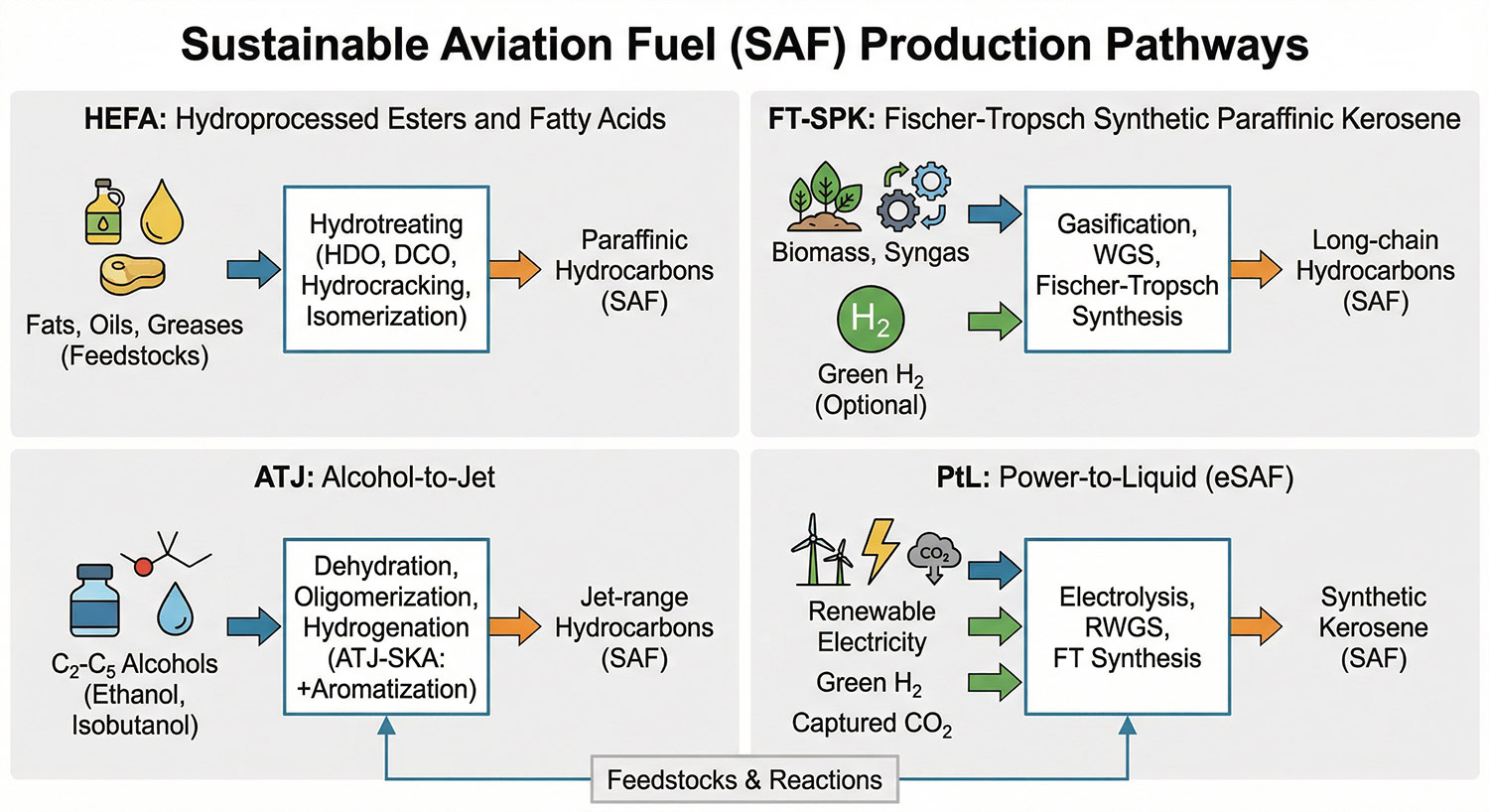
Sustainable Aviation Fuel is the most viable near-term strategy for decarbonizing commercial aviation. Its performance depends fundamentally on the quality of the feedstock and conversion efficiency. This paper examines the four principal ASTM-certified pathways: Hydroprocessed Esters and Fatty Acids (HEFA), Fischer-Tropsch Synthetic Paraffinic Kerosene (FT-SPK), Alcohol-to-Jet (ATJ), and Power-to-Liquid (PtL/eSAF). Additionally, it highlights how feedstock chemical composition, contaminants, moisture content, and carbon intensity affect conversion outcomes, including fuel yield, catalyst performance, minimum fuel selling price, and lifecycle greenhouse gas reduction. Feedstock cost accounts for 60-80% of the minimum fuel selling price across bio-based pathways. Fatty acid chain-length profiles directly determine hydrocarbon yield and jet-fraction selectivity in HEFA. Lignocellulosic heterogeneity is the principal technical bottleneck in gasification-FT routes. PtL pathways decouple production from biological feedstock constraints by substituting renewable electricity cost and CO$_2$ source quality as the governing variables.
Graphical Abstract
Keywords
Data Availability Statement
Funding
Conflicts of Interest
AI Use Statement
Ethical Approval and Consent to Participate
References
- Luman, R. (2025). AI-powered feedstock optimization in sustainable aviation fuel production: Enhancing efficiency and reducing costs. International Journal of Advanced Research in Computer Science, 16(5), 22.
[CrossRef] [Google Scholar] - Uddin, M. N., & Wang, F. (2025). Sustainable Aviation Fuels: A Review of Current Techno Economic Viability and Life Cycle Impacts. Energies. https://www.h2knowledgecentre.com/content/journal8007
[Google Scholar] - Grimme, W. (2023). The Introduction of Sustainable Aviation Fuels—A Discussion of Challenges, Options and Alternatives. Aerospace, 10(3), 218.
[CrossRef] [Google Scholar] - Rosales-Calderon, O., Tao, L., Abdullah, Z., Talmadge, M., Milbrandt, A., Smolinski, S., Moriarty, K., Bhatt, A., Zhang, Y., Ravi, V., Skangos, C., Davis, R., & Payne, C. (2024). Sustainable Aviation Fuel State-of-Industry Report: Hydroprocessed Esters and Fatty Acids Pathway (NREL/TP-5100-87803). National Renewable Energy Laboratory (NREL).
[CrossRef] [Google Scholar] - Wandelt, S., Zhang, Y., & Sun, X. (2025). Sustainable aviation fuels: A meta-review of surveys and key challenges. Journal of the Air Transport Research Society, 4, 100056.
[CrossRef] [Google Scholar] - Holladay, J., Abdullah, Z., & Heyne, J. (2020). Sustainable Aviation Fuel: Review of Technical Pathways (DOE/EE-2041). Bioenergy Technologies Office. U.S. Department of Energy.
[CrossRef] [Google Scholar] - Klimczyk, W., Jasiński, R., Niklas, J., Siedlecki, M., & Ziółkowski, A. (2025). Sustainable Aviation Fuels: A Comprehensive Review of Production Pathways, Environmental Impacts, Lifecycle Assessment, and Certification Frameworks. Energies, 18(14), 3705.
[CrossRef] [Google Scholar] - Lau, J. I. C., Wang, Y. S., Ang, T., Seo, J. C. F., Khadaroo, S. N. B. A., Chew, J. J., Ng Kay Lup, A., & Sunarso, J. (2024). Emerging technologies, policies and challenges toward implementing sustainable aviation fuel (SAF). Biomass and Bioenergy, 186, 107277.
[CrossRef] [Google Scholar] - Maghzian, A., & Saddler, J. (John). (2026). Which processes to making biojet/Sustainable Aviation Fuel (SAF) are likely to supplement the predominant, HEFA/lipid-to-biojet production route? Bioresource Technology, 441, 133631.
[CrossRef] [Google Scholar] - Mohanty, A., Ramasamy, A., Verayiah, R., Satpathy, A. S., Mohanty, P., Bhutto, J. K., Hakami, H., & Cuce, E. (2025). Sustainable aviation fuels from bio resources: Technological pathways, prospects, and deployment challenges. Sustainable Energy Technologies and Assessments, 83, 104642.
[CrossRef] [Google Scholar] - Xu, Y., Zhang, Y., Deng, X., Lee, S.-Y., Wang, K., & Li, L. (2025). Bibliometric analysis and literature review on sustainable aviation fuel (SAF): Economic and management perspective. Transport Policy, 162, 296-312.
[CrossRef] [Google Scholar] - Anetjärvi, E., Klüh, D., Dossow, M., Melin, K., & Vakkilainen, E. (2025). Comparative techno-economic assessment of Fischer Tropsch syncrude production via directly and indirectly electrified biomass gasification routes. Applied Thermal Engineering, 278, 127278.
[CrossRef] [Google Scholar] - Chireshe, F., Petersen, A. M., Ravinath, A., Mnyakeni, L., Ellis, G., Viljoen, H., Vienings, E., Wessels, C., Stafford, W. H. L., Bole-Rentel, T., Reeler, J., & Görgens, J. F. (2025). Cost-effective sustainable aviation fuel: Insights from a techno-economic and logistics analysis. Renewable and Sustainable Energy Reviews, 210, 115157.
[CrossRef] [Google Scholar] - Fu, J., Liu, Y., & Xia, Z. (2025). Coprocessing Renewable and Waste Feedstocks: Critical Technology for Aviation Decarbonization. Energy & Fuels, 39(49), 22943-22962.
[CrossRef] [Google Scholar] - Geleynse, S., Brandt, K., Garcia-Perez, M., Wolcott, M., & Zhang, X. (2018). The Alcohol-to-Jet Conversion Pathway for Drop-In Biofuels: Techno-Economic Evaluation. ChemSusChem, 11(21), 3728-3741.
[CrossRef] [Google Scholar] - Huq, N. A., Hafenstine, G. R., Huo, X., Nguyen, H., Tifft, S. M., Conklin, D. R., Stück, D., Stunkel, J., Yang, Z., Heyne, J. S., Wiatrowski, M. R., Zhang, Y., Tao, L., Zhu, J., McEnally, C. S., Christensen, E. D., Hays, C., Van Allsburg, K. M., Unocic, K. A., … Vardon, D. R. (2021). Toward net-zero sustainable aviation fuel with wet waste–derived volatile fatty acids. Proceedings of the National Academy of Sciences, 118(13), e2023008118.
[CrossRef] [Google Scholar] - Kurzawska-Pietrowicz, P., & Jasiński, R. (2024). A Review of Alternative Aviation Fuels. Energies, 17(16), 3890.
[CrossRef] [Google Scholar] - Rojas-Michaga, M. F., Michailos, S., Cardozo, E., Akram, M., Hughes, K. J., Ingham, D., & Pourkashanian, M. (2023). Sustainable aviation fuel (SAF) production through power-to-liquid (PtL): A combined techno-economic and life cycle assessment. Energy Conversion and Management, 292, 117427.
[CrossRef] [Google Scholar] - Seymour, K., Held, M., Stolz, B., Georges, G., & Boulouchos, K. (2024). Future costs of power-to-liquid sustainable aviation fuels produced from hybrid solar PV-wind plants in Europe. Sustainable Energy & Fuels, 8(4), 811-825.
[CrossRef] [Google Scholar] - Tao, L., Milbrandt, A., Zhang, Y., & Wang, W.-C. (2017). Techno-economic and resource analysis of hydroprocessed renewable jet fuel. Biotechnology for Biofuels, 10(1), 261.
[CrossRef] [Google Scholar] - Uddin, M. M., Lee, U., Xu, H., Li, Y., Kwon, H., Zhang, Y., Smolinski, S., Cai, H., & Tao, L. (2025). Sustainable aviation fuel from ethanol: Techno-economic analysis and life cycle analysis. Applied Energy, 398, 126373.
[CrossRef] [Google Scholar] - Usman, M., Cheng, S., Boonyubol, S., & Cross, J. S. (2023). The future of aviation soars with HTL-based SAFs: Exploring potential and overcoming challenges using organic wet feedstocks. Sustainable Energy & Fuels, 7(17), 4066-4087.
[CrossRef] [Google Scholar] - Vozka, P., Šimáček, P., & Kilaz, G. (2018). Impact of HEFA Feedstocks on Fuel Composition and Properties in Blends with Jet A. Energy & Fuels, 32(11), 11595-11606.
[CrossRef] [Google Scholar]
Cite This Article
TY  - JOUR
AU  - Felix, Guillermo
PY  - 2026
DA  - 2026/04/20
TI  - Feedstock Quality and Conversion Efficiency as Key Determinants of Sustainable Aviation Fuel Production: Pathways, Reactions, and Challenges
JO  - Journal of Chemical Engineering and Renewable Fuels
T2  - Journal of Chemical Engineering and Renewable Fuels
JF  - Journal of Chemical Engineering and Renewable Fuels
VL  - 2
IS  - 2
SP  - 39
EP  - 45
DO  - 10.62762/JCERF.2026.241704
UR  - https://www.icck.org/article/abs/JCERF.2026.241704
KW  - sustainable aviation fuel
KW  - reactions
KW  - HEFA
KW  - Fischer-Tropsch
KW  - Alcohol-to-Jet
KW  - Power-to-Liquid
AB  - Sustainable Aviation Fuel is the most viable near-term strategy for decarbonizing commercial aviation. Its performance depends fundamentally on the quality of the feedstock and conversion efficiency. This paper examines the four principal ASTM-certified pathways: Hydroprocessed Esters and Fatty Acids (HEFA), Fischer-Tropsch Synthetic Paraffinic Kerosene (FT-SPK), Alcohol-to-Jet (ATJ), and Power-to-Liquid (PtL/eSAF). Additionally, it highlights how feedstock chemical composition, contaminants, moisture content, and carbon intensity affect conversion outcomes, including fuel yield, catalyst performance, minimum fuel selling price, and lifecycle greenhouse gas reduction. Feedstock cost accounts for 60-80% of the minimum fuel selling price across bio-based pathways. Fatty acid chain-length profiles directly determine hydrocarbon yield and jet-fraction selectivity in HEFA. Lignocellulosic heterogeneity is the principal technical bottleneck in gasification-FT routes. PtL pathways decouple production from biological feedstock constraints by substituting renewable electricity cost and CO$_2$ source quality as the governing variables.
SN  - 3070-1058
PB  - Institute of Central Computation and Knowledge
LA  - English
ER  -
@article{Felix2026Feedstock,
  author = {Guillermo Felix},
  title = {Feedstock Quality and Conversion Efficiency as Key Determinants of Sustainable Aviation Fuel Production: Pathways, Reactions, and Challenges},
  journal = {Journal of Chemical Engineering and Renewable Fuels},
  year = {2026},
  volume = {2},
  number = {2},
  pages = {39-45},
  doi = {10.62762/JCERF.2026.241704},
  url = {https://www.icck.org/article/abs/JCERF.2026.241704},
  abstract = {Sustainable Aviation Fuel is the most viable near-term strategy for decarbonizing commercial aviation. Its performance depends fundamentally on the quality of the feedstock and conversion efficiency. This paper examines the four principal ASTM-certified pathways: Hydroprocessed Esters and Fatty Acids (HEFA), Fischer-Tropsch Synthetic Paraffinic Kerosene (FT-SPK), Alcohol-to-Jet (ATJ), and Power-to-Liquid (PtL/eSAF). Additionally, it highlights how feedstock chemical composition, contaminants, moisture content, and carbon intensity affect conversion outcomes, including fuel yield, catalyst performance, minimum fuel selling price, and lifecycle greenhouse gas reduction. Feedstock cost accounts for 60-80\% of the minimum fuel selling price across bio-based pathways. Fatty acid chain-length profiles directly determine hydrocarbon yield and jet-fraction selectivity in HEFA. Lignocellulosic heterogeneity is the principal technical bottleneck in gasification-FT routes. PtL pathways decouple production from biological feedstock constraints by substituting renewable electricity cost and CO\$\_2\$ source quality as the governing variables.},
  keywords = {sustainable aviation fuel, reactions, HEFA, Fischer-Tropsch, Alcohol-to-Jet, Power-to-Liquid},
  issn = {3070-1058},
  publisher = {Institute of Central Computation and Knowledge}
}
Article Metrics
Publisher's Note
ICCK stays neutral with regard to jurisdictional claims in published maps and institutional affiliations.
Rights and Permissions
 Copyright © 2026 by the Author(s). Published by Institute of Central Computation and Knowledge. This article is an open access article distributed under the terms and conditions of the Creative Commons Attribution (CC BY) license (https://creativecommons.org/licenses/by/4.0/), which permits use, sharing, adaptation, distribution and reproduction in any medium or format, as long as you give appropriate credit to the original author(s) and the source, provide a link to the Creative Commons licence, and indicate if changes were made.


Portico
