

Lessons Learned from 10 Years H-Oil Exploitation


Article Information
Abstract
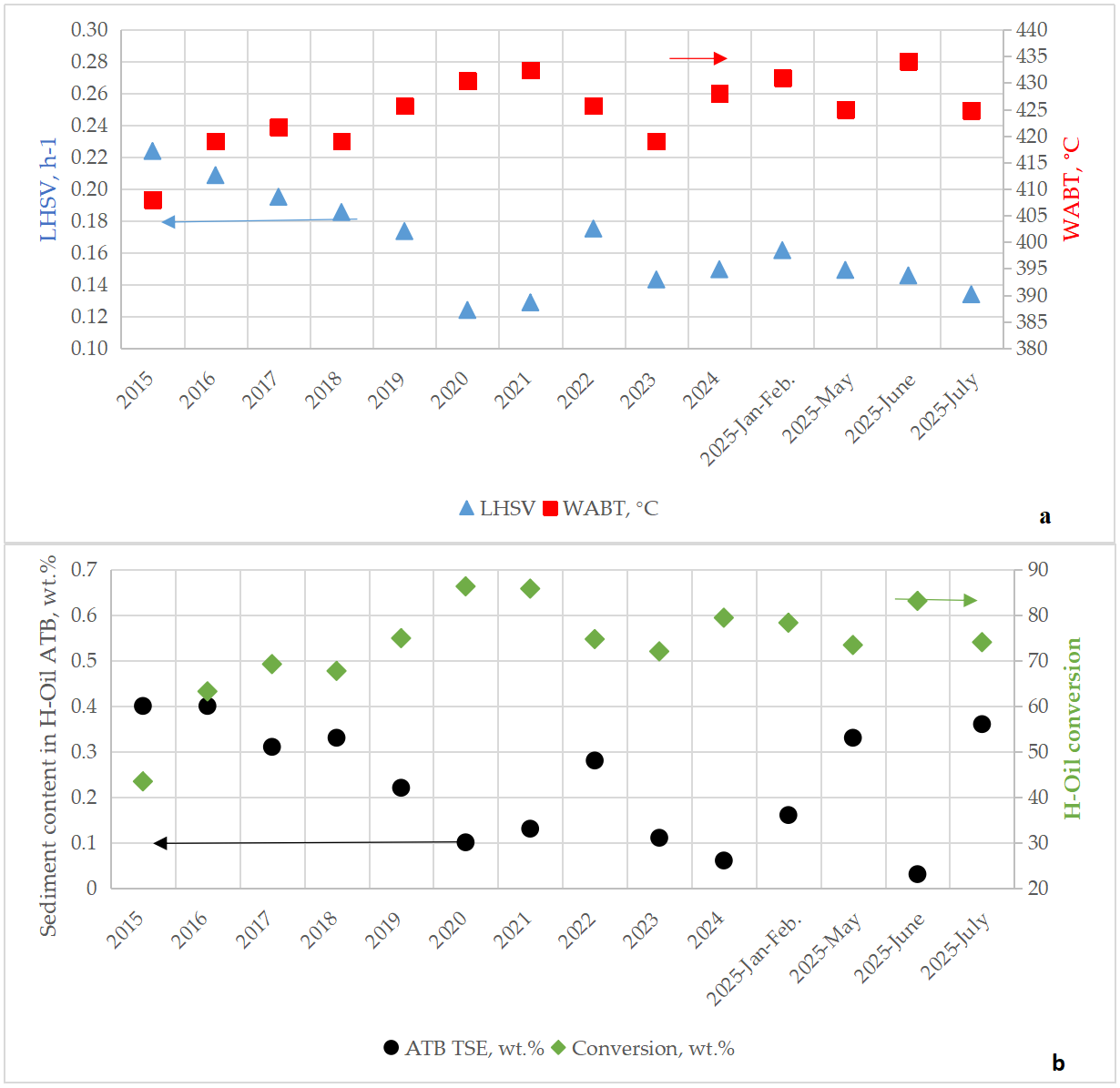
The ebulled bed hydrocracking technology of petroleum residues, called H-Oil, was invented in the 1950s. The first patent was issued in 1961. A demonstration unit was started up in 1963, and the first large-scale commercial unit was started up in 1968. There are currently 21 vacuum residue hydrocracking units operating worldwide using the ebulled bed reactor technology. Since 2015, the ebulated bed vacuum residue (VR) hydrocracking has been operated at the LUKOIL Neftohim Burgas (LNB) refinery. Performance of LNB ebullated bed vacuum residue H-Oil hydrocracker for a period of 10 years during processing 39 different vacuum residues at reactor temperatures between 408 and 434°C, and liquid hourly space velocity (LHSV) between 0.12 and 0.22 h-1 is discussed in this study. The feasible co-processing of renewable feedstocks in the H-Oil hydrocracker is also outlined.
Graphical Abstract
Keywords
Data Availability Statement
Funding
Conflicts of Interest
Ethical Approval and Consent to Participate
References
- Stratiev, D., Dinkov, R., Shishkova, I., Sharafutdinov, I., Ivanova, N., Mitkova, M., ... & Chushkov, B. (2016). What is behind the high values of hot filtration test of the ebullated bed residue H-Oil hydrocracker residual oils?. Energy & Fuels, 30(9), 7037-7054.
[CrossRef] [Google Scholar] - Stratiev, D., Nedelchev, A., Shishkova, I., Ivanov, A., Sharafutdinov, I., Nikolova, R., ... & Atanassov, K. (2015). Dependence of visbroken residue viscosity and vacuum residue conversion in a commercial visbreaker unit on feedstock quality. Fuel Processing Technology, 138, 595-604.
[CrossRef] [Google Scholar] - Stratiev, D., Shishkova, I., Ivanova, N., Veli, A., Nikolova, R., Mitkova, M., ... & Nikolaychuk, E. (2019). Colloidal stability and hot filtration test of residual fuel oils based on visbreaking and ebullated bed residue H-Oil hydrocracking. International Journal of Oil, Gas and Coal Technology, 20(2), 169-188.
[CrossRef] [Google Scholar] - Ancheyta, J. (2016). Deactivation of heavy oil hydroprocessing catalysts: fundamentals and modeling. John Wiley & Sons.
[Google Scholar] - Robinson, P. R., & Dolbear, G. E. (2017). Hydrocracking. In Springer Handbook of Petroleum Technology (pp. 713-776). Cham: Springer International Publishing.
[Google Scholar] - Mukherjee, U., & Gillis, D. (2018). Advances in residue hydrocracking. PTQ Magazine.
[Google Scholar] - Georgiev, B. E., Stratiev, D. S., Argirov, G. S., Nedelchev, A., Dinkov, R., Shishkova, I. K., ... & Stratiev, D. D. (2023). Commercial ebullated bed vacuum residue hydrocracking performance improvement during processing difficult feeds. Applied Sciences, 13(6), 3755.
[CrossRef] [Google Scholar] - Stratiev, D., Shishkova, I., Nikolaychuk, E., Ijlstra, W., Holmes, B., & Caillot, M. (2019). Feed properties effect on the performance of vacuum residue ebullated bed H-Oil hydrocracking. Oil Gas Eur, 4, 194-199.
[Google Scholar] - Gray, M. R., Yarranton, H. W., Chacon-Patino, M. L., Rodgers, R. P., Bouyssiere, B., & Giusti, P. (2021). Distributed properties of asphaltene nanoaggregates in crude oils: A review. Energy & Fuels, 35(22), 18078-18103.
[CrossRef] [Google Scholar] - Stratiev, D., Shiskova, I., Toteva, V., Georgiev, G., Dinkov, R., Kolev, I., ... & Veli, A. (2024). Experience in processing alternative crude oils to replace design oil in the refinery. Resources, 13(6), 86.
[CrossRef] [Google Scholar] - Eccles, R. M. (1993). Residue hydroprocessing using ebullated-bed reactors. Fuel processing technology, 35(1-2), 21-38.
[CrossRef] [Google Scholar] - Shishkova, I., Stratiev, D., Kirov, P., Dinkov, R., Sotirov, S., Sotirova, E., ... & Veli, A. (2025). Root Cause Analysis for Observed Increased Sedimentation in a Commercial Residue Hydrocracker. Processes, 13(3), 674.
[CrossRef] [Google Scholar] - Stratiev, D. (2025). Hydrocracking of Various Vacuum Residues. Fuels, 6(2), 35.
[CrossRef] [Google Scholar] - Murray, A. (2017, January). Feed Effects on Sediment and Catalyst. In Proceedings of the Criterion—LukOil Workshop, Burgas, Bulgaria (pp. 26-27).
[Google Scholar]
Cite This Article
TY  - JOUR
AU  - Stratiev, Dicho
PY  - 2025
DA  - 2025/09/30
TI  - Lessons Learned from 10 Years H-Oil Exploitation
JO  - Journal of Chemical Engineering and Renewable Fuels
T2  - Journal of Chemical Engineering and Renewable Fuels
JF  - Journal of Chemical Engineering and Renewable Fuels
VL  - 1
IS  - 1
SP  - 15
EP  - 21
DO  - 10.62762/JCERF.2025.759076
UR  - https://www.icck.org/article/abs/JCERF.2025.759076
KW  - hydrocracking
KW  - vacuum residue
KW  - conversion
KW  - sedimentation
KW  - co-processing
AB  - The ebulled bed hydrocracking technology of petroleum residues, called H-Oil, was invented in the 1950s. The first patent was issued in 1961. A demonstration unit was started up in 1963, and the first large-scale commercial unit was started up in 1968. There are currently 21 vacuum residue hydrocracking units operating worldwide using the ebulled bed reactor technology. Since 2015, the ebulated bed vacuum residue (VR) hydrocracking has been operated at the LUKOIL Neftohim Burgas (LNB) refinery. Performance of LNB ebullated bed vacuum residue H-Oil hydrocracker for a period of 10 years during processing 39 different vacuum residues at reactor temperatures between 408 and 434°C, and liquid hourly space velocity (LHSV) between 0.12 and 0.22 h-1 is discussed in this study. The feasible co-processing of renewable feedstocks in the H-Oil hydrocracker is also outlined.
SN  - 3070-1058
PB  - Institute of Central Computation and Knowledge
LA  - English
ER  -
@article{Stratiev2025Lessons,
  author = {Dicho Stratiev},
  title = {Lessons Learned from 10 Years H-Oil Exploitation},
  journal = {Journal of Chemical Engineering and Renewable Fuels},
  year = {2025},
  volume = {1},
  number = {1},
  pages = {15-21},
  doi = {10.62762/JCERF.2025.759076},
  url = {https://www.icck.org/article/abs/JCERF.2025.759076},
  abstract = {The ebulled bed hydrocracking technology of petroleum residues, called H-Oil, was invented in the 1950s. The first patent was issued in 1961. A demonstration unit was started up in 1963, and the first large-scale commercial unit was started up in 1968. There are currently 21 vacuum residue hydrocracking units operating worldwide using the ebulled bed reactor technology. Since 2015, the ebulated bed vacuum residue (VR) hydrocracking has been operated at the LUKOIL Neftohim Burgas (LNB) refinery. Performance of LNB ebullated bed vacuum residue H-Oil hydrocracker for a period of 10 years during processing 39 different vacuum residues at reactor temperatures between 408 and 434°C, and liquid hourly space velocity (LHSV) between 0.12 and 0.22 h-1 is discussed in this study. The feasible co-processing of renewable feedstocks in the H-Oil hydrocracker is also outlined.},
  keywords = {hydrocracking, vacuum residue, conversion, sedimentation, co-processing},
  issn = {3070-1058},
  publisher = {Institute of Central Computation and Knowledge}
}
Article Metrics
Publisher's Note
ICCK stays neutral with regard to jurisdictional claims in published maps and institutional affiliations.
Rights and Permissions
 Copyright © 2025 by the Author(s). Published by Institute of Central Computation and Knowledge. This article is an open access article distributed under the terms and conditions of the Creative Commons Attribution (CC BY) license (https://creativecommons.org/licenses/by/4.0/), which permits use, sharing, adaptation, distribution and reproduction in any medium or format, as long as you give appropriate credit to the original author(s) and the source, provide a link to the Creative Commons licence, and indicate if changes were made.


Portico
