

Perspective
Open Access
Integrating Supercritical Water and Catalysts: A Synergistic Approach for Heavy Oil Upgrading


1
Tecnológico Nacional de México/IT de Los Mochis, Los Mochis, Sinaloa 81259, México
2
Department of Petroleum Engineering, Kazan Federal University, Kazan 420008, Russia
* Corresponding Author:
Guillermo Felix,
[email protected]
Volume 2, Issue 1
2026
Received: 26 July 2025
Accepted: 11 August 2025
Published: 07 December 2025

You have full access to this open access article
·
CC BY 4.0 License
Article Information
Published in
Journal of Chemical Engineering and Renewable Fuels
Volume/Issue
Volume 2, Issue 1, 2026
Pages
9-12
Abstract
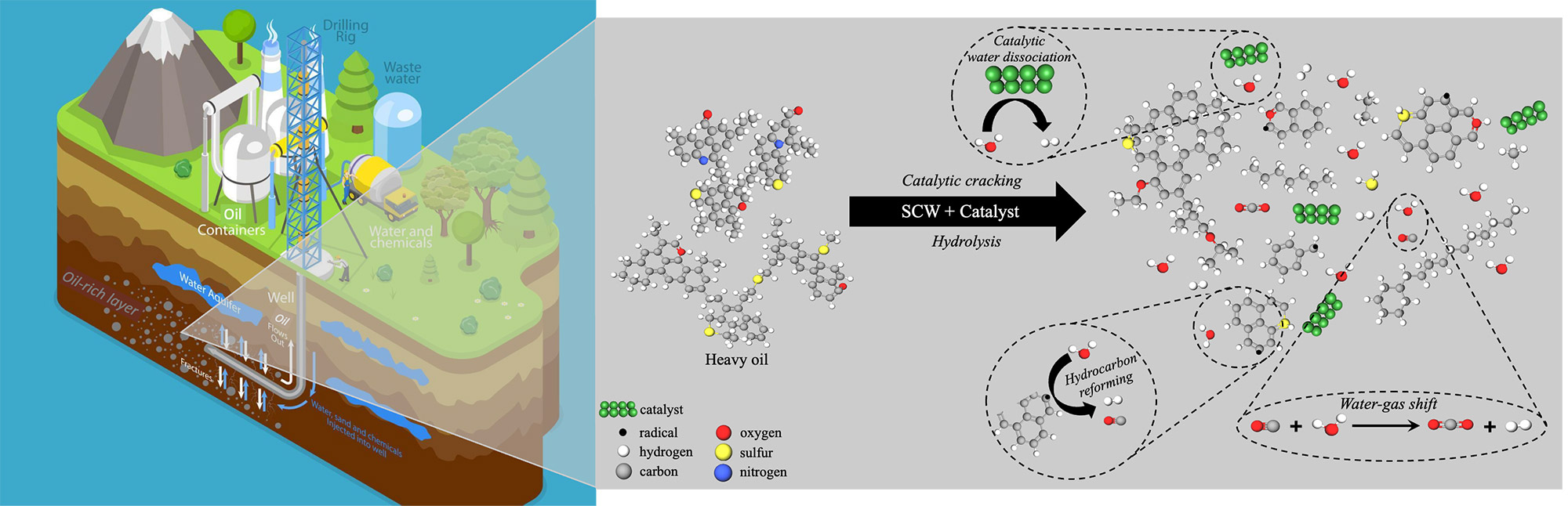
The depletion of conventional hydrocarbons has forced researchers to focus on unconventional petroleum, i.e., heavy crude oils. However, the typical methods to recover the former are not suitable for the latter. Therefore, new technologies, such as supercritical water (SCW) upgrading, commercial and novel catalytic compounds have been proposed individually and in combination to solve the difficulties in recovering these reserves. In this work, the advantages and disadvantages, mechanisms, reactions, and challenges when using SCW and catalysts for heavy oil upgrading are discussed, giving a perspective for new synergetic approaches.
Graphical Abstract
Keywords
supercritical water
catalyst
heavy oil
Data Availability Statement
Not applicable.
Funding
This work was supported by the Russian Science Foundation under Grant 21-73-30023 (extension) dated 22.05.2025, https://rscf.ru/project/21-73-30023/.
Conflicts of Interest
The author declares no conflicts of interest.
Ethical Approval and Consent to Participate
Not applicable.
References
- Ates, A., Azimi, G., Choi, K. H., Green, W. H., & Timko, M. T. (2014). The role of catalyst in supercritical water desulfurization. Applied Catalysis B: Environmental, 147, 144–155.
[CrossRef] [Google Scholar] - Chen, Z. (2024). New insight into subcritical and supercritical water reactivity during non-catalytic hydrothermal upgrading of heavy oil. Fuel, 366, 131380.
[CrossRef] [Google Scholar] - Djimasbe, R., Ilyasov, I. R., Kwofie, M., Khelkhal, M. A., Emelianov, D. A., Al-Muntaser, A. A., Suwaid, M. A., & Varfolomeev, M. A. (2022). Direct Hydrogen Production from Extra-Heavy Crude Oil under Supercritical Water Conditions Using a Catalytic (Ni-Co/Al2O3) Upgrading Process. Catalysts, 12(10), 1183.
[CrossRef] [Google Scholar] - Dong, X., Liu, H., Chen, Z., Wu, K., Lu, N., & Zhang, Q. (2019). Enhanced oil recovery techniques for heavy oil and oilsands reservoirs after steam injection. Applied Energy, 239, 1190–1211.
[CrossRef] [Google Scholar] - Fan, Z. X., Wang, T. F., & He, Y. H. (2009). Upgrading and viscosity reducing of heavy oils by [BMIM][AlCl4] ionic liquid. Journal of Fuel Chemistry and Technology, 37(6), 690–693.
[CrossRef] [Google Scholar] - Félix, G., Djimasbe, R., Tirado, A., Varfolomeev, M. A., & Ancheyta, J. (2025). Kinetic study for the Ashalcha heavy crude oil upgrading at supercritical water conditions. Fuel, 380, 133145.
[CrossRef] [Google Scholar] - Gomaa, S., Salem, K. G., & El-hoshoudy, A. N. (2024). Enhanced heavy and extra heavy oil recovery: Current status and new trends. Petroleum, 10(3), 399-410.
[CrossRef] [Google Scholar] - Hosseinpour, M., Fatemi, S., & Ahmadi, S. J. (2016). Deuterium tracing study of unsaturated aliphatics hydrogenation by supercritical water in upgrading heavy oil. Part II: Hydrogen donating capacity of water in the presence of iron(III) oxide nanocatalyst. The Journal of Supercritical Fluids, 110, 75–82.
[CrossRef] [Google Scholar] - Kornienko, V., & Avtonomov, P. (2015). Application of Neutron Activation Analysis for Heavy Oil Production Control. Procedia - Social and Behavioral Sciences, 195, 2451–2456.
[CrossRef] [Google Scholar] - Kosari, M., Golmohammadi, M., Ahmadi, S. J., Towfighi, J., & Chenari, A. H. (2017). On the catalysis capability of transition metal oxide nanoparticles in upgrading of heavy petroleum residue by supercritical water. The Journal of Supercritical Fluids, 126, 14–24.
[CrossRef] [Google Scholar] - Li, N., Yan, B., & Xiao, X. M. (2015). A review of laboratory-scale research on upgrading heavy oil in supercritical water. Energies, 8(8), 8962–8989.
[CrossRef] [Google Scholar] - Liu, R., Zhang, L., Han, X., Wang, Y., Li, J., Huang, C., ... & Lin, R. (2024). Viscosity reduction of heavy oil based on rice husk char-based nanocatalysts of NiO/Fe2O3. Journal of Analytical and Applied Pyrolysis, 183, 106788.
[CrossRef] [Google Scholar] - Muraza, O., & Galadima, A. (2015). Aquathermolysis of heavy oil: A review and perspective on catalyst development. Fuel, 157, 219–231.
[CrossRef] [Google Scholar] - Zheng, L., Zhao, Q., Dong, Y., Wang, X., Jin, H., & Guo, L. (2024). Supercritical water upgrading of heavy oil: Effects of reservoir minerals on pyrolysis product distribution. Journal of Analytical and Applied Pyrolysis, 181, 106616.
[CrossRef] [Google Scholar]
Cite This Article
APA Style
Felix, G. (2025). Integrating Supercritical Water and Catalysts: A Synergistic Approach for Heavy Oil Upgrading. Journal of Chemical Engineering and Renewable Fuels, 1(2), 9–12. https://doi.org/10.62762/JCERF.2025.734454
Export Citation
RIS Format
Compatible with EndNote, Zotero, Mendeley, and other reference managers
TY  - JOUR
AU  - Felix, Guillermo
PY  - 2025
DA  - 2025/12/07
TI  - Integrating Supercritical Water and Catalysts: A Synergistic Approach for Heavy Oil Upgrading
JO  - Journal of Chemical Engineering and Renewable Fuels
T2  - Journal of Chemical Engineering and Renewable Fuels
JF  - Journal of Chemical Engineering and Renewable Fuels
VL  - 2
IS  - 1
SP  - 9
EP  - 12
DO  - 10.62762/JCERF.2025.734454
UR  - https://www.icck.org/article/abs/JCERF.2025.734454
KW  - supercritical water
KW  - catalyst
KW  - heavy oil
AB  - The depletion of conventional hydrocarbons has forced researchers to focus on unconventional petroleum, i.e., heavy crude oils. However, the typical methods to recover the former are not suitable for the latter. Therefore, new technologies, such as supercritical water (SCW) upgrading, commercial and novel catalytic compounds have been proposed individually and in combination to solve the difficulties in recovering these reserves. In this work, the advantages and disadvantages, mechanisms, reactions, and challenges when using SCW and catalysts for heavy oil upgrading are discussed, giving a perspective for new synergetic approaches.
SN  - 3070-1058
PB  - Institute of Central Computation and Knowledge
LA  - English
ER  -
BibTeX Format
Compatible with LaTeX, BibTeX, and other reference managers
@article{Felix2025Integratin,
  author = {Guillermo Felix},
  title = {Integrating Supercritical Water and Catalysts: A Synergistic Approach for Heavy Oil Upgrading},
  journal = {Journal of Chemical Engineering and Renewable Fuels},
  year = {2025},
  volume = {2},
  number = {1},
  pages = {9-12},
  doi = {10.62762/JCERF.2025.734454},
  url = {https://www.icck.org/article/abs/JCERF.2025.734454},
  abstract = {The depletion of conventional hydrocarbons has forced researchers to focus on unconventional petroleum, i.e., heavy crude oils. However, the typical methods to recover the former are not suitable for the latter. Therefore, new technologies, such as supercritical water (SCW) upgrading, commercial and novel catalytic compounds have been proposed individually and in combination to solve the difficulties in recovering these reserves. In this work, the advantages and disadvantages, mechanisms, reactions, and challenges when using SCW and catalysts for heavy oil upgrading are discussed, giving a perspective for new synergetic approaches.},
  keywords = {supercritical water, catalyst, heavy oil},
  issn = {3070-1058},
  publisher = {Institute of Central Computation and Knowledge}
}
Article Metrics
Publisher's Note
ICCK stays neutral with regard to jurisdictional claims in published maps and institutional affiliations.
Rights and Permissions
 Copyright © 2025 by the Author(s). Published by Institute of Central Computation and Knowledge. This article is an open access article distributed under the terms and conditions of the Creative Commons Attribution (CC BY) license (https://creativecommons.org/licenses/by/4.0/), which permits use, sharing, adaptation, distribution and reproduction in any medium or format, as long as you give appropriate credit to the original author(s) and the source, provide a link to the Creative Commons licence, and indicate if changes were made.


Preserved at
Portico
Portico

Scan to read this article