

Hydrogen Storage in ZSM-5: Advances and Challenges



Article Information
Abstract
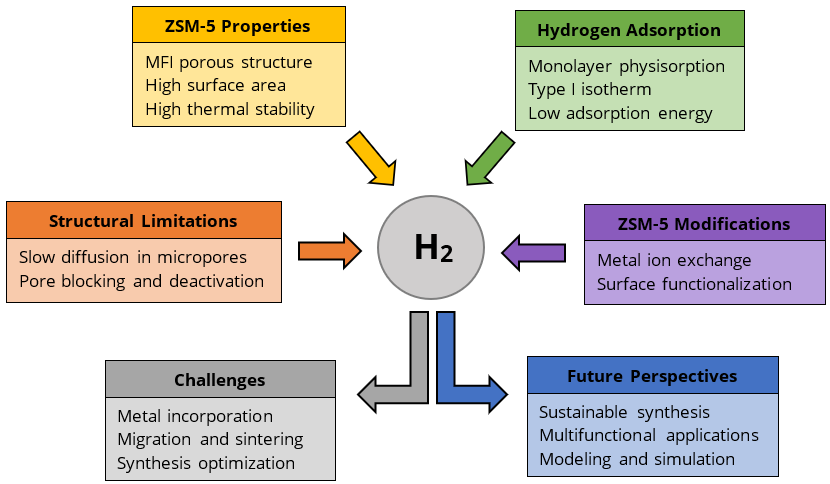
ZSM-5 zeolite possesses a three-dimensional network of microporous channels formed by oxygen-linked Si and Al tetrahedra, which confers a high surface area, stability, and hydrophobic properties that increase with the Si/Al ratio. These characteristics make ZSM-5 a suitable material for the adsorption of gases such as hydrogen. In pure ZSM-5, hydrogen storage occurs primarily through physisorption in the micropores, exhibiting type I isotherms and an adsorption capacity that increases with pressure, especially at low temperatures. The relatively low adsorption energy indicates weak interactions that keep the hydrogen in a molecular state and allow for its reversible release. However, the storage capacity can be significantly modified by the incorporation of metals, which generate new active sites capable of activating or even dissociating hydrogen, partially altering the adsorption mechanism. Despite these advantages, the microporous nature of ZSM-5 can limit diffusion and mass transfer efficiency. Therefore, strategies such as the creation of hierarchical structures with mesopores, variation of composition and synthesis of the material represent key parameters of research to improve its performance in hydrogen storage applications.
Graphical Abstract
Keywords
Data Availability Statement
Funding
Conflicts of Interest
AI Use Statement
Ethical Approval and Consent to Participate
References
- Belarbi, H., Lounis, Z., Hamacha, R., Bengueddach, A., & Trens, P. (2014). Textural properties of ZSM-5 nanocrystals prepared in alkaline potassium fluoride medium. Colloids and Surfaces A: Physicochemical and Engineering Aspects, 453, 86-93.
[CrossRef] [Google Scholar] - Dalconi, M. C., Cruciani, G., Alberti, A., & Ciambelli, P. (2006). Over-loaded Cu-ZSM-5 upon heating treatment: A time resolved X-ray diffraction study. Microporous and Mesoporous Materials, 94(1–3), 139–147.
[CrossRef] [Google Scholar] - Wei, Y., De Jongh, P. E., Bonati, M. L. M., Law, D. J., Sunley, G. J., & De Jong, K. P. (2015). Enhanced catalytic performance of zeolite ZSM-5 for conversion of methanol to dimethyl ether by combining alkaline treatment and partial activation. Applied Catalysis A: General, 504, 211–219.
[CrossRef] [Google Scholar] - Shu, Q., Sun, Z., Zhu, G., Wang, C., Li, H., Qi, F., ... & Li, S. (2022). Highly efficient synthesis of ZSM-5 zeolite by one-step microwave using desilication solution of coal gasification coarse slag and its application to VOCs adsorption. Process Safety and Environmental Protection, 167, 173-183.
[CrossRef] [Google Scholar] - Pérez-Page, M., Makel, J., Guan, K., Zhang, S., Tringe, J., Castro, R. H. R., & Stroeve, P. (2016). Gas adsorption properties of ZSM-5 zeolites heated to extreme temperatures. Ceramics International, 42(14), 15423–15431.
[CrossRef] [Google Scholar] - Kazansky, V. B., Serykh, A. I., Anderson, B. G., & Van Santen, R. A. (2003). The sites of molecular and dissociative hydrogen adsorption in high-silica zeolites modified with zinc ions. III DRIFT study of H2 adsorption by the zeolites with different zinc content and Si/Al ratios in the framework. Catalysis letters, 88(3), 211-217.
[CrossRef] [Google Scholar] - Wang, H., & Lin, Y. S. (2012). Synthesis and modification of ZSM-5/silicalite bilayer membrane with improved hydrogen separation performance. Journal of membrane science, 396, 128-137.
[CrossRef] [Google Scholar] - Fatriansyah, J. F., Dhaneswara, D., Suhariadi, I., Widyantoro, M. I., Ramadhan, B. A., Rahmatullah, M. Z., & Hadi, R. (2021). Simple molecular dynamics simulation of hydrogen adsorption on ZSM 5, graphite nanofiber, graphene oxide framework, and reduced graphene oxide. Heliyon, 7(12), e08528.
[CrossRef] [Google Scholar] - Prasanth, K. P., Raj, M. C., Bajaj, H. C., Kim, T. H., & Jasra, R. V. (2010). Hydrogen sorption in transition metal modified mesoporous materials. International Journal of Hydrogen Energy, 35(6), 2351-2360.
[CrossRef] [Google Scholar] - Zhu, W., Luo, Z., Miao, F., & Liu, L. (2025). Synergistic effect of Pd and Mo catalysts on the biomass hydropyrolysis vapor upgrading for aromatic hydrocarbons. Journal of Analytical and Applied Pyrolysis, 190, 107162.
[CrossRef] [Google Scholar] - Wu, S., Wang, Y., Sun, C., Zhao, T., Zhao, J., Wang, Z., ... & Zhi, Y. (2021). Novel preparation of binder-free Y/ZSM-5 zeolite composites for VOCs adsorption. Chemical Engineering Journal, 417, 129172.
[CrossRef] [Google Scholar] - Yang, G., Zhou, L., Liu, X., Han, X., & Bao, X. (2006). H2 adsorption on Fe/ZSM-5 zeolite: A theoretical approach. The Journal of Physical Chemistry B, 110(45), 22295-22297.
[CrossRef] [Google Scholar] - Yan, X. H., Li, P., Yuan, H., Huang, W., Hu, Z., & Yang, R. T. (2025). CO2 capture by ZSM-5 with varied Si/Al molar ratios: Isothermal adsorption capacity of CO2 vs dynamic CO2 adsorption capacity. Separation and Purification Technology, 354, 129304.
[CrossRef] [Google Scholar] - Yue, X., Wang, S., & Wang, S. (2025). Two-step dealumination-silanization enhances toluene adsorption-desorption of high-silica ZSM-5 under high humidity. Journal of Environmental Chemical Engineering, 13(6), 119439.
[CrossRef] [Google Scholar] - Triwahyono, S., Jalil, A. A., Mukti, R. R., Musthofa, M., Razali, N. A. M., & Aziz, M. A. A. (2011). Hydrogen spillover behavior of Zn/HZSM-5 showing catalytically active protonic acid sites in the isomerization of n-pentane. Applied Catalysis A: General, 407(1-2), 91-99.
[CrossRef] [Google Scholar] - Qi, Y., Li, X., Zhang, X., Meng, K., Wang, K., Wu, J., ... & Wang, Z. (2026). Enhanced electronic metal-support interaction and enhanced mass transfer via supercritical CO2-synergized catalysis for efficient hydrogenation of polycyclic aromatic hydrocarbons. Fuel, 406, 137099.
[CrossRef] [Google Scholar] - Fujiwara, M., Fujio, Y., Sakurai, H., Senoh, H., & Kiyobayashi, T. (2014). Storage of molecular hydrogen into ZSM-5 zeolite in the ambient atmosphere by the sealing of the micropore outlet. Chemical Engineering and Processing: Process Intensification, 79, 1–6.
[CrossRef] [Google Scholar] - Setiabudi, H. D., Jalil, A. A., Triwahyono, S., Kamarudin, N. H. N., & Mukti, R. R. (2012). IR study of iridium bonded to perturbed silanol groups of Pt-HZSM5 for n-pentane isomerization. Applied Catalysis A: General, 417, 190-199.
[CrossRef] [Google Scholar] - Hu, Y., Zhang, C., Zhou, X., Liu, J., Xiao, X., Cen, W., ... & Wang, Y. (2025). High-shear stirring assisted synthesis of Ni nanoparticles confined in H-ZSM-5 for hydrodeoxygenation of palmitic acid. Microporous and Mesoporous Materials, 398, 113813.
[CrossRef] [Google Scholar] - Georgiev, P. A., Drenchev, N., Hadjiivanov, K. I., Ollivier, J., Unruh, T., & Albinati, A. (2021). Dynamics of bound states of dihydrogen at Cu (I) and Cu (II) species coordinated near one and two zeolite framework aluminium atoms: A combined sorption, INS, IR and DFT study. international journal of hydrogen energy, 46(53), 26897-26914.
[CrossRef] [Google Scholar] - Hartanto, D., Kurniawati, R., Pambudi, A. B., Utomo, W. P., Leaw, W. L., & Nur, H. (2019). One-pot non-template synthesis of hierarchical ZSM-5 from kaolin source. Solid State Sciences, 87, 150-154.
[CrossRef] [Google Scholar] - Bi, W., Min, F., Fan, X., Zhang, T., Liu, Q., & Liang, P. (2025). Recent advances in zeolite-based adsorbents for enhanced CH4/N2/CO2 separation in coalbed methane. Chemical Engineering Research and Design, 222, 205–226.
[CrossRef] [Google Scholar] - Morankar, D., Barhate, K., & Hatvate, N. (2026). ZSM-5 zeolite: Structural features, catalytic properties, and multidisciplinary applications in organic synthesis, material science, and environmental remediation. Coordination Chemistry Reviews, 549, 217245.
[CrossRef] [Google Scholar] - Liu, S., Cheng, Z., Li, B., Zeng, H., Liang, W., Luo, Y., ... & Shu, X. (2024). Recent advances in biomass-assisted synthesis of hierarchical porous zeolite. Materials Today Sustainability, 27, 100917.
[CrossRef] [Google Scholar] - Wang, Y., Song, J., Baxter, N. C., Kuo, G. T., & Wang, S. (2017). Synthesis of hierarchical ZSM-5 zeolites by solid-state crystallization and their catalytic properties. Journal of Catalysis, 349, 53-65.
[CrossRef] [Google Scholar] - Abdulkadir, B. A., Zaki, R. M., Abd Wahab, A. T., Miskan, S. N., Nguyen, A. T., Vo, D. V. N., & Setiabudi, H. D. (2024). A concise review on surface and structural modification of porous zeolite scaffold for enhanced hydrogen storage. Chinese Journal of Chemical Engineering, 70, 33-53.
[CrossRef] [Google Scholar]
Cite This Article
TY  - JOUR
AU  - García, Osmín Avilés
AU  - Contreras-Pacheco, Yéssica Vanessa
AU  - Espinoza, Gerardo Vallejo
AU  - Pérez-Larios, Alejandro
PY  - 2026
DA  - 2026/04/08
TI  - Hydrogen Storage in ZSM-5: Advances and Challenges
JO  - Journal of Chemical Engineering and Renewable Fuels
T2  - Journal of Chemical Engineering and Renewable Fuels
JF  - Journal of Chemical Engineering and Renewable Fuels
VL  - 2
IS  - 2
SP  - 34
EP  - 38
DO  - 10.62762/JCERF.2026.576089
UR  - https://www.icck.org/article/abs/JCERF.2026.576089
KW  - hydrogen storage
KW  - ZSM-5 zeolite
KW  - porous materials
KW  - modified zeolite
AB  - ZSM-5 zeolite possesses a three-dimensional network of microporous channels formed by oxygen-linked Si and Al tetrahedra, which confers a high surface area, stability, and hydrophobic properties that increase with the Si/Al ratio. These characteristics make ZSM-5 a suitable material for the adsorption of gases such as hydrogen. In pure ZSM-5, hydrogen storage occurs primarily through physisorption in the micropores, exhibiting type I isotherms and an adsorption capacity that increases with pressure, especially at low temperatures. The relatively low adsorption energy indicates weak interactions that keep the hydrogen in a molecular state and allow for its reversible release. However, the storage capacity can be significantly modified by the incorporation of metals, which generate new active sites capable of activating or even dissociating hydrogen, partially altering the adsorption mechanism. Despite these advantages, the microporous nature of ZSM-5 can limit diffusion and mass transfer efficiency. Therefore, strategies such as the creation of hierarchical structures with mesopores, variation of composition and synthesis of the material represent key parameters of research to improve its performance in hydrogen storage applications.
SN  - 3070-1058
PB  - Institute of Central Computation and Knowledge
LA  - English
ER  -
@article{Garca2026Hydrogen,
  author = {Osmín Avilés García and Yéssica Vanessa Contreras-Pacheco and Gerardo Vallejo Espinoza and Alejandro Pérez-Larios},
  title = {Hydrogen Storage in ZSM-5: Advances and Challenges},
  journal = {Journal of Chemical Engineering and Renewable Fuels},
  year = {2026},
  volume = {2},
  number = {2},
  pages = {34-38},
  doi = {10.62762/JCERF.2026.576089},
  url = {https://www.icck.org/article/abs/JCERF.2026.576089},
  abstract = {ZSM-5 zeolite possesses a three-dimensional network of microporous channels formed by oxygen-linked Si and Al tetrahedra, which confers a high surface area, stability, and hydrophobic properties that increase with the Si/Al ratio. These characteristics make ZSM-5 a suitable material for the adsorption of gases such as hydrogen. In pure ZSM-5, hydrogen storage occurs primarily through physisorption in the micropores, exhibiting type I isotherms and an adsorption capacity that increases with pressure, especially at low temperatures. The relatively low adsorption energy indicates weak interactions that keep the hydrogen in a molecular state and allow for its reversible release. However, the storage capacity can be significantly modified by the incorporation of metals, which generate new active sites capable of activating or even dissociating hydrogen, partially altering the adsorption mechanism. Despite these advantages, the microporous nature of ZSM-5 can limit diffusion and mass transfer efficiency. Therefore, strategies such as the creation of hierarchical structures with mesopores, variation of composition and synthesis of the material represent key parameters of research to improve its performance in hydrogen storage applications.},
  keywords = {hydrogen storage, ZSM-5 zeolite, porous materials, modified zeolite},
  issn = {3070-1058},
  publisher = {Institute of Central Computation and Knowledge}
}
Article Metrics
Publisher's Note
ICCK stays neutral with regard to jurisdictional claims in published maps and institutional affiliations.
Rights and Permissions
 Copyright © 2026 by the Author(s). Published by Institute of Central Computation and Knowledge. This article is an open access article distributed under the terms and conditions of the Creative Commons Attribution (CC BY) license (https://creativecommons.org/licenses/by/4.0/), which permits use, sharing, adaptation, distribution and reproduction in any medium or format, as long as you give appropriate credit to the original author(s) and the source, provide a link to the Creative Commons licence, and indicate if changes were made.


Portico
