

A Hybrid Framework Combining CNN, LSTM, and Transfer Learning for Emotion Recognition




Article Information
Abstract
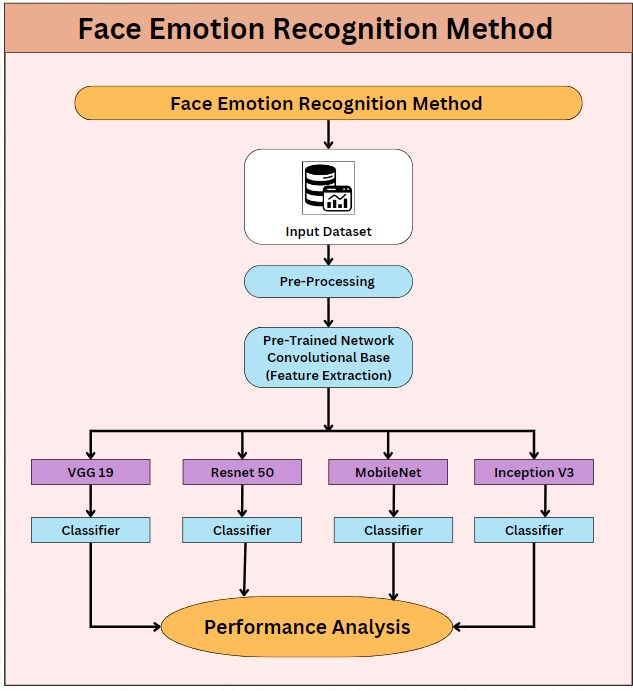
Deep learning has substantially enhanced facial emotion recognition, an essential element of human--computer interaction. This study evaluates the performance of multiple architectures, including a custom CNN, VGG-16, ResNet-50, and a hybrid CNN-LSTM framework, across FER2013 and CK+ datasets. Preprocessing steps involved grayscale conversion, image resizing, and pixel normalization. Experimental results show that ResNet-50 achieved the highest accuracy on FER2013 (76.85%), while the hybrid CNN-LSTM model attained superior performance on CK+ (92.30%). Performance metrics such as precision, recall, and F1-score were used for evaluation. Findings highlight the trade-off between computational efficiency and recognition accuracy, offering insights for developing robust, real-time emotion recognition systems.
Graphical Abstract
Keywords
Data Availability Statement
Funding
Conflicts of Interest
Ethical Approval and Consent to Participate
References
- Naga, P., Marri, S. D., & Borreo, R. (2023). Facial emotion recognition methods, datasets and technologies: A literature survey. Materials Today: Proceedings, 80, 2824-2828.
[CrossRef] [Google Scholar] - Chowdary, M. K., Nguyen, T. N., & Hemanth, D. J. (2023). Deep learning-based facial emotion recognition for human–computer interaction applications. Neural Computing and Applications, 35(32), 23311-23328.
[CrossRef] [Google Scholar] - Ming, Y., Qian, H., & Guangyuan, L. (2022). CNN‐LSTM Facial Expression Recognition Method Fused with Two‐Layer Attention Mechanism. Computational Intelligence and Neuroscience, 2022(1), 7450637.
[CrossRef] [Google Scholar] - Sarvakar, K., Senkamalavalli, R., Raghavendra, S., Kumar, J. S., Manjunath, R., & Jaiswal, S. (2023). Facial emotion recognition using convolutional neural networks. Materials Today: Proceedings, 80, 3560-3564.
[CrossRef] [Google Scholar] - Dias, W., Andalo, F., Padilha, R., Bertocco, G., Almeida, W., Costa, P., & Rocha, A. (2022). Cross-dataset emotion recognition from facial expressions through convolutional neural networks. Journal of Visual Communication and Image Representation, 82, 103395.
[CrossRef] [Google Scholar] - Hernandez-Luquin, F., & Escalante, H. J. (2023). Multi-branch deep radial basis function networks for facial emotion recognition. Neural Computing and Applications, 35(25), 18131-18145.
[CrossRef] [Google Scholar] - Kopalidis, T., Solachidis, V., Vretos, N., & Daras, P. (2024). Advances in facial expression recognition: a survey of methods, benchmarks, models, and datasets. Information, 15(3), 135.
[CrossRef] [Google Scholar] - Nan, Y., Ju, J., Hua, Q., Zhang, H., & Wang, B. (2022). A-MobileNet: An approach of facial expression recognition. Alexandria Engineering Journal, 61(6), 4435-4444.
[CrossRef] [Google Scholar] - Shahzad, H. M., Bhatti, S. M., Jaffar, A., Akram, S., Alhajlah, M., & Mahmood, A. (2023). Hybrid facial emotion recognition using CNN-based features. Applied Sciences, 13(9), 5572.
[CrossRef] [Google Scholar] - Ahmad, M., Alfandi, O., Khattak, A. M., Qadri, S. F., Saeed, I. A., Khan, S., ... & Ahmad, A. (2023). Facial expression recognition using lightweight deep learning modeling. Mathematical Biosciences and Engineering, 20(5), 8208.
[CrossRef] [Google Scholar] - Borgalli, R. A., & Surve, S. (2022, March). Deep learning framework for facial emotion recognition using CNN architectures. In 2022 International Conference on Electronics and Renewable Systems (ICEARS) (pp. 1777-1784). IEEE.
[CrossRef] [Google Scholar] - Khattak, A., Asghar, M. Z., Ali, M., & Batool, U. (2022). An efficient deep learning technique for facial emotion recognition. Multimedia Tools and Applications, 81(2), 1649-1683.
[CrossRef] [Google Scholar] - Singh, R., Saurav, S., Kumar, T., Saini, R., Vohra, A., & Singh, S. (2023). Facial expression recognition in videos using hybrid CNN & ConvLSTM. International Journal of Information Technology, 15(4), 1819-1830.
[CrossRef] [Google Scholar] - Magherini, R., Mussi, E., Servi, M., & Volpe, Y. (2022). Emotion recognition in the times of COVID19: Coping with face masks. Intelligent Systems with Applications, 15, 200094.
[CrossRef] [Google Scholar] - Dar, T., Javed, A., Bourouis, S., Hussein, H. S., & Alshazly, H. (2022). Efficient-SwishNet based system for facial emotion recognition. IEEE Access, 10, 71311-71328.
[CrossRef] [Google Scholar] - Slimani, K., Ruichek, Y., & Messoussi, R. (2022). Compound facial emotional expression recognition using cnn deep features. Engineering Letters, 30(4), 1402-1416. https://www.engineeringletters.com/issues_v30/issue_4/EL_30_4_25.pdf
[Google Scholar] - Pise, A., Vadapalli, H., & Sanders, I. (2022). Facial emotion recognition using temporal relational network: an application to E-learning. Multimedia Tools and Applications, 81(19), 26633-26653.
[CrossRef] [Google Scholar] - Abate, A. F., Cimmino, L., Mocanu, B. C., Narducci, F., & Pop, F. (2023). The limitations for expression recognition in computer vision introduced by facial masks. Multimedia Tools and Applications, 82(8), 11305-11319.
[CrossRef] [Google Scholar] - Khan, A. R. (2022). Facial emotion recognition using conventional machine learning and deep learning methods: current achievements, analysis and remaining challenges. Information, 13(6), 268.
[CrossRef] [Google Scholar] - Minaee, S., Minaei, M., & Abdolrashidi, A. (2021). Deep-emotion: Facial expression recognition using attentional convolutional network. Sensors, 21(9), 3046.
[CrossRef] [Google Scholar] - Dwijayanti, S., Iqbal, M., & Suprapto, B. Y. (2022). Real-time implementation of face recognition and emotion recognition in a humanoid robot using a convolutional neural network. IEEE Access, 10, 89876-89886.
[CrossRef] [Google Scholar] - Gupta, S., Kumar, P., & Tekchandani, R. K. (2023). Facial emotion recognition based real-time learner engagement detection system in online learning context using deep learning models. Multimedia Tools and Applications, 82(8), 11365-11394.
[CrossRef] [Google Scholar] - Canal, F. Z., Müller, T. R., Matias, J. C., Scotton, G. G., de Sa Junior, A. R., Pozzebon, E., & Sobieranski, A. C. (2022). A survey on facial emotion recognition techniques: A state-of-the-art literature review. Information Sciences, 582, 593-617.
[CrossRef] [Google Scholar] - ELsayed, Y., ELSayed, A., & Abdou, M. A. (2023). An automatic improved facial expression recognition for masked faces. Neural Computing and Applications, 35(20), 14963-14972.
[CrossRef] [Google Scholar] - Alsharekh, M. F. (2022). Facial emotion recognition in verbal communication based on deep learning. Sensors, 22(16), 6105.
[CrossRef] [Google Scholar] - Farkhod, A., Abdusalomov, A. B., Mukhiddinov, M., & Cho, Y. I. (2022). Development of real-time landmark-based emotion recognition CNN for masked faces. Sensors, 22(22), 8704.
[CrossRef] [Google Scholar] - Dewi, C., Gunawan, L. S., Hastoko, S. G., & Christanto, H. J. (2024). Real-time facial expression recognition: advances, challenges, and future directions. Vietnam Journal of Computer Science, 11(02), 167-193.
[CrossRef] [Google Scholar] - Mukhiddinov, M., Djuraev, O., Akhmedov, F., Mukhamadiyev, A., & Cho, J. (2023). Masked face emotion recognition based on facial landmarks and deep learning approaches for visually impaired people. Sensors, 23(3), 1080.
[CrossRef] [Google Scholar] - Sajjad, M., Ullah, F. U. M., Ullah, M., Christodoulou, G., Cheikh, F. A., Hijji, M., ... & Rodrigues, J. J. (2023). A comprehensive survey on deep facial expression recognition: challenges, applications, and future guidelines. Alexandria Engineering Journal, 68, 817-840.
[CrossRef] [Google Scholar] - Mohana, M., Subashini, P., & Krishnaveni, M. (2023). Emotion recognition from facial expression using hybrid CNN–LSTM network. International Journal of Pattern Recognition and Artificial Intelligence, 37(08), 2356008.
[CrossRef] [Google Scholar] - Pereira, R., Mendes, C., Ribeiro, J., Ribeiro, R., Miragaia, R., Rodrigues, N., ... & Pereira, A. (2024). Systematic review of emotion detection with computer vision and deep learning. Sensors, 24(11), 3484.
[CrossRef] [Google Scholar] - Varma, S., Shinde, M., & Chavan, S. S. (2019, November). Analysis of PCA and LDA features for facial expression recognition using SVM and HMM classifiers. In Techno-Societal 2018: Proceedings of the 2nd International Conference on Advanced Technologies for Societal Applications-Volume 1 (pp. 109-119). Cham: Springer International Publishing.
[CrossRef] [Google Scholar] - Reddy, C. V. R., Reddy, U. S., & Kishore, K. V. K. (2019). Facial emotion recognition using NLPCA and SVM. Traitement du Signal, 36(1), 13-22.
[CrossRef] [Google Scholar] - Sajjad, M., Nasir, M., Ullah, F. U. M., Muhammad, K., Sangaiah, A. K., & Baik, S. W. (2019). Raspberry Pi assisted facial expression recognition framework for smart security in law-enforcement services. Information Sciences, 479, 416-431.
[CrossRef] [Google Scholar] - Nazir, M., Jan, Z., & Sajjad, M. (2017). Facial expression recognition using weber discrete wavelet transform. Journal of Intelligent & Fuzzy Systems, 33(1), 479-489.
[CrossRef] [Google Scholar] - Zeng, N., Zhang, H., Song, B., Liu, W., Li, Y., & Dobaie, A. M. (2018). Facial expression recognition via learning deep sparse autoencoders. Neurocomputing, 273, 643-649.
[CrossRef] [Google Scholar] - Uddin, M. Z., Hassan, M. M., Almogren, A., Zuair, M., Fortino, G., & Torresen, J. (2017). A facial expression recognition system using robust face features from depth videos and deep learning. Computers & Electrical Engineering, 63, 114-125.
[CrossRef] [Google Scholar] - Al-agha, L. S. A., Saleh, P. H. H., & Ghani, P. R. F. (2017). Geometric-based feature extraction and classification for emotion expressions of 3D video film. Journal of Advances in Information Technology, 8(2).
[CrossRef] [Google Scholar] - Ghimire, D., Lee, J., Li, Z. N., & Jeong, S. (2017). Recognition of facial expressions based on salient geometric features and support vector machines. Multimedia Tools and Applications, 76(6), 7921-7946.
[CrossRef] [Google Scholar] - Li, S., & Deng, W. (2020). Deep facial expression recognition: A survey. IEEE transactions on affective computing, 13(3), 1195-1215.
[CrossRef] [Google Scholar] - Wu, P. P., Liu, H., Zhang, X. W., & Gao, Y. (2017). Spontaneous versus posed smile recognition via region-specific texture descriptor and geometric facial dynamics. Frontiers of Information Technology & Electronic Engineering, 18(7), 955-967.
[CrossRef] [Google Scholar] - Ekundayo, O. S., & Viriri, S. (2021). Facial expression recognition: A review of trends and techniques. IEEE Access, 9, 136944-136973.
[CrossRef] [Google Scholar] - Kim, D. J. (2016). Facial expression recognition using ASM-based post-processing technique. Pattern Recognition and Image Analysis, 26(3), 576-581.
[CrossRef] [Google Scholar] - Cornejo, J. Y. R., Pedrini, H., & Flórez-Revuelta, F. (2015, October). Facial expression recognition with occlusions based on geometric representation. In Iberoamerican Congress on Pattern Recognition (pp. 263-270). Cham: Springer International Publishing.
[CrossRef] [Google Scholar] - Siddiqi, M. H., Ali, R., Khan, A. M., Kim, E. S., Kim, G. J., & Lee, S. (2015). Facial expression recognition using active contour-based face detection, facial movement-based feature extraction, and non-linear feature selection. Multimedia Systems, 21(6), 541-555.
[CrossRef] [Google Scholar] - Chang, K. Y., Chen, C. S., & Hung, Y. P. (2013, October). Intensity rank estimation of facial expressions based on a single image. In 2013 IEEE International Conference on Systems, Man, and Cybernetics (pp. 3157-3162). IEEE.
[CrossRef] [Google Scholar] - Du, S., Tao, Y., & Martinez, A. M. (2014). Compound facial expressions of emotion. Proceedings of the national academy of sciences, 111(15), E1454-E1462.
[CrossRef] [Google Scholar] - Mavani, V., Raman, S., & Miyapuram, K. P. (2017, October). Facial Expression Recognition Using Visual Saliency and Deep Learning. In 2017 IEEE International Conference on Computer Vision Workshops (ICCVW) (pp. 2783-2788). IEEE.
[CrossRef] [Google Scholar] - Slimani, K., Lekdioui, K., Messoussi, R., & Touahni, R. (2019, March). Compound facial expression recognition based on highway CNN. In Proceedings of the new challenges in data sciences: acts of the second conference of the Moroccan Classification Society (pp. 1-7).
[CrossRef] [Google Scholar] - Li, S., Deng, W., & Du, J. (2017). Reliable crowdsourcing and deep locality-preserving learning for expression recognition in the wild. In Proceedings of the IEEE conference on computer vision and pattern recognition (pp. 2852-2861).
[CrossRef] [Google Scholar] - Fan, Y., Lam, J. C., & Li, V. O. (2018, September). Multi-region ensemble convolutional neural network for facial expression recognition. In International Conference on Artificial Neural Networks (pp. 84-94). Cham: Springer International Publishing.
[CrossRef] [Google Scholar] - Ghosh, S., Dhall, A., & Sebe, N. (2018, October). Automatic group affect analysis in images via visual attribute and feature networks. In 2018 25th IEEE International Conference on Image Processing (ICIP) (pp. 1967-1971). IEEE.
[CrossRef] [Google Scholar] - Shen, F., Liu, J., & Wu, P. (2018, October). Double complete d-lbp with extreme learning machine auto-encoder and cascade forest for facial expression analysis. In 2018 25th IEEE International Conference on Image Processing (ICIP) (pp. 1947-1951). IEEE.
[CrossRef] [Google Scholar] - Vielzeuf, V., Kervadec, C., Pateux, S., Lechervy, A., & Jurie, F. (2018, October). An occam's razor view on learning audiovisual emotion recognition with small training sets. In Proceedings of the 20th ACM International Conference on Multimodal Interaction (pp. 589-593).
[CrossRef] [Google Scholar] - Acharya, D., Huang, Z., Paudel, D. P., & Van Gool, L. (2018, June). Covariance Pooling for Facial Expression Recognition. In 2018 IEEE/CVF Conference on Computer Vision and Pattern Recognition Workshops (CVPRW) (pp. 480-4807). IEEE.
[CrossRef] [Google Scholar] - Li, Y., Zeng, J., Shan, S., & Chen, X. (2018, August). Patch-gated CNN for occlusion-aware facial expression recognition. In 2018 24th international conference on pattern recognition (ICPR) (pp. 2209-2214). IEEE.
[CrossRef] [Google Scholar] - Deng, J., Pang, G., Zhang, Z., Pang, Z., Yang, H., & Yang, G. (2019). cGAN based facial expression recognition for human-robot interaction. IEEE Access, 7, 9848-9859.
[CrossRef] [Google Scholar] - Wang, K., Peng, X., Yang, J., Meng, D., & Qiao, Y. (2020). Region attention networks for pose and occlusion robust facial expression recognition. IEEE Transactions on Image Processing, 29, 4057-4069.
[CrossRef] [Google Scholar] - Vo, T. H., Lee, G. S., Yang, H. J., & Kim, S. H. (2020). Pyramid with super resolution for in-the-wild facial expression recognition. IEEE Access, 8, 131988-132001.
[CrossRef] [Google Scholar] - Yu, J., Cai, Z., Li, R., Zhao, G., Xie, G., Zhu, J., ... & Zheng, W. (2023, June). Exploring Large-scale Unlabeled Faces to Enhance Facial Expression Recognition. In 2023 IEEE/CVF Conference on Computer Vision and Pattern Recognition Workshops (CVPRW) (pp. 5803-5810). IEEE.
[CrossRef] [Google Scholar] - Yu, S., Jia, W., Shu, X., Yuan, X., Gui, J., Tang, J., ... & Liu, Q. (Eds.). (2025). Biometric Recognition. In 18th Chinese Conference, CCBR 2024, Nanjing, China, November 22–24, 2024, Proceedings, Part II. Springer Nature.
[CrossRef] [Google Scholar]
Cited By (6)
-
Meenakshi Garg, Nor Asilah Wati Abdul Hamid, Dafik, Sunder R.. AI-driven feature descriptor design using CNNs and transfer learning for enhanced image retrieval accuracy and efficiency.
Scientific Reports, 2026 , 16 (1).
[CrossRef] -
Mengyun Wang, Manru Xun, Qinglin Yun. Fine-Grained Human Action Recognition Via Laban Movement Analysis and Attentive Bi-LSTM.
International Journal of Pattern Recognition and Artificial Intelligence, 2026 .
[CrossRef] -
Gaurav Dhiman, Kiran Deep Singh, Prabh Deep Singh, Norah Saleh Alghamdi, Ghadah Shukri Albakri. A novel approach to reliable and flexible distributed computing with virtualization in smart healthcare applications.
Scientific Reports, 2026 , 16 (1).
[CrossRef] -
Bin Sun. Lightweight GIS-based large-scale urban fire spread simulation method.
Journal of Industrial Information Integration, 2026 , 50 .
[CrossRef] -
İlknur Dönmez, Faruk Bulut. Multidimensional diversity in video recommender systems: a holistic framework of literature gaps and future directions.
Intelligent Systems with Applications, 2026 , 31 .
[CrossRef] -
Shubhani Aggarwal, Arzoo Miglani, Norah Saleh Alghamdi, Gaurav Dhiman. Resilient and decentralized demand-side management in smart grids using blockchain.
Scientific Reports, 2026 , 16 (1).
[CrossRef]
Cite This Article
TY  - JOUR
AU  - Sarvakar, Ketan
AU  - Rana, Kaushik
PY  - 2025
DA  - 2025/09/26
TI  - A Hybrid Framework Combining CNN, LSTM, and Transfer Learning for Emotion Recognition
JO  - ICCK Transactions on Machine Intelligence
T2  - ICCK Transactions on Machine Intelligence
JF  - ICCK Transactions on Machine Intelligence
VL  - 1
IS  - 2
SP  - 103
EP  - 116
DO  - 10.62762/TMI.2025.572412
UR  - https://www.icck.org/article/abs/TMI.2025.572412
KW  - face expressions
KW  - face emotion recognition
KW  - deep learning
KW  - CNN
KW  - VGG-16
KW  - ResNet-50
KW  - LSTM
KW  - transfer learning
AB  - Deep learning has substantially enhanced facial emotion recognition, an essential element of human--computer interaction. This study evaluates the performance of multiple architectures, including a custom CNN, VGG-16, ResNet-50, and a hybrid CNN-LSTM framework, across FER2013 and CK+ datasets. Preprocessing steps involved grayscale conversion, image resizing, and pixel normalization. Experimental results show that ResNet-50 achieved the highest accuracy on FER2013 (76.85%), while the hybrid CNN-LSTM model attained superior performance on CK+ (92.30%). Performance metrics such as precision, recall, and F1-score were used for evaluation. Findings highlight the trade-off between computational efficiency and recognition accuracy, offering insights for developing robust, real-time emotion recognition systems.
SN  - 3068-7403
PB  - Institute of Central Computation and Knowledge
LA  - English
ER  -
@article{Sarvakar2025A,
  author = {Ketan Sarvakar and Kaushik Rana},
  title = {A Hybrid Framework Combining CNN, LSTM, and Transfer Learning for Emotion Recognition},
  journal = {ICCK Transactions on Machine Intelligence},
  year = {2025},
  volume = {1},
  number = {2},
  pages = {103-116},
  doi = {10.62762/TMI.2025.572412},
  url = {https://www.icck.org/article/abs/TMI.2025.572412},
  abstract = {Deep learning has substantially enhanced facial emotion recognition, an essential element of human--computer interaction. This study evaluates the performance of multiple architectures, including a custom CNN, VGG-16, ResNet-50, and a hybrid CNN-LSTM framework, across FER2013 and CK+ datasets. Preprocessing steps involved grayscale conversion, image resizing, and pixel normalization. Experimental results show that ResNet-50 achieved the highest accuracy on FER2013 (76.85\%), while the hybrid CNN-LSTM model attained superior performance on CK+ (92.30\%). Performance metrics such as precision, recall, and F1-score were used for evaluation. Findings highlight the trade-off between computational efficiency and recognition accuracy, offering insights for developing robust, real-time emotion recognition systems.},
  keywords = {face expressions, face emotion recognition, deep learning, CNN, VGG-16, ResNet-50, LSTM, transfer learning},
  issn = {3068-7403},
  publisher = {Institute of Central Computation and Knowledge}
}
Publisher's Note
ICCK stays neutral with regard to jurisdictional claims in published maps and institutional affiliations.
Rights and Permissions


Portico
