

FedTLRec: Federated Recommendation with Transformer-based Parameter Aggregation and LoRA Compression



Article Information
Abstract
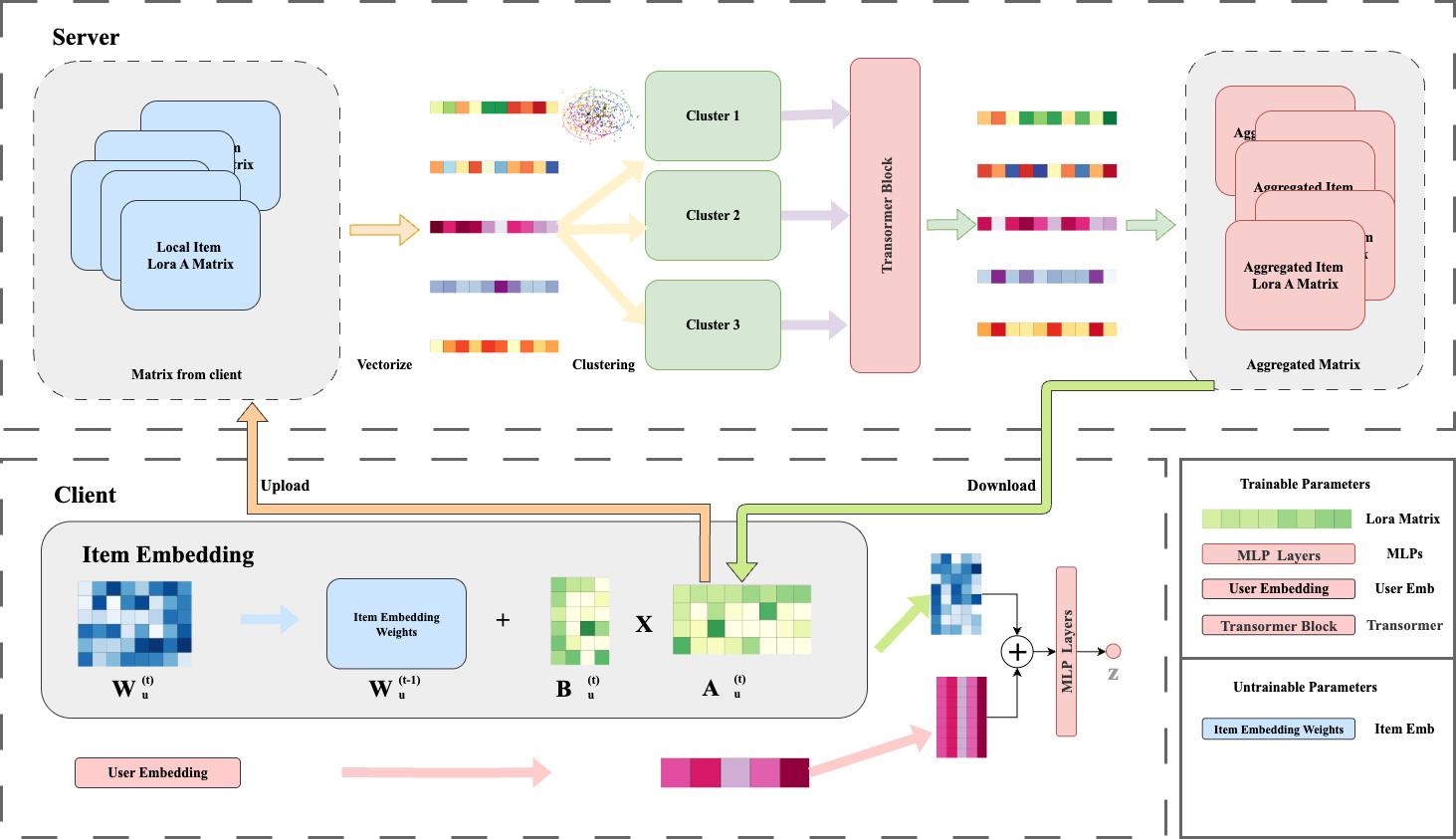
Federated learning has emerged as a key paradigm in privacy-preserving computing due to its "data usable but not visible" property, enabling users to collaboratively train models without sharing raw data. Motivated by this, federated recommendation systems offer a promising architecture that balances user privacy with recommendation accuracy through distributed collaborative learning. However, existing federated recommendation systems face significant challenges in balancing model performance, communication efficiency, and user privacy. In this paper, we propose FedTLRec (Federated Recommendation with Transformer-based Parameter Aggregation and Collaborative LoRA), which introduces a federated recommendation framework that integrates Low-Rank Adaptation (LoRA) for parameter compression and Transformer-based aggregation. It addresses key challenges in communication efficiency and model performance by compressing client updates via LoRA and employing a Transformer model with attention mechanisms to effectively aggregate parameters from multiple clients. A K-means clustering strategy further enhances efficiency by grouping similar clients. Experiments on real-world datasets show that FedTLRec achieves superior recommendation accuracy with significantly reduced communication costs, while maintaining robust performance in client dropout scenarios. Code is available at: https://github.com/trueWangSyutung/FedTLRec.
Graphical Abstract
Keywords
Data Availability Statement
Funding
Conflicts of Interest
AI Use Statement
Ethical Approval and Consent to Participate
References
- Sun, Z., Xu, Y., Liu, Y., He, W., Kong, L., Wu, F., ... & Cui, L. (2024). A survey on federated recommendation systems. IEEE Transactions on Neural Networks and Learning Systems, 36(1), 6-20.
[CrossRef] [Google Scholar] - Alamgir, Z., Khan, F. K., & Karim, S. (2022). Federated recommenders: Methods, challenges and future. Cluster Computing, 25(6), 4075-4096.
[CrossRef] [Google Scholar]
[Google Scholar]
[Google Scholar]- Chai, D., Wang, L., Chen, K., & Yang, Q. (2020). Secure federated matrix factorization. IEEE Intelligent Systems, 36(5), 11-20.
[CrossRef] [Google Scholar] - Perifanis, V., & Efraimidis, P. S. (2022). Federated neural collaborative filtering. Knowledge-Based Systems, 242, 108441.
[CrossRef] [Google Scholar] - Zhang, H., Luo, F., Wu, J., He, X., & Li, Y. (2023). LightFR: Lightweight federated recommendation with privacy-preserving matrix factorization. ACM Transactions on Information Systems, 41(4), 1-28.
[CrossRef] [Google Scholar] - Zhang, C., Long, G., Zhou, T., Yan, P., Zhang, Z., Zhang, C., & Yang, B. (2023). Dual personalization on federated recommendation. In Proceedings of the International Joint Conference on Artificial Intelligence (pp. 4558–4566).
[CrossRef] [Google Scholar] - Jiang, J., Zhang, C., Zhang, H., Li, Z., Li, Y., & Yang, B. (2025, May). A Tutorial of Personalized Federated Recommender Systems: Recent Advances and Future Directions. In Companion Proceedings of the ACM on Web Conference 2025 (pp. 21-24).
[CrossRef] [Google Scholar] - Ye, R., Ni, Z., Wu, F., Chen, S., & Wang, Y. (2023, July). Personalized federated learning with inferred collaboration graphs. In International conference on machine learning (pp. 39801-39817). PMLR.
[Google Scholar] - Zhang, C., Long, G., Zhou, T., Zhang, Z., Yan, P., & Yang, B. (2024). Gpfedrec: Graph-guided personalization for federated recommendation. In Proceedings of the ACM SIGKDD International Conference on Knowledge Discovery & Data Mining (pp. 4131–4142).
[CrossRef] [Google Scholar] - Li, Z., Long, G., & Zhou, T. (2024, May). Federated recommendation with additive personalization. In International Conference on Learning Representations (Vol. 2024, pp. 11770-11787).
[Google Scholar] - Wang, X. (2025). UFGraphFR: An attempt at a federated recommendation system based on user text characteristics. arXiv preprint arXiv:2501.08044. https://arxiv.org/html/2501.08044v1
[Google Scholar] - Hu, E. J., Shen, Y., Wallis, P., Allen-Zhu, Z., Li, Y., Wang, S., ... & Chen, W. (2021). Lora: Low-rank adaptation of large language models. arXiv preprint arXiv:2106.09685.
[CrossRef] [Google Scholar] - Zhang, Q., Chen, M., Bukharin, A., Karampatziakis, N., He, P., Cheng, Y., ... & Zhao, T. (2023). Adalora: Adaptive budget allocation for parameter-efficient fine-tuning. arXiv preprint arXiv:2303.10512.
[CrossRef] [Google Scholar] - Chen, J., Zhang, H., Li, H., Zhang, C., Li, Z., & Li, Y. (2025). Beyond Personalization: Federated Recommendation with Calibration via Low-rank Decomposition. arXiv preprint arXiv:2506.09525.
[CrossRef] [Google Scholar] - Vaswani, A., Shazeer, N., Parmar, N., Uszkoreit, J., Jones, L., Gomez, A. N., ... & Polosukhin, I. (2017). Attention is all you need. Advances in neural information processing systems, 30.
[Google Scholar] - Kang, W. C., & McAuley, J. (2018). Self-Attentive Sequential Recommendation. In 2018 IEEE International Conference on Data Mining (pp. 197–206).
[CrossRef] [Google Scholar] - Sun, F., Liu, J., Wu, J., Pei, C., Lin, X., Ou, W., & Jiang, P. (2019). BERT4Rec: Sequential Recommendation with Bidirectional Encoder Representations from Transformer. In Proceedings of the 28th ACM International Conference on Information and Knowledge Management (pp. 1441–1450).
[CrossRef] [Google Scholar] - Li, H., Cai, Z., Wang, J., Tang, J., Ding, W., Lin, C.-T., & Shi, Y. (2024). FedTP: Federated learning by transformer personalization. IEEE Transactions on Neural Networks and Learning Systems, 35, 13426--13440.
[CrossRef] [Google Scholar] - Ji, S., Pan, S., Long, G., Li, X., Jiang, J., & Huang, Z. (2019). Learning private neural language modeling with attentive aggregation. In Proceedings of the International Joint Conference on Neural Networks (pp. 5260--5267). IEEE.
[CrossRef] [Google Scholar] - Zhu, Y., Liu, J., Chowdhury, M., & Lai, F. (2024). Fedtrans: Efficient federated learning via multi-model transformation. Proceedings of Machine Learning and Systems, 6, 395-407.
[Google Scholar] - Ding, Y., Zhang, S., Fan, B., Sun, W., Liao, Y., & Zhou, P. Y. (2024). Fedloca: Low-rank coordinated adaptation with knowledge decoupling for federated recommendations. In Proceedings of the ACM Conference on Recommender Systems (pp. 690–700).
[CrossRef] [Google Scholar] - Harper, F. M., & Konstan, J. A. (2015). The movielens datasets: History and context. Acm transactions on interactive intelligent systems (tiis), 5(4), 1-19.
[CrossRef] [Google Scholar] - Cantador, I., Brusilovsky, P., & Kuflik, T. (2011). Second workshop on information heterogeneity and fusion in recommender systems (hetrec2011). In Proceedings of the ACM Conference on Recommender Systems (pp. 387–388).
[CrossRef] [Google Scholar] - Koren, Y., Bell, R., & Volinsky, C. (2009). Matrix factorization techniques for recommender systems. Computer, 42(8), 30–37.
[CrossRef] [Google Scholar] - He, X., Liao, L., Zhang, H., Nie, L., Hu, X., & Chua, T.-S. (2017). Neural collaborative filtering. In Proceedings of the International World Wide Web Conference (pp. 173–182).
[CrossRef] [Google Scholar] - He, X., Deng, K., Wang, X., Li, Y., Zhang, Y., & Wang, M. (2020). Lightgcn: Simplifying and powering graph convolution network for recommendation. In Proceedings of the ACM SIGIR International Conference on Research and Development in Information Retrieval (pp. 639–648).
[CrossRef] [Google Scholar]
Cited By (5)
-
Yingying Jiao. Research on an interactive film and entertainment style generation system based on multimodal input and AI models.
Entertainment Computing, 2026 , 57 .
[CrossRef] -
Meenakshi Garg, Nor Asilah Wati Abdul Hamid, Dafik, Sunder R.. AI-driven feature descriptor design using CNNs and transfer learning for enhanced image retrieval accuracy and efficiency.
Scientific Reports, 2026 , 16 (1).
[CrossRef] -
Gaurav Dhiman, Kiran Deep Singh, Prabh Deep Singh, Norah Saleh Alghamdi, Ghadah Shukri Albakri. A novel approach to reliable and flexible distributed computing with virtualization in smart healthcare applications.
Scientific Reports, 2026 , 16 (1).
[CrossRef] -
İlknur Dönmez, Faruk Bulut. Multidimensional diversity in video recommender systems: a holistic framework of literature gaps and future directions.
Intelligent Systems with Applications, 2026 , 31 .
[CrossRef] -
Shubhani Aggarwal, Arzoo Miglani, Norah Saleh Alghamdi, Gaurav Dhiman. Resilient and decentralized demand-side management in smart grids using blockchain.
Scientific Reports, 2026 , 16 (1).
[CrossRef]
Cite This Article
TY  - JOUR
AU  - Wang, Xudong
AU  - Zhao, Ruixin
PY  - 2026
DA  - 2026/02/08
TI  - FedTLRec: Federated Recommendation with Transformer-based Parameter Aggregation and LoRA Compression
JO  - ICCK Transactions on Machine Intelligence
T2  - ICCK Transactions on Machine Intelligence
JF  - ICCK Transactions on Machine Intelligence
VL  - 2
IS  - 2
SP  - 65
EP  - 76
DO  - 10.62762/TMI.2025.882476
UR  - https://www.icck.org/article/abs/TMI.2025.882476
KW  - federated recommendation
KW  - low-rank adaptation
KW  - transformer
AB  - Federated learning has emerged as a key paradigm in privacy-preserving computing due to its "data usable but not visible" property, enabling users to collaboratively train models without sharing raw data. Motivated by this, federated recommendation systems offer a promising architecture that balances user privacy with recommendation accuracy through distributed collaborative learning. However, existing federated recommendation systems face significant challenges in balancing model performance, communication efficiency, and user privacy. In this paper, we propose FedTLRec (Federated Recommendation with Transformer-based Parameter Aggregation and Collaborative LoRA), which introduces a federated recommendation framework that integrates Low-Rank Adaptation (LoRA) for parameter compression and Transformer-based aggregation. It addresses key challenges in communication efficiency and model performance by compressing client updates via LoRA and employing a Transformer model with attention mechanisms to effectively aggregate parameters from multiple clients. A K-means clustering strategy further enhances efficiency by grouping similar clients. Experiments on real-world datasets show that FedTLRec achieves superior recommendation accuracy with significantly reduced communication costs, while maintaining robust performance in client dropout scenarios. Code is available at: https://github.com/trueWangSyutung/FedTLRec.
SN  - 3068-7403
PB  - Institute of Central Computation and Knowledge
LA  - English
ER  -
@article{Wang2026FedTLRec,
  author = {Xudong Wang and Ruixin Zhao},
  title = {FedTLRec: Federated Recommendation with Transformer-based Parameter Aggregation and LoRA Compression},
  journal = {ICCK Transactions on Machine Intelligence},
  year = {2026},
  volume = {2},
  number = {2},
  pages = {65-76},
  doi = {10.62762/TMI.2025.882476},
  url = {https://www.icck.org/article/abs/TMI.2025.882476},
  abstract = {Federated learning has emerged as a key paradigm in privacy-preserving computing due to its "data usable but not visible" property, enabling users to collaboratively train models without sharing raw data. Motivated by this, federated recommendation systems offer a promising architecture that balances user privacy with recommendation accuracy through distributed collaborative learning. However, existing federated recommendation systems face significant challenges in balancing model performance, communication efficiency, and user privacy. In this paper, we propose FedTLRec (Federated Recommendation with Transformer-based Parameter Aggregation and Collaborative LoRA), which introduces a federated recommendation framework that integrates Low-Rank Adaptation (LoRA) for parameter compression and Transformer-based aggregation. It addresses key challenges in communication efficiency and model performance by compressing client updates via LoRA and employing a Transformer model with attention mechanisms to effectively aggregate parameters from multiple clients. A K-means clustering strategy further enhances efficiency by grouping similar clients. Experiments on real-world datasets show that FedTLRec achieves superior recommendation accuracy with significantly reduced communication costs, while maintaining robust performance in client dropout scenarios. Code is available at: https://github.com/trueWangSyutung/FedTLRec.},
  keywords = {federated recommendation, low-rank adaptation, transformer},
  issn = {3068-7403},
  publisher = {Institute of Central Computation and Knowledge}
}
Publisher's Note
ICCK stays neutral with regard to jurisdictional claims in published maps and institutional affiliations.
Rights and Permissions


Portico
