

A Hybrid Machine Learning Fuzzy Non-linear Regression Approach for Neutrosophic Fuzzy Set




Article Information
Abstract
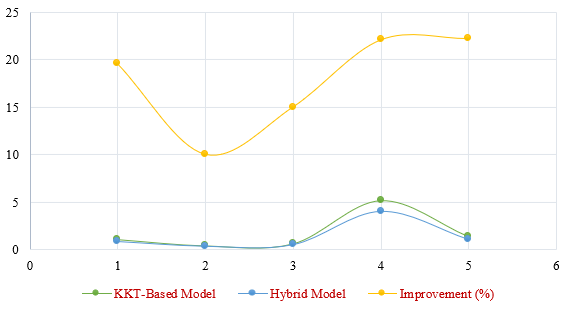
Neutrosophic sets play a significant role for handling indeterminacy. In this paper, we introduce a novel hybrid fuzzy non-linear regression model that combines a neural-network-based initialisation stage with a Kuhn-Tucker constrained optimisation stage to find the minimum spread of neutrosophic fuzzy sets. Kuhn-Tucker's necessary conditions are employed to estimate the parameters for non-linear regression models, which can be applied to any data set. The resulting hybrid model possesses the ability to minimise the spread of uncertainty in a much better fashion than the existing non-linear regression contenders which rely on the KKT-based model. The hybrid approach reduces the maximum spread by 22.09% and improves prediction accuracy, as shown by a 21.90% reduction in RMSE. The study’s findings highlight the hybrid model’s ability to achieve tighter spreads and enhanced predictive reliability, particularly in complex systems where uncertainties in data are significant. This research contributes to advancing fuzzy regression techniques and offers a powerful tool for improved uncertainty quantification in nonlinear systems.
Graphical Abstract
Keywords
Data Availability Statement
Funding
Conflicts of Interest
Ethical Approval and Consent to Participate
References
- Smarandache, F. (2006). Neutrosophic set–a generalization of the intuitionistic fuzzy set. Infinite Study.
[Google Scholar] - Abo-Sinna, M. A., & Ragab, N. G. (2023). Neutrosophic non-linear regression based on Kuhn-Tucker necessary conditions. Journal of Statistics Applications & Probability, 12(1), 49-59. http://doi.org/10.18576/jsap/120105
[Google Scholar] - Ishibuchi, H., & Tanaka, H. (1992). Fuzzy regression analysis using neural networks. Fuzzy Sets and Systems, 50(3), 257-265.
[CrossRef] [Google Scholar] - Nagarajan, D., Broumi, S., Smarandache, F., & Kavikumar, J. (2021). Analysis of neutrosophic multiple regression. Neutrosophic Sets and Systems, 43, 44-53. https://digitalrepository.unm.edu/nss_journal/vol43/iss1/4/
[Google Scholar] - Salama, A., Khaled, O. M., & Mahfouz, K. M. (2014). Neutrosophic correlation and simple linear regression. Neutrosophic Sets and Systems, 5(1), 2-8. https://digitalrepository.unm.edu/nss_journal/vol5/iss1/2
[Google Scholar] - Reig-Mullor, J., & Salas-Molina, F. (2022). Non-linear neutrosophic numbers and its application to multiple criteria performance assessment. International Journal of Fuzzy Systems, 24(6), 2889-2904.
[CrossRef] [Google Scholar] - Buckley, J. J., & Feuring, T. (2000). Linear and non-linear fuzzy regression: Evolutionary algorithm solutions. Fuzzy Sets and Systems, 112(3), 381-394.
[CrossRef] [Google Scholar] - Zhang, D., Deng, L. F., Cai, K. Y., & So, A. (2005). Fuzzy nonlinear regression with fuzzified radial basis function network. IEEE Transactions on Fuzzy Systems, 13(6), 742-760.
[CrossRef] [Google Scholar] - Tanaka, H., & Lee, H. (1998). Interval regression analysis by quadratic programming approach. IEEE Transactions on Fuzzy Systems, 6(4), 473-481.
[CrossRef] [Google Scholar] - Darehmiraki, M. (2024). Neutrosophic Fuzzy Regression: A Linear Programming Approach. Iranian Journal of Operations Research, 15(1), 1-11. https://iors.ir/journal/article-1-818-en.html&sw=Regression
[Google Scholar] - Wu, H.-C. (2009). The Karush-Kuhn-Tucker optimality conditions for multi-objective programming problems with fuzzy-valued objective functions. Fuzzy Optimization and Decision Making, 8(1), 1-28.
[CrossRef] [Google Scholar] - Ye, J., Cui, W., & Lu, Z. (2018). Neutrosophic number nonlinear programming problems and their general solution methods under neutrosophic number environments. Axioms, 7(1), 13.
[CrossRef] [Google Scholar] - Agarwal, D., Singh, P., & El Sayed, M. A. (2023). The Karush–Kuhn–Tucker (KKT) optimality conditions for fuzzy-valued fractional optimization problems. Mathematics and Computers in Simulation, 205, 861-877.
[CrossRef] [Google Scholar] - Diamond, P. (1988). Fuzzy least squares. Information Sciences, 46(3), 141-157.
[CrossRef] [Google Scholar] - Aslam, M., & Arif, O. H. (2024). Neutrosophic regression modeling with dummy variables: applications and simulations. International Journal of Analysis and Applications, 22, 114.
[CrossRef] [Google Scholar] - Sarkar, D., & Srivastava, P. K. (2024). Recent development and applications of neutrosophic fuzzy optimization approach. International Journal of System Assurance Engineering and Management, 15(6), 2042-2066.
[CrossRef] [Google Scholar] - Alhabib, R., & Salama, A. A. (2020). The neutrosophic time series-study its models (linear-logarithmic) and test the coefficients significance of its linear model. Neutrosophic Sets and Systems, 33, 105-115. https://digitalrepository.unm.edu/nss_journal/vol33/iss1/
[Google Scholar] - Hesamian, G., Johannssen, A., & Chukhrova, N. (2023). Fuzzy nonlinear regression modeling with radial basis function networks. IEEE transactions on fuzzy systems, 32(4), 1733-1742.
[CrossRef] [Google Scholar] - Chukhrova, N., & Johannssen, A. (2019). Fuzzy regression analysis: Systematic review and bibliography. Applied Soft Computing, 84, 105708.
[CrossRef] [Google Scholar] - Wu, H.-C. (2007). The Karush-Kuhn-Tucker optimality conditions for the optimization problem with fuzzy-valued objective function. Mathematical Methods of Operations Research, 66(2), 203-224.
[CrossRef] [Google Scholar] - Tanaka, H., Uejima, S., & Asai, K. (1982). Linear regression analysis with fuzzy model. IEEE Transactions on Systems, Man, and Cybernetics, 12(6), 903-907.
[CrossRef] [Google Scholar] - Hong, D. H., & Hwang, C. (2003). Support vector fuzzy regression machines. Fuzzy Sets and Systems, 138(2), 271-281.
[CrossRef] [Google Scholar] - Arefi, M., & Taheri, S. M. (2015). Least-squares regression based on Atanassov's intuitionistic fuzzy inputs-outputs and Atanassov's intuitionistic fuzzy parameters. IEEE Transactions on Fuzzy Systems, 23(4), 1142-1154.
[CrossRef] [Google Scholar]
Cited By (9)
-
Gaurav Dhiman, Kiran Deep Singh, Prabh Deep Singh, Norah Saleh Alghamdi, Ghadah Shukri Albakri. A novel approach to reliable and flexible distributed computing with virtualization in smart healthcare applications.
Scientific Reports, 2026 , 16 (1).
[CrossRef] -
Bin Sun. Lightweight GIS-based large-scale urban fire spread simulation method.
Journal of Industrial Information Integration, 2026 , 50 .
[CrossRef] -
Ashok Singh Bhandari, Nitin Uniyal, Sukhveer Singh, Abhishek Sharma, Norah Saleh Alghamdi, Gaurav Dhiman. Heterogeneous Component Mixing With Cold Standby for Optimising Reliability and Redundancy.
Expert Systems, 2026 , 43 (3).
[CrossRef] -
Shubhani Aggarwal, Arzoo Miglani, Norah Saleh Alghamdi, Gaurav Dhiman. Resilient and decentralized demand-side management in smart grids using blockchain.
Scientific Reports, 2026 , 16 (1).
[CrossRef] -
İlknur Dönmez, Faruk Bulut. Multidimensional diversity in video recommender systems: a holistic framework of literature gaps and future directions.
Intelligent Systems with Applications, 2026 , 31 .
[CrossRef] -
Niva Tripathy, Sampa Sahoo, Norah Saleh Alghamdi, Wattana Viriyasitavat, Gaurav Dhiman. Energy and makespan optimised task mapping in fog enabled IoT application: a hybrid approach.
Scientific Reports, 2026 , 16 (1).
[CrossRef] -
Meenakshi Garg, Nor Asilah Wati Abdul Hamid, Dafik, Sunder R.. AI-driven feature descriptor design using CNNs and transfer learning for enhanced image retrieval accuracy and efficiency.
Scientific Reports, 2026 , 16 (1).
[CrossRef] -
Jinhao Du, Yarong Chen, Jabir Mumtaz, Faisal Alkaabneh, Ziyang Ji, Kaynat Afzal Minhas. Multi-agent deep reinforcement learning for dynamic lot-streaming flow shop problems with unequal sub-lots and capacity constraints.
Journal of Industrial Information Integration, 2026 , 51 .
[CrossRef] -
Shahad Almansour, Kusum Yadav, Lulwah M. Alkwai, Norah Saleh Alghamdi, Wattana Viriyasitavat, Gaurav Dhiman. Adaptive personalized federated learning with lightweight depthwise convolutional bottleneck network for novel intrusion detection system in internet of vehicles.
Scientific Reports, 2025 , 15 (1).
[CrossRef]
Cite This Article
TY  - JOUR
AU  - Khan, Mufala
AU  - Kumar, Rakesh
AU  - Dhiman, Gaurav
PY  - 2025
DA  - 2025/06/02
TI  - A Hybrid Machine Learning Fuzzy Non-linear Regression Approach for Neutrosophic Fuzzy Set
JO  - ICCK Transactions on Machine Intelligence
T2  - ICCK Transactions on Machine Intelligence
JF  - ICCK Transactions on Machine Intelligence
VL  - 1
IS  - 1
SP  - 42
EP  - 51
DO  - 10.62762/TMI.2025.561363
UR  - https://www.icck.org/article/abs/TMI.2025.561363
KW  - fuzzy sets
KW  - regression analysis
KW  - fuzzy non-linear regression model
KW  - neutrosophic fuzzy set
AB  - Neutrosophic sets play a significant role for handling indeterminacy. In this paper, we introduce a novel hybrid fuzzy non-linear regression model that combines a neural-network-based initialisation stage with a Kuhn-Tucker constrained optimisation stage to find the minimum spread of neutrosophic fuzzy sets. Kuhn-Tucker's necessary conditions are employed to estimate the parameters for non-linear regression models, which can be applied to any data set. The resulting hybrid model possesses the ability to minimise the spread of uncertainty in a much better fashion than the existing non-linear regression contenders which rely on the KKT-based model. The hybrid approach reduces the maximum spread by 22.09% and improves prediction accuracy, as shown by a 21.90% reduction in RMSE. The study’s findings highlight the hybrid model’s ability to achieve tighter spreads and enhanced predictive reliability, particularly in complex systems where uncertainties in data are significant. This research contributes to advancing fuzzy regression techniques and offers a powerful tool for improved uncertainty quantification in nonlinear systems.
SN  - 3068-7403
PB  - Institute of Central Computation and Knowledge
LA  - English
ER  -
@article{Khan2025A,
  author = {Mufala Khan and Rakesh Kumar and Gaurav Dhiman},
  title = {A Hybrid Machine Learning Fuzzy Non-linear Regression Approach for Neutrosophic Fuzzy Set},
  journal = {ICCK Transactions on Machine Intelligence},
  year = {2025},
  volume = {1},
  number = {1},
  pages = {42-51},
  doi = {10.62762/TMI.2025.561363},
  url = {https://www.icck.org/article/abs/TMI.2025.561363},
  abstract = {Neutrosophic sets play a significant role for handling indeterminacy. In this paper, we introduce a novel hybrid fuzzy non-linear regression model that combines a neural-network-based initialisation stage with a Kuhn-Tucker constrained optimisation stage to find the minimum spread of neutrosophic fuzzy sets. Kuhn-Tucker's necessary conditions are employed to estimate the parameters for non-linear regression models, which can be applied to any data set. The resulting hybrid model possesses the ability to minimise the spread of uncertainty in a much better fashion than the existing non-linear regression contenders which rely on the KKT-based model. The hybrid approach reduces the maximum spread by 22.09\% and improves prediction accuracy, as shown by a 21.90\% reduction in RMSE. The study’s findings highlight the hybrid model’s ability to achieve tighter spreads and enhanced predictive reliability, particularly in complex systems where uncertainties in data are significant. This research contributes to advancing fuzzy regression techniques and offers a powerful tool for improved uncertainty quantification in nonlinear systems.},
  keywords = {fuzzy sets, regression analysis, fuzzy non-linear regression model, neutrosophic fuzzy set},
  issn = {3068-7403},
  publisher = {Institute of Central Computation and Knowledge}
}
Publisher's Note
ICCK stays neutral with regard to jurisdictional claims in published maps and institutional affiliations.
Rights and Permissions


Portico
