

Integrating Artificial Intelligence and Machine Learning in Autism Detection via Gut Microbiome Analysis



Article Information
Abstract
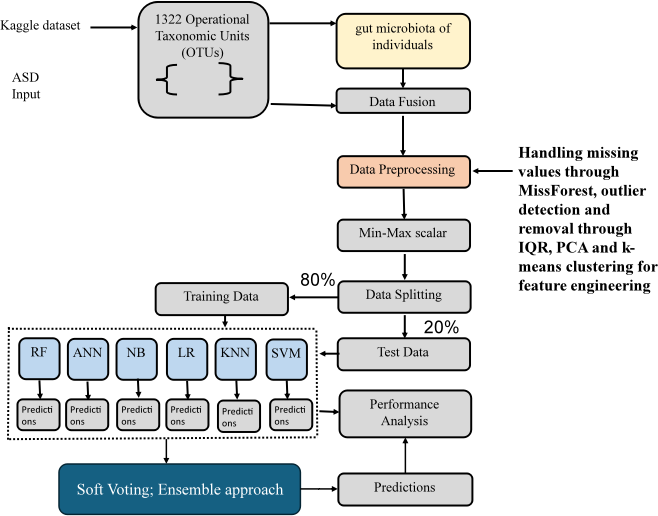
The Autism Spectrum Disorder (ASD) diagnosis and detection in its initial stages is a more complex issue in the face of the wide-ranging, diverse nature and causes. Subsequent literature inclined towards a possible correlation of gut microbiome with ASD, and its disclosure presents a more promising attribute for imminent discovery conduits. The dataset on gut microbiome associated with ASD focuses specifically on the microbial compositions obtained through 16S rRNA sequencing. This study presents a novel method that integrates Artificial Intelligence employing various Machine Learning (ML) robust classifiers such as Support Vector Machines (SVM), Random Forest, k-Nearest Neighbors (KNN), Logistic Regression, and Artificial Neural Networks (ANN), additionally PCA and k-means clustering is implemented for feature extraction to reveal important hidden patterns of ASD associated microbiomes from microbiome profiles. By integrating these model classifiers, the ensemble technique was developed to harness the strengths of each model, which enhances the dependability of the gut microbiome and offers a novel approach. The ensemble method suggested has an accuracy of 98.75%, a precision of 95.11%, a recall of 96.47% and an F1 score of 95.78% in the early determination of autism. The observational feature of this multifaceted approach not only enhances accuracy and precision but also provides a more complete picture of the role of autism spectrum disorders and eventually leads to the development of interventions and personalised approaches to these problems.
Graphical Abstract
Keywords
Data Availability Statement
Funding
Conflicts of Interest
Ethical Approval and Consent to Participate
References
- Thabtah, F. (2019). Machine learning in autistic spectrum disorder behavioral research: A review and ways forward. Informatics for Health and Social Care, 44(3), 278-297.
[CrossRef] [Google Scholar] - Lou, M., Cao, A., Jin, C., Mi, K., Xiong, X., Zeng, Z., ... & Wang, Y. (2022). Deviated and early unsustainable stunted development of gut microbiota in children with autism spectrum disorder. Gut, 71(8), 1588-1599.
[CrossRef] [Google Scholar] - Wan, Y., Wong, O. W., Tun, H. M., Su, Q., Xu, Z., Tang, W., ... & Ng, S. C. (2024). Fecal microbial marker panel for aiding diagnosis of autism spectrum disorders. Gut Microbes, 16(1), 2418984.
[CrossRef] [Google Scholar] - Raj, S., & Masood, S. (2020). Analysis and detection of autism spectrum disorder using machine learning techniques. Procedia Computer Science, 167, 994-1004.
[CrossRef] [Google Scholar] - Bhushan, M., Singal, M., & Negi, A. (2024). Impact of Machine Learning and Deep Learning Techniques in Autism. In Future of AI in Medical Imaging (pp. 116-136). IGI Global Scientific Publishing.
[CrossRef] [Google Scholar] - Rahman, M. M., Usman, O. L., Muniyandi, R. C., Sahran, S., Mohamed, S., & Razak, R. A. (2020). A review of machine learning methods of feature selection and classification for autism spectrum disorder. Brain sciences, 10(12), 949.
[CrossRef] [Google Scholar] - Peralta-Marzal, L. N., Rojas-Velazquez, D., Rigters, D., Prince, N., Garssen, J., Kraneveld, A. D., ... & Lopez-Rincon, A. (2024). A robust microbiome signature for autism spectrum disorder across different studies using machine learning. Scientific Reports, 14(1), 814.
[CrossRef] [Google Scholar] - Vuong, H. E., & Hsiao, E. Y. (2017). Emerging roles for the gut microbiome in autism spectrum disorder. Biological psychiatry, 81(5), 411-423.
[CrossRef] [Google Scholar] - Vakadkar, K., Purkayastha, D., & Krishnan, D. (2021). Detection of autism spectrum disorder in children using machine learning techniques. SN computer science, 2(5), 386.
[CrossRef] [Google Scholar] - Olaguez-Gonzalez, J. M., Chairez, I., Breton-Deval, L., & Alfaro-Ponce, M. (2023). Machine learning algorithms applied to predict autism spectrum disorder based on gut microbiome composition. Biomedicines, 11(10), 2633.
[CrossRef] [Google Scholar] - Balasubramanian, J., Gururaj, B., & Gayatri, N. (2024). An effective autism spectrum disorder screening method using machine learning classification techniques. Concurrency and Computation: Practice and Experience, 36(2), e7898.
[CrossRef] [Google Scholar] - Mazumdar, A., Chatterjee, B., Banerjee, M., & Shanker, S. (2024). Machine learning based autism screening tool—a modified approach. Multimedia Tools and Applications, 83(32), 77831-77848.
[CrossRef] [Google Scholar] - Rasul, R. A., Saha, P., Bala, D., Karim, S. R. U., Abdullah, M. I., & Saha, B. (2024). An evaluation of machine learning approaches for early diagnosis of autism spectrum disorder. Healthcare Analytics, 5, 100293.
[CrossRef] [Google Scholar] - Ding, X., Xu, Y., Zhang, X., Zhang, L., Duan, G., Song, C., ... & Zhu, C. (2020). Gut microbiota changes in patients with autism spectrum disorders. Journal of psychiatric research, 129, 149-159.
[CrossRef] [Google Scholar] - Zou, R., Xu, F., Wang, Y., Duan, M., Guo, M., Zhang, Q., ... & Zheng, H. (2020). Changes in the gut microbiota of children with autism spectrum disorder. Autism Research, 13(9), 1614-1625.
[CrossRef] [Google Scholar] - Hung, L. Y., & Margolis, K. G. (2024). Autism spectrum disorders and the gastrointestinal tract: insights into mechanisms and clinical relevance. Nature Reviews Gastroenterology & Hepatology, 21(3), 142-163.
[CrossRef] [Google Scholar] - Tuli, M., Chandrasekhar, A., Tyagi, S., & Singhal, A. (2024, January). Development of AI Based Autism Detection System. In 2024 14th International Conference on Cloud Computing, Data Science & Engineering (Confluence) (pp. 41-46). IEEE.
[CrossRef] [Google Scholar] - Mittal, K., Gill, K. S., Upadhyay, D., Singh, V., & Aluvala, S. (2024, February). Applying Machine Learning for Autism Risk Evaluation Using a Decision Tree Classification Technique. In 2024 2nd International Conference on Computer, Communication and Control (IC4) (pp. 1-6). IEEE.
[CrossRef] [Google Scholar] - Novielli, P., Romano, D., Magarelli, M., Diacono, D., Monaco, A., Amoroso, N., ... & Tangaro, S. (2024). Personalized identification of autism-related bacteria in the gut microbiome using explainable artificial intelligence. Iscience, 27(9).
[CrossRef] [Google Scholar] - Climent-Pérez, P., Martínez-González, A. E., & Andreo-Martínez, P. (2024). Contributions of artificial intelligence to analysis of gut microbiota in autism spectrum disorder: a systematic review. Children, 11(8), 931.
[CrossRef] [Google Scholar] - Kumar, A., & Jaiswal, U. C. (2024, March). A survey of machine learning techniques related to understanding autism spectrum disorder. In 2024 2nd International Conference on Disruptive Technologies (ICDT) (pp. 717-725). IEEE.
[CrossRef] [Google Scholar] - Olaguez-Gonzalez, J. M., Schaeffer, S. E., Breton-Deval, L., Alfaro-Ponce, M., & Chairez, I. (2024). Assessment of machine learning strategies for simplified detection of autism spectrum disorder based on the gut microbiome composition. Neural Computing and Applications, 36(14), 8163-8180.
[CrossRef] [Google Scholar]
Cited By (7)
-
Bin Sun. Lightweight GIS-based large-scale urban fire spread simulation method.
Journal of Industrial Information Integration, 2026 , 50 .
[CrossRef] -
Shubhani Aggarwal, Arzoo Miglani, Norah Saleh Alghamdi, Gaurav Dhiman. Resilient and decentralized demand-side management in smart grids using blockchain.
Scientific Reports, 2026 , 16 (1).
[CrossRef] -
Meenakshi Garg, Nor Asilah Wati Abdul Hamid, Dafik, Sunder R.. AI-driven feature descriptor design using CNNs and transfer learning for enhanced image retrieval accuracy and efficiency.
Scientific Reports, 2026 , 16 (1).
[CrossRef] -
Gaurav Dhiman, Kiran Deep Singh, Prabh Deep Singh, Norah Saleh Alghamdi, Ghadah Shukri Albakri. A novel approach to reliable and flexible distributed computing with virtualization in smart healthcare applications.
Scientific Reports, 2026 , 16 (1).
[CrossRef] -
Jinyuan Ni, Long Chen, Gu Tang, Ning Yu, Wenyue Tang, Xiaoyin Yi, Shuyin Xia. Hierarchical granular-ball graph pooling via feature–structure coupling.
Information Sciences, 2026 , 748 .
[CrossRef] -
İlknur Dönmez, Faruk Bulut. Multidimensional diversity in video recommender systems: a holistic framework of literature gaps and future directions.
Intelligent Systems with Applications, 2026 , 31 .
[CrossRef] -
Jinhao Du, Yarong Chen, Jabir Mumtaz, Faisal Alkaabneh, Ziyang Ji, Kaynat Afzal Minhas. Multi-agent deep reinforcement learning for dynamic lot-streaming flow shop problems with unequal sub-lots and capacity constraints.
Journal of Industrial Information Integration, 2026 , 51 .
[CrossRef]
Cite This Article
TY  - JOUR
AU  - Singh, Shobhita
AU  - Aggarwal, Shubhani
AU  - Singh, Aishani
AU  - Sharma, Anupriya
PY  - 2025
DA  - 2025/09/21
TI  - Integrating Artificial Intelligence and Machine Learning in Autism Detection via Gut Microbiome Analysis
JO  - ICCK Transactions on Machine Intelligence
T2  - ICCK Transactions on Machine Intelligence
JF  - ICCK Transactions on Machine Intelligence
VL  - 1
IS  - 2
SP  - 90
EP  - 102
DO  - 10.62762/TMI.2025.682666
UR  - https://www.icck.org/article/abs/TMI.2025.682666
KW  - autism spectrum disorder (ASD)
KW  - gut microbiome
KW  - artificial intelligence
KW  - machine learning
KW  - ensemble approach
AB  - The Autism Spectrum Disorder (ASD) diagnosis and detection in its initial stages is a more complex issue in the face of the wide-ranging, diverse nature and causes. Subsequent literature inclined towards a possible correlation of gut microbiome with ASD, and its disclosure presents a more promising attribute for imminent discovery conduits. The dataset on gut microbiome associated with ASD focuses specifically on the microbial compositions obtained through 16S rRNA sequencing. This study presents a novel method that integrates Artificial Intelligence employing various Machine Learning (ML) robust classifiers such as Support Vector Machines (SVM), Random Forest, k-Nearest Neighbors (KNN), Logistic Regression, and Artificial Neural Networks (ANN), additionally PCA and k-means clustering is implemented for feature extraction to reveal important hidden patterns of ASD associated microbiomes from microbiome profiles. By integrating these model classifiers, the ensemble technique was developed to harness the strengths of each model, which enhances the dependability of the gut microbiome and offers a novel approach. The ensemble method suggested has an accuracy of 98.75%, a precision of 95.11%, a recall of 96.47% and an F1 score of 95.78% in the early determination of autism. The observational feature of this multifaceted approach not only enhances accuracy and precision but also provides a more complete picture of the role of autism spectrum disorders and eventually leads to the development of interventions and personalised approaches to these problems.
SN  - 3068-7403
PB  - Institute of Central Computation and Knowledge
LA  - English
ER  -
@article{Singh2025Integratin,
  author = {Shobhita Singh and Shubhani Aggarwal and Aishani Singh and Anupriya Sharma},
  title = {Integrating Artificial Intelligence and Machine Learning in Autism Detection via Gut Microbiome Analysis},
  journal = {ICCK Transactions on Machine Intelligence},
  year = {2025},
  volume = {1},
  number = {2},
  pages = {90-102},
  doi = {10.62762/TMI.2025.682666},
  url = {https://www.icck.org/article/abs/TMI.2025.682666},
  abstract = {The Autism Spectrum Disorder (ASD) diagnosis and detection in its initial stages is a more complex issue in the face of the wide-ranging, diverse nature and causes. Subsequent literature inclined towards a possible correlation of gut microbiome with ASD, and its disclosure presents a more promising attribute for imminent discovery conduits. The dataset on gut microbiome associated with ASD focuses specifically on the microbial compositions obtained through 16S rRNA sequencing. This study presents a novel method that integrates Artificial Intelligence employing various Machine Learning (ML) robust classifiers such as Support Vector Machines (SVM), Random Forest, k-Nearest Neighbors (KNN), Logistic Regression, and Artificial Neural Networks (ANN), additionally PCA and k-means clustering is implemented for feature extraction to reveal important hidden patterns of ASD associated microbiomes from microbiome profiles. By integrating these model classifiers, the ensemble technique was developed to harness the strengths of each model, which enhances the dependability of the gut microbiome and offers a novel approach. The ensemble method suggested has an accuracy of 98.75\%, a precision of 95.11\%, a recall of 96.47\% and an F1 score of 95.78\% in the early determination of autism. The observational feature of this multifaceted approach not only enhances accuracy and precision but also provides a more complete picture of the role of autism spectrum disorders and eventually leads to the development of interventions and personalised approaches to these problems.},
  keywords = {autism spectrum disorder (ASD), gut microbiome, artificial intelligence, machine learning, ensemble approach},
  issn = {3068-7403},
  publisher = {Institute of Central Computation and Knowledge}
}
Publisher's Note
ICCK stays neutral with regard to jurisdictional claims in published maps and institutional affiliations.
Rights and Permissions


Portico
