Volume 3, Issue 1, Agricultural Science and Food Processing
Volume 3, Issue 1, 2026
Submit Manuscript Edit a Special Issue
Article QR Code
Article QR Code
Scan the QR code for reading
Popular articles
Agricultural Science and Food Processing, Volume 3, Issue 1, 2026: 6-18

Open Access | Review Article | 28 February 2026
Bioelectrocatalytic Materials for Green Agriculture and Environmental Remediation
1 Department of Physics, Beijing Technology and Business University, Beijing 100048, China
* Corresponding Author: Denghui Xu, [email protected]
ARK: ark:/57805/asfp.2026.804492
Received: 31 January 2026, Accepted: 07 February 2026, Published: 28 February 2026  
Abstract
The advancement of global sustainable agriculture is currently impeded by the dual challenges of energy-intensive industrial nitrogen fixation and the persistent accumulation of agro-environmental pollutants. Bioelectrocatalysis has emerged as a transformative solution to these issues by synergizing the exquisite selectivity of biological catalysts with the controllability of renewable electricity-driven systems. However, the practical deployment of bioelectrocatalytic technologies is fundamentally constrained by kinetic bottlenecks associated with interfacial electron transfer (ET) between biocatalysts and solid electrodes. This review systematically summarizes recent advances in bioelectrocatalytic materials, with a specific focus on interface engineering strategies designed to overcome energy barriers and optimize both Direct Electron Transfer (DET) and Mediated Electron Transfer (MET) pathways. Furthermore, we critically examine the application of these systems in electricity-driven nitrogen fertilizer synthesis, real-time environmental sensing, and pollutant remediation. Finally, future perspectives on integrating synthetic biology and advanced material design are discussed to accelerate the development of next-generation technologies for green agriculture and ecological preservation.

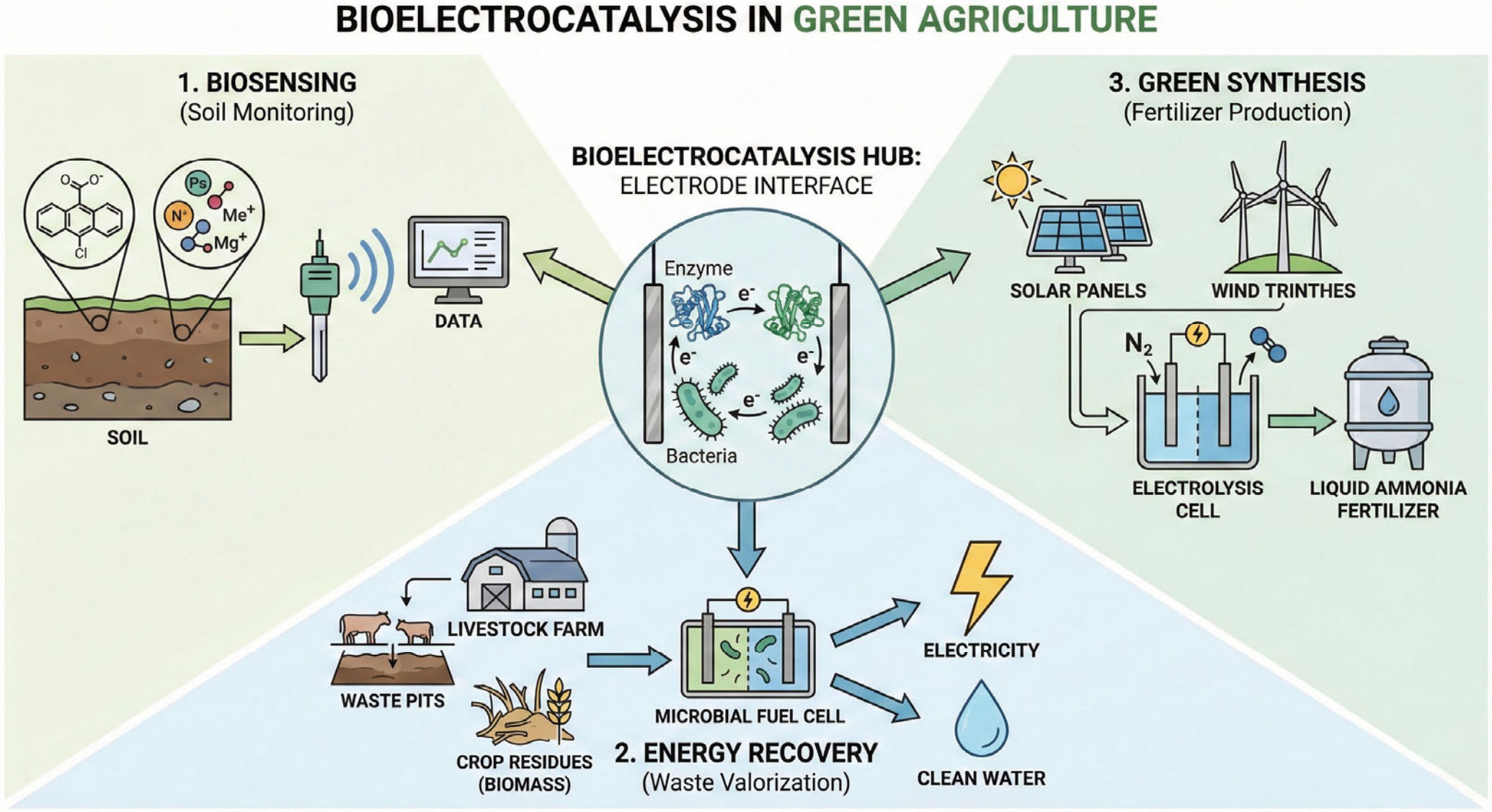
Graphical Abstract
Bioelectrocatalytic Materials for Green Agriculture and Environmental Remediation

Keywords
bioelectrocatalysis
green agriculture
nitrogen fixation
interface engineering
waste valorization
sustainable energy

Data Availability Statement
Data will be made available on request.

Funding
This work was supported without any funding.

Conflicts of Interest
The authors declare no conflicts of interest.

AI Use Statement
The authors declare that no generative AI was used in the preparation of this manuscript.

Ethical Approval and Consent to Participate
Not applicable.

References
  1. Hill, H. A. O., & Higgins, I. J. (1981). Bioelectrocatalysis. Philosophical Transactions of the Royal Society of London. Series A, Mathematical and Physical Sciences, 302(1468), 267-273.
    [CrossRef]   [Google Scholar]
  2. Schmid, A., Dordick, J. S., Hauer, B., Kiener, A., Wubbolts, M., & Witholt, B. (2001). Industrial biocatalysis today and tomorrow. nature, 409(6817), 258-268.
    [CrossRef]   [Google Scholar]
  3. De Carvalho, C. C. (2011). Enzymatic and whole cell catalysis: finding new strategies for old processes. Biotechnology advances, 29(1), 75-83.
    [CrossRef]   [Google Scholar]
  4. Chen, H., Dong, F., & Minteer, S. D. (2020). The progress and outlook of bioelectrocatalysis for the production of chemicals, fuels and materials. Nature Catalysis, 3(3), 225-244.
    [CrossRef]   [Google Scholar]
  5. Cadoux, C., & Milton, R. D. (2020). Recent enzymatic electrochemistry for reductive reactions. ChemElectroChem, 7(9), 1974-1986.
    [CrossRef]   [Google Scholar]
  6. Wong, T. S., & Schwaneberg, U. (2003). Protein engineering in bioelectrocatalysis. Current Opinion in Biotechnology, 14(6), 590-596.
    [CrossRef]   [Google Scholar]
  7. Milton, R. D., Wang, T., Knoche, K. L., & Minteer, S. D. (2016). Tailoring biointerfaces for electrocatalysis. Langmuir, 32(10), 2291-2301.
    [CrossRef]   [Google Scholar]
  8. Arechederra, R., & Minteer, S. D. (2008). Organelle-based biofuel cells: Immobilized mitochondria on carbon paper electrodes. Electrochimica Acta, 53(23), 6698-6703.
    [CrossRef]   [Google Scholar]
  9. Takeuchi, R., Suzuki, A., Sakai, K., Kitazumi, Y., Shirai, O., & Kano, K. (2018). Construction of photo-driven bioanodes using thylakoid membranes and multi-walled carbon nanotubes. Bioelectrochemistry, 122, 158-163.
    [CrossRef]   [Google Scholar]
  10. Adachi, T., Kataoka, K., Kitazumi, Y., Shirai, O., & Kano, K. (2019). A bio-solar cell with thylakoid membranes and bilirubin oxidase. Chemistry Letters, 48(7), 686-689.
    [CrossRef]   [Google Scholar]
  11. Rasmussen, M., Shrier, A., & Minteer, S. D. (2013). High performance thylakoid bio-solar cell using laccase enzymatic biocathodes. Physical Chemistry Chemical Physics, 15(23), 9062-9065.
    [CrossRef]   [Google Scholar]
  12. Lovley, D. R., & Walker, D. J. F. (2019). Geobacter protein nanowires. Frontiers in Microbiology, 10, 2078.
    [CrossRef]   [Google Scholar]
  13. Ueki, T., Walker, D. J., Tremblay, P. L., Nevin, K. P., Ward, J. E., Woodard, T. L., ... & Lovley, D. R. (2019). Decorating the outer surface of microbially produced protein nanowires with peptides. ACS synthetic biology, 8(8), 1809-1817.
    [CrossRef]   [Google Scholar]
  14. Tan, Y., Adhikari, R. Y., Malvankar, N. S., Ward, J. E., Nevin, K. P., Woodard, T. L., ... & Lovley, D. R. (2016). The low conductivity of Geobacter uraniireducens pili suggests a diversity of extracellular electron transfer mechanisms in the genus Geobacter. Frontiers in microbiology, 7, 980.
    [CrossRef]   [Google Scholar]
  15. Hartshorne, R. S., Reardon, C. L., Ross, D., Nuester, J., Clarke, T. A., Gates, A. J., ... & Richardson, D. J. (2009). Characterization of an electron conduit between bacteria and the extracellular environment. Proceedings of the National Academy of Sciences, 106(52), 22169-22174.
    [CrossRef]   [Google Scholar]
  16. Ross, D. E., Flynn, J. M., Baron, D. B., Gralnick, J. A., & Bond, D. R. (2011). Towards electrosynthesis in Shewanella: Energetics of reversing the Mtr pathway for reductive metabolism. PLoS ONE, 6(2), e16649.
    [CrossRef]   [Google Scholar]
  17. Wu, R., Ma, C., & Zhu, Z. (2020). Enzymatic electrosynthesis as an emerging electrochemical synthesis platform. Current Opinion in Electrochemistry, 19, 1-7.
    [CrossRef]   [Google Scholar]
  18. Kracke, F., Vassilev, I., & Krömer, J. O. (2015). Microbial electron transport and energy conservation–the foundation for optimizing bioelectrochemical systems. Frontiers in microbiology, 6, 575.
    [CrossRef]   [Google Scholar]
  19. Xiao, Y., Patolsky, F., Katz, E., Hainfeld, J. F., & Willner, I. (2003). `` Plugging into enzymes'': Nanowiring of redox enzymes by a gold nanoparticle. Science, 299(5614), 1877-1881.
    [CrossRef]   [Google Scholar]
  20. Milton, R. D., Cai, R., Abdellaoui, S., Leech, D., De Lacey, A. L., Pita, M., & Minteer, S. D. (2017). Bioelectrochemical Haber–Bosch process: an ammonia‐producing H2/N2 fuel cell. Angewandte Chemie International Edition, 56(10), 2680-2683.
    [CrossRef]   [Google Scholar]
  21. Su, Y., Cestellos-Blanco, S., Kim, J. M., Shen, Y. X., Kong, Q., Lu, D., ... & Yang, P. (2020). Close-packed nanowire-bacteria hybrids for efficient solar-driven CO2 fixation. Joule, 4(4), 800-811.
    [CrossRef]   [Google Scholar]
  22. Liu, C., Sakimoto, K. K., Colon, B. C., Silver, P. A., & Nocera, D. G. (2017). Ambient nitrogen reduction cycle using a hybrid inorganic biological system. Proceedings of the National Academy of Sciences of the United States of America, 114(25), 6450-6455.
    [CrossRef]   [Google Scholar]
  23. Ortiz, R., Matsumura, H., Tasca, F., Zahma, K., Samejima, M., Igarashi, K., Ludwig, R., & Gorton, L. (2012). Effect of deglycosylation of cellobiose dehydrogenases on the enhancement of direct electron transfer with electrodes. Analytical Chemistry, 84(23), 10315-10323.
    [CrossRef]   [Google Scholar]
  24. Zhang, L., Cui, H., Zou, Z., Garakani, T. M., Novoa Henriquez, C., Jooyeh, B., & Schwaneberg, U. (2019). Directed evolution of a bacterial laccase (CueO) for enzymatic biofuel cells. Angewandte Chemie International Edition, 58(14), 4610-4613.
    [CrossRef]   [Google Scholar]
  25. Lim, K., Sima, M., Stewart, R. J., & Minteer, S. D. (2020). Direct bioelectrocatalysis by redox enzymes immobilized in electrostatically condensed oppositely charged polyelectrolyte electrode coatings. Analyst, 145(4), 1250-1257.
    [CrossRef]   [Google Scholar]
  26. Xu, H., Dai, H., & Chen, G. (2010). Direct electrochemistry and electrocatalysis of hemoglobin protein entrapped in graphene and chitosan composite film. Talanta, 81(1-2), 334-338.
    [CrossRef]   [Google Scholar]
  27. Dong, F., Chen, H., Malapit, C. A., Prater, M. B., Li, M., Yuan, M., ... & Minteer, S. D. (2020). Biphasic bioelectrocatalytic synthesis of chiral $\beta$-hydroxy nitriles. Journal of the American Chemical Society, 142(18), 8374-8382.
    [CrossRef]   [Google Scholar]
  28. Arduini, F., Cinti, S., Caratelli, V., Amendola, L., Palleschi, G., & Moscone, D. (2019). Origami multiple paper-based electrochemical biosensors for pesticide detection. Biosensors and Bioelectronics, 126, 346-354.
    [CrossRef]   [Google Scholar]
  29. Chen, H., Prater, M. B., Cai, R., Dong, F., Chen, H., & Minteer, S. D. (2020). Bioelectrocatalytic conversion from N2 to chiral amino acids in a H2/$\alpha$-keto acid enzymatic fuel cell. Journal of the American Chemical Society, 142(8), 4028-4036.
    [CrossRef]   [Google Scholar]
  30. Blackford, J. C., & Gilbert, F. J. (2007). pH variability and CO2 induced acidification in the North Sea. Journal of Marine Systems, 64(1-4), 229-241.
    [CrossRef]   [Google Scholar]
  31. Finn, C., Schnittger, S., Yellowlees, L. J., & Love, J. B. (2012). Molecular approaches to the electrochemical reduction of carbon dioxide. Chemical Communications, 48(10), 1392-1399.
    [CrossRef]   [Google Scholar]
  32. Delecouls-Servat, K., Basseguy, R., & Bergel, A. (2002). Designing membrane electrochemical reactors for oxidoreductase-catalysed synthesis. Bioelectrochemistry, 55(1-2), 93-95.
    [CrossRef]   [Google Scholar]
  33. Steckhan, E. (2005). Electroenzymatic synthesis. In Electrochemistry V (pp. 83-111). Berlin, Heidelberg: Springer Berlin Heidelberg.
    [CrossRef]   [Google Scholar]
  34. Simon, H., Gunther, H., Bader, J., & Tischer, W. (1981). Electro-enzymatic and electro-microbial stereospecific reductions. Angewandte Chemie International Edition in English, 20(10), 861-863.
    [CrossRef]   [Google Scholar]
  35. Son, E. J., Lee, S. H., Kuk, S. K., Pesic, M., Choi, D. S., Ko, J. W., ... & Park, C. B. (2018). Carbon nanotube–graphitic carbon nitride hybrid films for flavoenzyme‐catalyzed photoelectrochemical cells. Advanced Functional Materials, 28(24), 1705232.
    [CrossRef]   [Google Scholar]
  36. Montpart, N., Rago, L., Baeza, J. A., & Guisasola, A. (2015). Hydrogen production in single chamber microbial electrolysis cells with different complex substrates. Water Research, 68, 601-615.
    [CrossRef]   [Google Scholar]
  37. Lovley, D. R. (2011). Powering microbes with electricity: direct electron transfer from electrodes to microbes. Environmental microbiology reports, 3(1), 27-35.
    [CrossRef]   [Google Scholar]
  38. Jiang, Y., May, H. D., Lu, L., Liang, P., Huang, X., & Ren, Z. J. (2019). Carbon dioxide and organic waste valorization by microbial electrosynthesis and electro-fermentation. Water research, 149, 42-55.
    [CrossRef]   [Google Scholar]
  39. Mateo, C., Palomo, J. M., Fernandez-Lorente, G., Guisan, J. M., & Fernandez-Lafuente, R. (2007). Improvement of enzyme activity, stability and selectivity via immobilization techniques. Enzyme and microbial technology, 40(6), 1451-1463.
    [CrossRef]   [Google Scholar]
  40. Li, J., Ma, H., Ma, H., Lei, F., He, D., Huang, X., ... & Fan, G. (2023). Comprehensive effects of N reduction combined with biostimulants on N use efficiency and yield of the winter wheat–summer maize rotation system. Agronomy, 13(9), 2319.
    [CrossRef]   [Google Scholar]
  41. Babanova, S., Jones, J., Phadke, S., Lu, M., Angulo, C., Garcia, J., ... & Bretschger, O. (2020). Continuous flow, large‐scale, microbial fuel cell system for the sustained treatment of swine waste. Water Environment Research, 92(1), 60-72.
    [CrossRef]   [Google Scholar]
  42. Ieropoulos, I. A., Stinchcombe, A., Gajda, I., Forbes, S., Merino-Jimenez, I., Pasternak, G., Sanchez-Herranz, D., & Greenman, J. (2016). Pee power urinal - Microbial fuel cell technology field trials in the context of sanitation. Environmental Science: Water Research & Technology, 2(2), 336-343.
    [CrossRef]   [Google Scholar]
  43. Schievano, A., Colombo, A., Grattieri, M., Trasatti, S. P., Liberale, A., Tremolada, P., Pino, C., & Cristiani, P. (2017). Floating microbial fuel cells as energy harvesters for signal transmission from natural water bodies. Journal of Power Sources, 340, 80-88.
    [CrossRef]   [Google Scholar]
  44. Walter, X. A., Stinchcombe, A., Greenman, J., & Ieropoulos, I. (2017). Urine transduction to usable energy: A modular MFC approach for smartphone and remote system charging. Applied Energy, 192, 575-581.
    [CrossRef]   [Google Scholar]
  45. Logan, B. E., & Rabaey, K. (2012). Conversion of wastes into bioelectricity and chemicals by using microbial electrochemical technologies. science, 337(6095), 686-690.
    [CrossRef]   [Google Scholar]
  46. Santoro, C., Talarposhti, M. R., Kodali, M., Gokhale, R., Serov, A., Merino-Jimenez, I., Ieropoulos, I., & Atanassov, P. (2017). Microbial desalination cells with efficient platinum-group-metal-free cathode catalysts. ChemElectroChem, 4(12), 3322-3330.
    [CrossRef]   [Google Scholar]
  47. Alkotaini, B., Tinucci, S. L., Robertson, S. J., Hasan, K., Minteer, S. D., & Grattieri, M. (2018). Alginate-encapsulated bacteria for the treatment of hypersaline solutions in microbial fuel cells. ChemBioChem, 19(11), 1162-1169.
    [CrossRef]   [Google Scholar]
  48. Grattieri, M., & Minteer, S. D. (2018). Microbial fuel cells in saline and hypersaline environments: Advancements, challenges and future perspectives. Bioelectrochemistry, 120, 127-137.
    [CrossRef]   [Google Scholar]
  49. Lazzarini Behrmann, I. C., Grattieri, M., Minteer, S. D., Ramirez, S. A., & Vullo, D. L. (2020). Online self-powered Cr(VI) monitoring with autochthonous Pseudomonas and a bio-inspired redox polymer. Analytical and Bioanalytical Chemistry, 412(24), 6449-6457.
    [CrossRef]   [Google Scholar]

Cite This Article
APA Style
Jiang, Y., & Xu, D. (2026). Bioelectrocatalytic Materials for Green Agriculture and Environmental Remediation. Agricultural Science and Food Processing, 3(1), 6–18. https://doi.org/10.62762/ASFP.2026.804492
Export Citation
RIS Format
Compatible with EndNote, Zotero, Mendeley, and other reference managers
RIS format data for reference managers
TY  - JOUR
AU  - Jiang, Yuying
AU  - Xu, Denghui
PY  - 2026
DA  - 2026/02/28
TI  - Bioelectrocatalytic Materials for Green Agriculture and Environmental Remediation
JO  - Agricultural Science and Food Processing
T2  - Agricultural Science and Food Processing
JF  - Agricultural Science and Food Processing
VL  - 3
IS  - 1
SP  - 6
EP  - 18
DO  - 10.62762/ASFP.2026.804492
UR  - https://www.icck.org/article/abs/ASFP.2026.804492
KW  - bioelectrocatalysis
KW  - green agriculture
KW  - nitrogen fixation
KW  - interface engineering
KW  - waste valorization
KW  - sustainable energy
AB  - The advancement of global sustainable agriculture is currently impeded by the dual challenges of energy-intensive industrial nitrogen fixation and the persistent accumulation of agro-environmental pollutants. Bioelectrocatalysis has emerged as a transformative solution to these issues by synergizing the exquisite selectivity of biological catalysts with the controllability of renewable electricity-driven systems. However, the practical deployment of bioelectrocatalytic technologies is fundamentally constrained by kinetic bottlenecks associated with interfacial electron transfer (ET) between biocatalysts and solid electrodes. This review systematically summarizes recent advances in bioelectrocatalytic materials, with a specific focus on interface engineering strategies designed to overcome energy barriers and optimize both Direct Electron Transfer (DET) and Mediated Electron Transfer (MET) pathways. Furthermore, we critically examine the application of these systems in electricity-driven nitrogen fertilizer synthesis, real-time environmental sensing, and pollutant remediation. Finally, future perspectives on integrating synthetic biology and advanced material design are discussed to accelerate the development of next-generation technologies for green agriculture and ecological preservation.
SN  - 3066-1579
PB  - Institute of Central Computation and Knowledge
LA  - English
ER  - 
BibTeX Format
Compatible with LaTeX, BibTeX, and other reference managers
BibTeX format data for LaTeX and reference managers
@article{Jiang2026Bioelectro,
  author = {Yuying Jiang and Denghui Xu},
  title = {Bioelectrocatalytic Materials for Green Agriculture and Environmental Remediation},
  journal = {Agricultural Science and Food Processing},
  year = {2026},
  volume = {3},
  number = {1},
  pages = {6-18},
  doi = {10.62762/ASFP.2026.804492},
  url = {https://www.icck.org/article/abs/ASFP.2026.804492},
  abstract = {The advancement of global sustainable agriculture is currently impeded by the dual challenges of energy-intensive industrial nitrogen fixation and the persistent accumulation of agro-environmental pollutants. Bioelectrocatalysis has emerged as a transformative solution to these issues by synergizing the exquisite selectivity of biological catalysts with the controllability of renewable electricity-driven systems. However, the practical deployment of bioelectrocatalytic technologies is fundamentally constrained by kinetic bottlenecks associated with interfacial electron transfer (ET) between biocatalysts and solid electrodes. This review systematically summarizes recent advances in bioelectrocatalytic materials, with a specific focus on interface engineering strategies designed to overcome energy barriers and optimize both Direct Electron Transfer (DET) and Mediated Electron Transfer (MET) pathways. Furthermore, we critically examine the application of these systems in electricity-driven nitrogen fertilizer synthesis, real-time environmental sensing, and pollutant remediation. Finally, future perspectives on integrating synthetic biology and advanced material design are discussed to accelerate the development of next-generation technologies for green agriculture and ecological preservation.},
  keywords = {bioelectrocatalysis, green agriculture, nitrogen fixation, interface engineering, waste valorization, sustainable energy},
  issn = {3066-1579},
  publisher = {Institute of Central Computation and Knowledge}
}

Article Metrics
Citations:

Crossref

0

Scopus

0

Web of Science

0
Article Access Statistics:
Views: 23
PDF Downloads: 6

Publisher's Note
ICCK stays neutral with regard to jurisdictional claims in published maps and institutional affiliations.

Rights and Permissions
CC BY Copyright © 2026 by the Author(s). Published by Institute of Central Computation and Knowledge. This article is an open access article distributed under the terms and conditions of the Creative Commons Attribution (CC BY) license (https://creativecommons.org/licenses/by/4.0/), which permits use, sharing, adaptation, distribution and reproduction in any medium or format, as long as you give appropriate credit to the original author(s) and the source, provide a link to the Creative Commons licence, and indicate if changes were made.
Agricultural Science and Food Processing

Agricultural Science and Food Processing

ISSN: 3066-1579 (Online) | ISSN: 3066-1560 (Print)

Email: [email protected]

Portico

Portico

All published articles are preserved here permanently:
https://www.portico.org/publishers/icck/