

-
CiteScore
-
Impact Factor
Volume 1, Issue 3, Biomedical Informatics and Smart Healthcare
Volume 1, Issue 3, 2025
Submit Manuscript Edit a Special Issue
Article QR Code
Article QR Code
Scan the QR code for reading
Popular articles
Biomedical Informatics and Smart Healthcare, Volume 1, Issue 3, 2025: 98-117

Open Access | Research Article | 17 December 2025
Breast Cancer Image Classification into Benign and Malignant using an Intelligent CNN Framework
1 School of Computer Science and Technology, Chongqing University of Posts and Telecommunications, Chongqing 400065, China
* Corresponding Author: Altaf Hussain, [email protected]
Received: 09 September 2025, Accepted: 07 November 2025, Published: 17 December 2025  
Abstract
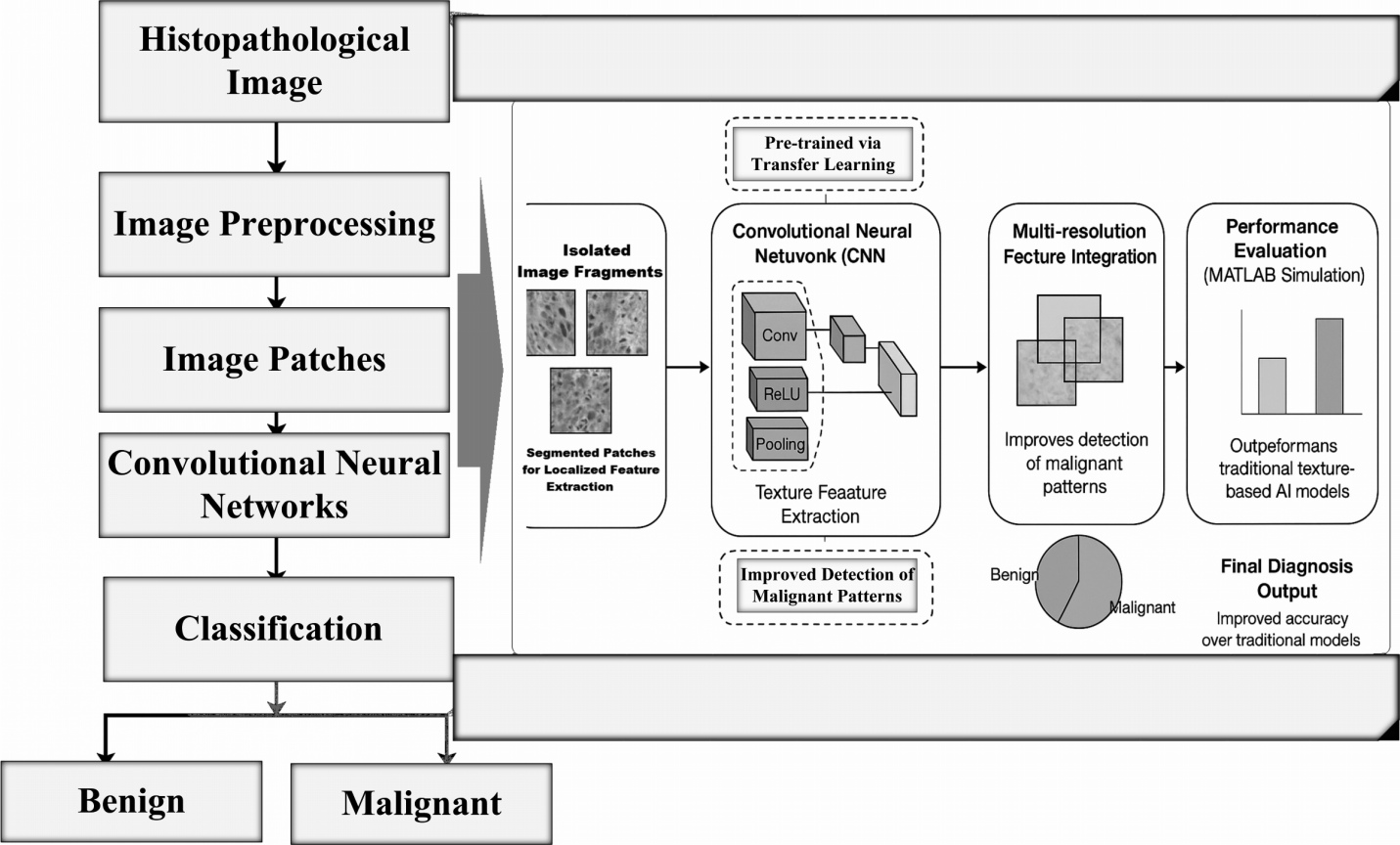
Breast cancer is one of the most prevalent and life-threatening diseases among women worldwide. Accurate diagnosis from histopathological biopsy samples is essential, yet manual examination is time-consuming and subject to inter-observer variability, particularly given the shortage of trained pathologists alongside the increasing number of cases. Deep learning, especially Convolutional Neural Networks (CNNs), has emerged as a powerful tool for classifying medical images by automatically extracting discriminative features from raw data. In this study, we investigate the use of the publicly available Breast Cancer Histopathological (BreakHis) image database, which contains benign and malignant samples across multiple magnifications. Our proposed approach extracts isolated image patches, applies CNN-based feature learning and integrates multi-resolution information to improve classification performance. To enhance generalization under limited data, we adopt transfer learning with optimized fine-tuning. Experiments implemented in MATLAB demonstrate that our CNN-based framework achieves higher accuracy than traditional machine learning approaches relying on handcrafted texture descriptors. These findings highlight the potential of CNNs, combined with patch-based multi-resolution analysis, to support pathologists in reliable and efficient breast cancer diagnosis.

Graphical Abstract
Breast Cancer Image Classification into Benign and Malignant using an Intelligent CNN Framework

Keywords
breast cancer detection
tissue pathological images
benign and malignant images
deep learning
transfer learning
AlexNet
CNN

Data Availability Statement
The dataset used and/or analyzed during the current study is publicly available at the following link: https://web.inf.ufpr.br/vri/databases/breast-cancer-histopathological-database-breakhis (accessed on 15 December 2025).

Funding
This work was supported without any funding.

Conflicts of Interest
The authors declare no conflicts of interest.

Ethical Approval and Consent to Participate
Ethical approval and informed consent were not required for this study, as it exclusively utilized the publicly available BreakHis dataset, which has been previously de-identified and approved for research purposes.

References
  1. Aguerchi, K., Jabrane, Y., Habba, M., & El Hassani, A. H. (2024). A CNN hyperparameters optimization based on particle swarm optimization for mammography breast cancer classification. Journal of Imaging, 10(2), 30.
    [CrossRef]   [Google Scholar]
  2. Alshdaifat, E. H., Amin, M., Mhanna, H. Y. A., Malkawi, M., Al-Mnayyis, A. A. M., Gharaibeh, H., ... & Sindiani, A. M. (2025). (KAUH-BCUSD) Computer-Aided Breast Cancer Diagnosis Using Transformer and CNN Using Ultrasound Dataset. Intelligence-Based Medicine, 100270.
    [CrossRef]   [Google Scholar]
  3. Araújo, T., Aresta, G., Castro, E., Rouco, J., Aguiar, P., Eloy, C., ... & Campilho, A. (2017). Classification of breast cancer histology images using convolutional neural networks. PloS One, 12(6), e0177544.
    [CrossRef]   [Google Scholar]
  4. Ashour, L. S., Mohammed, A. A., Zaid, M. M. A., Sumari, P., Al-Nussairi, A. K. J., Al-Shammari, S. A., & Abdulmunem, S. T. (2025). Non-overlapping Patch-Based Pre-trained CNN for Breast Cancer Classification. Iraqi Journal for Computer Science and Mathematics, 6(2), 29.
    [CrossRef]   [Google Scholar]
  5. Bardou, D., Zhang, K., & Ahmad, S. M. (2018). Classification of breast cancer based on histology images using convolutional neural networks. IEEE Access, 6, 24680-24693.
    [CrossRef]   [Google Scholar]
  6. Bengio, Y., Courville, A., & Vincent, P. (2013). Representation learning: A review and new perspectives. IEEE Transactions on Pattern Analysis and Machine Intelligence, 35(8), 1798-1828.
    [CrossRef]   [Google Scholar]
  7. Benhammou, Y., Tabik, S., Achchab, B., & Herrera, F. (2018, May). A first study exploring the performance of the state-of-the art CNN model in the problem of breast cancer. In Proceedings of the International Conference on Learning and Optimization Algorithms: Theory and Applications (pp. 1-6).
    [CrossRef]   [Google Scholar]
  8. Hong, J., Zhang, Y. D., & Chen, W. (2022). Source-free unsupervised domain adaptation for cross-modality abdominal multi-organ segmentation. Knowledge-Based Systems, 250, 109155.
    [CrossRef]   [Google Scholar]
  9. Bonfiglio, R., Scimeca, M., Toschi, N., Pistolese, C. A., Giannini, E., Antonacci, C., ... & Bonanno, E. (2018). Radiological, histological and chemical analysis of breast microcalcifications: diagnostic value and biological significance. Journal of Mammary Gland Biology and Neoplasia, 23(1), 89-99.
    [CrossRef]   [Google Scholar]
  10. Bošnački, D., van Riel, N., & Veta, M. (2019). Deep Learning with Convolutional Neural Networks for Histopathology Image Analysis. In Automated Reasoning for Systems Biology and Medicine (pp. 453-469). Springer, Cham.
    [CrossRef]   [Google Scholar]
  11. Boyle, P., & Levin, B. (2008). World cancer report 2008. IARC Press, International Agency for Research on Cancer.
    [Google Scholar]
  12. Chakravarthy, S., Bharanidharan, N., Khan, S. B., Kumar, V. V., Mahesh, T. R., Almusharraf, A., & Albalawi, E. (2024). Multi-class breast cancer classification using CNN features hybridization. International Journal of Computational Intelligence Systems, 17(1), 191.
    [CrossRef]   [Google Scholar]
  13. Chang, J., Yu, J., Han, T., Chang, H. J., & Park, E. (2017, October). A method for classifying medical images using transfer learning: a pilot study on histopathology of breast cancer. In 2017 IEEE 19th International Conference on e-Health Networking, Applications and Services (Healthcom) (pp. 1-4). IEEE.
    [CrossRef]   [Google Scholar]
  14. Duodu, N. Y., Patel, W. D., & Koyuncu, H. (2025). Advancements in Telehealth: Enhancing breast cancer detection and health automation through smart integration of iot and cnn deep learning in residential and healthcare settings. J. Adv. Res. Appl. Sci. Eng. Technol, 45(2), 214-226.
    [CrossRef]   [Google Scholar]
  15. Fischer, A. H., Jacobson, K. A., Rose, J., & Zeller, R. (2008). Hematoxylin and eosin staining of tissue and cell sections. Cold Spring Harbor Protocols, 2008(5), pdb-prot4986.
    [CrossRef]   [Google Scholar]
  16. Fontes, J. P. P., Raimundo, J. N. C., Magalhães, L. G. M., & Lopez, M. A. G. (2025). Accurate phenotyping of luminal A breast cancer in magnetic resonance imaging: a new 3D CNN approach. Computers in Biology and Medicine, 189, 109903.
    [CrossRef]   [Google Scholar]
  17. Goodfellow, I., Bengio, Y., & Courville, A. (2016). Deep feedforward networks. Deep learning, 1, 161-217.
    [Google Scholar]
  18. Gopal, J. (2025). An automatic classification of breast cancer using fuzzy scoring based ResNet CNN model. Scientific Reports, 15(1), 20739.
    [CrossRef]   [Google Scholar]
  19. Guan, J. S., Kang, S. B., & Sun, Y. (2019). Medical image fusion algorithm based on multi-resolution analysis coupling approximate spare representation. Future Generation Computer Systems, 98, 201-207.
    [CrossRef]   [Google Scholar]
  20. Gül, M. (2025). A novel local binary patterns-based approach and proposed CNN model to diagnose breast cancer by analyzing histopathology images. IEEE Access.
    [CrossRef]   [Google Scholar]
  21. Litjens, G., Kooi, T., Bejnordi, B. E., Setio, A. A. A., Ciompi, F., Ghafoorian, M., ... & Sánchez, C. I. (2017). A survey on deep learning in medical image analysis. Medical image analysis, 42, 60-88.
    [CrossRef]   [Google Scholar]
  22. Jadoon, M. M., Zhang, Q., Haq, I. U., Butt, S., & Jadoon, A. (2017). Three‐class mammogram classification based on descriptive CNN features. BioMed research international, 2017(1), 3640901.
    [CrossRef]   [Google Scholar]
  23. Kaddes, M., Ayid, Y. M., Elshewey, A. M., & Fouad, Y. (2025). Breast cancer classification based on hybrid CNN with LSTM model. Scientific Reports, 15(1), 4409.
    [CrossRef]   [Google Scholar]
  24. Kassani, S. H., Kassani, P. H., Wesolowski, M. J., Schneider, K. A., & Deters, R. (2019, October). Breast cancer diagnosis with transfer learning and global pooling. In 2019 International Conference on Information and Communication Technology Convergence (ICTC) (pp. 519-524). IEEE.
    [CrossRef]   [Google Scholar]
  25. Yıldız, G., & Yakut, Ö. (2026). Multi-class cancer diagnosis on histopathological images with deep ensemble learning model. Computers in Biology and Medicine, 200, 111381.
    [CrossRef]   [Google Scholar]
  26. Kollem, S., Sirigiri, C., & Peddakrishna, S. (2024). A novel hybrid deep CNN model for breast cancer classification using Lipschitz-based image augmentation and recursive feature elimination. Biomedical Signal Processing and Control, 95, 106406.
    [CrossRef]   [Google Scholar]
  27. Kowal, M., Filipczuk, P., Obuchowicz, A., Korbicz, J., & Monczak, R. (2013). Computer-aided diagnosis of breast cancer based on fine needle biopsy microscopic images. Computers in Biology and Medicine, 43(10), 1563-1572.
    [CrossRef]   [Google Scholar]
  28. Krizhevsky, A., Sutskever, I., & Hinton, G. E. (2017). ImageNet classification with deep convolutional neural networks. Communications of the ACM, 60(6), 84-90.
    [CrossRef]   [Google Scholar]
  29. LeCun, Y., Bengio, Y., & Hinton, G. (2015). Deep learning. Nature, 521(7553), 436-444.
    [CrossRef]   [Google Scholar]
  30. LeCun, Y., Boser, B., Denker, J. S., Henderson, D., Howard, R. E., Hubbard, W., & Jackel, L. D. (1989). Backpropagation applied to handwritten zip code recognition. Neural Computation, 1(4), 541-551.
    [CrossRef]   [Google Scholar]
  31. LeCun, Y., Kavukcuoglu, K., & Farabet, C. (2010, May). Convolutional networks and applications in vision. In Proceedings of 2010 IEEE International Symposium on Circuits and Systems (pp. 253-256). IEEE.
    [CrossRef]   [Google Scholar]
  32. Liu, J., Li, W., Zhao, N., Cao, K., Yin, Y., Song, Q., ... & Gong, X. (2018, September). Integrate domain knowledge in training CNN for ultrasonography breast cancer diagnosis. In International Conference on Medical Image Computing and Computer-Assisted Intervention (pp. 868-875). Springer, Cham.
    [CrossRef]   [Google Scholar]
  33. Liu, W., Liang, S., & Qin, X. (2024). A novel embedded kernel cnn-pcff algorithm for breast cancer pathological image classification. Scientific Reports, 14(1), 23758.
    [CrossRef]   [Google Scholar]
  34. Mannarsamy, V., Mahalingam, P., Kalivarathan, T., Amutha, K., Paulraj, R. K., & Ramasamy, S. (2025). Sift-BCD: SIFT-CNN integrated machine learning-based breast cancer detection. Biomedical Signal Processing and Control, 106, 107686.
    [CrossRef]   [Google Scholar]
  35. Mohammed, A. D., & Ekmekci, D. (2024). Breast cancer diagnosis using YOLO-based multiscale parallel CNN and flattened threshold swish. Applied Sciences, 14(7), 2680.
    [CrossRef]   [Google Scholar]
  36. Momtahen, M., & Golnaraghi, F. (2025). A Multitask CNN for Near-Infrared Probe: Enhanced Real-Time Breast Cancer Imaging. Sensors, 25(8), 2349.
    [CrossRef]   [Google Scholar]
  37. Nahid, A. A., & Kong, Y. (2017). Involvement of machine learning for breast cancer image classification: a survey. Computational and mathematical methods in medicine, 2017(1), 3781951.
    [CrossRef]   [Google Scholar]
  38. Nguyen Chi, T., Le Thi Thu, H., Doan Quang, T., & Taniar, D. (2025). A Lightweight Method for Breast Cancer Detection Using Thermography Images with Optimized CNN Feature and Efficient Classification. Journal of Imaging Informatics in Medicine, 38(3), 1434-1451.
    [CrossRef]   [Google Scholar]
  39. Nielsen, M. A. (2015). Neural networks and deep learning (Vol. 25, pp. 15-24). San Francisco, CA, USA: Determination press.
    [Google Scholar]
  40. Pandey, S. K., Rathore, Y. K., Ojha, M. K., Janghel, R. R., Sinha, A., & Kumar, A. (2025). BCCHI-HCNN: breast Cancer classification from histopathological images using hybrid deep CNN models. Journal of Imaging Informatics in Medicine, 38(3), 1690-1703.
    [CrossRef]   [Google Scholar]
  41. Priya CV, L., VG, B., BR, V., & Ramachandran, S. (2024). Deep learning approaches for breast cancer detection in histopathology images: A review. Cancer Biomarkers, 40(1), 1-25.
    [CrossRef]   [Google Scholar]
  42. Saifullah, S., & Dreżewski, R. (2024, June). Enhancing breast cancer diagnosis: A CNN-based approach for medical image segmentation and classification. In International Conference on Computational Science (pp. 155-162). Cham: Springer Nature Switzerland.
    [CrossRef]   [Google Scholar]
  43. Salh, C. H., & Ali, A. M. (2024). Automatic detection of breast cancer for mastectomy based on MRI images using Mask R-CNN and Detectron2 models. Neural Computing and Applications, 36(6), 3017-3035.
    [CrossRef]   [Google Scholar]
  44. Sengodan, N. (2024). Breast Cancer Histopathology Classification using CBAM-EfficientNetV2 with Transfer Learning. arXiv preprint arXiv:2410.22392.
    [Google Scholar]
  45. Simonyan, E. O., Badejo, J. A., & Weijin, J. S. (2024). Histopathological breast cancer classification using CNN. Materials Today: Proceedings, 105, 268-275.
    [CrossRef]   [Google Scholar]
  46. Spanhol, F. A., Oliveira, L. S., Petitjean, C., & Heutte, L. (2016, July). Breast cancer histopathological image classification using convolutional neural networks. In 2016 International Joint Conference on Neural Networks (IJCNN) (pp. 2560-2567). IEEE.
    [CrossRef]   [Google Scholar]
  47. Spanhol, F. A., Oliveira, L. S., Petitjean, C., & Heutte, L. (2015). A dataset for breast cancer histopathological image classification. IEEE Transactions on Biomedical Engineering, 63(7), 1455-1462.
    [CrossRef]   [Google Scholar]
  48. Sreelekshmi, V., Pavithran, K., & Nair, J. J. (2024). SwinCNN: an integrated Swin transformer and CNN for improved breast Cancer grade classification. IEEE Access, 12, 68697-68710.
    [CrossRef]   [Google Scholar]
  49. Sureshkumar, V., Prasad, R. S. N., Balasubramaniam, S., Jagannathan, D., Daniel, J., & Dhanasekaran, S. (2024). Breast cancer detection and analytics using hybrid CNN and extreme learning machine. Journal of Personalized Medicine, 14(8), 792.
    [CrossRef]   [Google Scholar]
  50. Vesal, S., Ravikumar, N., Davari, A., Ellmann, S., & Maier, A. (2018, June). Classification of breast cancer histology images using transfer learning. In International Conference on Image Analysis and Recognition (pp. 812-819). Springer, Cham.
    [CrossRef]   [Google Scholar]
  51. Vu, T. H., Mousavi, H. S., Monga, V., Rao, U. A., & Rao, G. (2015, April). DFDL: Discriminative feature-oriented dictionary learning for histopathological image classification. In 2015 IEEE 12th International Symposium on Biomedical Imaging (ISBI) (pp. 990-994). IEEE.
    [CrossRef]   [Google Scholar]
  52. Wahab, N., Khan, A., & Lee, Y. S. (2019). Transfer learning based deep CNN for segmentation and detection of mitoses in breast cancer histopathological images. Microscopy, 68(3), 216-233.
    [CrossRef]   [Google Scholar]
  53. Wahed, M. A., Alqaraleh, M., Alzboon, M. S., & Al-Batah, M. S. (2025). Evaluating AI and Machine Learning Models in Breast Cancer Detection: A Review of Convolutional Neural Networks (CNN) and Global Research Trends. LatIA, 3, 117-117.
    [CrossRef]   [Google Scholar]
  54. Wang, Y. M., Wang, C. Y., Liu, K. Y., Huang, Y. H., Chen, T. B., Chiu, K. N., ... & Lu, N. H. (2024). CNN-based cross-modality fusion for enhanced breast cancer detection using mammography and ultrasound. Tomography, 10(12), 2038-2057.
    [CrossRef]   [Google Scholar]
  55. Yan, R., Ren, F., Wang, Z., Wang, L., Zhang, T., Liu, Y., ... & Zhang, F. (2020). Breast cancer histopathological image classification using a hybrid deep neural network. Methods, 173, 52-60.
    [CrossRef]   [Google Scholar]
  56. Zeynali, A., Tinati, M. A., & Tazehkand, B. M. (2024). Hybrid cnn-transformer architecture with xception-based feature enhancement for accurate breast cancer classification. IEEE Access.
    [CrossRef]   [Google Scholar]

Cite This Article
APA Style
Hussain, A., Hussain, N., Wushishi, U. J., Khalid, M. I., & Wagan, A. A. (2025). Breast Cancer Image Classification into Benign and Malignant using an Intelligent CNN Framework. Biomedical Informatics and Smart Healthcare, 1(3), 98–117. https://doi.org/10.62762/BISH.2025.936105
Export Citation
RIS Format
Compatible with EndNote, Zotero, Mendeley, and other reference managers
RIS format data for reference managers
TY  - JOUR
AU  - Hussain, Altaf
AU  - Hussain, Nasir
AU  - Wushishi, Usman Jibrin
AU  - Khalid, Muhammad Imran
AU  - Wagan, Atif Ali
PY  - 2025
DA  - 2025/11/17
TI  - Breast Cancer Image Classification into Benign and Malignant using an Intelligent CNN Framework
JO  - Biomedical Informatics and Smart Healthcare
T2  - Biomedical Informatics and Smart Healthcare
JF  - Biomedical Informatics and Smart Healthcare
VL  - 1
IS  - 3
SP  - 98
EP  - 117
DO  - 10.62762/BISH.2025.936105
UR  - https://www.icck.org/article/abs/BISH.2025.936105
KW  - breast cancer detection
KW  - tissue pathological images
KW  - benign and malignant images
KW  - deep learning
KW  - transfer learning
KW  - AlexNet
KW  - CNN
AB  - Breast cancer is one of the most prevalent and life-threatening diseases among women worldwide. Accurate diagnosis from histopathological biopsy samples is essential, yet manual examination is time-consuming and subject to inter-observer variability, particularly given the shortage of trained pathologists alongside the increasing number of cases. Deep learning, especially Convolutional Neural Networks (CNNs), has emerged as a powerful tool for classifying medical images by automatically extracting discriminative features from raw data. In this study, we investigate the use of the publicly available Breast Cancer Histopathological (BreakHis) image database, which contains benign and malignant samples across multiple magnifications. Our proposed approach extracts isolated image patches, applies CNN-based feature learning and integrates multi-resolution information to improve classification performance. To enhance generalization under limited data, we adopt transfer learning with optimized fine-tuning. Experiments implemented in MATLAB demonstrate that our CNN-based framework achieves higher accuracy than traditional machine learning approaches relying on handcrafted texture descriptors. These findings highlight the potential of CNNs, combined with patch-based multi-resolution analysis, to support pathologists in reliable and efficient breast cancer diagnosis.
SN  - 3068-5524
PB  - Institute of Central Computation and Knowledge
LA  - English
ER  - 
BibTeX Format
Compatible with LaTeX, BibTeX, and other reference managers
BibTeX format data for LaTeX and reference managers
@article{Hussain2025Breast,
  author = {Altaf Hussain and Nasir Hussain and Usman Jibrin Wushishi and Muhammad Imran Khalid and Atif Ali Wagan},
  title = {Breast Cancer Image Classification into Benign and Malignant using an Intelligent CNN Framework},
  journal = {Biomedical Informatics and Smart Healthcare},
  year = {2025},
  volume = {1},
  number = {3},
  pages = {98-117},
  doi = {10.62762/BISH.2025.936105},
  url = {https://www.icck.org/article/abs/BISH.2025.936105},
  abstract = {Breast cancer is one of the most prevalent and life-threatening diseases among women worldwide. Accurate diagnosis from histopathological biopsy samples is essential, yet manual examination is time-consuming and subject to inter-observer variability, particularly given the shortage of trained pathologists alongside the increasing number of cases. Deep learning, especially Convolutional Neural Networks (CNNs), has emerged as a powerful tool for classifying medical images by automatically extracting discriminative features from raw data. In this study, we investigate the use of the publicly available Breast Cancer Histopathological (BreakHis) image database, which contains benign and malignant samples across multiple magnifications. Our proposed approach extracts isolated image patches, applies CNN-based feature learning and integrates multi-resolution information to improve classification performance. To enhance generalization under limited data, we adopt transfer learning with optimized fine-tuning. Experiments implemented in MATLAB demonstrate that our CNN-based framework achieves higher accuracy than traditional machine learning approaches relying on handcrafted texture descriptors. These findings highlight the potential of CNNs, combined with patch-based multi-resolution analysis, to support pathologists in reliable and efficient breast cancer diagnosis.},
  keywords = {breast cancer detection, tissue pathological images, benign and malignant images, deep learning, transfer learning, AlexNet, CNN},
  issn = {3068-5524},
  publisher = {Institute of Central Computation and Knowledge}
}

Article Metrics
Citations:

Crossref

0

Scopus

0

Web of Science

0
Article Access Statistics:
Views: 17
PDF Downloads: 7

Publisher's Note
ICCK stays neutral with regard to jurisdictional claims in published maps and institutional affiliations.

Rights and Permissions
CC BY Copyright © 2025 by the Author(s). Published by Institute of Central Computation and Knowledge. This article is an open access article distributed under the terms and conditions of the Creative Commons Attribution (CC BY) license (https://creativecommons.org/licenses/by/4.0/), which permits use, sharing, adaptation, distribution and reproduction in any medium or format, as long as you give appropriate credit to the original author(s) and the source, provide a link to the Creative Commons licence, and indicate if changes were made.
Biomedical Informatics and Smart Healthcare

Biomedical Informatics and Smart Healthcare

ISSN: 3068-5524 (Online)

Email: [email protected]

Portico

Portico

All published articles are preserved here permanently:
https://www.portico.org/publishers/icck/