

Digital Intelligence in Agriculture
ISSN: 3069-3187 (Online)
Email: [email protected]

 Submit Manuscript
Edit a Special Issue
Submit Manuscript
Edit a Special Issue


TY  - JOUR
AU  - Gu, Chengyan
AU  - Sun, Tianxu
AU  - Wang, Zhihui
AU  - Fu, Sang
PY  - 2025
DA  - 2025/11/06
TI  - Global Research Trends on Ecosystem Service Valuation Using Remote Sensing (1990–2024)
JO  - Digital Intelligence in Agriculture
T2  - Digital Intelligence in Agriculture
JF  - Digital Intelligence in Agriculture
VL  - 1
IS  - 2
SP  - 47
EP  - 60
DO  - 10.62762/DIA.2025.654827
UR  - https://www.icck.org/article/abs/DIA.2025.654827
KW  - remote sensing
KW  - ecosystem service valuation
KW  - bibliometric analysis
KW  - natural capital accounting
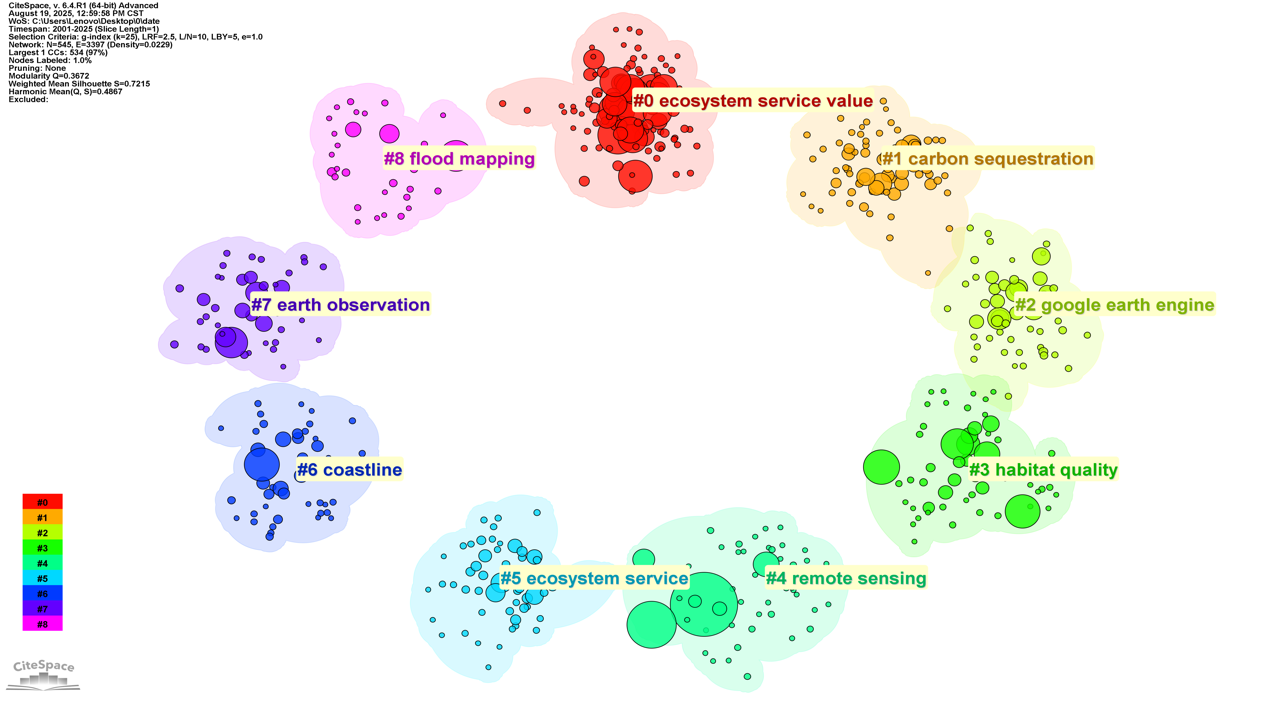
AB  - Ecosystem service valuation (ESV) provides a scientific basis for balancing ecological conservation and socioeconomic development. With the rapid progress of Earth observation technologies, remote sensing has become an essential tool for quantifying and mapping ecosystem services at multiple spatial and temporal scales. However, a comprehensive understanding of the global research landscape on ecosystem service valuation using remote sensing remains limited. In this study, this study conducted a bibliometric analysis of publications retrieved from the Web of Science Core Collection between 1990 and 2024. A total of 1172 articles were identified through a systematic search strategy integrating ecosystem service valuation and remote sensing keywords. The analysis employed performance indicators (e.g., publication output, citation trends, and core journals), collaboration networks (countries, institutions, and authors), and keyword co-occurrence to reveal research hotspots and emerging frontiers. The results show a steady growth of publications, with a significant surge after 2010 driven by the application of MODIS, Landsat, and Google Earth Engine in large-scale ESV studies. China, the United States, and several European countries play dominant roles in terms of both output and international collaboration. Research hotspots have shifted from conceptual frameworks and regional case studies to methodological innovations, such as spatial modeling, integration of remote sensing with ecosystem accounting frameworks, and applications in ecological security and sustainable development. This study highlights the increasing importance of remote sensing in advancing ecosystem service valuation and provides insights into future directions, including high-resolution monitoring, machine learning integration, and policy-oriented assessments.
SN  - 3069-3187
PB  - Institute of Central Computation and Knowledge
LA  - English
ER  -
@article{Gu2025Global,
  author = {Chengyan Gu and Tianxu Sun and Zhihui Wang and Sang Fu},
  title = {Global Research Trends on Ecosystem Service Valuation Using Remote Sensing (1990–2024)},
  journal = {Digital Intelligence in Agriculture},
  year = {2025},
  volume = {1},
  number = {2},
  pages = {47-60},
  doi = {10.62762/DIA.2025.654827},
  url = {https://www.icck.org/article/abs/DIA.2025.654827},
  abstract = {Ecosystem service valuation (ESV) provides a scientific basis for balancing ecological conservation and socioeconomic development. With the rapid progress of Earth observation technologies, remote sensing has become an essential tool for quantifying and mapping ecosystem services at multiple spatial and temporal scales. However, a comprehensive understanding of the global research landscape on ecosystem service valuation using remote sensing remains limited. In this study, this study conducted a bibliometric analysis of publications retrieved from the Web of Science Core Collection between 1990 and 2024. A total of 1172 articles were identified through a systematic search strategy integrating ecosystem service valuation and remote sensing keywords. The analysis employed performance indicators (e.g., publication output, citation trends, and core journals), collaboration networks (countries, institutions, and authors), and keyword co-occurrence to reveal research hotspots and emerging frontiers. The results show a steady growth of publications, with a significant surge after 2010 driven by the application of MODIS, Landsat, and Google Earth Engine in large-scale ESV studies. China, the United States, and several European countries play dominant roles in terms of both output and international collaboration. Research hotspots have shifted from conceptual frameworks and regional case studies to methodological innovations, such as spatial modeling, integration of remote sensing with ecosystem accounting frameworks, and applications in ecological security and sustainable development. This study highlights the increasing importance of remote sensing in advancing ecosystem service valuation and provides insights into future directions, including high-resolution monitoring, machine learning integration, and policy-oriented assessments.},
  keywords = {remote sensing, ecosystem service valuation, bibliometric analysis, natural capital accounting},
  issn = {3069-3187},
  publisher = {Institute of Central Computation and Knowledge}
}
 Copyright © 2025 by the Author(s). Published by Institute of Central Computation and Knowledge. This article is an open access article distributed under the terms and conditions of the Creative Commons Attribution (CC BY) license (https://creativecommons.org/licenses/by/4.0/), which permits use, sharing, adaptation, distribution and reproduction in any medium or format, as long as you give appropriate credit to the original author(s) and the source, provide a link to the Creative Commons licence, and indicate if changes were made.

Portico
All published articles are preserved here permanently:
https://www.portico.org/publishers/icck/