
Development of an Intelligent Fertigation Machine and Its Application Test in Soilless Cultivation of Mountain Blueberry



Article Information
Abstract
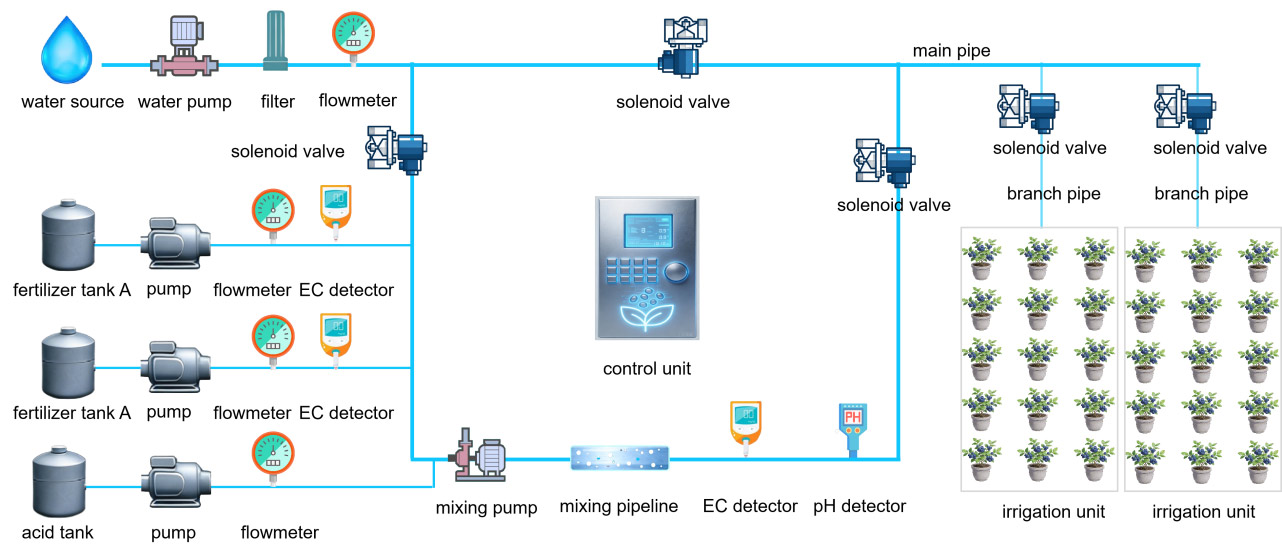
Conventional manual fertigation practices are generally limited by low control precision, considerable water and fertilizer waste, and poor adaptability to varied horticultural cultivation conditions. These limitations create particularly prominent challenges for high-value cash crops that are highly sensitive to root-zone substrate electrical conductivity (EC) and pH dynamics. To address these gaps, this study developed a digitally intelligent integrated fertigation system that integrates multi-sensor autonomous sensing, precise nutrient ratio regulation, and full-cycle operational monitoring modules. Systematic validation of both equipment performance and field production benefits was carried out via field plot experiments under typical mountainous soilless blueberry cultivation conditions. The test results showed that the developed fertigation system achieved a control uniformity of 95.28% for EC and 95.07% for pH. Under the prerequisite of identical total irrigation volume and total nutrient supply across the whole growing season, the precise control mode (PCM) of the proposed intelligent fertigation system exhibited significantly higher water use efficiency (WUE) and partial factor productivity of fertilizer (PFP) than the conventional simple fertigation management mode (SFM). Meanwhile, the unit-area yield of blueberries in the PCM treatment increased by 20.1%, and the commercial uniformity of individual fruit weight was significantly improved. This fully validated system can well meet the intelligent production requirements of mountainous soilless blueberry cultivation and provides a viable technical solution to support the intelligent upgrading of local soilless blueberry industries in Southwest China.
Graphical Abstract
Keywords
Data Availability Statement
Funding
Conflicts of Interest
AI Use Statement
Ethical Approval and Consent to Participate
References
- FAO. (2025). The State of the World's Land and Water Resources for Food and Agriculture 2025: The potential to produce more and better. Rome: FAO.
[CrossRef] [Google Scholar] - FAO. (2025). FAOSTAT: Fertilizers by nutrient. Last update July 11, 2025. Retrieved from https://www.fao.org/faostat/en/#data/RFN
[Google Scholar] - Liu, J., Wang, H., Penuelas, J., Mou, J., Delgado-Baquerizo, M., Sardans, J., ... & Fang, L. (2025). Global-scale prevalence of low nutrient use efficiency across major crops. Nature Communications, 16(1), 11036.
[CrossRef] [Google Scholar] - Adamo, T., Caivano, D., Colizzi, L., Dimauro, G., & Guerriero, E. (2025). Optimization of irrigation and fertigation in smart agriculture: An IoT-based micro-services framework. Smart Agricultural Technology, 11, 100885.
[CrossRef] [Google Scholar] - Incrocci, L., Massa, D., & Pardossi, A. (2017). New trends in the fertigation management of irrigated vegetable crops. Horticulturae, 3(2), 37.
[CrossRef] [Google Scholar] - Xing, Y., & Wang, X. (2024). Precise application of water and fertilizer to crops: challenges and opportunities. Frontiers in Plant Science, 15, 1444560.
[CrossRef] [Google Scholar] - Sun, G., Li, X., Wang, X., Li, Y., Chen, M., Zhang, Y., & Yan, T. (2015). Design and testing of a nutrient mixing machine for greenhouse fertigation. Engineering in Agriculture, Environment and Food, 8(2), 114-121.
[CrossRef] [Google Scholar] - Wu, Y., Li, L., Li, S., Wang, H., Zhang, M., Sun, H., Sygrimis, N., & Li, M. (2019). Optimal control algorithm of fertigation system in greenhouse based on EC model. International Journal of Agricultural and Biological Engineering, 12(3), 118-125. https://dx.doi.org/10.25165/j.ijabe.20191203.4680
[Google Scholar] - Lin, N., Wang, X., Zhang, Y., Hu, X., & Ruan, J. (2020). Fertigation management for sustainable precision agriculture based on Internet of Things. Journal of Cleaner Production, 277, 124119.
[CrossRef] [Google Scholar] - Zhu, F., Zhang, L., Hu, X., Zhao, J., Meng, Z., & Zheng, Y. (2023). Research and design of hybrid optimized backpropagation (BP) neural network PID algorithm for integrated water and fertilizer precision fertilization control system for field crops. Agronomy, 13(5), 1423.
[CrossRef] [Google Scholar] - Li, W., Zhao, J., Xu, H., Wang, C., Liu, X., Lou, S., ... & Zou, H. (2026). Development of a vision-based growth-stage determination and PLC-based fertigation parameter invocation system for greenhouse blueberry. Agriculture, 16(15), 1638.
[CrossRef] [Google Scholar] - Fathidarehnijeh, E., Nadeem, M., Cheema, M., Thomas, R., Krishnapillai, M., & Galagedara, L. (2023). Current perspective on nutrient solution management strategies to improve the nutrient and water use efficiency in hydroponic systems. Canadian Journal of Plant Science, 104(2), 88-102.
[CrossRef] [Google Scholar] - Li, H., Mei, X., Wang, J., Huang, F., Hao, W., & Li, B. (2021). Drip fertigation significantly increased crop yield, water productivity and nitrogen use efficiency with respect to traditional irrigation and fertilization practices: A meta-analysis in China. Agricultural Water Management, 244, 106534.
[CrossRef] [Google Scholar] - Domingues, D. S., Takahashi, H. W., Camara, C. A. P., & Nixdorf, S. L. (2012). Automated system developed to control pH and concentration of nutrient solution evaluated in hydroponic lettuce production. Computers and Electronics in Agriculture, 84, 53-61.
[CrossRef] [Google Scholar] - Ehret, D. L., Frey, B., Forge, T., Helmer, T., & Bryla, D. R. (2012). Effects of drip irrigation configuration and rate on yield and fruit quality of young highbush blueberry plants. HortScience, 47(3), 414-421.
[CrossRef] [Google Scholar] - Wang, X., & Xing, Y. (2017). Evaluation of the effects of irrigation and fertilization on tomato fruit yield and quality: a principal component analysis. Scientific Reports, 7(1), 350.
[CrossRef] [Google Scholar] - Howell, T. A. (2001). Enhancing water use efficiency in irrigated agriculture. Agronomy Journal, 93(2), 281-289.
[CrossRef] [Google Scholar] - Fixen, P., Brentrup, F., Bruulsema, T., Garcia, F., Norton, R., & Zingore, S. (2015). Nutrient/fertilizer use efficiency: measurement, current situation and trends. Managing water and fertilizer for sustainable agricultural intensification, 270, 1-30.
[Google Scholar] - Dobermann, A. (2007). Nutrient use efficiency - measurement and management. In Fertilizer Best Management Practices: General Principles, Strategy for their Adoption and Voluntary Initiatives vs Regulations (pp. 1-28). Paris: International Fertilizer Industry Association (IFA). https://digitalcommons.unl.edu/agronomyfacpub/1442/
[Google Scholar] - Anwar, A., Zheng, J., Chen, C., Chen, M., Xue, Y., Wang, J., ... & Song, S. (2024). Effects of NH4+-N: NO3--N ratio on growth, nutrient uptake and production of blueberry (Vaccinium spp.) under soilless culture. Frontiers in plant science, 15, 1438811.
[CrossRef] [Google Scholar] - Feng, X., Pu, J., Liu, H., Wang, D., Liu, Y., Qiao, S., Lei, T., & Liu, R. (2023). Effect of fertigation frequency on soil nitrogen distribution and tomato yield under alternate partial root-zone drip irrigation. Journal of Integrative Agriculture, 22(3), 897-907.
[CrossRef] [Google Scholar] - Michelon, N., Pennisi, G., Myint, N. O., Orsini, F., & Gianquinto, G. (2020). Strategies for improved water use efficiency (WUE) of field-grown lettuce (Lactuca sativa L.) under a semi-arid climate. Agronomy, 10(5), 668.
[CrossRef] [Google Scholar] - Qubbaj, T., & Shtaya, M. (2022). Effect of different soilless agriculture methods on irrigation water saving and growth of lettuce (Lactuca sativa). Research on Crops, 23(1), 156-162. http://dx.doi.org/10.31830/2348-7542.2022.022
[Google Scholar] - Segal, E., Ben-Gal, A., & Shani, U. (2006). Root water uptake efficiency under ultra-high irrigation frequency. Plant and Soil, 282(1-2), 333-341.
[CrossRef] [Google Scholar] - Farneselli, M., Benincasa, P., Tosti, G., Simonne, E., Guiducci, M., & Tei, F. (2015). High fertigation frequency improves nitrogen uptake and crop performance in processing tomato grown with high nitrogen and water supply. Agricultural Water Management, 154, 52-58.
[CrossRef] [Google Scholar] - Silber, A., Xu, G., Levkovitch, I., Soriano, S., Bilu, A., & Wallach, R. (2003). High fertigation frequency: the effects on uptake of nutrients, water and plant growth. Plant and Soil, 253(2), 467-477.
[CrossRef] [Google Scholar] - Pinzon, D. A., Amado, G., Rodriguez, J., & Villagran, E. (2026). A systematic review of integrated management in blueberry (Vaccinium spp.): technological innovation, sustainability, and practices in propagation, physiology, agronomy, harvest, and postharvest. Crops, 6(1), 15.
[CrossRef] [Google Scholar] - Tuxun, A., Xiang, Y., Shao, Y., Son, J. E., Yamada, M., Yamada, S., ... & Yang, Q. (2025). Soilless cultivation: precise nutrient provision and growth environment regulation under different substrates. Plants, 14(14), 2203.
[CrossRef] [Google Scholar] - Hussain, F., Ahmed, S., Naqvi, S. M. Z. A., Awais, M., Zhang, Y., Zhang, H., ... & Hu, J. (2025). Agricultural non-point source pollution: comprehensive analysis of sources and assessment methods. Agriculture, 15(5), 531.
[CrossRef] [Google Scholar] - Jarecki, W., Balawejder, M., & Matłok, N. (2025). Sustainable Fertilization Management Consequences to Horticultural Crops. Horticulturae, 11(9), 1049.
[CrossRef] [Google Scholar] - Yang, H., Duan, Y., Wei, Z., Wu, Y., Zhang, C., Wu, W., ... & Li, W. (2022). Integrated physiological and metabolomic analyses reveal the differences in the fruit quality of the blueberry cultivated in three soilless substrates. Foods, 11(24), 3965.
[CrossRef] [Google Scholar] - Massa, D., Magán, J. J., Montesano, F. F., & Tzortzakis, N. (2020). Minimizing water and nutrient losses from soilless cropping in southern Europe. Agricultural water management, 241, 106395.
[CrossRef] [Google Scholar]
Cite This Article
TY  - JOUR
AU  - Yang, Chunxiang
PY  - 2026
DA  - 2026/11/09
TI  - Development of an Intelligent Fertigation Machine and Its Application Test in Soilless Cultivation of Mountain Blueberry
JO  - Digital Intelligence in Agriculture
T2  - Digital Intelligence in Agriculture
JF  - Digital Intelligence in Agriculture
VL  - 2
IS  - 4
SP  - 203
EP  - 213
DO  - 10.62762/DIA.2026.142287
UR  - https://www.icck.org/article/abs/dia.2026.142287
KW  - intelligent fertigation machine
KW  - water-fertilizer integration
KW  - mountain blueberry
KW  - soilless cultivation
KW  - equipment performance evaluation
AB  - Conventional manual fertigation practices are generally limited by low control precision, considerable water and fertilizer waste, and poor adaptability to varied horticultural cultivation conditions. These limitations create particularly prominent challenges for high-value cash crops that are highly sensitive to root-zone substrate electrical conductivity (EC) and pH dynamics. To address these gaps, this study developed a digitally intelligent integrated fertigation system that integrates multi-sensor autonomous sensing, precise nutrient ratio regulation, and full-cycle operational monitoring modules. Systematic validation of both equipment performance and field production benefits was carried out via field plot experiments under typical mountainous soilless blueberry cultivation conditions. The test results showed that the developed fertigation system achieved a control uniformity of 95.28% for EC and 95.07% for pH. Under the prerequisite of identical total irrigation volume and total nutrient supply across the whole growing season, the precise control mode (PCM) of the proposed intelligent fertigation system exhibited significantly higher water use efficiency (WUE) and partial factor productivity of fertilizer (PFP) than the conventional simple fertigation management mode (SFM). Meanwhile, the unit-area yield of blueberries in the PCM treatment increased by 20.1%, and the commercial uniformity of individual fruit weight was significantly improved. This fully validated system can well meet the intelligent production requirements of mountainous soilless blueberry cultivation and provides a viable technical solution to support the intelligent upgrading of local soilless blueberry industries in Southwest China.
SN  - 3069-3187
PB  - Institute of Central Computation and Knowledge
LA  - English
ER  -
@article{Yang2026Developmen,
  author = {Chunxiang Yang},
  title = {Development of an Intelligent Fertigation Machine and Its Application Test in Soilless Cultivation of Mountain Blueberry},
  journal = {Digital Intelligence in Agriculture},
  year = {2026},
  volume = {2},
  number = {4},
  pages = {203-213},
  doi = {10.62762/DIA.2026.142287},
  url = {https://www.icck.org/article/abs/dia.2026.142287},
  abstract = {Conventional manual fertigation practices are generally limited by low control precision, considerable water and fertilizer waste, and poor adaptability to varied horticultural cultivation conditions. These limitations create particularly prominent challenges for high-value cash crops that are highly sensitive to root-zone substrate electrical conductivity (EC) and pH dynamics. To address these gaps, this study developed a digitally intelligent integrated fertigation system that integrates multi-sensor autonomous sensing, precise nutrient ratio regulation, and full-cycle operational monitoring modules. Systematic validation of both equipment performance and field production benefits was carried out via field plot experiments under typical mountainous soilless blueberry cultivation conditions. The test results showed that the developed fertigation system achieved a control uniformity of 95.28\% for EC and 95.07\% for pH. Under the prerequisite of identical total irrigation volume and total nutrient supply across the whole growing season, the precise control mode (PCM) of the proposed intelligent fertigation system exhibited significantly higher water use efficiency (WUE) and partial factor productivity of fertilizer (PFP) than the conventional simple fertigation management mode (SFM). Meanwhile, the unit-area yield of blueberries in the PCM treatment increased by 20.1\%, and the commercial uniformity of individual fruit weight was significantly improved. This fully validated system can well meet the intelligent production requirements of mountainous soilless blueberry cultivation and provides a viable technical solution to support the intelligent upgrading of local soilless blueberry industries in Southwest China.},
  keywords = {intelligent fertigation machine, water-fertilizer integration, mountain blueberry, soilless cultivation, equipment performance evaluation},
  issn = {3069-3187},
  publisher = {Institute of Central Computation and Knowledge}
}
Article Metrics
Publisher's Note
ICCK stays neutral with regard to jurisdictional claims in published maps and institutional affiliations.
Rights and Permissions
 Copyright © 2026 by the Author(s). Published by Institute of Central Computation and Knowledge. This article is an open access article distributed under the terms and conditions of the Creative Commons Attribution (CC BY) license (https://creativecommons.org/licenses/by/4.0/), which permits use, sharing, adaptation, distribution and reproduction in any medium or format, as long as you give appropriate credit to the original author(s) and the source, provide a link to the Creative Commons licence, and indicate if changes were made.