Volume 1, Issue 1, Frontiers in Biomedical Signal Processing
Volume 1, Issue 1, 2025
Submit Manuscript Edit a Special Issue
Article QR Code
Article QR Code
Scan the QR code for reading
Popular articles
Frontiers in Biomedical Signal Processing, Volume 1, Issue 1, 2025: 49-70

Open Access | Research Article | 26 February 2026
Advancing PCOS Diagnosis: Harnessing the Power of AI and Machine Learning for Enhanced Accuracy and Efficiency
1 Department of Computing and Esports, School of Digital, Technology, Innovation and Business, Staffordshire University, Stoke-on-Trent ST4 2DE, United Kingdom
2 Preventative Gynaecology Research Center, Shahid Beheshti University of Medical Sciences, Tehran, Iran
3 Iran University of Science and Technology (IUST), Tehran 16846-13114, Iran
4 Faculty of Broadcast Engineering, Islamic Republic of Iran Broadcasting University (IRIBU), Tehran, Iran
5 Department of Mechanical Engineering, School of Engineering, University of Birmingham, Birmingham, United Kingdom
6 Department of Computer Engineering, Central Tehran Branch, Islamic Azad University, Tehran, Iran
7 Department of Obstetrics and Gynecology, School of Medicine, Iran University of Medical Sciences, Tehran, Iran
8 Tehran University of Medical Sciences, Tehran, Iran
9 Department of Computer Science and Mathematics, Amirkabir University of Technology, Tehran 1591634311, Iran
10 Student Research Committee, Urmia University of Medical Sciences, Urmia, Iran
* Corresponding Author: Alireza Soleimani Mamalo, [email protected]
ARK: ark:/57805/fbsp.2025.529389
Received: 09 July 2025, Accepted: 26 July 2025, Published: 26 February 2026  
Abstract
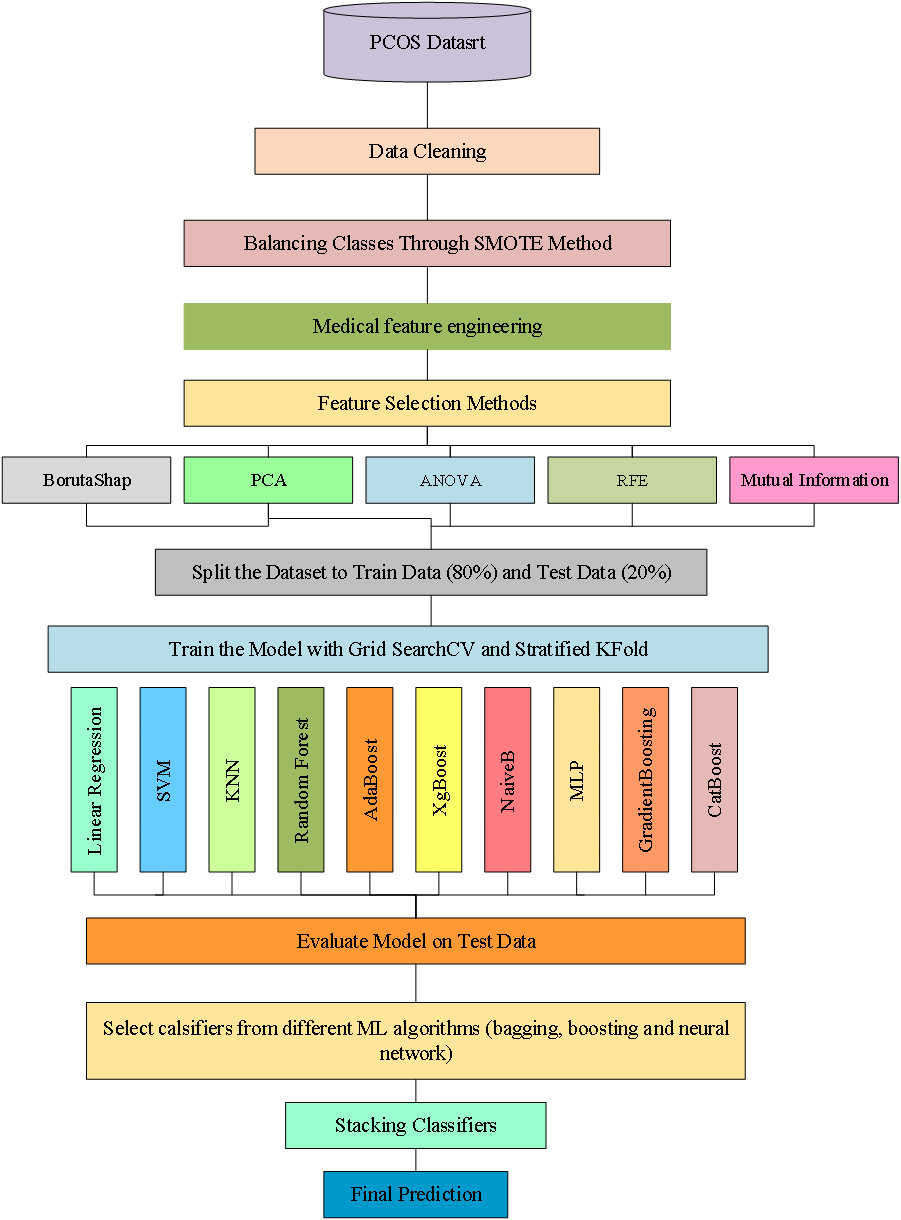
This research presents a diagnostic method for Polycystic Ovary Syndrome (PCOS), a common hormonal disorder among women of childbearing age. The study applied machine learning classifiers—Random Forest, CatBoost, and MLP—to the Kaggle PCOS dataset, enhanced by BorutaShap and SMOTE feature selection methods. The ensemble classifier achieved an F1 score of 93.54% and an accuracy of 96.71%. These results demonstrate AI's potential to improve PCOS diagnosis for broader clinical applications. Future research should integrate genetic and epigenetic factors into AI models, validated through clinical trials. Key contributions include: using an ensemble of machine learning classifiers, advanced feature selection methods, and achieving high F1 and accuracy scores, showing the model's clinical effectiveness.

Graphical Abstract
Advancing PCOS Diagnosis: Harnessing the Power of AI and Machine Learning for Enhanced Accuracy and Efficiency

Keywords
polycystic ovary syndrome (PCOS)
hormonal disorder
reproductive age
infertility
early detection
classifiers
feature selection
artificial intelligence

Data Availability Statement
Data will be made available on request.

Funding
This work was supported without any funding.

Conflicts of Interest
The authors declare no conflicts of interest. 

AI Use Statement
The authors declare that no generative AI was used in the preparation of this manuscript.

Ethical Approval and Consent to Participate
This study was conducted in accordance with the ethical principles and national norms and standards for conducting medical research in Iran, as approved by the Research Ethics Committee of Urmia University of Medical Sciences (Approval ID: IR.UMSU.REC.1403.234, Approval Date: 2024-10-30). Written informed consent was obtained from all participants. The researchers ensured compliance with all professional and legal requirements, maintaining the confidentiality and anonymity of participant data.

References
  1. Riestenberg, C., Jagasia, A., Markovic, D., Buyalos, R. P., & Azziz, R. (2022). Health care-related economic burden of polycystic ovary syndrome in the United States: pregnancy-related and long-term health consequences. The Journal of Clinical Endocrinology & Metabolism, 107(2), 575-585.
    [CrossRef]   [Google Scholar]
  2. Notaro, A. L. G., & Neto, F. T. L. (2022). The use of metformin in women with polycystic ovary syndrome: an updated review. Journal of assisted reproduction and genetics, 39(3), 573-579.
    [CrossRef]   [Google Scholar]
  3. Dinsdale, N., Nepomnaschy, P., & Crespi, B. (2021). The evolutionary biology of endometriosis. Evolution, medicine, and public health, 9(1), 174-191.
    [CrossRef]   [Google Scholar]
  4. Harris, H. R., Titus, L. J., Cramer, D. W., & Terry, K. L. (2017). Long and irregular menstrual cycles, polycystic ovary syndrome, and ovarian cancer risk in a population‐based case‐control study. International journal of cancer, 140(2), 285-291.
    [CrossRef]   [Google Scholar]
  5. Zheng, S., Chen, Y., Ma, M., & Li, M. (2022). Mechanism of quercetin on the improvement of ovulation disorder and regulation of ovarian CNP/NPR2 in PCOS model rats. Journal of the Formosan Medical Association, 121(6), 1081-1092.
    [CrossRef]   [Google Scholar]
  6. Schmid, J., Kirchengast, S., Vytiska-Binstorfer, E., & Huber, J. (2004). Infertility caused by PCOS—health-related quality of life among Austrian and Moslem immigrant women in Austria. Human reproduction, 19(10), 2251-2257.
    [CrossRef]   [Google Scholar]
  7. Homburg, R. (2003). The management of infertility associated with polycystic ovary syndrome. Reproductive Biology and Endocrinology, 1(1), 109.
    [CrossRef]   [Google Scholar]
  8. Ahmed, A. A., Moselhy, S. S., Kumosani, T. A., Huwait, E. A., Al-Ghamdi, M. A., Al-Madani, K. A., ... & Kumosani, A. T. (2020). Ultrasonographic and biochemical assessments as early prediction of polycystic ovarian syndrome in obese women. African Health Sciences, 20(2), 676-681.
    [CrossRef]   [Google Scholar]
  9. Kodama, S., & Torrealday, S. (2021). Pharmacologic treatments for PCOS patients. Clinical obstetrics and gynecology, 64(1), 55-64.
    [CrossRef]   [Google Scholar]
  10. Fernandez, R. C., Moore, V. M., Rumbold, A. R., Whitrow, M. J., Avery, J. C., & Davies, M. J. (2021). Diagnosis delayed: health profile differences between women with undiagnosed polycystic ovary syndrome and those with a clinical diagnosis by age 35 years. Human Reproduction, 36(8), 2275-2284.
    [CrossRef]   [Google Scholar]
  11. ESHRE, T. R., & ASRM-Sponsored PCOS Consensus Workshop Group. (2004). Revised 2003 consensus on diagnostic criteria and long-term health risks related to polycystic ovary syndrome. Fertility and sterility, 81(1), 19-25.
    [CrossRef]   [Google Scholar]
  12. Gesteiro, E., Megía, A., Guadalupe-Grau, A., Fernandez-Veledo, S., Vendrell, J., & González-Gross, M. (2021). Early identification of metabolic syndrome risk: A review of reviews and proposal for defining pre-metabolic syndrome status. Nutrition, Metabolism and Cardiovascular Diseases, 31(9), 2557-2574.
    [CrossRef]   [Google Scholar]
  13. Wang, J., Chen, R., Long, H., He, J., Tang, M., Su, M., ... & Tang, L. (2025). Artificial intelligence in polycystic ovarian syndrome management: past, present, and future. La radiologia medica, 1-33.
    [CrossRef]   [Google Scholar]
  14. Sadi, R. P. R., Raju, Y., Saravanan, M. G., & Chandra, G. R. (2022). AI APPLICATIONS. GCS PUBLISHERS.
    [Google Scholar]
  15. Greener, J. G., Kandathil, S. M., Moffat, L., & Jones, D. T. (2022). A guide to machine learning for biologists. Nature reviews Molecular cell biology, 23(1), 40-55.
    [CrossRef]   [Google Scholar]
  16. Zigarelli, A., Jia, Z., & Lee, H. (2022). Machine-aided self-diagnostic prediction models for polycystic ovary syndrome: observational study. JMIR Formative Research, 6(3), e29967.
    [CrossRef]   [Google Scholar]
  17. Allan, S., Olaiya, R., & Burhan, R. (2022). Reviewing the use and quality of machine learning in developing clinical prediction models for cardiovascular disease. Postgraduate Medical Journal, 98(1161), 551-558.
    [CrossRef]   [Google Scholar]
  18. Mahesswari, G. U., & Maheswari, P. U. (2024). SmartScanPCOS: a feature-driven approach to cutting-edge prediction of polycystic ovary syndrome using machine learning and explainable artificial intelligence. Heliyon, 11, e39205.
    [CrossRef]   [Google Scholar]
  19. Kumar, A., Sharma, D., Tyagi, A., Kapoor, A., & Mishra, A. (2024, April). Machine Learning Framework for Polycystic Ovary Syndrome. In International Conference on Information and Communication Technology for Intelligent Systems (pp. 367-379). Singapore: Springer Nature Singapore.
    [CrossRef]   [Google Scholar]
  20. Rachana, B., Priyanka, T., Sahana, K. N., Supritha, T. R., Parameshachari, B. D., & Sunitha, R. (2021). Detection of polycystic ovarian syndrome using follicle recognition technique. Global Transitions Proceedings, 2(2), 304-308.
    [CrossRef]   [Google Scholar]
  21. Gopalakrishnan, C., & Iyapparaja, M. (2021). Multilevel thresholding based follicle detection and classification of polycystic ovary syndrome from the ultrasound images using machine learning. International Journal of System Assurance Engineering and Management, 1-8.
    [CrossRef]   [Google Scholar]
  22. Jeevitha, S., & Priya, N. (2022, July). Optimized segmentation technique for detecting PCOS in ultrasound images. In Congress on Intelligent Systems: Proceedings of CIS 2021, Volume 1 (pp. 759-771). Singapore: Springer Nature Singapore.
    [CrossRef]   [Google Scholar]
  23. Zhang, L., Wen, J., Li, Y., Chen, J., Ye, Y., Fu, Y., & Livingood, W. (2021). A review of machine learning in building load prediction. Applied Energy, 285, 116452.
    [CrossRef]   [Google Scholar]
  24. Liu, H., & Yu, L. (2005). Toward integrating feature selection algorithms for classification and clustering. IEEE Transactions on knowledge and data engineering, 17(4), 491-502.
    [CrossRef]   [Google Scholar]
  25. Urbanowicz, R. J., Meeker, M., La Cava, W., Olson, R. S., & Moore, J. H. (2018). Relief-based feature selection: Introduction and review. Journal of biomedical informatics, 85, 189-203.
    [CrossRef]   [Google Scholar]
  26. Maroco, J., Silva, D., Rodrigues, A., Guerreiro, M., Santana, I., & De Mendonça, A. (2011). Data mining methods in the prediction of Dementia: A real-data comparison of the accuracy, sensitivity and specificity of linear discriminant analysis, logistic regression, neural networks, support vector machines, classification trees and random forests. BMC research notes, 4(1), 299.
    [CrossRef]   [Google Scholar]
  27. Jaw, E., & Wang, X. (2021). Feature selection and ensemble-based intrusion detection system: an efficient and comprehensive approach. Symmetry, 13(10), 1764.
    [CrossRef]   [Google Scholar]
  28. Danaei Mehr, H., & Polat, H. (2022). Diagnosis of polycystic ovary syndrome through different machine learning and feature selection techniques. Health and Technology, 12(1), 137-150.
    [CrossRef]   [Google Scholar]
  29. Meena, K., Manimekalai, M., & Rethinavalli, S. (2015). Correlation of artificial neural network classification and NFRS attribute filtering algorithm for PCOS data. Int. J. Res. Eng. Technol, 4(3), 519-524.
    [CrossRef]   [Google Scholar]
  30. Balogun, J. A., Egejuru, N. C., & Idowu, P. A. (2018). Comparative analysis of predictive models for the likelihood of infertility in women using supervised machine learning techniques. Computer Reviews Journal, 2(1), 313-330.
    [Google Scholar]
  31. Vikas, B., Anuhya, B. S., Chilla, M., & Sarangi, S. (2018). A critical study of Polycystic Ovarian Syndrome (PCOS) classification techniques. Int J Comput Eng Manag, 4, 1-7.
    [Google Scholar]
  32. Zhang, X., Liang, B., Zhang, J., Hao, X., Xu, X., Chang, H. M., ... & Tan, J. (2021). Raman spectroscopy of follicular fluid and plasma with machine-learning algorithms for polycystic ovary syndrome screening. Molecular and cellular endocrinology, 523, 111139.
    [CrossRef]   [Google Scholar]
  33. Nandipati, S. C., & Ying, C. X. (2020). Polycystic Ovarian Syndrome (PCOS) classification and feature selection by machine learning techniques. Applied Mathematics and Computational Intelligence (AMCI), 9, 65-74.
    [Google Scholar]
  34. Inan, M. S. K., Ulfath, R. E., Alam, F. I., Bappee, F. K., & Hasan, R. (2021, January). Improved sampling and feature selection to support extreme gradient boosting for PCOS diagnosis. In 2021 IEEE 11th annual computing and communication workshop and conference (CCWC) (pp. 1046-1050). IEEE.
    [CrossRef]   [Google Scholar]
  35. Munjal, A., Khandia, R., & Gautam, B. (2020). A machine learning approach for selection of Polycystic Ovarian Syndrome (PCOS) attributes and comparing different classifier performance with the help of WEKA and PyCaret. Int. J. Sci. Res, 9, 1-5.
    [Google Scholar]
  36. Pushkarini, H., & Anusuya, M. A. (2020). A prediction model for evaluating the risk of developing PCOS. Int Res J Eng Technol (IRJET), 7(9), 1150-6.
    [Google Scholar]
  37. Neto, C., Silva, M., Fernandes, M., Ferreira, D., & Machado, J. (2021, February). Prediction models for Polycystic Ovary Syndrome using data mining. In International Conference on Advances in Digital Science (pp. 210-221). Cham: Springer International Publishing.
    [CrossRef]   [Google Scholar]
  38. Bharati, S., Podder, P., & Mondal, M. R. H. (2020, June). Diagnosis of polycystic ovary syndrome using machine learning algorithms. In 2020 IEEE region 10 symposium (TENSYMP) (pp. 1486-1489). IEEE.
    [CrossRef]   [Google Scholar]
  39. Hassan, M. M., & Mirza, T. (2020). Comparative analysis of machine learning algorithms in diagnosis of polycystic ovarian syndrome. Int. J. Comput. Appl, 975(8887).
    [CrossRef]   [Google Scholar]
  40. Prapty, A. S., & Shitu, T. T. (2020, December). An efficient decision tree establishment and performance analysis with different machine learning approaches on polycystic ovary syndrome. In 2020 23rd International conference on computer and information technology (ICCIT) (pp. 1-5). IEEE.
    [CrossRef]   [Google Scholar]
  41. Tanwani, N. (2020). Detecting PCOS using machine learning. Int J Modern Trends Eng Sci (IJMTES), 7(1), 1-20.
    [Google Scholar]
  42. Thomas, N., & Kavitha, A. (2020). Prediction of polycystic ovarian syndrome with clinical dataset using a novel hybrid data mining classification technique. Int J Adv Res Eng Technol (IJARET), 11(11), 1872-1881.
    [Google Scholar]
  43. Dekking, F. M. (2005). A Modern Introduction to Probability and Statistics: Understanding why and how. Springer Science & Business Media.
    [Google Scholar]
  44. Kiconco, S., Earnest, A., Enticott, J., Hart, R., Mori, T. A., Hickey, M., ... & Joham, A. E. (2023). Normative cut-offs for polycystic ovary syndrome diagnostic features in adolescents using cluster analysis. European journal of endocrinology, 188(6), 494-502.
    [CrossRef]   [Google Scholar]
  45. Dapas, M., Lin, F. T., Nadkarni, G. N., Sisk, R., Legro, R. S., Urbanek, M., ... & Dunaif, A. (2020). Distinct subtypes of polycystic ovary syndrome with novel genetic associations: an unsupervised, phenotypic clustering analysis. PLoS medicine, 17(6), e1003132.
    [CrossRef]   [Google Scholar]
  46. Ester, M., Kriegel, H. P., Sander, J., & Xu, X. (1996, August). A density-based algorithm for discovering clusters in large spatial databases with noise. In kdd (Vol. 96, No. 34, pp. 226-231).
    [Google Scholar]
  47. Karadayı Ataş, P. (2024). Exploring the molecular interaction of PCOS and endometrial carcinoma through novel hyperparameter-optimized ensemble clustering approaches. Mathematics, 12(2), 295.
    [CrossRef]   [Google Scholar]
  48. Expert Panel on the Identification, Treatment of Overweight, Obesity in Adults (US), National Heart, Lung, Blood Institute, ... & Kidney Diseases (US). (1998). Clinical guidelines on the identification, evaluation, and treatment of overweight and obesity in adults: the evidence report (No. 98). National Institutes of Health, National Heart, Lung, and Blood Institute.
    [Google Scholar]
  49. Consultation, W. H. O. (2000). Obesity: preventing and managing the global epidemic. World Health Organ Tech Rep Ser, 894, 1-253.
    [Google Scholar]
  50. Fraser, I. S., Critchley, H. O., Munro, M. G., & Broder, M. (2007). A process designed to lead to international agreement on terminologies and definitions used to describe abnormalities of menstrual bleeding. Fertility and sterility, 87(3), 466-476.
    [CrossRef]   [Google Scholar]
  51. Fraser, I. S., Critchley, H. O. D., Munro, M. G., & Broder, M. (2007). Can we achieve international agreement on terminologies and definitions used to describe abnormalities of menstrual bleeding?. Human reproduction, 22(3), 635-643.
    [CrossRef]   [Google Scholar]
  52. Grenache, D. G. (2020). Current practices when reporting quantitative human chorionic gonadotropin test results. The Journal of Applied Laboratory Medicine, 5(5), 850-857.
    [CrossRef]   [Google Scholar]
  53. Ae, T. (1997). Determinants of abnormal gonadotropin secretion in clinically defined women with polycystic ovary syndrome. J Clin Endocrinol Metab, 82, 2248-2256.
    [Google Scholar]
  54. Arroyo, A., Laughlin, G. A., Morales, A. J., & Yen, S. S. C. (1997). Inappropriate gonadotropin secretion in polycystic ovary syndrome: influence of adiposity. The Journal of Clinical Endocrinology & Metabolism, 82(11), 3728-3733.
    [CrossRef]   [Google Scholar]
  55. Alberti, K. G. M., Zimmet, P., & Shaw, J. (2005). The metabolic syndrome—a new worldwide definition. The Lancet, 366(9491), 1059-1062.
    [CrossRef]   [Google Scholar]
  56. Cappola, A. R. (2019). The thyrotropin reference range should be changed in older patients. Jama, 322(20), 1961-1962.
    [CrossRef]   [Google Scholar]
  57. Schlechte, J., Sherman, B., Halmi, N., vanGilder, J., Chapler, F., Dolan, K., ... & Harris, C. (1980). Prolactin-secreting pituitary tumors in amenorrheic women: a comprehensive study. Endocrine reviews, 1(3), 295-308.
    [CrossRef]   [Google Scholar]
  58. Giustina, A., Adler, R. A., Binkley, N., Bouillon, R., Ebeling, P. R., Lazaretti-Castro, M., ... & Bilezikian, J. P. (2019). Controversies in vitamin D: summary statement from an international conference. The Journal of Clinical Endocrinology & Metabolism, 104(2), 234-240.
    [CrossRef]   [Google Scholar]
  59. Chen, S., & He, H. (2013). Nonstationary stream data learning with imbalanced class distribution. Imbalanced learning: Foundations, algorithms, and applications, 151-186.
    [Google Scholar]
  60. Guyon, I., & Elisseeff, A. (2003). An introduction to variable and feature selection. Journal of machine learning research, 3(Mar), 1157-1182. https://psycnet.apa.org/doi/10.1162/153244303322753616
    [Google Scholar]
  61. Duch, W. (2006). Filter methods. In Feature extraction: foundations and applications (pp. 89-117). Berlin, Heidelberg: Springer Berlin Heidelberg.
    [CrossRef]   [Google Scholar]
  62. Ang, J. C., Mirzal, A., Haron, H., & Hamed, H. N. A. (2015). Supervised, unsupervised, and semi-supervised feature selection: a review on gene selection. IEEE/ACM transactions on computational biology and bioinformatics, 13(5), 971-989.
    [CrossRef]   [Google Scholar]
  63. Li, G., Yu, Z., Yang, K., Lin, M., & Chen, C. P. (2024). Exploring feature selection with limited labels: A comprehensive survey of semi-supervised and unsupervised approaches. IEEE Transactions on Knowledge and Data Engineering, 36(11), 6124-6144.
    [CrossRef]   [Google Scholar]
  64. Kuhn, M., & Johnson, K. (2013). Applied predictive modeling (Vol. 26, p. 13). New York: Springer.
    [CrossRef]   [Google Scholar]
  65. Liu, B., Xia, H., Zhang, J., Hu, Y., & Wang, Q. (2025). Building Personalized Risk Prediction Models fBuilding Personalized Risk Prediction Models for Polycystic Ovary Syndrome Using Machine Learning Techniques: A Retrospectivor Polycystic Ovary Syndrome Using Machine Learning Techniques: A Retrospective Study. Current Science, 5(2), 1942-1955.
    [Google Scholar]
  66. Schober, P., Boer, C., & Schwarte, L. A. (2018). Correlation coefficients: appropriate use and interpretation. Anesthesia & analgesia, 126(5), 1763-1768.
    [CrossRef]   [Google Scholar]
  67. Lafortuna, C. L., Agosti, F., Marazzi, N., & Sartorio, A. (2004). The relationship between body composition and muscle power output in men and women with obesity. Journal of endocrinological investigation, 27(9), 854-861.
    [CrossRef]   [Google Scholar]
  68. Chen, X. W., & Jeong, J. C. (2007, December). Enhanced recursive feature elimination. In Sixth international conference on machine learning and applications (ICMLA 2007) (pp. 429-435). IEEE.
    [CrossRef]   [Google Scholar]
  69. Ejiyi, C. J., Qin, Z., Ukwuoma, C. C., Nneji, G. U., Monday, H. N., Ejiyi, M. B., ... & Bamisile, O. O. (2025). Comparative performance analysis of Boruta, SHAP, and Borutashap for disease diagnosis: a study with multiple machine learning algorithms. Network: Computation in Neural Systems, 36(3), 507-544.
    [CrossRef]   [Google Scholar]
  70. Samara, M. N., & Harry, K. D. (2025). Integrating Boruta, LASSO, and SHAP for Clinically Interpretable Glioma Classification Using Machine Learning. BioMedInformatics, 5(3), 34.
    [CrossRef]   [Google Scholar]
  71. Bulut, O., Tan, B., Mazzullo, E., & Syed, A. (2025). Benchmarking Variants of Recursive Feature Elimination: Insights from Predictive Tasks in Education and Healthcare. Information, 16(6), 476.
    [CrossRef]   [Google Scholar]
  72. Sawyer, S. F. (2009). Analysis of variance: the fundamental concepts. Journal of Manual & Manipulative Therapy, 17(2), 27E-38E.
    [CrossRef]   [Google Scholar]
  73. Bouchene, M. M., & Fatima, M. (2025). Normalized mean difference (NMD): a novel filter-based feature selection method. International Journal of Machine Learning and Cybernetics, 1-19.
    [CrossRef]   [Google Scholar]
  74. Vergara, J. R., & Estévez, P. A. (2014). A review of feature selection methods based on mutual information. Neural computing and applications, 24(1), 175-186.
    [CrossRef]   [Google Scholar]
  75. Agrawal, R., Gehrke, J., Gunopulos, D., & Raghavan, P. (1998, June). Automatic subspace clustering of high dimensional data for data mining applications. In Proceedings of the 1998 ACM SIGMOD international conference on Management of data (pp. 94-105).
    [CrossRef]   [Google Scholar]
  76. Abdi, H., & Williams, L. J. (2010). Principal component analysis. Wiley interdisciplinary reviews: computational statistics, 2(4), 433-459.
    [CrossRef]   [Google Scholar]
  77. Agrawal, T. (2020). Hyperparameter optimization using scikit-learn. In Hyperparameter optimization in machine learning: make your machine learning and deep learning models more efficient (pp. 31-51). Berkeley, CA: Apress.
    [CrossRef]   [Google Scholar]
  78. Kramer, O. (2016). Machine learning for evolution strategies (Vol. 20). Switzerland: Springer.
    [CrossRef]   [Google Scholar]
  79. Nusinovici, S., Tham, Y. C., Yan, M. Y. C., Ting, D. S. W., Li, J., Sabanayagam, C., ... & Cheng, C. Y. (2020). Logistic regression was as good as machine learning for predicting major chronic diseases. Journal of clinical epidemiology, 122, 56-69.
    [CrossRef]   [Google Scholar]
  80. Denny, A., Raj, A., Ashok, A., Ram, C. M., & George, R. (2019, October). i-hope: Detection and prediction system for polycystic ovary syndrome (pcos) using machine learning techniques. In TENCON 2019-2019 IEEE Region 10 Conference (TENCON) (pp. 673-678). IEEE.
    [CrossRef]   [Google Scholar]
  81. Shah, K., Patel, H., Sanghvi, D., & Shah, M. (2020). A comparative analysis of logistic regression, random forest and KNN models for the text classification. Augmented Human Research, 5(1), 12.
    [CrossRef]   [Google Scholar]
  82. Tiwari, S., Kane, L., Koundal, D., Jain, A., Alhudhaif, A., Polat, K., ... & Althubiti, S. A. (2022). SPOSDS: A smart Polycystic Ovary Syndrome diagnostic system using machine learning. Expert Systems with Applications, 203, 117592.
    [CrossRef]   [Google Scholar]
  83. Rehman Javed, A., Jalil, Z., Atif Moqurrab, S., Abbas, S., & Liu, X. (2022). Ensemble adaboost classifier for accurate and fast detection of botnet attacks in connected vehicles. Transactions on Emerging Telecommunications Technologies, 33(10), e4088.
    [CrossRef]   [Google Scholar]
  84. Yu, D., Liu, Z., Su, C., Han, Y., Duan, X., Zhang, R., ... & Xu, S. (2020). Copy number variation in plasma as a tool for lung cancer prediction using Extreme Gradient Boosting (XGBoost) classifier. Thoracic cancer, 11(1), 95-102.
    [CrossRef]   [Google Scholar]
  85. Domingos, P., & Pazzani, M. (1997). On the optimality of the simple Bayesian classifier under zero-one loss. Machine learning, 29(2), 103-130.
    [CrossRef]   [Google Scholar]
  86. Bahad, P., & Saxena, P. (2019, December). Study of adaboost and gradient boosting algorithms for predictive analytics. In International Conference on Intelligent Computing and Smart Communication 2019: Proceedings of ICSC 2019 (pp. 235-244). Singapore: Springer Singapore.
    [CrossRef]   [Google Scholar]
  87. Ibrahim, A. A., Ridwan, R. L., Muhammed, M. M., Abdulaziz, R. O., & Saheed, G. A. (2020). Comparison of the CatBoost classifier with other machine learning methods. International Journal of Advanced Computer Science and Applications, 11(11), 738-748.
    [CrossRef]   [Google Scholar]
  88. Lundberg, S. M., Erion, G. G., & Lee, S. I. (2018). Consistent individualized feature attribution for tree ensembles. arXiv preprint arXiv:1802.03888.
    [Google Scholar]
  89. Jolliffe, I. (2011). Principal component analysis. In International encyclopedia of statistical science (pp. 1094-1096). Springer, Berlin, Heidelberg.
    [CrossRef]   [Google Scholar]
  90. Johnstone, E. B., Rosen, M. P., Neril, R., Trevithick, D., Sternfeld, B., Murphy, R., ... & Cedars, M. I. (2010). The polycystic ovary post-Rotterdam: a common, age-dependent finding in ovulatory women without metabolic significance. The Journal of Clinical Endocrinology & Metabolism, 95(11), 4965-4972.
    [CrossRef]   [Google Scholar]
  91. Ehrmann, D. A. (2005). Polycystic ovary syndrome. New England Journal of Medicine, 352(12), 1223-1236.
    [CrossRef]   [Google Scholar]
  92. Dumesic, D. A., Oberfield, S. E., Stener-Victorin, E., Marshall, J. C., Laven, J. S., & Legro, R. S. (2015). Scientific statement on the diagnostic criteria, epidemiology, pathophysiology, and molecular genetics of polycystic ovary syndrome. Endocrine reviews, 36(5), 487-525.
    [CrossRef]   [Google Scholar]
  93. Hoeger, K. M., Dokras, A., & Piltonen, T. (2021). Update on PCOS: consequences, challenges, and guiding treatment. The Journal of Clinical Endocrinology & Metabolism, 106(3), e1071-e1083.
    [CrossRef]   [Google Scholar]
  94. Gibson-Helm, M. E., Lucas, I. M., Boyle, J. A., & Teede, H. J. (2014). Women’s experiences of polycystic ovary syndrome diagnosis. Family practice, 31(5), 545-549.
    [CrossRef]   [Google Scholar]

Cite This Article
APA Style
Sadegh-Zadeh, S. A., Behforouz, A., Chaparnia, M., Sadri, R., Hajiyavand, A. M., Damavandi, P. K., Naderi, Z., Mobaser, E., Kavianpour, K., Mamalo, A. S., Abbasi, H., & Moshiri, F. (2026). Advancing PCOS Diagnosis: Harnessing the Power of AI and Machine Learning for Enhanced Accuracy and Efficiency. Frontiers in Biomedical Signal Processing, 1(1), 49–70. https://doi.org/10.62762/FBSP.2025.529389
Export Citation
RIS Format
Compatible with EndNote, Zotero, Mendeley, and other reference managers
RIS format data for reference managers
TY  - JOUR
AU  - Sadegh-Zadeh, Seyed-Ali
AU  - Behforouz, Atena
AU  - Chaparnia, Masoumeh
AU  - Sadri, Razieh
AU  - Hajiyavand, Amir M.
AU  - Damavandi, Parisa khatibi
AU  - Naderi, Zahra
AU  - Mobaser, Elaheh
AU  - Kavianpour, Kaveh
AU  - Mamalo, Alireza Soleimani
AU  - Abbasi, Hajar
AU  - Moshiri, Farnaz
PY  - 2026
DA  - 2026/02/26
TI  - Advancing PCOS Diagnosis: Harnessing the Power of AI and Machine Learning for Enhanced Accuracy and Efficiency
JO  - Frontiers in Biomedical Signal Processing
T2  - Frontiers in Biomedical Signal Processing
JF  - Frontiers in Biomedical Signal Processing
VL  - 1
IS  - 1
SP  - 49
EP  - 70
DO  - 10.62762/FBSP.2025.529389
UR  - https://www.icck.org/article/abs/FBSP.2025.529389
KW  - polycystic ovary syndrome (PCOS)
KW  - hormonal disorder
KW  - reproductive age
KW  - infertility
KW  - early detection
KW  - classifiers
KW  - feature selection
KW  - artificial intelligence
AB  - This research presents a diagnostic method for Polycystic Ovary Syndrome (PCOS), a common hormonal disorder among women of childbearing age. The study applied machine learning classifiers—Random Forest, CatBoost, and MLP—to the Kaggle PCOS dataset, enhanced by BorutaShap and SMOTE feature selection methods. The ensemble classifier achieved an F1 score of 93.54% and an accuracy of 96.71%. These results demonstrate AI's potential to improve PCOS diagnosis for broader clinical applications. Future research should integrate genetic and epigenetic factors into AI models, validated through clinical trials. Key contributions include: using an ensemble of machine learning classifiers, advanced feature selection methods, and achieving high F1 and accuracy scores, showing the model's clinical effectiveness.
SN  - request pending
PB  - Institute of Central Computation and Knowledge
LA  - English
ER  - 
BibTeX Format
Compatible with LaTeX, BibTeX, and other reference managers
BibTeX format data for LaTeX and reference managers
@article{SadeghZadeh2026Advancing,
  author = {Seyed-Ali Sadegh-Zadeh and Atena Behforouz and Masoumeh Chaparnia and Razieh Sadri and Amir M. Hajiyavand and Parisa khatibi Damavandi and Zahra Naderi and Elaheh Mobaser and Kaveh Kavianpour and Alireza Soleimani Mamalo and Hajar Abbasi and Farnaz Moshiri},
  title = {Advancing PCOS Diagnosis: Harnessing the Power of AI and Machine Learning for Enhanced Accuracy and Efficiency},
  journal = {Frontiers in Biomedical Signal Processing},
  year = {2026},
  volume = {1},
  number = {1},
  pages = {49-70},
  doi = {10.62762/FBSP.2025.529389},
  url = {https://www.icck.org/article/abs/FBSP.2025.529389},
  abstract = {This research presents a diagnostic method for Polycystic Ovary Syndrome (PCOS), a common hormonal disorder among women of childbearing age. The study applied machine learning classifiers—Random Forest, CatBoost, and MLP—to the Kaggle PCOS dataset, enhanced by BorutaShap and SMOTE feature selection methods. The ensemble classifier achieved an F1 score of 93.54\% and an accuracy of 96.71\%. These results demonstrate AI's potential to improve PCOS diagnosis for broader clinical applications. Future research should integrate genetic and epigenetic factors into AI models, validated through clinical trials. Key contributions include: using an ensemble of machine learning classifiers, advanced feature selection methods, and achieving high F1 and accuracy scores, showing the model's clinical effectiveness.},
  keywords = {polycystic ovary syndrome (PCOS), hormonal disorder, reproductive age, infertility, early detection, classifiers, feature selection, artificial intelligence},
  issn = {request pending},
  publisher = {Institute of Central Computation and Knowledge}
}

Article Metrics
Citations:

Crossref

0

Scopus

0

Web of Science

0
Article Access Statistics:
Views: 16
PDF Downloads: 4

Publisher's Note
ICCK stays neutral with regard to jurisdictional claims in published maps and institutional affiliations.

Rights and Permissions
CC BY Copyright © 2026 by the Author(s). Published by Institute of Central Computation and Knowledge. This article is an open access article distributed under the terms and conditions of the Creative Commons Attribution (CC BY) license (https://creativecommons.org/licenses/by/4.0/), which permits use, sharing, adaptation, distribution and reproduction in any medium or format, as long as you give appropriate credit to the original author(s) and the source, provide a link to the Creative Commons licence, and indicate if changes were made.
Frontiers in Biomedical Signal Processing

Frontiers in Biomedical Signal Processing

ISSN: request pending (Online) | ISSN: request pending (Print)

Email: [email protected]

Portico

Portico

All published articles are preserved here permanently:
https://www.portico.org/publishers/icck/